Req 9 — Essential Electrical Terms
This requirement is your electrical vocabulary toolkit. These are the words people use when they talk about circuits, power systems, devices, and safety. If you understand the terms, diagrams, instructions, and badge projects become much easier to follow.
Requirement 9a
- Current: the flow of electric charge through a conductor.
- Energy: the total amount of electrical work used over time.
- Power: the rate at which energy is used or delivered.
- Resistance: how much a material opposes current flow.
- Voltage: the electrical push that drives current through a circuit.
A good analogy is water in pipes. Voltage is like pressure, current is like flow rate, and resistance is like a narrow section of pipe that makes flow harder. The analogy is not perfect, but it helps you picture how these ideas fit together.
Requirement 9b
- Ampere (amp): unit of current.
- Ohm: unit of resistance.
- Volt: unit of voltage.
- Watt: unit of power.
- Watt-hour: unit of energy.
If a device is using 100 watts, that tells you the rate of energy use at that moment. If it runs long enough to use 100 watt-hours, that tells you the total energy consumed over time.
Requirement 9c
- Generating source: the part of a system that produces electrical energy, such as a battery, generator, or solar panel.
- Ground: a reference point in a circuit and, in many systems, a safe path for fault current.
- Open circuit: a broken path where current cannot flow.
- Overvoltage: voltage higher than the circuit or device is designed to handle.
- Potential difference: another way of describing voltage between two points.
- Short circuit: an unintended low-resistance path that allows too much current to flow.
A short circuit is especially important to understand because it can cause sudden high current, sparks, heat, and fast breaker trips.
Requirement 9d
Here is a clear one-line guide to each term:
- Circuit: a complete path that allows current to flow.
- Conductor: a material, like copper, that lets current move easily.
- Ground Fault Circuit Interrupter (GFCI): a safety device that quickly shuts off power if current is leaking where it should not.
- Insulator: a material, like rubber or plastic, that resists current flow.
- Inverter: changes DC into AC.
- Rectifier: changes AC into DC.
- Rheostat: a variable resistor used to control current.
- Substation: part of the grid where voltage is switched, routed, or transformed.
- Surge protection: equipment that helps protect devices from brief voltage spikes.
- Solar panel: device that turns sunlight into DC electricity.
- Transformer: changes AC voltage from one level to another.
- Transmission system: moves electricity long distances at high voltage.
- Distribution system: delivers electricity from substations to homes and businesses at usable levels.
- Wind turbine: machine that captures wind energy and drives a generator.
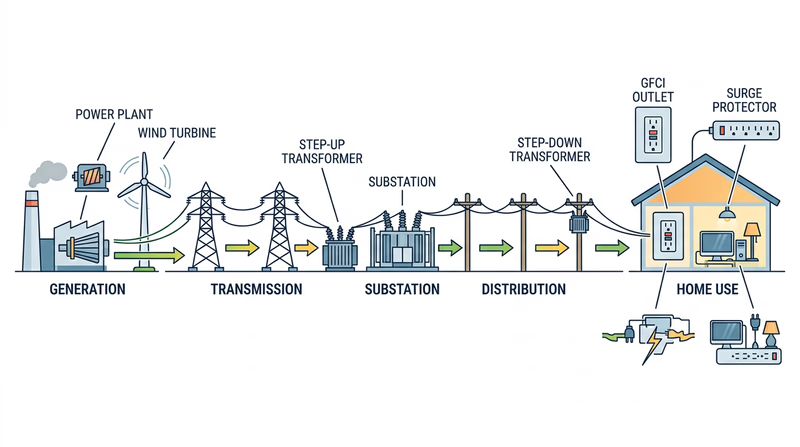
How these terms fit together
From power plant to plug
- Generation: a source such as a wind turbine, solar panel, or generator makes electricity.
- Transmission: high-voltage lines move it long distances.
- Substation and transformer: voltage is adjusted for safer local delivery.
- Distribution: neighborhood lines bring electricity to buildings.
- Protection and use: GFCIs, surge protection, circuits, conductors, and insulators help use it safely.