 Getting Started
Introduction & Overview
Every time you unlock your phone, flip a light switch, or hear music through a speaker, electronics are at work. The circuits inside those devices — tiny pathways of copper, silicon, and solder — carry electrical signals that make modern life possible. Understanding how those circuits work gives you something most people never have: the ability to build, fix, and invent things that run on electricity.
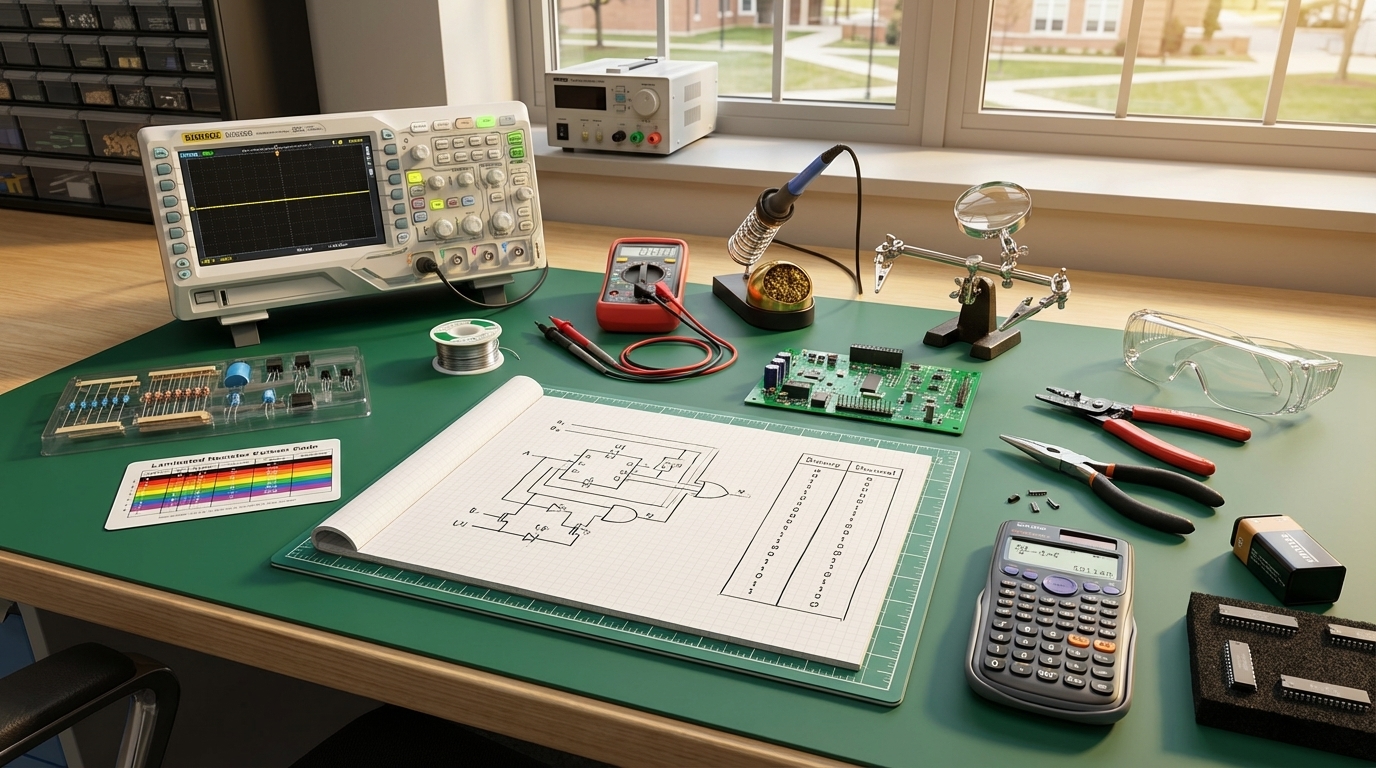
The Electronics merit badge takes you from reading schematic diagrams all the way to building a working circuit with your own hands. Along the way, you will learn to solder, measure voltage and current, decode resistor color bands, and think in binary — the language that every computer on the planet speaks.
Then and Now
Then — The story of electronics begins in the early 1900s, when inventors discovered that a vacuum tube — a sealed glass bulb with metal elements inside — could amplify weak radio signals and switch electrical currents on and off. Vacuum tubes powered the first radios, televisions, and computers. ENIAC, the first general-purpose electronic computer built in 1945, used over 17,000 vacuum tubes and filled an entire room. Those tubes burned hot, failed constantly, and consumed enormous amounts of power.
Now — In 1947, three physicists at Bell Labs — John Bardeen, Walter Brattain, and William Shockley — invented the transistor, a tiny semiconductor device that could do everything a vacuum tube did but was smaller, cooler, cheaper, and far more reliable. That invention changed the world. Today, a single microprocessor chip the size of your thumbnail contains billions of transistors. Your smartphone has more computing power than all the computers NASA used to put astronauts on the moon combined. Electronics now touch every part of daily life — from medical devices that save lives to satellites that guide your GPS.
Get Ready
This badge combines hands-on building with real science. You will solder components, read schematics, crunch numbers with Ohm’s law, and convert between decimal and binary. None of it is as hard as it sounds — and by the end, you will have a working circuit you built yourself to prove it.
Kinds of Electronics
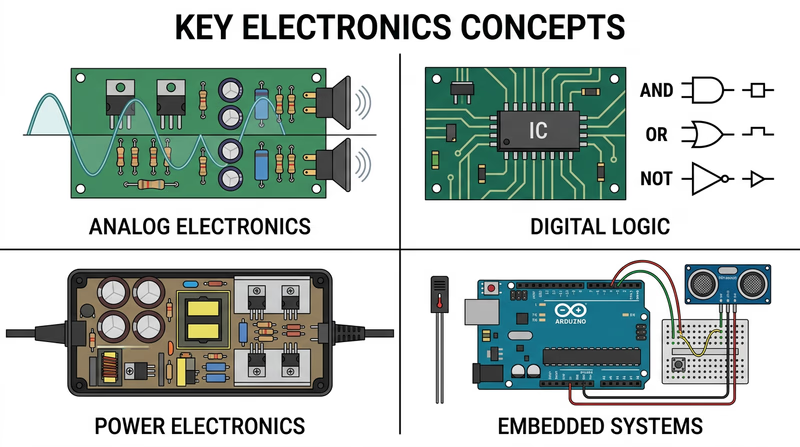
Electronics is a broad field. Here are the major branches you will encounter in this badge and beyond.
Analog Electronics
Analog circuits work with signals that change smoothly and continuously — like the wave of sound from a guitar string or the gradual dimming of a light. Amplifiers, radios, and audio equipment are classic analog devices. When you turn a volume knob and hear the sound get gradually louder, that is analog electronics at work.
Digital Electronics
Digital circuits deal in only two states: on and off, represented by the numbers 1 and 0. Every computer, smartphone, and digital watch runs on digital logic. By combining millions of simple on/off switches (transistors), digital circuits can perform incredibly complex calculations.
Power Electronics
Power electronics control and convert electrical energy — changing AC wall power to DC for your laptop charger, regulating voltage for sensitive components, or managing the power flow in an electric vehicle. Without power electronics, most of your devices would burn out the moment you plugged them in.
Embedded Systems
An embedded system is a small computer built into a larger device to perform a specific job. The controller in your microwave, the sensor system in a car’s anti-lock brakes, and the chip inside a fitness tracker are all embedded systems. Arduino and Raspberry Pi boards have made embedded systems accessible to hobbyists and Scouts alike.