Extended Learning
A. Congratulations, Circuit Builder
You have earned the Electronics merit badge. You can read schematics, solder and desolder components, convert between binary and decimal, apply Ohm’s law, use test equipment, and decode resistor color bands by sight. You have built a working circuit and can explain how it operates. Those skills put you ahead of most people — including many adults — when it comes to understanding the technology that surrounds us.
The sections below explore topics that go deeper than the requirements. They are here because electronics is a field where curiosity pays off, and the more you learn, the more you can build.
B. How Microcontrollers Changed Everything
The requirements of this badge cover fundamental electronics — discrete components, basic circuits, and manual soldering. But the real revolution in electronics over the past two decades has been the rise of the microcontroller: a tiny, inexpensive computer on a single chip that you can program to control almost anything.
What Is a Microcontroller?
A microcontroller is an integrated circuit that contains a processor, memory, and input/output pins — all on one chip smaller than your thumbnail. Unlike a desktop computer that runs an operating system and many programs, a microcontroller typically runs a single program that loops continuously, reading sensors and controlling outputs.
Arduino — The Gateway
The Arduino platform, launched in 2005 by a group of Italian engineers, made microcontrollers accessible to people with no engineering background. An Arduino board costs around $25 and can be programmed using free software with a simplified version of C++.
With an Arduino, you can build projects that would have required custom circuit design a generation ago:
- Weather station — Temperature, humidity, and barometric pressure sensors feeding data to an LCD display or a web dashboard.
- Automated plant watering — A moisture sensor triggers a pump when the soil gets dry, then shuts off when it is moist enough.
- MIDI controller — Buttons and potentiometers that send musical commands to a computer or synthesizer.
- Home automation — Control lights, fans, and locks from your phone using WiFi-enabled boards like the ESP32.
Beyond Arduino
Once you outgrow Arduino, an entire ecosystem awaits:
Raspberry Pi — A credit-card-sized computer that runs Linux. It can do everything an Arduino does, plus run web servers, stream video, process machine learning models, and more.
ESP32 — A low-cost microcontroller with built-in WiFi and Bluetooth, ideal for Internet of Things (IoT) projects.
Teensy — A small, fast microcontroller board popular in audio and USB projects. It can emulate a keyboard, mouse, or MIDI device.
STM32 — An industrial-grade microcontroller family used in commercial products. Learning STM32 development bridges the gap between hobbyist and professional embedded engineering.
C. The Art of Troubleshooting
Professional electronics technicians and engineers spend more time fixing broken circuits than building new ones. Troubleshooting is part detective work, part systematic reasoning, and part pattern recognition — and it is a skill that improves dramatically with practice.
The Scientific Method of Debugging
Great troubleshooters follow a process, not a hunch:
Observe — What are the symptoms? Does the circuit do nothing at all, or does it behave incorrectly? Does it work sometimes but not others? Write down exactly what you see.
Hypothesize — Based on the symptoms, what could be wrong? A circuit that is completely dead might have a power problem. A circuit that works erratically might have a loose connection or noise issue.
Test — Use your multimeter or oscilloscope to test one hypothesis at a time. Start with the simplest and most likely cause. Check power first — is the correct voltage reaching the circuit?
Isolate — Divide the circuit into sections and test each one independently. If the power supply section works, move to the next stage. This “divide and conquer” approach narrows down the problem quickly.
Fix and verify — Once you find the fault, fix it and test the entire circuit again. Sometimes fixing one problem reveals another that was hidden.
Common Failure Patterns
Experienced technicians learn to recognize patterns:
- Cold solder joints from Req 3 cause intermittent connections — they work when cool and fail when hot, or vice versa.
- Capacitor failure — Electrolytic capacitors dry out over time and lose their capacitance. This is one of the most common failures in aging electronics. Bulging or leaking caps are a telltale sign.
- Connector corrosion — Oxidation on connectors creates high-resistance junctions that cause signal loss or voltage drops.
- Thermal cycling — Components that heat up and cool down repeatedly can develop cracks in solder joints over time.
D. PCB Design — From Schematic to Product
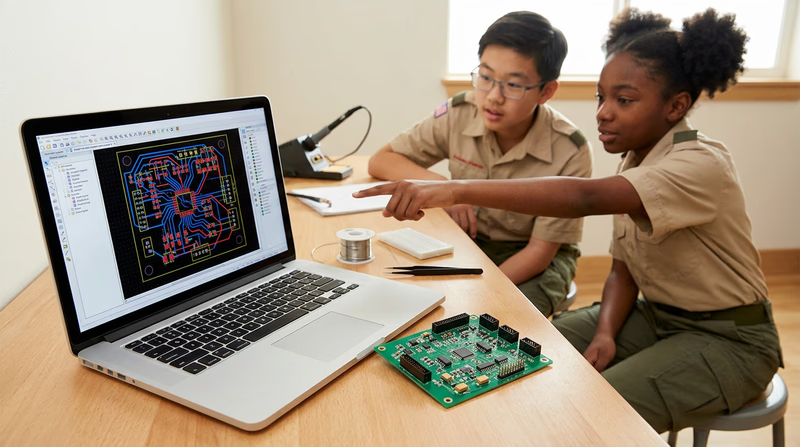
In Req 2, you drew a schematic by hand. In Req 3c, you learned about printed circuit boards. The next step — one that many hobbyists take after earning this badge — is designing your own PCB.
The Design Process
Schematic capture — Draw your circuit in EDA (Electronic Design Automation) software like KiCad, EasyEDA, or Eagle. The software checks for electrical errors automatically.
Component footprints — Each component in your schematic is linked to a physical footprint — the exact shape and size of the pads on the PCB.
Board layout — Arrange the components on a virtual board and route the copper traces that connect them. This is like solving a puzzle — traces cannot cross on the same layer, so you need to plan carefully.
Design rule check — The software verifies that traces are wide enough for the current they carry, spaced far enough apart to prevent short circuits, and that all holes are the correct size.
Manufacturing — Export your design files and send them to a PCB fabrication house. Companies like JLCPCB and PCBWay will manufacture custom PCBs for as little as $2-5 for small boards, with turnaround times of about a week.
Assembly — When the boards arrive, you solder on your components using the skills you learned in Req 3.
Holding a PCB you designed yourself — with your name and revision number printed on the silkscreen — is one of the most satisfying experiences in electronics.
E. Real-World Experiences
Electronics Experiences to Seek Out
Hands-on opportunities to deepen your skills
- Maker Faire or local maker meetup: Meet other electronics hobbyists, see projects, and learn new techniques. Many cities host regular maker events.
- Ham radio license (Technician class): Earn your amateur radio license and build your own radio equipment. The Technician license exam covers basic electronics and radio theory — topics you already know from this badge.
- Science museum or tech museum visit: Many museums have electronics exhibits with interactive circuit-building stations. The Computer History Museum in Mountain View, CA and the National Electronics Museum in Linthicum, MD are especially relevant.
- Electronics repair cafe: Community events where volunteers help people repair broken electronics. You bring your skills and learn by fixing real devices with real problems.
- Robotics competition: FIRST Robotics, VEX Robotics, and Science Olympiad all include electronics challenges. These competitions let you apply your skills in a team environment with real deadlines.