Req 5a — Ohm's Law
If electronics has one law you absolutely must know, this is it. Ohm’s law describes the relationship between voltage, current, and resistance in every electrical circuit. Once you understand it, you can predict how a circuit will behave, calculate the right component values, and troubleshoot problems logically instead of guessing.
The Three Variables
Before diving into the math, make sure you understand what each variable means:
Voltage (V) — The electrical “pressure” that pushes current through a circuit. Measured in volts. Think of it as the height of a waterfall — the higher the falls, the more force the water has.
Current (I) — The flow of electrical charge through a circuit. Measured in amperes (amps). Think of it as the amount of water flowing over the waterfall — gallons per second.
Resistance (R) — The opposition to current flow. Measured in ohms (the Greek letter omega). Think of it as a narrow pipe that restricts water flow — the narrower the pipe, the less water gets through.
The Formula
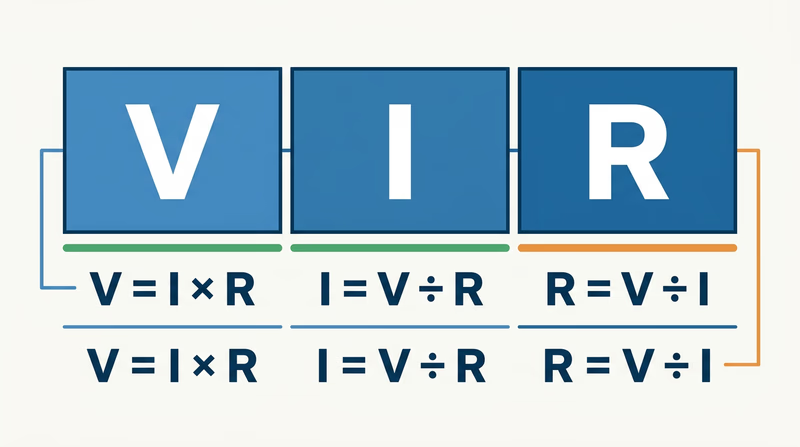
Ohm’s law is expressed in three equivalent forms:
- V = I x R (Voltage equals Current times Resistance)
- I = V / R (Current equals Voltage divided by Resistance)
- R = V / I (Resistance equals Voltage divided by Current)
All three say the same thing — they are just rearranged depending on which variable you need to find. Cover up the variable you are solving for, and the remaining two tell you what to do.
Solving Problems
Example 1: Find the Current
A 9V battery powers a circuit with 450 ohms of resistance. How much current flows?
Given: V = 9V, R = 450 ohms Find: I
I = V / R = 9 / 450 = 0.02 amps = 20 milliamps (mA)
Example 2: Find the Resistance
You want to limit current through an LED to 20mA using a 5V power supply. What resistor do you need?
Given: V = 5V, I = 20mA = 0.02A Find: R
R = V / I = 5 / 0.02 = 250 ohms
(In practice, you would use the nearest standard resistor value: 270 ohms.)
Example 3: Find the Voltage
A circuit has a 1,000-ohm resistor with 5mA of current flowing through it. What is the voltage across the resistor?
Given: R = 1,000 ohms, I = 5mA = 0.005A Find: V
V = I x R = 0.005 x 1,000 = 5 volts
Why It Matters
Ohm’s law is not just an equation for a test — it is a tool you will use every time you design or troubleshoot a circuit. When you calculated the resistor for the LED example above, you did exactly what a working engineer does. Without that calculation, you would either burn out the LED (too much current) or get a dim, barely visible light (too little current).
In your circuit project, Ohm’s law determined the value of every resistor in the schematic. And when you use a multimeter to measure voltage and current in a circuit, you are verifying that Ohm’s law holds true.
Practice Problems
Try these on your own before your counselor meeting. Work through the formula and check your answers:
- A 12V battery powers a 600-ohm circuit. What is the current?
- You need 50mA through a circuit powered by 3.3V. What resistance do you need?
- A 2,200-ohm resistor carries 10mA of current. What voltage is across it?