Req 5c — Resistor Color Codes
Resistors are too small to print numbers on, so manufacturers use a system of colored bands painted around the body of the resistor to indicate its value. Once you learn the code, you can pick up any resistor and read its value in seconds — a skill that will serve you every time you build or repair a circuit.
The Color Code
Each color represents a digit from 0 to 9:
| Color | Digit | Memory Aid |
|---|---|---|
| Black | 0 | Black = Zero, nothing |
| Brown | 1 | B comes after A, 1 comes after 0 |
| Red | 2 | Red has 2 letters after R |
| Orange | 3 | Orange has 3 more letters than Red |
| Yellow | 4 | Yellow — 4 letters in “yell” |
| Green | 5 | Green — 5 letters |
| Blue | 6 | Blue — 6 when you add “in” |
| Violet | 7 | Violet — 7 letters? Close enough |
| Gray | 8 | Gray — rhymes with eight |
| White | 9 | White — brightest, highest |
The Mnemonic
A classic way to remember the order is:
Bad Boys Run Over Yellow Gardens But Violets Grow Wild
Each word’s first letter matches the color: Black, Brown, Red, Orange, Yellow, Green, Blue, Violet, Gray, White.
Reading a 4-Band Resistor
Most resistors you will encounter have four colored bands. Here is how to read them:
- Orient the resistor so the band closest to one end is on the left. The tolerance band (usually gold or silver) should be on the right.
- Band 1 (leftmost) — First significant digit.
- Band 2 — Second significant digit.
- Band 3 — Multiplier (the number of zeros to add after the first two digits).
- Band 4 — Tolerance (how accurate the value is).
Multiplier Band
The multiplier band uses the same color-to-number code, but the number tells you how many zeros to add (or equivalently, the power of 10 to multiply by):
| Color | Multiplier | Multiply by |
|---|---|---|
| Black | x1 | 1 |
| Brown | x10 | 10 |
| Red | x100 | 100 |
| Orange | x1,000 | 1K |
| Yellow | x10,000 | 10K |
| Green | x100,000 | 100K |
| Blue | x1,000,000 | 1M |
| Gold | x0.1 | 0.1 |
| Silver | x0.01 | 0.01 |
Tolerance Band
| Color | Tolerance |
|---|---|
| Gold | ±5% |
| Silver | ±10% |
| None | ±20% |
Worked Examples
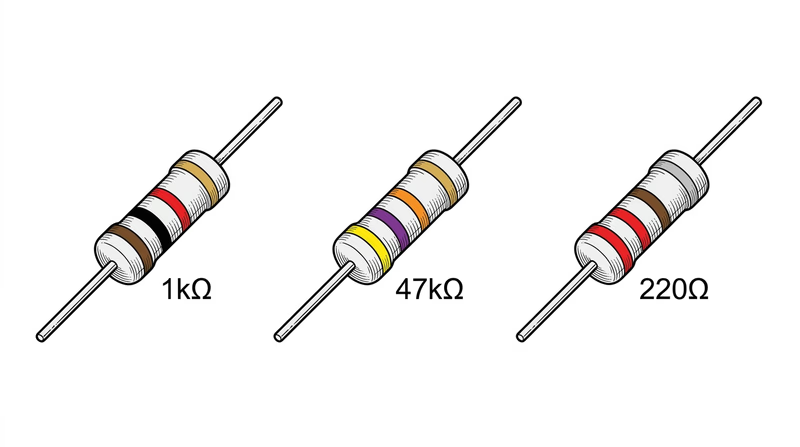
Example 1: Brown, Black, Red, Gold
- Band 1: Brown = 1
- Band 2: Black = 0
- Band 3: Red = x100
- Band 4: Gold = ±5%
Value: 10 x 100 = 1,000 ohms (1K ohm) ±5%
Example 2: Yellow, Violet, Orange, Gold
- Band 1: Yellow = 4
- Band 2: Violet = 7
- Band 3: Orange = x1,000
- Band 4: Gold = ±5%
Value: 47 x 1,000 = 47,000 ohms (47K ohm) ±5%
Example 3: Red, Red, Brown, Silver
- Band 1: Red = 2
- Band 2: Red = 2
- Band 3: Brown = x10
- Band 4: Silver = ±10%
Value: 22 x 10 = 220 ohms ±10%
5-Band Resistors
Higher-precision resistors use five bands instead of four. The first three bands are significant digits, the fourth is the multiplier, and the fifth is tolerance. For example:
Brown, Red, Green, Brown, Brown = 1, 2, 5 x 10 = 1,250 ohms ±1%
Verifying Your Reading
After reading the color code, always verify with your multimeter in resistance mode. Touch the probes to both leads and compare the displayed value to your reading. This confirms both your color-code interpretation and that the resistor has not been damaged by heat or overvoltage. You learned how to measure resistance in Req 5b.
Digi-Key Resistor Color Code Calculator Interactive online tool — select band colors and see the resistance value calculated instantly. Great for double-checking your readings.