Req 5d — Through Hole vs. Surface Mount
When you built your circuit in Req 4c, you probably pushed component leads through holes in a breadboard or circuit board. That method — sticking wire leads through holes — is one of two fundamental ways to assemble electronics. The other method skips the holes entirely and mounts components directly on the surface. Each approach has distinct advantages, and understanding both gives you a fuller picture of how the electronics around you are built.
Through Hole Technology (THT)
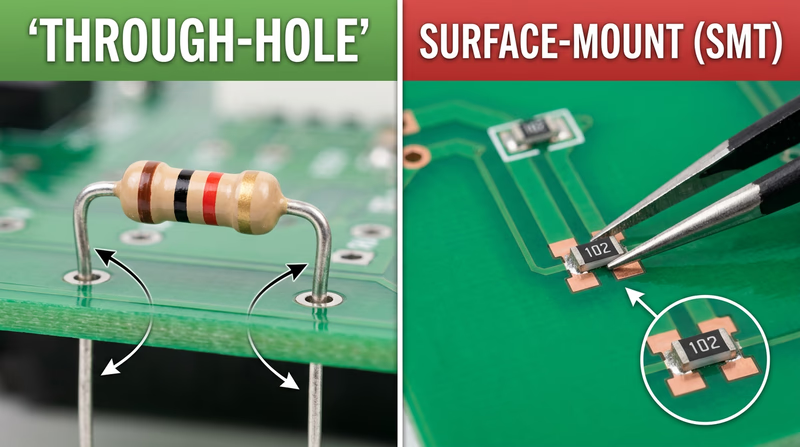
Through Hole components have wire leads (legs) that pass through holes drilled in the circuit board. The leads poke out the other side, where they are soldered to copper pads. This is the technology you have been using throughout this badge.
How It Works
- Component leads are inserted through holes in the PCB from the top (component side).
- The leads protrude from the bottom (solder side).
- Solder is applied to the leads on the bottom, forming mechanical and electrical connections.
Three Advantages of Through Hole
Strong mechanical connections — The leads pass completely through the board and are soldered on the other side, creating joints that are physically robust. Through Hole components can withstand vibration, shock, and mechanical stress much better than surface-mounted parts. This is why Through Hole is still used in aerospace, military, and industrial equipment where reliability under harsh conditions is critical.
Easy for hand soldering and prototyping — Through Hole components are large enough to handle with your fingers, and the holes guide placement. This makes them ideal for learning, prototyping on breadboards, and hand-assembly projects — exactly the kind of work you do for this merit badge.
Simple to inspect and rework — Because the components and solder joints are relatively large, you can visually inspect them without magnification. If a joint is bad or a component needs to be replaced, desoldering and reworking is straightforward with basic tools (as you demonstrated in Req 3a).
Surface Mount Technology (SMT)
Surface Mount components sit flat on the surface of the circuit board. Instead of leads that pass through holes, they have tiny metal pads or short tabs that are soldered directly to matching pads on the board’s surface.
How It Works
- Solder paste (a mixture of tiny solder particles and flux) is applied to the board’s surface pads.
- A pick-and-place machine positions each component precisely on its pads.
- The entire board passes through a reflow oven that melts the solder paste, bonding all components simultaneously.
Three Advantages of Surface Mount
Dramatically smaller size — Surface Mount components are a fraction of the size of their Through Hole equivalents. A Through Hole resistor might be 6mm long; an SMT resistor can be smaller than a grain of sand (as small as 0.4mm x 0.2mm). This miniaturization is what makes smartphones, smartwatches, and wireless earbuds possible.
Higher component density — Because SMT components are small and can be placed on both sides of the board, engineers can pack far more components into the same board area. A modern smartphone motherboard contains thousands of components in a space smaller than a playing card.
Better high-frequency performance — SMT components have shorter electrical paths and smaller lead inductance compared to Through Hole parts. At high frequencies (radio, wireless, high-speed digital), these shorter paths reduce signal distortion and interference. This is why all modern wireless devices use SMT.
Side-by-Side Comparison
| Feature | Through Hole | Surface Mount |
|---|---|---|
| Component size | Large (millimeters to centimeters) | Tiny (fractions of a millimeter) |
| Assembly method | Hand soldering or wave solder | Solder paste + reflow oven |
| Board density | Lower | Much higher |
| Mechanical strength | Very strong | Adequate for most uses |
| Repairability | Easy with basic tools | Requires specialized tools |
| Cost at high volume | Higher (drilling holes is expensive) | Lower |
| Prototyping ease | Excellent | Difficult without equipment |
| High-frequency performance | Good | Excellent |
The Modern Reality
Today’s electronics use both technologies — often on the same board. Through Hole is used for components that need mechanical strength (connectors, large capacitors, power components) or are intended for hand assembly. Surface Mount is used for everything else. When you open a computer or game console, you will see both types working together.
IPC — Association Connecting Electronics Industries The global trade association for the electronics manufacturing industry. IPC sets the standards that define soldering quality, PCB design, and assembly methods used worldwide.