Req 10 — Careers
The skills you learn in this merit badge are not just for earning a badge — they open doors to meaningful careers and lifelong hobbies. Choose one of the three options below and explore how emergency preparedness connects to your future.
Option A: Interview an Emergency Professional
Find and interview someone who works in emergency management or disaster response. This could be:
- A city or county emergency management coordinator
- A fire department captain or chief
- A Red Cross disaster response manager
- A FEMA employee or contractor
- A 911 dispatcher
- A hospital emergency preparedness director
- A school safety coordinator
Questions to ask in your interview:
- What does a typical day look like in your role?
- How did you get started in this career? What education or training did you need?
- What is the most challenging part of your job?
- What is the most rewarding part?
- What skills are most important for someone in your position?
- How has emergency management changed during your career?
- What advice would you give a young person interested in this field?
Option B: Research a Career in Emergency Services
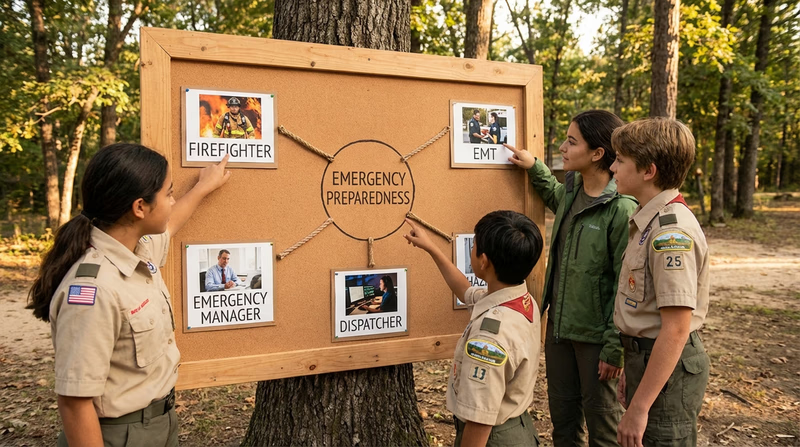
Identify three careers in the emergency services field, then pick one to research in depth. Here are some careers to consider:
| Career | Description |
|---|---|
| Emergency Management Director | Plans and coordinates disaster response for cities, counties, or states |
| Firefighter/Paramedic | Responds to fires, medical emergencies, and rescues |
| Emergency Medical Technician (EMT) | Provides pre-hospital emergency medical care |
| Search and Rescue Specialist | Locates and rescues people in wilderness, urban, and water environments |
| Hazardous Materials (HAZMAT) Technician | Responds to chemical, biological, and radiological incidents |
| 911 Dispatcher | Receives emergency calls and dispatches first responders |
| Public Health Emergency Planner | Prepares communities for disease outbreaks and health emergencies |
| Disaster Relief Coordinator | Manages relief operations for organizations like the Red Cross or FEMA |
| Wildland Firefighter | Fights wildfires in forests, grasslands, and wildland-urban interface areas |
For your chosen career, research:
- Education and certification requirements (degree, academy, certifications)
- Training programs and how long they take
- Starting salary and salary range with experience
- Job outlook and demand in your area
- Advancement opportunities (what positions can you grow into?)
- Day-to-day duties and work conditions
- Physical and mental requirements
Option C: Emergency Preparedness as a Hobby or Lifestyle
Emergency preparedness is not just a career — it can be a fulfilling personal pursuit. Many people find meaning and confidence in being prepared for anything life throws their way.
Ways to use emergency preparedness skills personally:
- CERT Training: The Community Emergency Response Team (CERT) program trains civilians to assist in emergencies. CERT members help with light search and rescue, fire suppression, first aid, and disaster psychology. Training is usually free and offered by local fire departments.
- Amateur (Ham) Radio: Licensed ham radio operators provide critical communication during disasters when cell networks and the internet go down. Getting your license requires studying and passing an exam, but the equipment and community are accessible to anyone.
- Wilderness First Responder (WFR): This certification teaches advanced backcountry medical skills. It is popular with hikers, climbers, and outdoor leaders who spend time far from hospitals.
- Preparedness Lifestyle: Building and maintaining disaster kits, developing skills in water purification, food preservation, and off-grid living, and staying informed about local hazards.
For your chosen hobby or lifestyle, research:
- What additional training or certifications are needed?
- What are the costs (equipment, courses, memberships)?
- What organizations can you join to learn more and connect with others?
- What are your short-term goals (within the next year)?
- What are your long-term goals (within the next 5 years)?