Req 7 — NIMS and ICS
When a disaster strikes, dozens — sometimes hundreds — of agencies respond. Fire departments, police, ambulance crews, utility companies, the National Guard, Red Cross volunteers, and more all converge on the scene. Without a common system for organizing all these people, the response would be chaos. That is exactly why NIMS and ICS exist.
7a. What Are NIMS and ICS?
National Incident Management System (NIMS)
NIMS is a nationwide framework created by FEMA that provides a consistent approach to managing emergencies at every level — local, state, tribal, and federal. It is not a response plan for a specific disaster. Instead, it is a set of guidelines that ensures everyone speaks the same language, uses the same organizational structure, and follows the same procedures, no matter where they are or what agency they represent.
Key features of NIMS:
- Common terminology: Everyone uses the same words for the same things, eliminating confusion between agencies.
- Unified command: Multiple agencies can work together under a single coordinated leadership structure.
- Scalability: The system works for a small local incident (a house fire) and scales up to a massive disaster (a hurricane affecting multiple states).
- Mutual aid: Standardized processes allow agencies from different regions to assist each other seamlessly.
Incident Command System (ICS)
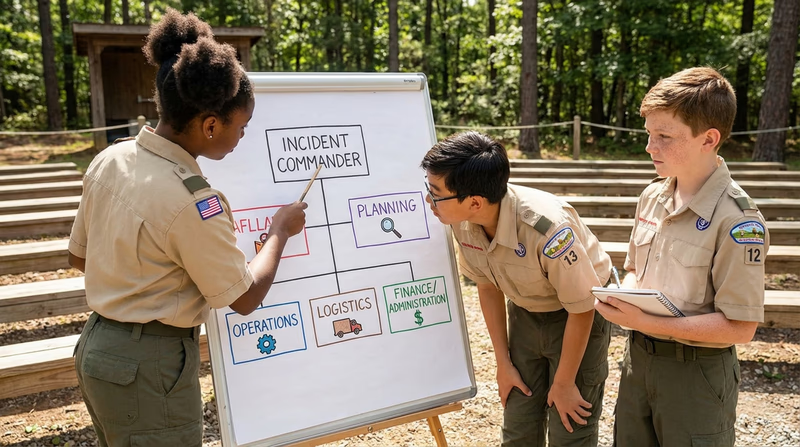
ICS is the operational component of NIMS — the system used on the ground to manage the actual response. Every incident has an Incident Commander (IC) who is responsible for the overall management of the response. Under the IC, the response is organized into five major functions:
| Function | Responsibility |
|---|---|
| Command | Overall incident management, safety, and communication |
| Operations | Carrying out the response (fighting the fire, rescuing people, etc.) |
| Planning | Collecting and analyzing information, developing the action plan |
| Logistics | Providing resources — food, water, equipment, facilities, transportation |
| Finance/Administration | Tracking costs, contracts, and personnel time |
7b. How Your Community Manages Disasters
Every community has an emergency management structure. Your task is to find out how yours works. Here are some ways to research this:
Who to contact:
- Your city or county Emergency Management Agency (EMA)
- Your local fire department or police department (they often coordinate with the EMA)
- Your city or county government website — most have an emergency preparedness section
Questions to ask:
- Who is the local emergency management coordinator?
- What types of disasters does your community plan for?
- How does the community alert residents about emergencies? (Sirens, text alerts, radio broadcasts?)
- Does your community conduct disaster drills or exercises? How often?
- Are there Community Emergency Response Team (CERT) programs in your area?
- What shelters or evacuation routes have been identified?
7c. How a Scout Troop Fits into ICS
Scout troops are not first responders, but they can be a valuable part of the emergency response when properly organized and supervised. Under ICS, a troop would typically be assigned to the Operations or Logistics section, depending on the task.
Roles a Scout troop can fill:
- Crowd and traffic control: Directing pedestrians away from a hazard area
- Messenger service: Carrying messages between command posts when electronic communication is down
- Collection and distribution: Helping organize and distribute donated supplies (food, water, clothing)
- Shelter support: Assisting with setup and operation of emergency shelters (cots, food service, sanitation)
- Search assistance: Helping form search lines under adult supervision for missing persons
How ICS applies to the troop:
When a troop mobilizes for emergency service, it should use ICS principles:
- The Scoutmaster acts as the troop’s Incident Commander, coordinating with the community’s IC.
- Patrol leaders lead their patrols as team leaders within the assigned section.
- Everyone follows the chain of command — individual Scouts do not freelance.
- Communication flows up and down the chain — patrol members report to patrol leaders, patrol leaders report to the Scoutmaster, the Scoutmaster reports to the community IC.