Req 8 — Emergency Service
This requirement brings everything together. You have learned about emergency preparedness, made family plans, and studied rescue techniques. Now it is time to put your skills to work — as part of a team, serving your community.
8a. Emergency Service Duties
For each of the four emergency services below, think about three things: What would the troop actually do? What training would they need first? What safety precautions are essential?
1. Crowd and Traffic Control
Duties: Directing pedestrian traffic away from hazard areas, keeping onlookers from interfering with emergency operations, guiding vehicles through detours, and maintaining order at shelters or distribution points.
Training needed: Clear hand signals, verbal communication techniques, understanding of traffic safety, conflict de-escalation.
Safety precautions: Wear high-visibility vests or reflective gear. Never step into traffic. Work in pairs. Always follow the directions of professional law enforcement.
Guidelines for Managing Crowds Cornell University's guide to crowd management principles and best practices.2. Messenger Service During an Incident
Duties: Carrying written or verbal messages between command posts, staging areas, and field teams when electronic communication is down or overloaded.
Training needed: How to take and relay messages accurately, how to navigate the incident scene safely, how to use maps and ICS organizational charts.
Safety precautions: Travel in pairs. Know the layout of the incident scene. Stay on designated routes. Report back to your supervisor after every delivery.
3. Collection and Distribution Services
Duties: Receiving, sorting, organizing, and distributing donated supplies — food, water, clothing, blankets, hygiene items — to people affected by the disaster.
Training needed: Inventory management, food safety basics, respectful interaction with disaster survivors, lifting and carrying techniques.
Safety precautions: Wear gloves when handling donated items. Follow food safety guidelines (check expiration dates, keep hot food hot and cold food cold). Do not distribute damaged or contaminated items.
4. Group Feeding, Shelter, and Sanitation
Duties: Helping set up and operate emergency shelters — assembling cots, serving meals, maintaining clean restroom facilities, and assisting with waste disposal.
Training needed: Basic food preparation and serving, sanitation standards, how to set up cots and bedding, how to interact compassionately with displaced families.
Safety precautions: Follow health department guidelines for food handling. Use personal protective equipment when cleaning. Ensure shelter areas have adequate ventilation and fire exits.
8b. Troop Mobilization Plan
A mobilization plan is a written document that tells your troop how to assemble quickly when called for emergency service. Think of it as your troop’s version of a fire drill — everyone knows their role, and no time is wasted.
Your plan should include:
Mobilization Plan Elements
What every troop mobilization plan should cover
- Notification system: How will troop members be alerted? (Phone tree, group text, email)
- Assembly point: Where does the troop meet?
- Timeline: How quickly should members report? (Goal: within 2 hours of notification)
- Roles and assignments: Who does what? (Scoutmaster = IC, patrol leaders = team leads)
- Equipment list: What does each Scout bring? (Personal emergency service pack — see 8c)
- Transportation plan: How will the troop get to the incident?
- Communication plan: How will the troop stay in contact during the event?
- Parent/guardian notification: How will parents be informed?
- Check-in and check-out procedures: How will you account for every Scout?
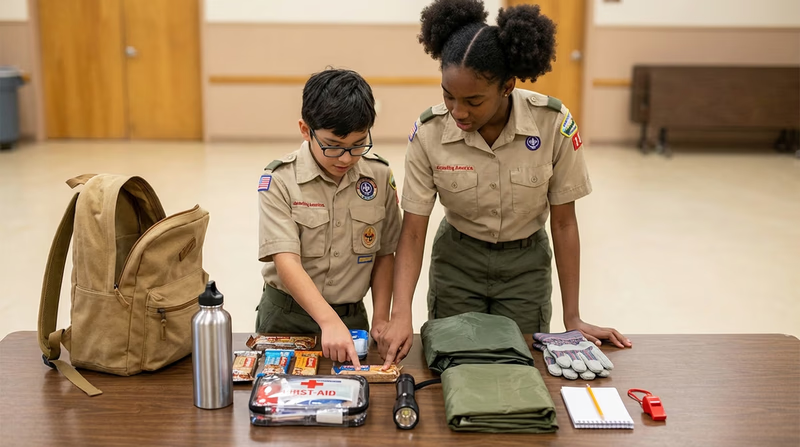
8c. Personal Emergency Service Pack (Go Bag)
Your personal emergency service pack is what you grab when the call comes in. It should be packed and ready to go at all times.
Personal Emergency Service Pack
Ready for a mobilization call
- Water bottle (filled) and water purification method
- Food for 24 hours (energy bars, trail mix, jerky)
- First aid kit (personal size)
- Flashlight or headlamp with extra batteries
- Rain gear or poncho
- Extra socks and underwear
- Work gloves
- Pocket knife or multi-tool
- Notepad and pencil
- Whistle
- Sunscreen and insect repellent
- Personal medications
- Emergency blanket (space blanket)
- Small amount of cash
- Copy of your emergency contact information
8d. Emergency Service Project
The final part of Requirement 8 is participation. You need to take part in an actual emergency service project or a practice exercise. Here are some options:
- Community disaster drill organized by your local emergency management agency
- Red Cross shelter exercise at a local school or community center
- Search and rescue practice with a community SAR team
- Scout camp emergency drill during a campout or summer camp
- School safety exercise such as a fire drill, lockdown drill, or evacuation practice
After the exercise, reflect on what you learned:
- What went well? What was the team good at?
- What did not go as planned? What surprised you?
- What would you do differently next time?
- How did ICS principles show up in the exercise?