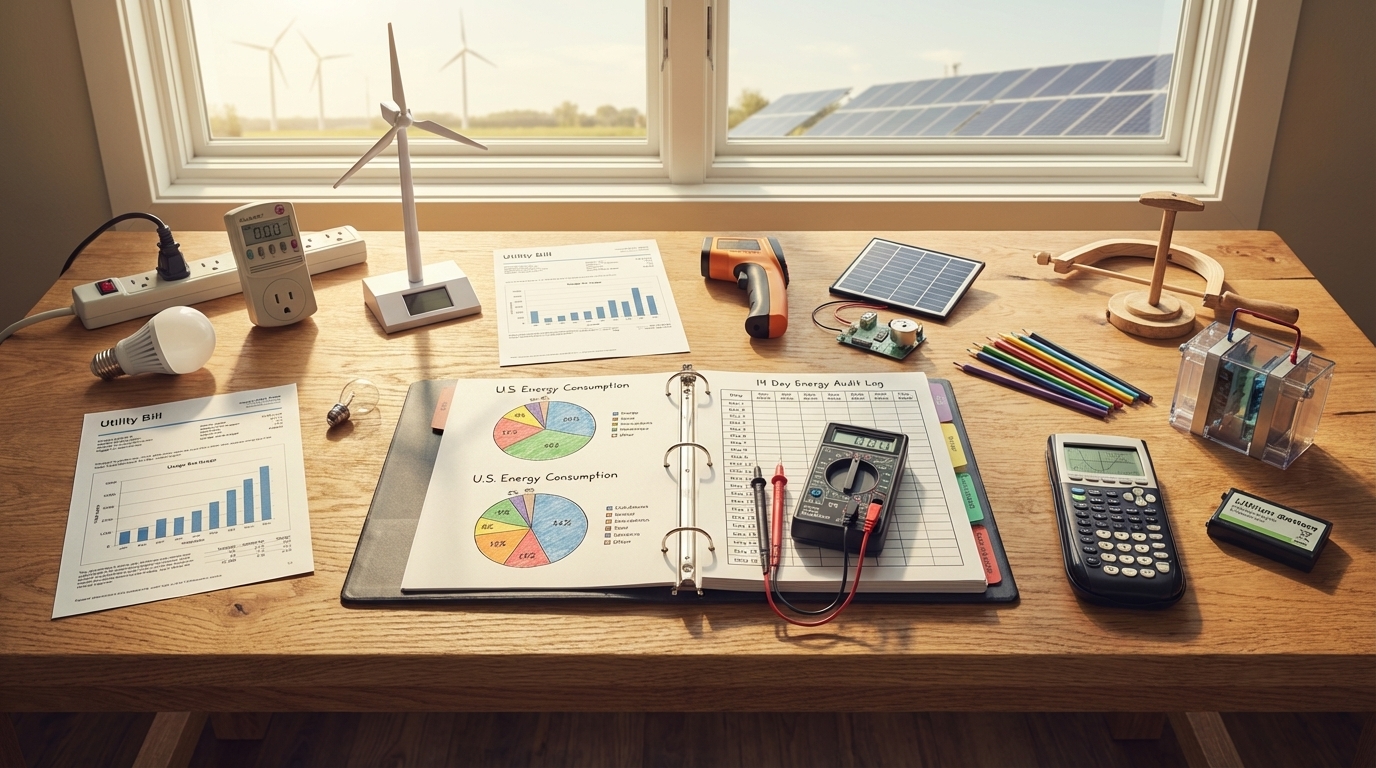
Energy Merit Badge — Complete Digital Resource Guide
https://merit-badge.university/merit-badges/energy/guide/
Introduction & Overview
Every time you flip on a light, charge a phone, toast bread, or ride in a car, you are using energy. Most of the time it feels invisible. This badge helps you see it clearly: where energy comes from, how it changes form, where it gets wasted, and how smart choices can stretch every unit farther.
Energy is one of the biggest ideas in science because it connects almost everything you do. It shapes your home, your community, the environment, and the jobs people do every day. Once you start tracing energy through real systems, the world stops looking ordinary and starts looking like one giant chain of inputs, conversions, and consequences.
Then and Now
Then
For most of human history, people used the energy they could reach with their own muscles, animals, firewood, wind, and moving water. A hand saw, a campfire, a sailing ship, and a grain mill all depended on energy sources that were local and easy to see. If you wanted more heat, you chopped more wood. If there was no wind, a sailboat sat still.
The Industrial Revolution changed that. Coal let factories run machines far bigger and faster than muscle power could handle. Steam engines turned heat into motion, railroads connected cities, and electric power systems began carrying energy across long distances. People no longer had to live right next to the source.
Now
Today, energy comes from a huge mix of fuels and technologies: coal, natural gas, uranium, sunlight, wind, moving water, biomass, batteries, and more. Energy can be generated hundreds of miles away, sent through wires or pipelines, stored in fuel tanks or batteries, and converted several times before it does the job you actually want.
Modern energy systems are also full of trade-offs. Some sources are cheap but polluting. Some are clean in operation but expensive to build. Some are always available, while others depend on sunshine, wind, or tides. Understanding those trade-offs is one of the most important skills this badge will help you build.
Get Ready!
You are going to read, measure, compare, sketch, audit, and investigate. Some requirements are about science ideas. Others are about real-life decisions your family, school, and community make every day. Bring a notebook, stay curious, and get ready to ask, “Where did that energy come from — and where did it go?”
Kinds of Energy
Chemical Energy
Chemical energy is stored in things like wood, gasoline, food, and batteries. When chemical bonds change, that stored energy can become heat, motion, or electricity. Your body runs on chemical energy from food. A car engine runs on chemical energy from fuel.
Electrical Energy
Electrical energy moves through circuits and power lines. It is especially useful because it can travel long distances and then be changed into light, sound, motion, cooling, or heat. Electricity is not the source for everything, though. Often it is just the delivery method.
Thermal Energy
Thermal energy is the energy of moving particles in matter. You notice it as heat. Camp stoves, furnaces, steam turbines, and even a hot sidewalk in summer all involve thermal energy. In many systems, unwanted thermal energy is a loss.
Mechanical Energy
Mechanical energy is energy of motion or position. A spinning fan blade, a lifted hammer, a moving bicycle, and a stretched rubber band all involve mechanical energy. Many machines exist to turn one form of energy into mechanical motion.
Radiant Energy
Radiant energy travels in waves. Sunlight is a common example. Solar panels use radiant energy to make electricity, while solar water heaters use radiant energy to make heat. A microwave oven also uses a form of radiant energy.
Nuclear Energy
Nuclear energy is stored in the nucleus of atoms. In nuclear power plants, splitting certain atoms releases large amounts of heat, which is then used to make steam and generate electricity.
Energy Literacy A U.S. Department of Energy resource that explains the big ideas behind energy, systems, and trade-offs in clear language. Link: Energy Literacy — https://www.energy.gov/eere/education/energy-literacy-essential-principles-and-fundamental-concepts-energy-educationYou have the big picture. Next, you will start with a simple but powerful step: reading how other people talk about energy and learning how to ask better questions.
Req 1 — Reading Energy Stories
This requirement has two connected parts. First, you find one energy-related source and talk about what catches your attention. Later, after finishing the rest of the badge, you come back to that same source and explain what you understand better now.
- Requirement 1a helps you practice curiosity.
- Requirement 1b helps you notice how much your understanding has grown.
Requirement 1a: Find a source and ask better questions
A good source for this requirement does not need to be perfect or advanced. It just needs to give you something real to react to. You might choose a news article about electric vehicles, a podcast about power outages, a website about solar panels, or a post about saving energy at home. The point is not to become an instant expert. The point is to notice what stands out, what seems important, and what you still do not understand.
When you read or listen, pay attention to specific claims. Does the source say one fuel is cheaper? Cleaner? More reliable? Does it mention efficiency, waste, storage, pollution, imports, or jobs? Those are clues that the source is talking about trade-offs. Energy stories are almost never about just one thing.
The best counselor discussion usually starts with details, not opinions. Instead of saying, “It was interesting,” say, “I noticed the article said most of the cost of running an appliance depends on how long it operates, not just how powerful it is.” That gives your counselor something concrete to talk through with you.
Choose a strong source
Pick something that gives you enough to discuss- Recent enough to matter: Energy technology and prices change, so choose something fairly current when possible.
- Specific topic: “How home insulation saves money” is easier to discuss than a vague article about “the environment.”
- Credible publisher: Government agencies, science organizations, news outlets, and educational sites are better than random social posts.
- A little challenging: It should raise at least one question you cannot answer yet.
What to bring to your counselor conversation
Make a short set of notes as you read or listen:
- one or two details that surprised you
- two or three questions the source raised
- one term or idea you do not fully understand yet
- one claim you want to test later as you finish the badge
Requirement 1b: Revisit the source after the badge
This is where the badge comes full circle. After you work through forms of energy, efficiency, home audits, waste, charts, energy systems, and careers, you return to the same source with a much stronger mental toolbox. You will probably notice that words like conversion, efficiency, losses, renewable, nonrenewable, cost, and trade-off now mean something more precise than they did at the start.
Suppose your original source was about electric vehicles. After Requirement 2, you can explain conversions from stored chemical energy in a battery to electrical energy to mechanical motion. After Requirement 3, you can talk about losses in the whole system. After Requirement 4 and 5, you might notice how charging habits or idling behavior connect to energy waste. After Requirement 6, you might understand where the electricity comes from. After Requirement 7, you can compare EVs to other energy systems with more confidence.
Your goal is not to say the source was right or wrong in every detail. Your goal is to explain what you understand better now and how the badge changed the way you read it.
EIA — Energy Explained A reliable starting place for clear explanations of major energy topics, from fuels and electricity to conservation and prices. Link: EIA — Energy Explained — https://www.eia.gov/energyexplained/You have practiced reading about energy like a scientist instead of just a headline-skimmer. Next, you will dig into one of the biggest ideas in the whole badge: how energy changes form.
Req 2 — Forms & Conversions
This requirement has two parts that belong together. First, you explain how real devices change energy from one form to another. Then you build a simple system that does at least two conversions so you can see the idea happen in front of you.
- Requirement 2a is about reading devices like energy maps.
- Requirement 2b is about making a conversion chain yourself.
Requirement 2a: Explain three devices and their conversions
The easiest way to explain a device is to track three things: the input energy, the useful output, and the losses. If you can name those clearly, you usually understand the conversion.
Here are a few examples from the list:
- Toaster: electrical energy becomes thermal energy in the heating elements. The useful output is heat that browns bread. Some energy is also lost by warming the surrounding air.
- Lightbulb: electrical energy becomes radiant energy and thermal energy. In older incandescent bulbs, a lot of the energy becomes unwanted heat.
- Bow drill: chemical energy in your body becomes mechanical energy in your arms, then thermal energy from friction, which heats tinder until it can catch.
- Cell phone: chemical energy stored in the battery becomes electrical energy, then turns into light, sound, radio signals, and heat.
- Electric vehicle: chemical energy in the battery becomes electrical energy, then mechanical energy in the motor and wheels. Some energy is lost as heat in the battery, wiring, and tires.
A greenhouse is especially interesting because it reminds you that not every system uses electricity or fuel directly. Sunlight enters as radiant energy, warms surfaces and air inside, and helps keep the greenhouse warmer than the outside environment.
How to explain any device
Use this pattern with your counselor- Name the main input: electricity, fuel, sunlight, food, uranium, or something else.
- Name the useful output: heat, motion, light, sound, communication, or stored energy.
- Mention at least one loss: heat, sound, friction, resistance, or wasted motion.
- Use arrows if helpful: for example, chemical → electrical → light + heat.
What makes a strong answer?
A strong answer sounds like an explanation, not a label. Do not stop at “A toaster uses electricity.” Go one step farther: “A toaster uses electrical energy in resistive heating wires. Those wires get hot and transfer thermal energy to the bread. Some energy also warms the surrounding air, which is a loss.”
Requirement 2b: Build a system with at least two conversions
You do not need a huge engineering project to complete this part. You need a safe, clear system that lets you point to the conversions. The more visible the conversions are, the easier your explanation will be.
Good project ideas include:
- a rubber-band car: chemical energy in your body winds the band, elastic potential energy is stored, then becomes motion and heat from friction
- a solar toy or solar fan: radiant energy from sunlight becomes electrical energy, then motion
- a battery-LED buzzer system: chemical energy in the battery becomes electrical energy, then light and sound
- a small water wheel model: gravitational potential energy of water becomes motion, then maybe electricity if attached to a generator kit
How to present your build
When you show your system, tell the story in order:
- Where does the energy start?
- What stores or carries it?
- What conversions happen next?
- What useful result do you get?
- Where is energy lost along the way?
You can now describe what energy does inside a device. Next, you will zoom out and look at a whole system to see where energy helps, where it is useful, and where it leaks away.
Req 3 — Following Energy Through a System
This requirement is about seeing the whole chain, not just one device. Pick one common system and follow energy from source to result. Good choices include a refrigerator, a bicycle and rider, a hair dryer, a home heating system, a toaster oven, or a phone charger.
A strong system for this requirement has clear parts, a clear source, an obvious useful result, and at least one important loss. If you can draw it as boxes with arrows, it is probably a good choice.
Requirement 3a: Identify the parts of the system
Suppose you choose a refrigerator. The parts include the electrical cord, compressor, refrigerant, coils, insulated walls, interior air, food inside, and the room air around it. Energy is moving through that whole system, not just one component.
If you choose a bicycle and rider, the system parts might include your muscles, lungs, food, chain, gears, tires, road surface, and the bike frame. Even your body is part of the system because it provides the original energy.
A good test
Ask yourself, “If I removed this part, would the system behave differently?” If the answer is yes, it probably belongs on your list.
Requirement 3b: Name the primary source of energy
The primary source is where the chain begins. In a plugged-in appliance, that source may be electrical energy. In a bicycle, it is chemical energy from food in your body. In a gasoline lawn mower, it is chemical energy in the fuel. In a solar-powered device, it is radiant energy from the Sun.
Be careful not to confuse the carrier with the source. Electricity often carries energy, but the deeper source might be coal, natural gas, wind, water, nuclear fuel, or sunlight used to generate that electricity.
Requirement 3c: Identify the useful outcomes
The useful outcome is the job you actually wanted done. In a refrigerator, the useful result is keeping food cold. In a hair dryer, it is warm moving air that dries hair. In a bicycle, it is motion that gets you somewhere. In a phone charger, it is stored energy in the battery.
This matters because efficiency is judged against the useful outcome, not just against motion or heat happening somewhere in the system.
Requirement 3d: Identify the energy losses
No real system is perfect. Some energy always ends up where you do not want it. Losses often appear as heat, sound, vibration, friction, air resistance, or wasted light.
A refrigerator keeps the inside cool, but the compressor and coils warm the surrounding room. A bicycle gets you down the street, but friction in the chain and tires produces heat. A phone charger warms up because some electrical energy is lost before it all reaches the battery.
Putting the whole explanation together
Here is a simple pattern you can use with your counselor:
Explain your system clearly
One sentence for each part of the story- System: Name the system and what it is supposed to do.
- Parts: List the major parts that the energy moves through.
- Primary source: Name where the energy starts.
- Useful outcome: Say what useful job gets done.
- Losses: Explain where energy escapes into less useful forms.
You have mapped energy through a system. Next, you will apply that way of thinking at home by measuring real use and tracking changes over two weeks.
Req 4 — Home Energy Audit
This requirement turns the badge from theory into real life. You are not just talking about energy anymore. You are observing how your household uses it, where it costs money, and what changes actually make a difference.
You have two jobs here:
- Requirement 4a helps you measure how energy reaches your home or vehicle and how it is billed.
- Requirement 4b helps you track smarter choices over 14 days and reflect on what really changed.
Requirement 4a: Identify the energy you use and how it is measured
A home energy audit starts with noticing inputs. Many homes use more than one kind of energy. Electricity may power lights, refrigerators, computers, and air conditioning. Natural gas might heat water or air. Some homes use propane, heating oil, wood, or other fuels. If your family prefers, you can track a vehicle instead and focus on fuel use, mileage, and trips.
For household energy, look at a recent bill with permission from your parent or guardian. Electricity is commonly measured in kilowatt-hours (kWh). Natural gas may be measured in therms or cubic feet. Propane and heating oil are often measured by the gallon. The bill also shows cost, which matters because efficiency is not just about science. It also affects family budgets.
If you choose the transportation path, track practical data: what fuel the vehicle uses, how many miles it was driven, approximate miles per gallon, and what kinds of trips were taken. Short repeated trips, long highway drives, and idling all change the story.
What to record
Use one of these two paths- Home path: energy types, how they arrive, how they are measured, and current cost.
- Vehicle path: fuel type, miles driven, miles per gallon, and the kinds of trips made.
- Either path: note patterns, not just numbers. Where is the biggest use? What seems frequent? What seems wasteful?
Requirement 4b: Track wiser use for 14 days
This part is about habits. You do not need a giant home renovation. Small repeatable actions matter because households do the same things over and over: lighting rooms, heating water, washing clothes, driving, and running electronics.
Good examples for a 14-day log include turning off lights in empty rooms, shortening showers, washing clothes in cold water, unplugging unused chargers, using a power strip, adjusting the thermostat a little, air-drying some laundry, combining errands into one trip, or shutting down a computer instead of leaving it awake all night.
A sustainable energy source is one that can keep being used over the long term without running out quickly or causing the kind of damage that makes the system impossible to continue. Sustainability is not only about “renewable” versus “nonrenewable.” It also includes land use, pollution, reliability, materials, and long-term impacts.
Reuse and recycling also connect to energy. Making new aluminum, steel, glass, paper, and plastic usually takes more energy than reusing an item or making a new product from recycled material. When you reuse a bottle or recycle a can, you are not creating energy, but you may be reducing how much energy has to be spent upstream.
Energy Saver Practical guidance from the Department of Energy on home energy use, bills, appliances, insulation, and everyday ways to save energy. Link: Energy Saver — https://www.energy.gov/energysaver/energy-saverYou have looked closely at your own household. Next, you will zoom out and look for waste in your school or community, where the biggest patterns can be even easier to spot.
Req 5 — Community Energy Waste
This requirement asks you to become an observer. Waste is often hiding in plain sight: lights on in empty rooms, doors propped open while heat or air conditioning escapes, engines idling, old equipment running longer than needed, or buildings heated and cooled at the same time.
Your job is not to shame people. Your job is to notice patterns, suggest realistic improvements, and explain the trade-offs that come with change.
Requirement 5a: Explain how your changes would help
Every strong suggestion should connect to a clear benefit. If classroom lights are left on all evening, turning them off lowers electricity use and saves money. If school buses or family pickup lines sit idling for long stretches, reducing idling can save fuel and reduce air pollution near where students walk. If an old refrigerator in a concession stand runs inefficiently, replacing it may cut both cost and wasted energy.
Community improvements can also make spaces more comfortable and reliable. Better insulation can keep rooms warmer in winter and cooler in summer. Automatic controls can reduce waste without relying on perfect human memory. Maintenance on doors, windows, or HVAC equipment can improve comfort and reduce strain on machines.
Five examples you might notice
- hallway lights on when daylight is enough
- vending machines or display coolers running inefficiently
- exterior doors left open while heating or cooling is running
- computers, projectors, or scoreboards left on when not in use
- vehicles idling during pickup, drop-off, or deliveries
Make each example stronger
For every waste example, include these parts- What is being wasted? Electricity, fuel, or heat/cooling.
- Where do you see it? Be specific about the place.
- What could change? A habit, a repair, a replacement, or a control system.
- What is the benefit? Lower cost, less pollution, better comfort, or less wear on equipment.
Requirement 5b: Explain habits, convenience, and resistance
This is where energy gets interesting. Most waste does not continue because people love wasting energy. It continues because routines are easy and change can feel annoying, slow, expensive, or unfamiliar.
Suppose you suggest keeping classroom doors closed. That sounds simple, but people may prop them open because they are carrying supplies, moving groups of students, or trying to cool a room quickly. If you suggest less vehicle idling, families may resist because they want air conditioning or heat while waiting. If you recommend motion sensors or more efficient equipment, decision-makers may hesitate because of the upfront cost.
These are called trade-offs. A trade-off means gaining something in one area while giving up something in another. Maybe you save energy but lose a little convenience. Maybe you spend more money now to spend less later. Maybe you improve comfort in one room but need new rules for the whole building.
Energy Saver Useful examples of common energy waste and practical ways buildings and households can reduce it. Link: Energy Saver — https://www.energy.gov/energysaver/energy-saverYou have learned how to spot waste and think through realistic fixes. Next, you will organize energy facts into pie charts so you can explain what the numbers reveal.
Req 6 — Energy by the Numbers
This requirement is really about patterns. A pie chart helps you compare parts of a whole quickly, but the chart matters only if you can explain what the slices mean. You are not just drawing circles. You are telling the story behind the data.
Use a reliable source, record where the data came from, and make sure your categories add up clearly. If exact categories differ a little from year to year or source to source, that is fine as long as you can explain your source honestly.
Requirement 6a: Main U.S. energy resources
This chart shows the big mix: petroleum, natural gas, coal, nuclear, renewables, and other categories depending on the source. Your key job is to notice which sources dominate and which ones are growing or shrinking.
A strong explanation points out that the United States uses a mixed energy system. No single source does everything. Different fuels are used because they fit different jobs, prices, and infrastructure.
Requirement 6b: Energy from other countries
This chart helps you talk about dependence, supply chains, and energy security. If a significant share comes from outside the country, world events, transportation routes, and prices can affect what Americans pay and use.
This does not mean imported energy is automatically bad. It means energy systems are connected to geography, trade, and politics.
Requirement 6c: Where energy is used
This chart is useful because it shows that energy use is spread across sectors. Homes matter, but so do factories, stores, offices, trucks, cars, trains, and many other systems. That keeps you from thinking all energy problems can be solved in just one place.
When you explain this chart, connect it to your own experience. Home habits matter, but transportation and industry often involve huge amounts of energy too.
Requirement 6d: Fuels used to generate electricity
This chart is not exactly the same as total energy use. It focuses only on electricity generation. That is important because people often confuse the entire energy system with the electric grid.
For example, transportation may use a large share of total energy, but much of it comes from petroleum rather than directly from grid electricity. This chart helps you keep those ideas separate.
Requirement 6e: World energy reserves
This chart helps you think long-term. Reserves tell part of the story about how much of a resource is known or estimated to exist, but they do not guarantee it will all be cheap, easy, or wise to use. Access, extraction difficulty, environmental impacts, and technology all matter.
How cost changes what is practical
A nonrenewable resource may still exist in large amounts, but if it becomes expensive to find, extract, process, or transport, alternatives start to look better. That is why cost is so important. High prices can make efficiency upgrades, renewable systems, or new technologies more attractive.
For example, if fuel prices rise, people may drive less, choose more efficient vehicles, improve insulation, or invest in different power sources. Alternatives do not become practical only because they are cleaner. They also become practical when the economics shift.
Explain each chart clearly
Use the same simple structure each time- What whole does the chart represent? U.S. energy, imported share, electricity generation, and so on.
- What are the biggest slices? Name them.
- What does that reveal? Dependence, diversity, concentration, growth, or risk.
- Why does it matter? Connect the chart to cost, environment, reliability, or national choices.
You have worked with energy data at a big-picture level. Next, you will choose five energy systems and compare how engineers are trying to make them produce more usable energy.
Req 7 — Choose Five Energy Systems
You must choose exactly five of the nine options in this requirement. This page is here to help you decide which five will give you the strongest comparison and the most interesting discussion with your counselor.
Your Options
- Req 7a — Biomass & Waste-to-Energy: Learn how plants, food waste, and garbage can become fuel, heat, or electricity — and why pollution control matters.
- Req 7b — Combined Heat and Power: See how one fuel source can produce electricity and useful heat at the same time for greater overall efficiency.
- Req 7c — Modern Fossil Fuel Plants: Explore how engineers squeeze more efficiency out of coal and natural gas systems while trying to reduce emissions.
- Req 7d — Fuel Cells: Study a technology that makes electricity electrochemically instead of by burning fuel.
- Req 7e — Geothermal Power: Investigate how Earth’s internal heat can be turned into useful power.
- Req 7f — Nuclear Power: Compare how advanced reactor designs aim for high output with strong safety systems.
- Req 7g — Solar Power Systems: Look at how panels, tracking systems, storage, and improved materials help capture more sunlight.
- Req 7h — Ocean Energy Systems: Explore how tides, waves, and ocean temperature differences can be used — and why the ocean is such a tough engineering environment.
- Req 7i — Wind Turbines: Learn how larger rotors, better controls, and smarter siting help turbines capture more energy from moving air.
How to Choose
Choosing your five
Compare the options before you commit- Time and familiarity: Solar, wind, fossil fuel plants, and nuclear often have lots of easy-to-find background information.
- Most different from each other: Choosing a mix like solar, nuclear, biomass, fuel cells, and ocean energy gives you stronger comparison points than choosing five very similar systems.
- What you will gain: Some options teach grid-scale power generation, some teach waste reduction, and some teach cutting-edge technology.
- Where trade-offs stand out: Nuclear, fossil fuels, biomass, and ocean energy are especially strong if you want rich discussions about environment, safety, and cost.
A balanced set many Scouts could use
One strong five-option mix is:
- solar power systems
- wind turbines
- nuclear power plants
- combined heat and power
- fuel cells
That group gives you a nice spread across mature systems, newer systems, renewable and nonrenewable sources, and very different engineering approaches.
You have your menu of options. Next comes the first one: how biomass digesters and waste-to-energy plants try to turn materials people often throw away into useful power.
Req 7a — Biomass & Waste-to-Energy
Biomass systems try to get useful energy out of material that was recently living or out of waste streams people already produce. That can include food scraps, manure, crop waste, wood waste, landfill gas, and municipal trash. Engineers improve these systems by increasing how much usable fuel they recover and by reducing pollution.
A biomass digester uses microorganisms to break down organic material in a low-oxygen environment. The process produces biogas, which is mostly methane and carbon dioxide. That gas can be burned for heat or used to generate electricity. A waste-to-energy plant burns trash in a controlled facility to make steam and electricity.
Technology improvements
Newer systems improve sorting, moisture control, gas capture, combustion controls, and emissions cleanup. Better sensors can keep a digester at the right temperature and chemistry. Better boilers and scrubbers can make waste-to-energy plants recover more useful heat while reducing harmful emissions.
Cost
These facilities can be expensive to build and operate because they need specialized equipment, fuel handling systems, and emissions controls. On the other hand, they may reduce landfill use, lower waste-hauling costs, or turn a disposal problem into a source of usable energy.
Environmental impacts
The environmental story depends on the system. Using manure or food waste in a digester can reduce methane escaping directly into the atmosphere. Burning trash can reduce landfill volume, but it also creates emissions and ash that must be managed carefully. Biomass is not automatically clean just because it comes from organic material.
Safety concerns
Digesters involve methane, pressure, machinery, and sometimes corrosive materials. Waste-to-energy plants involve high heat, combustion equipment, air-pollution controls, and worker safety issues around fuel handling.
EPA — Basic Information about Landfill Gas Explains how organic waste produces gas and how that gas can be captured for useful energy. Link: EPA — Basic Information about Landfill Gas — https://www.epa.gov/lmop/basic-information-about-landfill-gasYou have looked at systems that turn waste into energy. Next, compare that with a system designed to get more useful output from a fuel by using both electricity and heat.
Req 7b — Combined Heat and Power
Cogeneration is often called combined heat and power (CHP). The big idea is simple: instead of making electricity and throwing away a lot of waste heat, use that heat for something useful like warming buildings, industrial processes, or hot water.
In a traditional power plant, a large amount of energy can be lost as heat. CHP systems improve usable energy output by capturing part of that heat and putting it to work. That can make the overall system much more efficient.
Technology improvements
Engineers improve CHP systems with better heat recovery units, better turbine and engine efficiency, smarter controls, and better matching between the plant’s output and the building or factory’s heat demand. If the system is designed for the right site, much less input energy is wasted.
Cost
CHP can save money over time by getting more useful work from the same fuel. The challenge is the upfront cost. The equipment, planning, and installation can be expensive, and CHP works best where there is a steady need for both electricity and heat.
Environmental impacts
If the same useful jobs can be done with less total fuel, emissions can go down. But the impact still depends on the fuel source. A highly efficient natural-gas CHP system may emit less than separate boilers and purchased electricity, yet it still relies on fossil fuel.
Safety concerns
These systems involve hot pipes, steam, pressure, rotating machinery, combustion equipment, and electrical systems. Industrial CHP sites also require strong maintenance and monitoring.
U.S. Department of Energy — Combined Heat and Power A clear DOE overview of how CHP works and why it can improve overall efficiency. Link: U.S. Department of Energy — Combined Heat and Power — https://www.energy.gov/eere/amo/combined-heat-and-power-basicsYou have seen how a site can use both electricity and heat from one fuel source. Next, compare that with large fossil fuel plants that are trying to improve efficiency and reduce emissions at utility scale.
Req 7c — Modern Fossil Fuel Plants
Fossil fuel plants use coal, natural gas, or oil to produce electricity. Engineers have spent decades trying to make these plants produce more usable energy from each unit of fuel while also reducing pollution.
Technology improvements
Modern natural-gas plants often use combined-cycle systems. First, a gas turbine makes electricity. Then the hot exhaust is used to make steam that drives a second turbine. That captures energy that would otherwise be lost. Coal plants may use improved boilers, steam conditions, controls, and pollution-control equipment to raise performance and reduce harmful emissions.
Cost
Fossil fuel plants often benefit from existing infrastructure, fuel supply networks, and familiar technology. But costs can rise when fuel prices increase, when older plants need maintenance, or when stricter pollution controls are required. Those costs can make alternatives more attractive.
Environmental impacts
Burning fossil fuels releases carbon dioxide. Depending on the fuel and controls, plants may also emit nitrogen oxides, sulfur dioxide, particulates, and other pollutants. Newer equipment can reduce some pollutants, but it does not remove the basic climate impact of burning carbon-based fuels.
Safety concerns
High temperatures, high-pressure steam, combustible fuels, rotating equipment, and electrical hazards are major safety concerns. Fuel transport and storage also create risks.
Why combined-cycle matters
A quick way to explain improved fossil fuel efficiency- Step 1: Burn fuel to run a gas turbine.
- Step 2: Capture the hot exhaust instead of wasting it.
- Step 3: Use that heat to make steam.
- Step 4: Run another turbine for more electricity.
You have looked at systems that still rely on combustion. Next, compare that with fuel cells, which make electricity without burning fuel in the same way.
Req 7d — Fuel Cells
Fuel cells make electricity through an electrochemical reaction instead of by burning fuel to make heat first. Hydrogen fuel cells are the best-known example. They combine hydrogen and oxygen to produce electricity, water, and heat.
Technology improvements
Engineers work to improve catalysts, membranes, durability, startup times, and cost. A key goal is getting more electricity from the same amount of fuel while making fuel cells last longer. Better storage and delivery of hydrogen also matter.
Cost
Fuel cells can be expensive because of specialized materials, fuel handling, and manufacturing costs. The cost of producing and transporting hydrogen can also be a major factor. That is one reason fuel cells are promising in some applications but not everywhere.
Environmental impacts
At the point of use, hydrogen fuel cells can be very clean because they mainly produce water. But the bigger environmental question is how the hydrogen was made. If it came from fossil fuels without carbon controls, the overall impact is different than if it came from low-carbon electricity.
Safety concerns
Hydrogen is highly flammable and must be stored and handled carefully. Pressurized systems, fuel leaks, and electrical hazards are important safety issues.
U.S. Department of Energy — Hydrogen and Fuel Cell Technologies Office DOE overview of fuel cells, hydrogen systems, current uses, and technology challenges. Link: U.S. Department of Energy — Hydrogen and Fuel Cell Technologies Office — https://www.energy.gov/eere/fuelcells/hydrogen-and-fuel-cell-technologies-officeYou have looked at a system that skips ordinary combustion. Next, move underground and see how engineers try to use the Earth’s own heat as a power source.
Req 7e — Geothermal Power
Geothermal plants use heat from inside the Earth. In places with strong geothermal resources, hot water or steam from underground can drive turbines and generate electricity.
Technology improvements
Engineers improve geothermal systems with better drilling, better heat exchangers, better turbine designs, and enhanced geothermal systems that aim to make use of hot rock even when natural steam is limited. These improvements try to expand where geothermal can work and how much usable energy it can deliver.
Cost
The biggest challenge is often upfront cost. Exploring sites and drilling wells can be expensive, and not every location will work well. But once a good site is operating, geothermal can provide steady output.
Environmental impacts
Geothermal power generally has lower greenhouse gas emissions than fossil fuel plants, but the impact is not zero. Drilling can disturb land, fluids must be managed carefully, and some locations raise questions about induced seismic activity or water use.
Safety concerns
Workers deal with drilling hazards, hot fluids, pressure, steam, and industrial machinery. Site-specific geologic risks also matter.
U.S. Department of Energy — Geothermal Energy DOE introduction to geothermal systems, drilling, enhanced geothermal, and current research. Link: U.S. Department of Energy — Geothermal Energy — https://www.energy.gov/eere/geothermal/geothermal-energyYou have looked below ground for energy. Next, compare that with nuclear power, where the heat source comes from atomic reactions rather than Earth’s geology.
Req 7f — Nuclear Power
Nuclear plants generate electricity by using heat released from nuclear fission. That heat makes steam, which spins turbines. Engineers work to make nuclear systems produce large amounts of reliable power while maintaining very strong safety standards.
Technology improvements
Improvements include better fuels, better control systems, passive safety features, improved cooling methods, and new reactor designs such as small modular reactors. These aim to improve reliability, reduce construction difficulty, and increase safety.
Cost
Nuclear plants can have very high construction costs and long project timelines. But once running, they can produce large amounts of electricity for a long time. Cost discussions often focus on financing, regulation, fuel, maintenance, and decommissioning.
Environmental impacts
Nuclear plants do not emit carbon dioxide while generating electricity, which is one reason many people see them as important for low-carbon power. At the same time, nuclear waste handling, mining impacts, water use, and rare but serious accident concerns are part of the overall picture.
Safety concerns
Radiation protection, reactor cooling, containment, emergency planning, and waste handling are major safety issues. The safety systems are extensive because the consequences of failures can be severe.
A balanced nuclear explanation
Be ready to explain both strengths and concerns- Strength: very large reliable electricity output.
- Strength: low direct carbon emissions during generation.
- Concern: high construction cost and long timelines.
- Concern: safety systems and waste management must be taken seriously.
You have looked at a high-output low-carbon system with major safety and cost questions. Next, move to solar power systems, where the fuel arrives as sunlight.
Req 7g — Solar Power Systems
Solar systems try to capture radiant energy from the Sun and turn more of it into useful electricity or heat. Engineers improve solar output by improving the panels themselves and by improving how the whole system is installed and operated.
Technology improvements
Higher-efficiency photovoltaic cells, better inverters, tracking systems that follow the Sun, better panel placement, cleaner surfaces, and battery storage all help increase usable energy. Some systems also use concentrated solar power, where mirrors focus sunlight to make heat.
Cost
Solar costs have fallen a great deal over time, but installation, storage, permitting, and maintenance still matter. In some places solar is very practical; in others, roof angle, shade, weather, or grid policies can change the economics.
Environmental impacts
Solar systems produce electricity without air pollution during operation, but manufacturing, land use, mining of materials, and end-of-life disposal or recycling are still part of the environmental story.
Safety concerns
Electrical hazards, rooftop work, battery safety, and weather exposure are common concerns. Large solar farms also involve site maintenance and grid-connection issues.
U.S. Department of Energy — Solar Energy Basics DOE overview of how solar works, where it can be used, and what affects performance. Link: U.S. Department of Energy — Solar Energy Basics — https://www.energy.gov/eere/solar/solar-energy-basicsYou have explored systems that harvest sunlight. Next, move to the ocean and see why capturing energy from tides, waves, or temperature differences is promising but difficult.
Req 7h — Ocean Energy Systems
Ocean energy systems try to capture useful energy from tides, waves, or temperature differences in ocean water. The ocean holds a lot of energy, but it is also one of the harshest engineering environments on Earth.
Technology improvements
Engineers work on stronger materials, better anchors, better corrosion resistance, smarter control systems, and designs that survive storms while still capturing energy efficiently. Ocean thermal energy conversion systems also require improved heat exchangers and fluid systems.
Cost
These systems can be expensive because installation, maintenance, and repairs in marine environments are difficult. Specialized equipment and limited site suitability also raise costs.
Environmental impacts
Ocean energy can avoid some air-pollution problems tied to fossil fuels, but the systems may affect marine habitats, sediment movement, shipping routes, or fisheries. Environmental review is a big part of any serious project.
Safety concerns
Storm damage, underwater maintenance, electrical hazards, remote work, and marine operations all add risk. Saltwater corrosion is a constant challenge.
U.S. Department of Energy — Water Power Technologies Office Background on marine energy, hydropower, wave and tidal systems, and the engineering challenges involved. Link: U.S. Department of Energy — Water Power Technologies Office — https://www.energy.gov/eere/water/water-power-technologies-officeYou have looked at systems that try to use the power of the ocean. Next, finish the options with one of the most familiar renewable technologies: wind turbines.
Req 7i — Wind Turbines
Wind turbines capture kinetic energy from moving air and turn it into electricity. To make more usable energy, engineers focus on blade design, turbine height, controls, siting, and maintenance.
Technology improvements
Modern turbines often have taller towers, longer blades, better materials, and control systems that adjust blade angle to changing wind conditions. Better forecasting and better placement across a wind farm can also improve how much useful power the whole site produces.
Cost
Wind can be very competitive in the right locations, but turbines still require major construction, transmission access, maintenance, and land agreements. Offshore wind can capture strong winds but often costs more to build and maintain.
Environmental impacts
Wind generation does not burn fuel during operation, but land use, visual impact, blade manufacturing, wildlife impacts, and transmission routes are important parts of the conversation. Siting matters a lot.
Safety concerns
Technicians work at heights and around large rotating machinery and high-voltage equipment. Severe weather, lightning, and maintenance access are also important safety issues.
Why bigger turbines can help
A few design ideas to explain with confidence- Longer blades sweep a larger area and can capture more wind energy.
- Taller towers reach steadier, faster winds.
- Blade pitch controls adjust to changing wind so the turbine works efficiently and safely.
- Smart siting reduces turbulence and helps each turbine perform better.
You have finished the energy-system comparison section. Next, turn from technologies to people and research the careers that use this knowledge in the real world.
Req 8 — Energy Careers
Energy is not one career field. It is a huge collection of jobs involving science, construction, maintenance, policy, transportation, utilities, data analysis, manufacturing, and public safety. That means you can approach this requirement from many directions.
Three examples of energy-related careers are:
- Electrical engineer — designs power systems, electronics, controls, and grid-related equipment.
- Wind turbine technician — installs, maintains, and repairs wind turbines.
- Energy auditor or building performance specialist — studies how buildings use energy and recommends improvements.
You could also explore nuclear engineer, solar installer, utility lineworker, environmental engineer, HVAC technician, power plant operator, fuel cell researcher, or battery engineer.
How to research one career well
Do not stop with a job title. Build a profile that answers the real-life questions someone would ask before entering the field.
Training and education
Some careers require a four-year degree or more. Others rely on apprenticeships, technical schools, certifications, or on-the-job training. A utility engineer and a solar installer both work in energy, but their pathways can be very different.
Certification and experience
Some jobs need licenses, safety certifications, or supervised field hours. Others care most about technical skill, internships, or work experience. Pay attention to what is legally required versus what makes someone more competitive.
Costs of entry
College tuition, trade school fees, tools, testing fees, and relocation costs can all matter. This part of the requirement is important because the path into a career has its own trade-offs.
Employment outlook and advancement
A strong career research summary includes job outlook, starting pay, chances to move up, and what long-term goals might look like. Could the person become a crew leader, project manager, licensed engineer, plant supervisor, or business owner?
Career research checklist
Gather facts you can explain clearly- Job description: What does the person actually do day to day?
- Education or training: Degree, apprenticeship, certificate, or license?
- Entry costs: Tuition, tools, exams, travel, or other expenses.
- Pay and outlook: Starting salary and expected job growth.
- Advancement: What can the career lead to later?
- Your reaction: Would you enjoy the work environment, schedule, and responsibilities?
You have now worked through the whole badge. Next, head to Extended Learning to see where Energy merit badge ideas connect to bigger questions, real experiences, and future paths.
Extended Learning
A. Introduction
Congratulations — you have finished the Energy merit badge. You have traced energy through devices and systems, studied waste and efficiency, looked at national data, and compared how different technologies try to produce more usable energy. That is already a big step toward understanding one of the most important systems in modern life.
But energy is not a finished topic. It keeps changing as engineers invent new tools, communities debate trade-offs, and families make practical decisions about cost, comfort, and reliability. These next sections will take you a little farther.
B. Deep Dive: The Grid Is a Giant Balancing Act
Many people imagine the electric grid as a simple one-way system: power plant makes electricity, wires carry it, house uses it. In reality, the grid is a giant balancing act that has to match supply and demand nearly every second. If too little power is available, voltage and frequency can drift and equipment may be damaged or customers may lose power. If too much is pushed onto the grid without enough demand or storage, operators still have a problem to solve.
Grid operators manage that balance by forecasting demand, dispatching different power plants, routing power across transmission lines, and using reserve capacity when conditions change suddenly. A hot afternoon can send air-conditioning demand soaring. A storm can knock out a transmission line. A cloud bank can reduce solar output in one area. Wind can rise in one region while demand drops in another.
This is why a diverse energy mix matters so much. Some sources are easy to turn up and down quickly. Others run best at a steady output. Some depend on weather. Some depend on fuel deliveries. Storage, flexible demand, and transmission upgrades all help the grid stay stable.
If you really want to understand energy, keep asking not just “Where was this electricity generated?” but also “How did the grid keep everything balanced while it got here?”
C. Deep Dive: Storage Changes the Conversation
Energy storage matters because energy is often available at a different time than when people want to use it. Sunlight is strongest during the day, but people still need electricity after dark. Wind may be strong overnight. A power plant may run most efficiently at steady output even though demand rises and falls through the day.
Batteries are one storage solution, but they are not the only one. Pumped hydroelectric storage moves water uphill when extra electricity is available and lets it flow back down later to generate power. Thermal storage can chill or heat materials ahead of time and use that stored effect later. Some systems store energy chemically, such as hydrogen production.
Storage does not create energy. It shifts when energy can be used. That distinction is important. Storage also comes with losses and costs, so engineers always ask whether the benefits are worth it. In some situations, better storage can make renewable systems more practical. In others, it may be cheaper to improve transmission, reduce peak demand, or use a different generation mix.
The future of energy will almost certainly include more storage, but the winning solution may not be one single battery chemistry. It may be a mix of tools matched to different time scales and locations.
D. Deep Dive: Efficiency Is Often the Fastest “New Energy Source”
When people talk about energy, they often focus on how to make more of it. But one of the fastest ways to gain usable energy is to waste less of what we already produce. That is why efficiency is sometimes called the “first fuel.”
Imagine two buildings that provide the same lighting, comfort, and function. If one uses better insulation, smarter controls, efficient motors, and better windows, it may need far less energy to deliver the same result. The same idea applies to appliances, cars, factories, and data centers.
Efficiency is not exciting in the same way as a giant wind farm or futuristic reactor, but it can be incredibly powerful. It lowers bills, reduces pressure on the grid, cuts pollution from wasted fuel, and can often be done faster than building a whole new power plant. Of course, efficiency upgrades still involve trade-offs. Some require upfront cost, construction time, or new habits.
If you remember one big idea from this badge, let it be this: the cleanest and cheapest unit of energy is often the one you never had to use.
E. Real-World Experiences
Tour a Utility or Power Facility
Visit a Science Museum Energy Exhibit
Attend a City or School Sustainability Meeting
Compare Buildings
Energy Career Shadow Day
F. Organizations
Federal agency covering energy science, efficiency, national labs, and educational resources across many energy topics.
Organization: U.S. Department of Energy — https://www.energy.gov/
The best place to find understandable energy data, charts, and explanations about U.S. production, use, imports, and electricity.
Organization: U.S. Energy Information Administration — https://www.eia.gov/
A major U.S. research lab focused on renewable energy, efficiency, storage, transportation, and grid technologies.
Organization: National Renewable Energy Laboratory — https://www.nrel.gov/
Independent federal agency that regulates commercial nuclear power plants and explains nuclear safety oversight.
Organization: Nuclear Regulatory Commission — https://www.nrc.gov/
Research and policy organization focused on saving energy in homes, buildings, transportation, and industry.
Organization: American Council for an Energy-Efficient Economy — https://www.aceee.org/
Reliable salary, training, and job outlook information for many energy-related careers.
Organization: Bureau of Labor Statistics Occupational Outlook Handbook — https://www.bls.gov/ooh/