 Getting Started
Introduction & Overview
Every bridge you cross, every building you enter, every device you use started as a problem someone needed to solve. Engineering is the discipline of turning scientific knowledge into practical solutions — designing the structures, machines, systems, and processes that shape modern life. From the water that flows from your faucet to the satellite that delivers your GPS signal, engineers made it possible.
This merit badge takes you inside the engineering process. You will tear apart how everyday objects work, research achievements that changed civilization, meet a working engineer, and design something of your own using real engineering methods. Along the way, you will discover that engineering is not just about math and science — it is about creativity, problem-solving, and the drive to make things better.
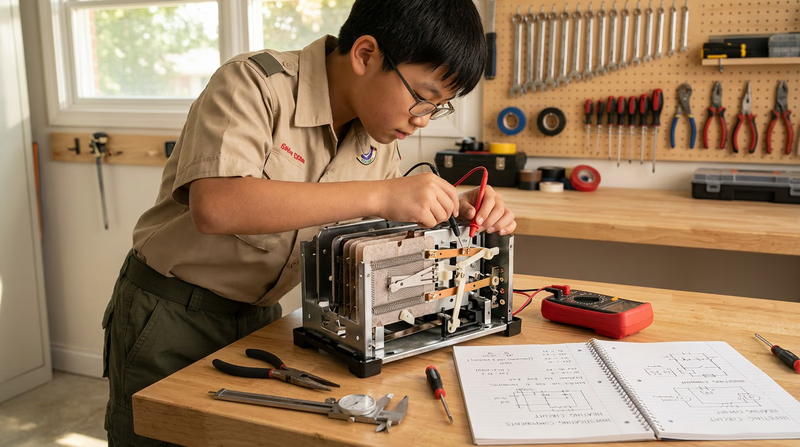
Then and Now
Then — Building by Trial and Error
For thousands of years, humans built remarkable structures without formal engineering training. The ancient Egyptians raised the Great Pyramid of Giza around 2560 BCE — 481 feet tall, assembled from 2.3 million stone blocks, each weighing an average of 2.5 tons. Roman engineers built aqueducts that carried water across valleys and concrete domes that still stand two thousand years later. They achieved these feats through experience, observation, and plenty of trial and error.
- Materials: Stone, wood, brick, and basic metals were the only options for millennia
- Design tools: Builders relied on geometric rules, physical models, and generations of accumulated knowledge passed from master to apprentice
- Failure rate: Many ancient structures collapsed during construction — we only see the ones that survived
The word “engineer” comes from the Latin ingenium, meaning cleverness or invention. The first people called engineers were military specialists who designed siege weapons, fortifications, and bridges for armies. Civil engineering — building things for everyday use — emerged as a separate profession only in the 18th century.
Now — Precision at Every Scale
Today, engineers work at scales the ancient builders could never have imagined. Biomedical engineers design artificial heart valves smaller than a coin. Aerospace engineers build rockets that land themselves on drone ships in the ocean. Software engineers write code that lets self-driving cars navigate city streets.
- Materials: Carbon fiber composites, shape-memory alloys, graphene, and thousands of engineered polymers give designers options ancient builders never had
- Design tools: Computer-aided design (CAD) software, finite element analysis, 3D printing for rapid prototyping, and AI-assisted optimization
- Precision: Modern manufacturing can hold tolerances tighter than a human hair — essential for jet engines, microchips, and medical devices
Get Ready!
You are about to think like an engineer. That means looking at everyday objects and asking “How does this actually work?” and “How could I make it better?” By the end of this badge, you will understand the engineering design process, know what different types of engineers do, and have built something of your own. These problem-solving skills will serve you in every part of your life — from planning a campout to choosing a career.
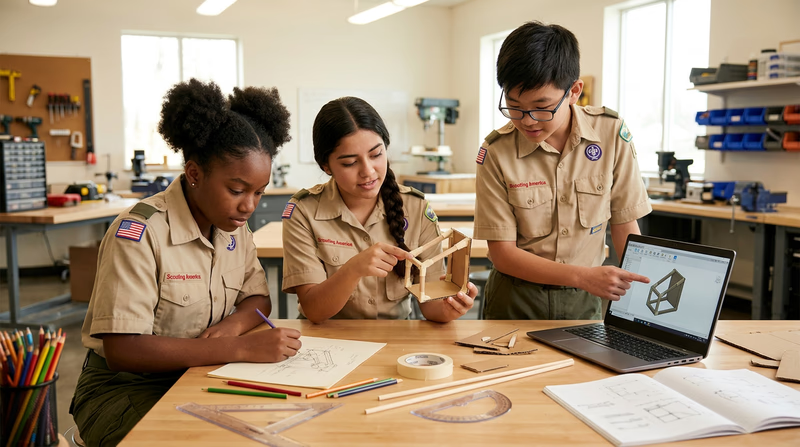
Kinds of Engineering
Mechanical Engineering
Mechanical engineers design things that move. If it has gears, pistons, motors, or moving parts, a mechanical engineer probably designed it. This is one of the broadest and oldest engineering fields, covering everything from bicycle transmissions to industrial robots to heating and cooling systems. Mechanical engineers use physics — especially the study of forces, energy, and motion — to make machines work reliably and efficiently.
Civil Engineering
Civil engineers build the infrastructure that keeps society running: roads, bridges, dams, tunnels, water treatment plants, and buildings. When you drive over a bridge, a civil engineer calculated exactly how much weight it needs to support, what forces wind and earthquakes might exert on it, and how to anchor it to the ground beneath. Civil engineering is one of the oldest engineering disciplines, stretching back to the first human settlements that needed walls, roads, and irrigation.
Electrical Engineering
Electrical engineers work with electricity and electronics — from massive power plants that generate electricity for entire cities to the tiny circuits inside your smartphone. This field splits into two main branches: power engineering (generating, transmitting, and distributing electricity) and electronics engineering (designing circuits, microchips, and electronic devices). Almost every modern technology depends on the work of electrical engineers.
Chemical Engineering
Chemical engineers transform raw materials into useful products. They design processes that turn crude oil into fuel, sand into computer chips, and plant sugars into biodegradable plastics. Chemical engineers work in pharmaceuticals, food production, cosmetics, and environmental cleanup. They combine chemistry, physics, biology, and mathematics to develop efficient, safe manufacturing processes.
Aerospace Engineering
Aerospace engineers design aircraft, spacecraft, satellites, and missiles. This field splits into aeronautical engineering (aircraft that fly within Earth’s atmosphere) and astronautical engineering (spacecraft that operate beyond it). Aerospace engineers must solve some of the most extreme engineering challenges — building structures that withstand supersonic speeds, extreme temperatures, and the vacuum of space while remaining as light as possible.
Biomedical Engineering
Biomedical engineers apply engineering principles to medicine and biology. They design artificial organs, prosthetic limbs, medical imaging equipment like MRI scanners, and drug delivery systems. This rapidly growing field sits at the intersection of engineering, biology, and medicine — and it produces technologies that directly save and improve lives.
Other Branches
Engineering has dozens of specialized branches beyond these six. Environmental engineers clean up pollution and design sustainable systems. Computer engineers design hardware and embedded systems. Industrial engineers optimize manufacturing processes. Nuclear engineers work with atomic energy. Materials engineers develop new substances with specific properties. As technology advances, new engineering specialties continue to emerge.
Ready to start thinking like an engineer? Your first task is to take something apart — at least in your mind — and figure out how it works.