Extended Learning
A. Beyond the Badge
You have investigated how manufactured items work, researched engineering achievements that changed civilization, met a working engineer, designed your own project using the systems engineering approach, and explored ethics, careers, and hands-on engineering activities. That is a solid foundation in engineering thinking — the ability to look at any problem and ask, “How can I solve this systematically?”
But the Engineering merit badge is a starting line, not a finish line. The sections below take you deeper into areas where engineering meets real-world challenges.
B. 3D Printing and Rapid Prototyping
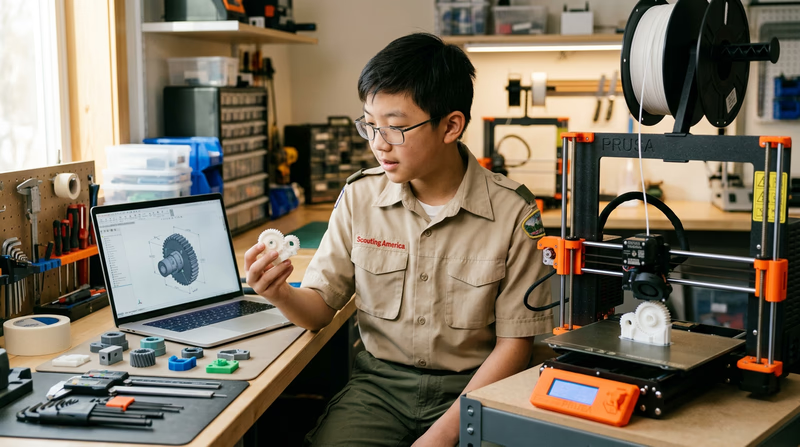
In Req 5, you learned the systems engineering approach and built a prototype. Rapid prototyping technology — especially 3D printing — has transformed how engineers move from concept to physical object. Instead of spending weeks machining a prototype in a workshop, an engineer can design a part on screen in the morning and hold it in their hands by afternoon.
How 3D Printing Works
The most common 3D printing method, Fused Deposition Modeling (FDM), works like a very precise hot glue gun. A spool of plastic filament (usually PLA or ABS) feeds through a heated nozzle that melts the plastic and deposits it layer by layer. Each layer is typically 0.1 to 0.3 millimeters thick — about the thickness of a sheet of paper. Hundreds or thousands of layers build up into a solid three-dimensional object.
Other methods include Stereolithography (SLA), which uses a UV laser to harden liquid resin layer by layer, and Selective Laser Sintering (SLS), which fuses powder material with a laser. Industrial versions can print in metal, ceramic, carbon fiber composites, and even food.
Getting Started
You do not need to own a 3D printer to start designing:
- Tinkercad (tinkercad.com) — Free, browser-based CAD software designed for beginners. Drag and drop shapes to build 3D models.
- Fusion 360 (autodesk.com) — Free for students and hobbyists. More powerful than Tinkercad, with simulation and analysis tools that professional engineers use.
- Library and maker space printers — Many public libraries now have 3D printers available for public use, often for free or a small materials fee.
3D printing teaches you the full engineering cycle in miniature: design, prototype, test, redesign. When your first print does not fit together properly, you adjust the dimensions and print again. That iterative process — the same one James Dyson used 5,127 times (as you read in Req 5) — is the heartbeat of engineering.
Tinkercad — Free 3D Design for Everyone Autodesk's free, browser-based 3D modeling tool designed for beginners — no download required. Perfect for learning CAD and preparing designs for 3D printing.C. Engineering for Disaster Relief
When earthquakes, hurricanes, floods, or wildfires strike, engineers are among the first professionals called into action — not just to rebuild, but to save lives during the crisis itself. Disaster engineering is a field where every decision matters urgently and the consequences of mistakes are measured in human lives.
What Disaster Engineers Do
After a natural disaster, structural engineers assess damaged buildings to determine which are safe to enter and which must be demolished. Civil engineers design temporary bridges, roads, and water systems. Environmental engineers ensure drinking water is safe and sewage systems are functioning. Electrical engineers restore power infrastructure. Mechanical engineers deploy and maintain generators, water pumps, and heavy equipment.
Engineers Without Borders
Engineers Without Borders USA (EWB-USA) sends volunteer engineering teams to communities around the world to build sustainable infrastructure — clean water systems, sanitation facilities, bridges, and renewable energy installations. Student chapters at universities let college-age engineers participate in real projects during their studies.
Designing for Resilience
Modern disaster engineering focuses on resilience — designing structures and systems that survive disasters rather than just being rebuilt afterward. Examples include earthquake-resistant buildings in Japan that sway with seismic waves instead of fighting them, and levee systems in the Netherlands engineered to withstand 10,000-year flood events. Engineers are also designing early warning systems for tsunamis, volcanic eruptions, and severe weather that give communities precious minutes to evacuate.
This is engineering at its most meaningful — using technical skills to protect the most vulnerable people in their most desperate moments.
Engineers Without Borders USA A nonprofit that partners with communities worldwide to design and implement sustainable engineering projects — with opportunities for students and professionals.D. The Future of Engineering: AI, Robotics, and Beyond
Engineering is evolving faster than at any point in history. Three trends are reshaping what engineers do and how they do it:
Artificial Intelligence in Engineering
AI is not replacing engineers — it is making them faster and more capable. Generative design software can explore thousands of possible shapes for a structural component, finding solutions that no human would think of. AI-powered simulation tools can test a bridge design under millions of loading scenarios in hours instead of weeks. Machine learning algorithms can predict when machines will fail before they break, enabling preventive maintenance that saves billions of dollars annually.
Advanced Robotics
Robots are moving beyond factory floors into construction sites, operating rooms, and disaster zones. Construction robots can lay bricks three times faster than human masons. Surgical robots let surgeons operate through incisions smaller than a pencil eraser. Inspection robots crawl through pipes, fly over power lines, and explore environments too dangerous for humans. Designing and programming these systems is a rapidly growing engineering specialty.
Sustainable Engineering
Climate change is creating the largest engineering challenge in human history. Engineers are designing carbon-capture systems that pull CO2 from the atmosphere, developing next-generation nuclear reactors that produce zero emissions, creating offshore wind farms that generate electricity from ocean winds, and engineering buildings that produce more energy than they consume. The engineers who solve these problems will shape the future of civilization.
E. Real-World Experiences
Visit an Engineering Firm or Construction Site
Contact a local engineering consulting firm, construction company, or manufacturing plant and ask about tours or job shadowing. Seeing a bridge under construction, a factory production line, or an engineering office full of CAD workstations makes the profession tangible in a way that reading about it cannot.
Join a FIRST Robotics Team
FIRST (For Inspiration and Recognition of Science and Technology) runs robotics competitions for students at every age level — FIRST LEGO League for middle schoolers and FIRST Robotics Competition for high schoolers. Teams design, build, and program robots to complete annual challenges. The experience combines mechanical engineering, electrical engineering, programming, teamwork, and project management into one intense, rewarding season.
Explore a Maker Space
Maker spaces provide access to tools most people cannot afford at home — 3D printers, laser cutters, CNC routers, electronics workbenches, and woodworking equipment. Many offer classes and open shop time for young makers. Check your local library, community college, or search for maker spaces in your area.
Attend an Engineering Open House
Many universities hold annual engineering open houses or STEM days where departments showcase projects, run demonstrations, and let visitors try hands-on activities. These events are free and give you a taste of what studying engineering in college feels like. Some notable ones include the University of Illinois Engineering Open House and Purdue University’s Spring Fest.
Volunteer for a Habitat for Humanity Build
Habitat for Humanity builds affordable housing with volunteer labor. Working on a build site teaches you practical construction skills — framing, roofing, drywall, painting — while seeing engineering principles in action. You will understand why walls are framed the way they are, how plumbing and electrical systems are routed, and why building codes exist.
F. Organizations
National Society of Professional Engineers (NSPE)
The leading professional society for licensed engineers in the United States. NSPE advocates for the engineering profession, provides career resources, and maintains the Engineer’s Code of Ethics you studied in Req 8.
National Society of Professional Engineers Professional development, licensure resources, ethical guidance, and career support for engineers at every career stage.DiscoverE (formerly National Engineers Week Foundation)
A coalition of engineering societies dedicated to increasing public understanding of engineering and attracting young people to the profession. They organize Engineers Week activities, the Future City Competition, and Introduce a Girl to Engineering Day.
DiscoverE Engineering outreach programs for young people — including the Future City Competition, Dream Big resources, and Introduce a Girl to Engineering Day.American Society of Mechanical Engineers (ASME)
One of the oldest and largest engineering societies, serving mechanical engineers worldwide. ASME develops the codes and standards that govern everything from pressure vessels to elevators. Student membership is available.
American Society of Mechanical Engineers Professional society for mechanical engineers — offering student programs, competitions, scholarships, and technical standards used worldwide.American Society of Civil Engineers (ASCE)
The professional home for civil engineers. ASCE publishes the annual Infrastructure Report Card that grades America’s infrastructure, and runs student competitions including steel bridge building and concrete canoe racing.
American Society of Civil Engineers The oldest national engineering society in the US — offering student chapters, competitions, career resources, and the Infrastructure Report Card.FIRST (For Inspiration and Recognition of Science and Technology)
Founded by inventor Dean Kamen, FIRST runs robotics programs for students of all ages. FIRST LEGO League, FIRST Tech Challenge, and FIRST Robotics Competition give hundreds of thousands of students hands-on engineering experience each year.
FIRST Robotics Robotics programs for students ages 4–18 — combining engineering, teamwork, and competition to inspire the next generation of innovators.