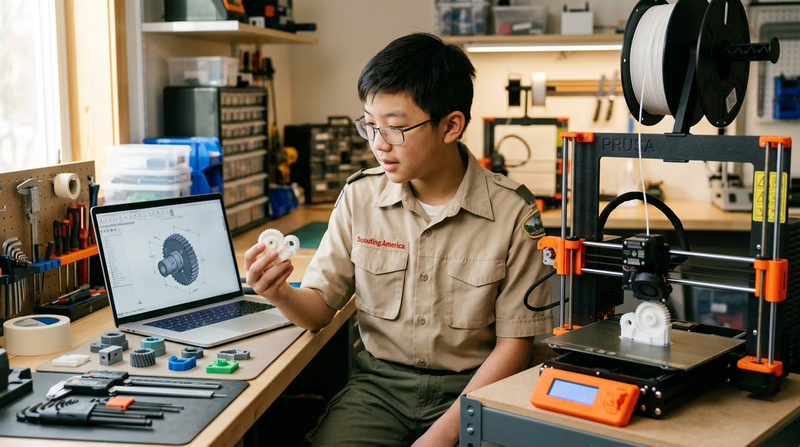
Engineering Merit Badge — Complete Digital Resource Guide
https://merit-badge.university/merit-badges/engineering/guide/
Introduction & Overview
Every bridge you cross, every building you enter, every device you use started as a problem someone needed to solve. Engineering is the discipline of turning scientific knowledge into practical solutions — designing the structures, machines, systems, and processes that shape modern life. From the water that flows from your faucet to the satellite that delivers your GPS signal, engineers made it possible.
This merit badge takes you inside the engineering process. You will tear apart how everyday objects work, research achievements that changed civilization, meet a working engineer, and design something of your own using real engineering methods. Along the way, you will discover that engineering is not just about math and science — it is about creativity, problem-solving, and the drive to make things better.
Then and Now
Then — Building by Trial and Error
For thousands of years, humans built remarkable structures without formal engineering training. The ancient Egyptians raised the Great Pyramid of Giza around 2560 BCE — 481 feet tall, assembled from 2.3 million stone blocks, each weighing an average of 2.5 tons. Roman engineers built aqueducts that carried water across valleys and concrete domes that still stand two thousand years later. They achieved these feats through experience, observation, and plenty of trial and error.
- Materials: Stone, wood, brick, and basic metals were the only options for millennia
- Design tools: Builders relied on geometric rules, physical models, and generations of accumulated knowledge passed from master to apprentice
- Failure rate: Many ancient structures collapsed during construction — we only see the ones that survived
The word “engineer” comes from the Latin ingenium, meaning cleverness or invention. The first people called engineers were military specialists who designed siege weapons, fortifications, and bridges for armies. Civil engineering — building things for everyday use — emerged as a separate profession only in the 18th century.
Now — Precision at Every Scale
Today, engineers work at scales the ancient builders could never have imagined. Biomedical engineers design artificial heart valves smaller than a coin. Aerospace engineers build rockets that land themselves on drone ships in the ocean. Software engineers write code that lets self-driving cars navigate city streets.
- Materials: Carbon fiber composites, shape-memory alloys, graphene, and thousands of engineered polymers give designers options ancient builders never had
- Design tools: Computer-aided design (CAD) software, finite element analysis, 3D printing for rapid prototyping, and AI-assisted optimization
- Precision: Modern manufacturing can hold tolerances tighter than a human hair — essential for jet engines, microchips, and medical devices
Get Ready!
You are about to think like an engineer. That means looking at everyday objects and asking “How does this actually work?” and “How could I make it better?” By the end of this badge, you will understand the engineering design process, know what different types of engineers do, and have built something of your own. These problem-solving skills will serve you in every part of your life — from planning a campout to choosing a career.
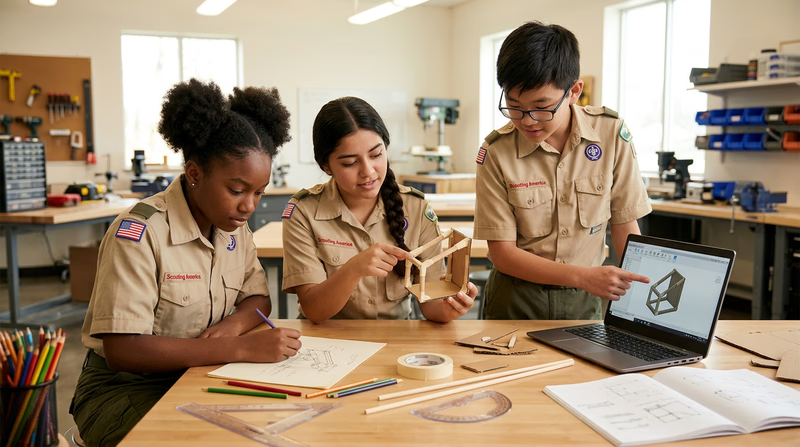
Kinds of Engineering
Mechanical Engineering
Mechanical engineers design things that move. If it has gears, pistons, motors, or moving parts, a mechanical engineer probably designed it. This is one of the broadest and oldest engineering fields, covering everything from bicycle transmissions to industrial robots to heating and cooling systems. Mechanical engineers use physics — especially the study of forces, energy, and motion — to make machines work reliably and efficiently.
Civil Engineering
Civil engineers build the infrastructure that keeps society running: roads, bridges, dams, tunnels, water treatment plants, and buildings. When you drive over a bridge, a civil engineer calculated exactly how much weight it needs to support, what forces wind and earthquakes might exert on it, and how to anchor it to the ground beneath. Civil engineering is one of the oldest engineering disciplines, stretching back to the first human settlements that needed walls, roads, and irrigation.
Electrical Engineering
Electrical engineers work with electricity and electronics — from massive power plants that generate electricity for entire cities to the tiny circuits inside your smartphone. This field splits into two main branches: power engineering (generating, transmitting, and distributing electricity) and electronics engineering (designing circuits, microchips, and electronic devices). Almost every modern technology depends on the work of electrical engineers.
Chemical Engineering
Chemical engineers transform raw materials into useful products. They design processes that turn crude oil into fuel, sand into computer chips, and plant sugars into biodegradable plastics. Chemical engineers work in pharmaceuticals, food production, cosmetics, and environmental cleanup. They combine chemistry, physics, biology, and mathematics to develop efficient, safe manufacturing processes.
Aerospace Engineering
Aerospace engineers design aircraft, spacecraft, satellites, and missiles. This field splits into aeronautical engineering (aircraft that fly within Earth’s atmosphere) and astronautical engineering (spacecraft that operate beyond it). Aerospace engineers must solve some of the most extreme engineering challenges — building structures that withstand supersonic speeds, extreme temperatures, and the vacuum of space while remaining as light as possible.
Biomedical Engineering
Biomedical engineers apply engineering principles to medicine and biology. They design artificial organs, prosthetic limbs, medical imaging equipment like MRI scanners, and drug delivery systems. This rapidly growing field sits at the intersection of engineering, biology, and medicine — and it produces technologies that directly save and improve lives.
Other Branches
Engineering has dozens of specialized branches beyond these six. Environmental engineers clean up pollution and design sustainable systems. Computer engineers design hardware and embedded systems. Industrial engineers optimize manufacturing processes. Nuclear engineers work with atomic energy. Materials engineers develop new substances with specific properties. As technology advances, new engineering specialties continue to emerge.
Ready to start thinking like an engineer? Your first task is to take something apart — at least in your mind — and figure out how it works.
Req 1 — Investigating a Manufactured Item
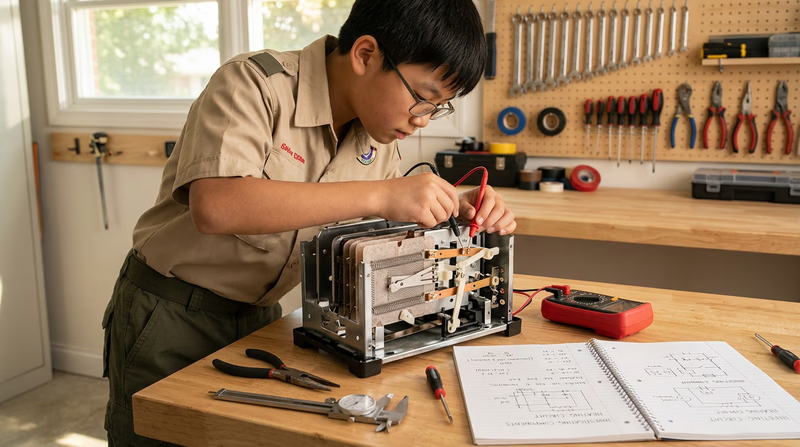
A toaster seems simple — you push down a lever, bread goes in, toast comes out. But inside that metal box, an electrical engineer designed nichrome wire heating elements that glow red-hot without melting. A mechanical engineer designed the spring-loaded carriage and the latch mechanism. A materials engineer chose plastics that won’t warp from heat and metals that conduct electricity efficiently. Even a “simple” household item is the result of multiple engineering disciplines working together.
This requirement asks you to pick one manufactured item, dig into how it actually works, and identify the engineering behind it. The goal is not just to describe what the item does, but to understand why it works the way it does.
Choosing Your Item
Pick something you find genuinely interesting — you will spend real time researching it. Here are some categories to consider:
Mechanical items (lots of moving parts to study):
- Bicycle gear system or brakes
- Mechanical pencil
- Door lock and key mechanism
- Wind-up clock or music box
Electrical/electronic items (circuits, motors, sensors):
- Flashlight or headlamp
- Smoke detector
- Electric fan or hair dryer
- Remote control car
Combination items (mechanical + electrical):
- Toaster or blender
- Battery-powered drill
- Automatic soap dispenser
- Sewing machine
How to Investigate
Think of yourself as an engineering detective. You are reverse-engineering a product — figuring out how it was designed by examining the finished result.
Step 1: Observe the Outside
Before you open anything up, study the exterior. Ask yourself:
- What does this item do? What problem does it solve?
- What materials is it made from? Why those materials?
- How does the user interact with it (buttons, switches, handles)?
- What are the inputs (electricity, batteries, manual force) and outputs (heat, light, motion, sound)?
Step 2: Investigate the Inside
With adult supervision, carefully take the item apart or research its internal components. Look for:
- Mechanical components: gears, springs, levers, bearings, screws
- Electrical components: wires, circuit boards, resistors, capacitors, motors
- Structural components: the frame, housing, or chassis that holds everything together
- Safety features: thermal fuses, grounding wires, insulation, protective guards
Step 3: Research the Engineering
Now connect what you see to engineering principles. Good research sources include:
- YouTube teardown videos — Search for “[your item] teardown” or “how does a [your item] work”
- How Stuff Works (howstuffworks.com) — Detailed explanations of common devices
- Manufacturer websites — Sometimes include technical specifications and diagrams
- Library books — Look in the engineering or technology section
Step 4: Identify the Engineering Disciplines
For each major component or system, identify which type of engineering was involved. For example, a hair dryer involves:
| Component | Engineering Discipline | Why |
|---|---|---|
| Heating element | Electrical engineering | Designed to convert electricity to heat safely |
| Fan motor | Mechanical + electrical | Motor converts electrical energy to rotational motion |
| Plastic housing | Materials engineering | Must withstand heat without melting or warping |
| Temperature switch | Electrical engineering | Safety cutoff prevents overheating |
| Aerodynamic nozzle | Mechanical engineering | Directs airflow efficiently |
Preparing for Your Counselor Discussion
Your counselor will want to hear:
- What you chose and why it interested you
- How the item works — explain the key mechanisms and systems
- Which engineering disciplines were needed to create it
- Where you found your information — what sources you used
- What surprised you — the most interesting thing you discovered
Investigation Checklist
Track your progress- Choose a manufactured item and get counselor approval.
- Observe and document the exterior (materials, controls, inputs/outputs).
- Investigate the interior with adult supervision.
- Research how the key components work.
- Identify at least three engineering disciplines involved.
- Prepare to discuss your findings and sources with your counselor.
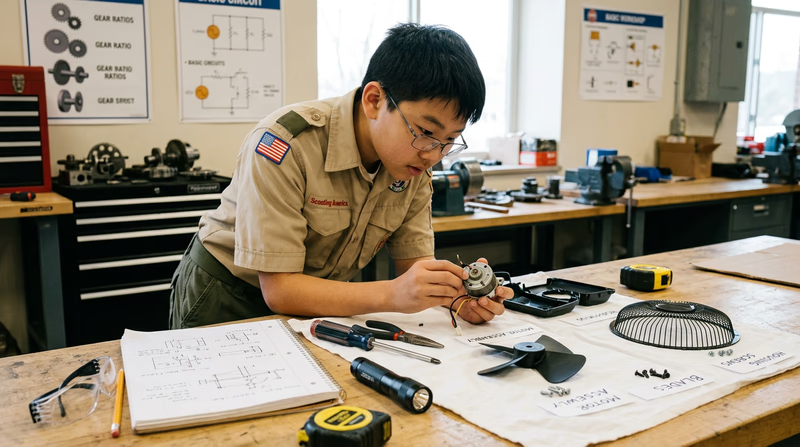
Req 2 — Engineering That Changed the World
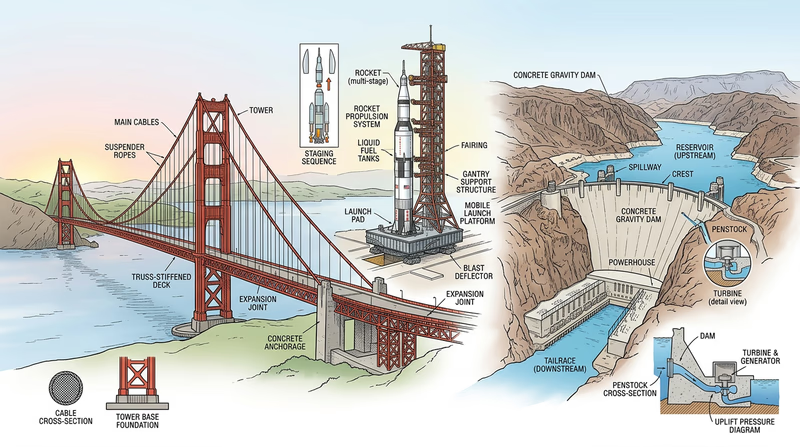
The Golden Gate Bridge almost wasn’t built. Critics said San Francisco Bay’s powerful tides, howling winds, and thick fog made a suspension bridge impossible at that location. Chief engineer Joseph Strauss and structural engineer Charles Ellis spent years proving them wrong — designing a bridge that could flex 27 feet sideways in high winds while supporting the weight of six lanes of traffic. When it opened in 1937, it was the longest suspension span in the world. Every great engineering achievement has a story like this — ambitious people overcoming obstacles that others called impossible.
Choosing Your Achievement
Pick an engineering feat that genuinely fascinates you. The best choice is something you want to learn more about, not just something easy to research. Here are ideas across different engineering fields:
Structural & Civil Engineering
- Hoover Dam — Tamed the Colorado River during the Great Depression
- Brooklyn Bridge — First steel-wire suspension bridge, built 1869–1883
- Channel Tunnel — 31-mile rail tunnel under the English Channel
- Panama Canal — Connected two oceans through miles of jungle and rock
Aerospace & Transportation
- Apollo 11 Moon Landing — Put humans on the Moon with 1960s technology
- The Wright Flyer — First powered, controlled aircraft
- Interstate Highway System — 48,000 miles of road that transformed American life
- The Space Shuttle — First reusable spacecraft
Electrical & Digital
- The Electric Power Grid — Delivers electricity to billions of people
- The Internet — Connected the world’s computers into one network
- The Transistor — The tiny switch that made modern electronics possible
- GPS (Global Positioning System) — Satellite-based navigation for everyone
Other Fields
- The Artificial Heart — Biomedical engineering keeping people alive
- The Haber Process — Chemical engineering that feeds half the world
- Water Purification Systems — Environmental engineering that prevents disease
What to Research
Your counselor will expect you to cover three areas. Here is how to approach each one.
The Engineers Behind It
Every great achievement has names behind it — and the stories behind those names are often fascinating.
- Who led the project? Find the chief engineer, lead designer, or key inventor
- What was their background? How did their education and experience prepare them?
- Who else contributed? Major engineering achievements are team efforts — look for other key contributors
- What personal challenges did they face? Many famous engineers overcame significant obstacles. Washington Roebling, who supervised the Brooklyn Bridge construction, was paralyzed by decompression sickness and directed work from his apartment window using a telescope.
The Obstacles They Overcame
This is often the most interesting part. Every major engineering project hits problems that seem unsolvable at first.
- Technical obstacles — Materials that didn’t exist yet, forces no one had calculated before, environments too extreme for existing technology
- Financial obstacles — Projects running over budget, losing funding, having to prove economic viability
- Natural obstacles — Geography, weather, geological surprises, environmental challenges
- Human obstacles — Political opposition, labor disputes, safety concerns, public skepticism
Impact on the World Today
Connect the achievement to modern life. How would the world be different without it?
- Direct impact — What does this achievement enable today? (e.g., the internet enables global communication, e-commerce, remote work)
- Indirect impact — What technologies or industries grew because of it? (e.g., the transistor led to computers, smartphones, and the entire digital age)
- Ongoing influence — Is the original achievement still in use, or did it inspire newer versions?
Organizing Your Presentation
When you tell your counselor what you learned, structure your presentation like a story:
- Hook — Start with a surprising fact or dramatic moment from the project
- The Vision — What were the engineers trying to accomplish and why?
- The People — Who were the key engineers and what made them qualified?
- The Obstacles — What nearly stopped the project? How were problems solved?
- The Result — What was achieved, and how did it change the world?
- Your Takeaway — What impressed you most? What engineering principles did you learn?

Req 3 — Six Fields of Engineering
A single skyscraper requires civil engineers to design the foundation, structural engineers to calculate the steel frame, mechanical engineers to plan the heating and cooling, electrical engineers to wire the power and lighting, environmental engineers to manage water and waste, and fire protection engineers to design the sprinkler systems. Engineering is not one profession — it is dozens of specialties that constantly overlap and collaborate.
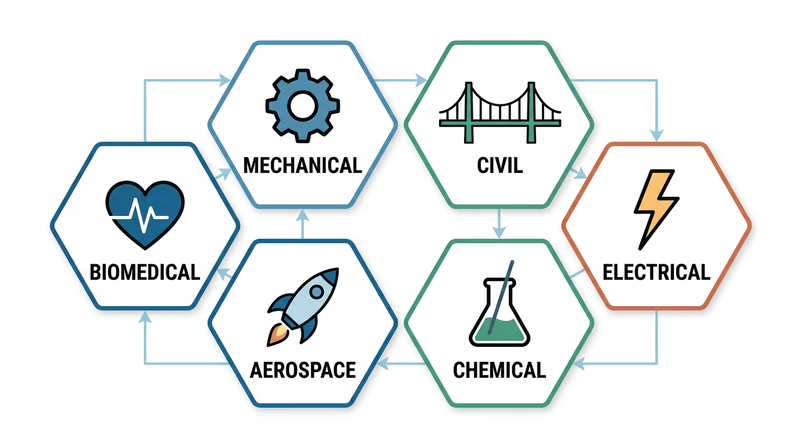
This requirement asks you to learn about six types of engineers. The Introduction page covered several branches, so here you will go deeper and think about how different engineering fields connect.
Major Engineering Disciplines
Below are descriptions of the most common engineering fields. Choose six that interest you, and be ready to explain what each type of engineer does.
Mechanical Engineering
Mechanical engineers design, build, and test machines and mechanical systems. This is the broadest engineering field, covering anything with moving parts — from car engines and industrial robots to medical devices and HVAC systems. A mechanical engineer’s toolkit includes thermodynamics (heat and energy), fluid mechanics (how liquids and gases flow), and materials science (choosing the right materials for the job).
What they build: Engines, turbines, elevators, prosthetic limbs, manufacturing equipment, aircraft components
Civil Engineering
Civil engineers design and oversee the construction of infrastructure — the physical systems that communities depend on. Roads, bridges, water supply systems, sewage treatment plants, airports, and buildings all fall under civil engineering. Sub-specialties include structural engineering (making sure buildings and bridges can handle the loads placed on them), geotechnical engineering (understanding the soil and rock beneath structures), and transportation engineering (designing roads and transit systems).
What they build: Bridges, highways, dams, tunnels, water treatment facilities, building foundations
Electrical Engineering
Electrical engineers work with electrical systems at every scale — from continent-spanning power grids to circuits smaller than a grain of rice. Power engineers focus on generating, transmitting, and distributing electricity. Electronics engineers design the circuits, processors, and sensors inside devices. Control engineers create systems that regulate other systems automatically (like a thermostat that maintains room temperature).
What they build: Power grids, electric motors, computer processors, control systems, telecommunications equipment
Chemical Engineering
Chemical engineers design processes that transform raw materials into valuable products. They work at the intersection of chemistry, physics, and biology — scaling up reactions from laboratory beakers to industrial plants that produce millions of tons of product. Chemical engineers are essential in oil refining, pharmaceuticals, food processing, plastics manufacturing, and environmental remediation.
What they build: Refineries, pharmaceutical production lines, fertilizer plants, water purification systems, biodegradable materials
Aerospace Engineering
Aerospace engineers design vehicles and systems that operate in the atmosphere or in space. Aeronautical engineers work on aircraft — everything from commercial jets to drones. Astronautical engineers design spacecraft, satellites, and launch systems. Both sub-fields deal with extreme conditions: high speeds, intense vibrations, temperature swings, and (in space) the absence of air and gravity.
What they build: Commercial aircraft, fighter jets, rockets, satellites, space stations, drones
Biomedical Engineering
Biomedical engineers apply engineering principles to problems in medicine and biology. They design medical devices, artificial organs, imaging systems (MRI, CT, ultrasound), and drug delivery mechanisms. This field requires a strong understanding of both engineering and human biology. Biomedical engineering is one of the fastest-growing engineering fields as healthcare technology advances.
What they build: Prosthetic limbs, pacemakers, MRI machines, surgical robots, 3D-printed tissues
Computer Engineering
Computer engineers design the hardware that makes computing possible — processors, memory systems, circuit boards, and embedded systems. They bridge the gap between electrical engineering (the physical circuits) and computer science (the software that runs on them). Computer engineers are behind everything from the chip in your smartphone to the supercomputers used for weather forecasting.
What they build: Microprocessors, computer motherboards, embedded systems, networking hardware, IoT devices
Environmental Engineering
Environmental engineers protect human health and the natural world by designing systems that manage pollution, clean contaminated sites, and treat water and air. They work on wastewater treatment, solid waste management, air pollution control, and hazardous waste cleanup. As climate change and sustainability become more urgent, this field is growing rapidly.
What they build: Water treatment plants, air filtration systems, landfill containment, renewable energy integration
Industrial Engineering
Industrial engineers optimize complex systems and processes — making manufacturing, logistics, and operations more efficient, safer, and less wasteful. They study how people, machines, materials, and information interact, then find ways to improve. If you have ever wondered how Amazon delivers packages so fast or how a hospital schedules thousands of surgeries per year, industrial engineers designed those systems.
What they build: Manufacturing workflows, supply chains, quality control systems, hospital scheduling systems
How Engineering Fields Relate
The second part of this requirement asks you to pick two types and explain how their work is related. Here is the key insight: no engineering project happens in isolation. Every real-world product or system requires multiple engineering disciplines working together.
Finding the Connections
When you pick your two types, think about projects where both are needed. Ask yourself:
- Do they work on the same products? (Mechanical and electrical engineers both work on cars)
- Does one depend on the other? (Civil engineers build the power plants that electrical engineers design)
- Do they share tools or methods? (Chemical and biomedical engineers both use laboratory testing and process design)
- Do they solve overlapping problems? (Aerospace and materials engineers both need lightweight, heat-resistant materials)
Example: Mechanical + Electrical Engineering
These two disciplines overlap constantly. A modern car is a perfect example — the engine, transmission, and brakes are mechanical systems, while the ignition, sensors, battery management, and infotainment system are electrical. Neither discipline alone could design the whole car. Mechanical engineers need electrical engineers to power and control their machines; electrical engineers need mechanical engineers to build housings, cooling systems, and moving parts for their electronics.
Example: Civil + Environmental Engineering
Every major construction project has environmental implications. When civil engineers design a new highway, environmental engineers assess the impact on local waterways, wildlife habitats, and air quality. When environmental engineers design a water treatment plant, civil engineers build the physical structure. Both disciplines rely on understanding how water flows through landscapes and how human-built systems affect natural ones.
Req 4 — Interview with an Engineer
This requirement has five parts that together give you a real-world window into what engineers actually do every day:
- Req 4a — Discuss the engineer’s work and tools
- Req 4b — Discuss a current project and their role in it
- Req 4c — Find out how their work is done and how results are achieved
- Req 4d — Ask to see reports the engineer writes
- Req 4e — Discuss what you learned with your counselor
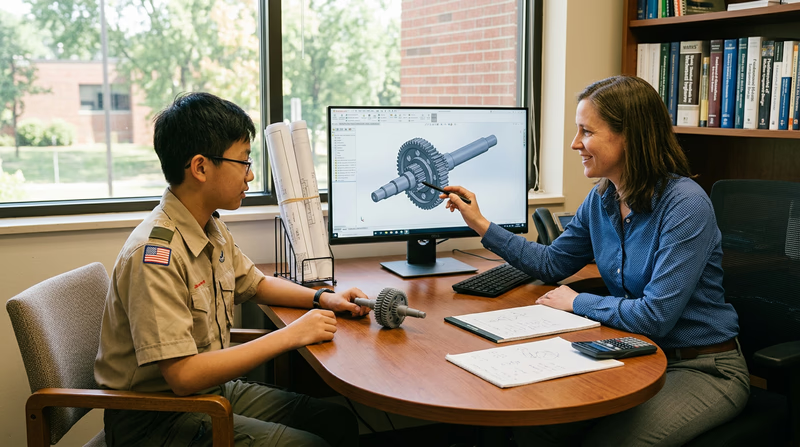
Talking to a working engineer is one of the most valuable parts of this merit badge. Books and websites can teach you what engineering is, but a conversation with someone who does it every day reveals what the job is really like — the daily challenges, the satisfying moments, and the parts that no textbook mentions.
Finding an Engineer to Visit
You have several options. The requirement specifically says the engineer may be your counselor, a parent, or a guardian — but you can also reach out more broadly:
- Your merit badge counselor — Many Engineering merit badge counselors are practicing engineers
- Family connections — Parents, guardians, aunts, uncles, or family friends who are engineers
- Troop network — Ask your Scoutmaster if any parents in the troop are engineers
- Local engineering firms — Some companies welcome student visits; have a parent help you reach out
- College engineering departments — University professors and graduate students are often happy to talk with interested young people
Preparing Great Questions
The difference between a forgettable visit and a genuinely useful one comes down to the questions you ask. Go beyond yes-or-no questions. Here are strong questions for each sub-requirement:
Req 4a — Their Work and Tools
- What type of engineering do you practice, and how did you end up in this specialty?
- Walk me through a typical day — what does your morning look like?
- What software tools do you use most often? (CAD, simulation, analysis tools?)
- What physical tools or lab equipment do you use regularly?
- Has your field changed significantly since you started your career?
Req 4b — A Current Project
- What project are you working on right now?
- What is your specific role on the project team?
- How many people are involved, and what other types of engineers are on the team?
- What is the most challenging part of this project?
- How long will the project take from start to finish?
Req 4c — How the Work Gets Done
- What is the process from initial idea to finished product or structure?
- How do you test whether your design will work before building it?
- What happens when something does not work as expected?
- How do you collaborate with engineers from other disciplines?
- What role do prototypes, simulations, or models play in your work?
Req 4d — Engineering Reports
- What kinds of reports or documentation do you write?
- Who reads your reports — other engineers, managers, clients, regulators?
- Can you show me an example of a report or drawing from a project?
- How important is writing and communication in engineering?
Req 4e — Your Takeaways
After the visit, reflect on what you learned and prepare to discuss these points with your counselor:
- What surprised you most about the engineer’s work?
- How does their daily work compare to what you expected?
- What skills (besides math and science) are important in their job?
- Could you see yourself doing this kind of work?
Visit Preparation Checklist
Get ready for your engineer visit- Identify an engineer to visit (counselor, family member, or professional).
- Schedule the visit or call and confirm the date and time.
- Review the five sub-requirements (4a through 4e) so you know what to cover.
- Write down at least three questions for each sub-requirement.
- Bring a notebook and pen to take notes during the visit.
- Ask permission before taking photos of tools, reports, or workspaces.
- Send a thank-you note or email after the visit.
What to Look For During the Visit
Beyond your prepared questions, pay attention to details that reveal what engineering work is really like:
- The workspace — Is it an office, a lab, a construction site, or a factory floor? Engineering happens in many settings.
- Teamwork — Notice how the engineer interacts with colleagues. Engineering is rarely a solo activity.
- Problem-solving in action — If you are lucky, you might witness the engineer working through an actual problem. Watch how they approach it.
- Communication — Engineering involves far more writing, presenting, and discussing than most people expect. Notice how much time the engineer spends communicating versus calculating.
Engineering Reports: What to Expect
When you ask to see reports (Req 4d), you might see several types:
| Report Type | Purpose |
|---|---|
| Design report | Documents the engineering decisions behind a design, including calculations and alternatives considered |
| Test report | Records the results of testing a prototype or component, with data and conclusions |
| Progress report | Updates stakeholders on project status, milestones, and issues |
| Technical specification | Defines exact requirements a product or system must meet |
| Feasibility study | Analyzes whether a proposed project is technically and financially possible |
Do not worry if you do not understand every detail in the reports. The goal is to see that engineering involves careful documentation — not just building things, but recording why design decisions were made so others can understand and build on them.
Req 5 — Systems Engineering Design Project
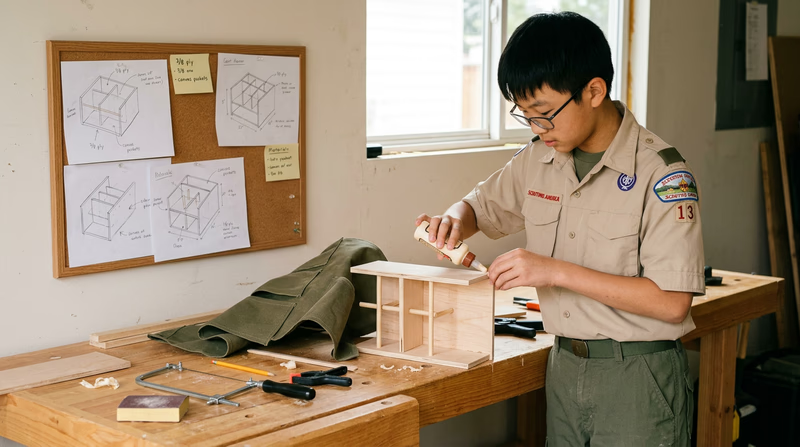
A 13-year-old Scout was tired of losing tent stakes in the dark. So he designed a tent stake with a glow-in-the-dark head, a built-in pull loop for easy removal, and a wider foot plate to hold in sandy soil. He didn’t just draw a picture — he defined the problem, listed his requirements, sketched three different designs, picked the best one, and built a prototype from a wooden dowel and some craft supplies. That is systems engineering in action.
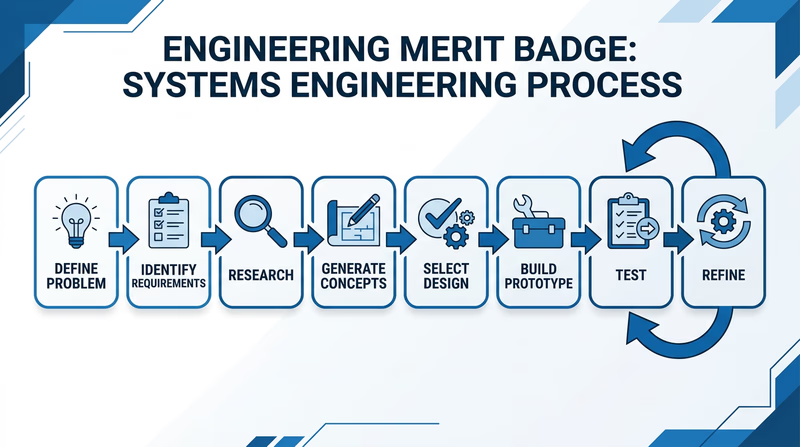
This requirement asks you to be the engineer. You will follow the same process that professional engineers use — the systems engineering approach — to design something original.
What Is Systems Engineering?
Systems engineering is a step-by-step method for designing complex things. Instead of jumping straight to building, you work through a structured process that helps you make better decisions, catch problems early, and create something that actually solves the problem you set out to solve.
Think of it as a map for the design journey. Each step builds on the one before it:
Step 1: Define the Problem
What need are you trying to fill? Be specific. “I want to build something cool” is not a problem statement. “Our patrol needs a way to organize cooking utensils so we can find them quickly at camp” — that is a problem statement an engineer can work with.
Ask yourself:
- What problem am I solving?
- Who will use this? (Your patrol, your family, yourself?)
- Where will it be used? (Outdoors, in a garage, at a desk?)
Step 2: Identify Requirements
Requirements are the rules your design must follow. They come in two types:
- Functional requirements — What must the device do? (Hold 10 utensils, fold flat for transport, keep items dry)
- Constraints — What limits exist? (Must cost under $15, must weigh less than 2 pounds, must fit in a backpack)
Step 3: Research Existing Solutions
Before inventing something new, look at what already exists. What products are available? What do they do well? What do they do poorly? Your design should improve on what is already out there — not reinvent something that already works perfectly.
Step 4: Generate Design Concepts
Sketch at least three different approaches to solving the problem. They do not need to be artistic — rough sketches with labels are perfect. The goal is to explore different ideas before committing to one.
For each concept, note:
- How it works
- What materials it needs
- Its strengths and weaknesses
- How well it meets your requirements
Step 5: Select the Best Design
Compare your concepts against your requirements list. Which design meets the most requirements? Which is most practical to build? A decision matrix can help:
| Requirement | Design A | Design B | Design C |
|---|---|---|---|
| Holds 10 utensils | Yes | Yes | No |
| Folds flat | No | Yes | Yes |
| Costs under $15 | Yes | Yes | Yes |
| Weighs under 2 lbs | Yes | No | Yes |
| Score | 3/4 | 3/4 | 3/4 |
When scores are close, consider which requirements matter most. Portability might be more important than capacity for a backpacking patrol.
Step 6: Build a Prototype
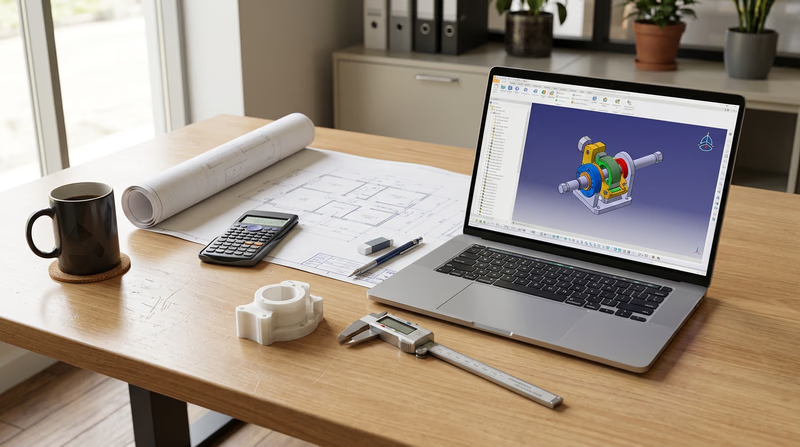
A prototype is a first version built to test your ideas. It does not need to be perfect or pretty — it needs to be functional enough to test whether your design works. Use whatever materials are available: cardboard, wood, PVC pipe, duct tape, 3D printing, or craft supplies.
Step 7: Test and Evaluate
Does your prototype actually solve the problem? Test it against your requirements. Have the intended users try it out and give feedback. Note what works and what needs improvement.
Step 8: Refine the Design
Based on testing, make changes to improve your design. Real engineering projects go through many rounds of testing and refinement. Professional engineers call this iteration — repeating the design-test-improve cycle until the product meets all requirements.
Project Ideas
The requirement gives you three categories. Here are ideas within each:
Patrol Equipment
- A lightweight, foldable camp table
- A utensil organizer roll for patrol cooking gear
- A fire-starting kit case that keeps materials dry and organized
- A patrol flag stand that is easy to transport and set up
- A lantern hanger for a dining fly
Toys
- A rubber-band-powered car
- A marble run made from recycled materials
- A simple catapult or trebuchet
- A spinning top with interchangeable weights
- A wind-powered vehicle
Useful Home/Office/Garage Devices
- A phone charging station organizer
- A tool holder for a workbench
- A key and wallet landing pad for the entryway
- A cable management system for a desk
- A jar opener assist device
Documenting Your Design
Keep a design notebook or folder with:
- Problem statement — One or two sentences defining the need
- Requirements list — Numbered functional requirements and constraints
- Research notes — What existing solutions you found and their limitations
- Concept sketches — At least three ideas with labels and notes
- Decision matrix — How you compared and selected your design
- Prototype photos — Pictures of your prototype at different stages
- Test results — How the prototype performed against requirements
- Refinements — Changes you made and why
This documentation is what your counselor will want to see. It proves you used the systems engineering approach, not just trial and error.
Req 6 — Engineering Activities
This requirement puts engineering knowledge into practice. You will choose two of seven activities, each exploring a different area of engineering. Read through all the options below, then pick the two that interest you most.
Your Options
Req 6a — Transforming Motion
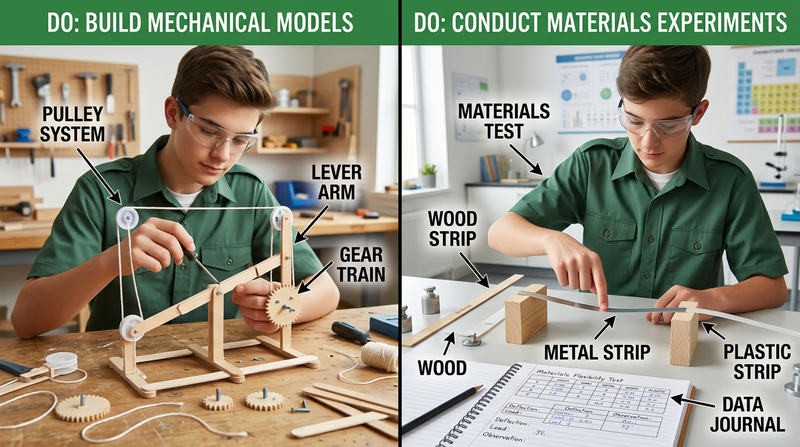
Build a simple model that demonstrates mechanical motion using levers, inclined planes, and other basic mechanisms. Great if you enjoy building things with your hands and understanding how gears, levers, and pulleys work.
Req 6b — Using Electricity
Survey the electrical appliances in your home, learn about electricity consumption and costs, and find ways to conserve energy. Ideal if you are interested in how electrical power works in everyday life.
Req 6c — Understanding Electronics
Investigate how a smartphone or tablet transmits sound, video, text, and images — and analyze its design for usability, function, and durability. Perfect if you are curious about the technology in your pocket.
Req 6d — Using Materials
Run experiments comparing the strength and heat conductivity of wood, metal, and plastic. Choose this if you enjoy hands-on experiments and want to understand why engineers choose specific materials for specific jobs.
Req 6e — Converting Energy
Design an experiment showing how energy converts between forms — mechanical, heat, chemical, solar, and electrical. A good choice if you are interested in physics and energy science.
Req 6f — Moving People
Study how people in your community get to work, conduct a traffic flow study, and propose transportation improvements. Great if you are interested in how cities work and how engineers solve large-scale problems.
Req 6g — Building an Engineering Project
Enter a science or engineering fair or participate on an engineering competition team, then discuss your experience. Choose this if you are already involved in STEM competitions or want to jump in.
Req 6a — Transforming Motion
Every machine — from a bicycle to a crane to a car engine — transforms motion. It takes force applied in one direction and converts it into useful movement in another. The six simple machines that make this possible have been used by humans for thousands of years, and they are still the building blocks of every mechanical system today.
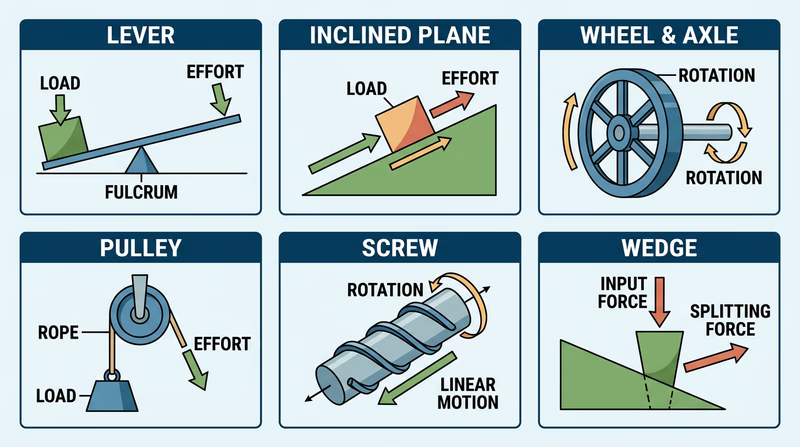
The Six Simple Machines
Before you build your model, understand the fundamental mechanisms that transform motion:
Lever
A rigid bar that pivots on a fixed point called a fulcrum. Levers multiply force or increase the distance of movement. A seesaw is a lever. So is a crowbar, a pair of scissors, and the handle on a water pump.
Inclined Plane
A flat surface tilted at an angle. It lets you raise heavy objects by spreading the effort over a longer distance. A ramp is an inclined plane. So is a loading dock, a wheelchair ramp, and a sloped driveway.
Wheel and Axle
A wheel attached to a smaller cylinder (the axle). When the wheel turns, the axle turns too — but with greater force. Doorknobs, steering wheels, and screwdrivers all use this principle.
Pulley
A wheel with a grooved rim that holds a rope or cable. A single pulley changes the direction of force (pull down to lift up). Multiple pulleys working together — called a block and tackle — multiply force, letting you lift loads much heavier than you could by hand.
Screw
An inclined plane wrapped around a cylinder. Each turn of a screw converts rotational motion into linear (straight-line) motion with great force. Jar lids, car jacks, and wood screws all use this principle.
Wedge
Two inclined planes joined back to back. Wedges convert motion in one direction into a splitting force in two directions. An axe, a knife blade, and a doorstop are all wedges.
Building Your Model
Your model should clearly show how at least two simple machines work together to transform motion. Here are project ideas:
Rube Goldberg Machine
A chain reaction device where each step triggers the next — a ball rolls down a ramp (inclined plane), hits a lever that releases a marble, which falls through a pulley system. This is a fun way to demonstrate multiple simple machines working in sequence.
Catapult or Trebuchet
A lever-based launching device. The throwing arm is a lever, and the sling acts as a force multiplier. You can build one from popsicle sticks, rubber bands, and a bottle cap.
Gear Train
Using a construction set (like LEGO Technic or K’NEX), build a gear train that shows how rotational motion can be sped up, slowed down, or reversed by connecting gears of different sizes.
Crane Model
Combine a pulley system with a lever arm and a wheel-and-axle winding mechanism. This demonstrates three simple machines working together to lift and move objects.
Model Building Steps
Follow this process- Choose which simple machines your model will demonstrate (at least two).
- Gather materials — construction set pieces, craft sticks, cardboard, string, rubber bands, or household items.
- Sketch your design before building.
- Build the model and test it.
- Identify each simple machine in your model and explain what it does.
- Find a real product that uses the same mechanism.
Connecting to Real Products
The requirement asks you to describe a real product that uses the same mechanisms as your model. Here are examples:
| Simple Machine Combination | Real Product |
|---|---|
| Lever + fulcrum | Wheelbarrow (the wheel is the fulcrum, the handles are levers) |
| Pulley + wheel and axle | Construction crane (pulleys lift the load, wheel and axle swings the boom) |
| Inclined plane + wedge | Log splitter (the wedge splits the wood, guided along an inclined track) |
| Gear train | Bicycle transmission (gears convert pedaling into wheel rotation at different speeds) |
| Lever + spring (stored energy) | Stapler (lever compresses a spring that drives a staple — a wedge — through paper) |
Req 6b — Using Electricity
Your home’s electricity bill is a mystery to most people — a number shows up, you pay it, and that is the end of the thought. But behind that number is a fascinating system of generation, transmission, and consumption that electrical engineers designed. Understanding how much electricity your appliances use gives you the power to make smarter decisions about energy.
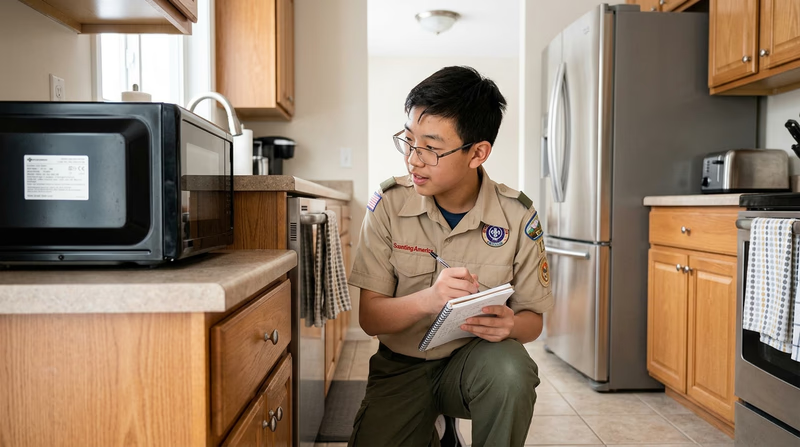
Step 1: List 10 Electrical Appliances
Walk through your home and identify 10 appliances that use electricity. Pick a variety — some that run constantly and some you use occasionally. Here is how to organize your list:
| Appliance | Location | Estimated Watts | Hours Used/Day | Monthly kWh |
|---|---|---|---|---|
| Refrigerator | Kitchen | 150 | 24 (runs ~8 hrs actively) | ~36 |
| Central AC | Whole house | 3,500 | 8 (summer average) | ~840 |
| Clothes dryer | Laundry room | 5,000 | 1 | ~150 |
| Television (55") | Living room | 100 | 5 | ~15 |
| Laptop computer | Bedroom | 50 | 6 | ~9 |
| Microwave oven | Kitchen | 1,200 | 0.25 | ~9 |
| LED light bulbs (10) | Throughout | 10 each = 100 | 6 | ~18 |
| Dishwasher | Kitchen | 1,800 | 1 | ~54 |
| Washing machine | Laundry room | 500 | 0.75 | ~11 |
| Gaming console | Bedroom | 200 | 3 | ~18 |
Note: These are approximate values. Your actual numbers will vary based on your appliances.
Step 2: Calculate Monthly Electricity Use
Electricity is measured in kilowatt-hours (kWh). One kilowatt-hour means using 1,000 watts for one hour. Here is the formula:
Monthly kWh = (Watts x Hours per Day x 30 days) / 1,000
For example, a 100-watt TV watched 5 hours per day: (100 x 5 x 30) / 1,000 = 15 kWh per month
Where to Find Wattage
- The appliance label — Look for a sticker or plate on the back or bottom listing watts, amps, or both
- The manual — Check the specifications section
- Online — Search for your appliance model number plus “wattage” or “power consumption”
- A kill-a-watt meter — This inexpensive device plugs into the wall and measures exactly how much electricity an appliance uses (about $20–$30)
Step 3: Understanding Your Electric Bill
Your electricity bill tells an engineering story. Here is what to look for:
Reading the Meter
Your electric meter measures total kWh consumed. Modern digital meters display the reading directly. Older analog meters have spinning dials you read right to left. Your utility company reads the meter each billing period and charges you for the difference.
Light Use vs. Heavy Use
Electricity use varies by season and habit:
- Heavy use periods: Summer (air conditioning), winter (electric heating), evenings (cooking, TV, lighting all at once)
- Light use periods: Spring and fall (no heating or cooling), midday when the house is empty, overnight
Some utility companies charge different rates depending on the time of day — this is called time-of-use pricing. Electricity costs more during peak hours (typically 2–7 PM on weekdays when demand is highest) and less during off-peak hours (nights and weekends).
Step 4: Five Ways to Conserve Electricity
Here are proven strategies — pick five that apply to your home and explain why each one works:
Switch to LED bulbs — LEDs use 75% less electricity than incandescent bulbs and last 25 times longer. Replacing 10 incandescent 60-watt bulbs with 10-watt LEDs saves about 45 kWh per month.
Unplug “vampire” devices — Many electronics draw power even when turned off (TVs, game consoles, chargers). This phantom load can account for 5–10% of your electricity bill. Use a power strip and switch it off when devices are not in use.
Use a programmable thermostat — Heating and cooling typically account for about half of a home’s electricity use. Setting the thermostat back 7–10 degrees for 8 hours a day can save up to 10% annually.
Wash clothes in cold water — About 90% of the energy a washing machine uses goes to heating the water. Modern detergents work just as well in cold water.
Air-dry dishes and clothes — Skip the dryer’s heated drying cycle in the dishwasher. Hang clothes on a line or drying rack instead of using the clothes dryer, which is one of the most energy-hungry appliances in any home.
Upgrade old appliances — ENERGY STAR certified appliances use 10–50% less energy than standard models. A new ENERGY STAR refrigerator uses about half the electricity of one made 15 years ago.
Use natural light — Open curtains and blinds during the day instead of turning on lights. Position desks and reading areas near windows.
Req 6c — Understanding Electronics
When you send a text message, it leaves your phone as a radio signal, hits a cell tower a mile away, travels through fiber-optic cables at the speed of light, bounces between data centers, and arrives on your friend’s phone — all in under a second. The engineering behind this journey involves electronics, telecommunications, software, and materials science all working together.
How Data Travels
Sound (Voice Calls and Voice Messages)
Your voice creates pressure waves in the air. Your phone’s microphone converts these pressure waves into an electrical signal — a rapidly changing voltage that mirrors the pattern of your voice. The phone’s processor then digitizes the signal, converting it from a continuous analog wave into a stream of numbers (binary data — ones and zeros).
This digital data is compressed (made smaller so it transmits faster) and sent as radio waves to the nearest cell tower. From there, the data travels through fiber-optic cables and network switches to the recipient’s cell tower, which sends it wirelessly to their phone. Their phone reverses the process: digital data becomes an electrical signal, and the speaker converts that signal back into sound waves your ear can hear.
Text Messages
Text is already digital — each letter, number, and emoji is assigned a numeric code (using a system called Unicode). When you type “Hello,” your phone converts those five characters into their numeric codes, packages them with addressing information (your phone number, the recipient’s number, a timestamp), and sends the package to the cell tower. The network routes the package to the correct destination, and the recipient’s phone decodes the numbers back into readable text.
Images and Video
A digital image is a grid of tiny colored dots called pixels. Your phone’s camera sensor captures light and records the color and brightness of each pixel. A typical smartphone photo contains 12 million pixels, which would create an enormous file — so the phone compresses the image (JPEG compression discards visual details your eye won’t miss) to shrink the file size by 90% or more.
Video works the same way, except it is a rapid sequence of images (typically 30 or 60 per second) combined with a synchronized audio track. Video compression is even more aggressive — it stores only the changes between frames, dramatically reducing the amount of data that needs to travel.
The Wireless Journey
All of this data — voice, text, images, video — reaches the cell tower via radio waves. Your phone transmits on specific frequencies assigned by the FCC. Modern phones use 4G LTE or 5G networks, which can transmit data at speeds fast enough to stream high-definition video in real time.
Designed for People: Ease of Use
Electronics engineers and industrial designers spend enormous effort making devices intuitive. For your phone or tablet, consider:
Touchscreen Interface
The capacitive touchscreen detects the electrical charge in your fingertip. Engineers designed the screen to respond to taps, swipes, pinches, and long presses — all without physical buttons. The goal: anyone can pick up the device and figure out the basics without reading a manual.
Display Quality
Modern phone screens pack over 400 pixels per inch — more than the human eye can distinguish at normal viewing distance. Engineers chose OLED or LCD technology, calibrated color accuracy, and designed auto-brightness sensors that adjust to ambient light.
Audio Design
Speakers, microphones, and noise-cancellation algorithms are engineered to deliver clear sound in noisy environments. The placement of microphones and speakers is carefully chosen based on how people naturally hold the device.
Designed to Work: Function
Engineers design smartphones to perform hundreds of functions reliably:
- Processor speed — The CPU handles billions of calculations per second, running apps, processing photos, and managing network connections simultaneously
- Battery management — Power management circuits balance performance with battery life, throttling the processor when full speed is not needed
- Thermal design — Heat sinks and thermal paste prevent the processor from overheating inside a sealed case
- Antenna design — Multiple antennas (cellular, Wi-Fi, Bluetooth, GPS, NFC) are crammed into a slim body without interfering with each other
Designed to Last: Durability
Consumer electronics face daily abuse — drops, water, dust, temperature swings. Engineers address durability through:
| Durability Feature | Engineering Solution |
|---|---|
| Drop resistance | Gorilla Glass or ceramic shield on the screen; aluminum or titanium frame |
| Water resistance | Rubber gaskets, adhesive seals, IP67/IP68 ratings |
| Dust protection | Sealed ports, mesh filters over speakers and microphones |
| Scratch resistance | Hardened glass rated 6+ on the Mohs hardness scale |
| Battery longevity | Charge management software that avoids stressing the battery |

Req 6d — Using Materials
An engineer designing a cooking pot chooses metal because it conducts heat quickly and evenly. The same engineer puts a plastic handle on the pot because plastic is a terrible heat conductor — which means it stays cool enough to grab. The pot sits on a wooden cutting board because wood insulates the countertop from heat and resists scratching. Every material choice in engineering is a deliberate decision based on properties like strength, heat conductivity, weight, and cost.
Understanding Material Properties
Before running your experiments, understand the two properties you are testing:
Strength
Strength describes how much force a material can resist before it bends, breaks, or deforms permanently. Different materials resist force in different ways:
- Tensile strength — Resistance to being pulled apart (stretching)
- Compressive strength — Resistance to being crushed (squeezing)
- Flexural strength — Resistance to bending
For your experiments, you will primarily test flexural strength — how much a sample bends before breaking.
Heat Conductivity
Heat conductivity (also called thermal conductivity) measures how quickly heat flows through a material. Metals conduct heat very well — that is why a metal spoon left in hot soup gets too hot to touch. Wood and most plastics are poor heat conductors — they are insulators.
| Material | Heat Conductivity | Strength | Common Engineering Uses |
|---|---|---|---|
| Metal (steel) | Very high | Very high | Structural beams, tools, machinery, cookware |
| Metal (aluminum) | High | Moderate | Aircraft, beverage cans, heat sinks |
| Wood (oak) | Low | Moderate | Furniture, construction framing, flooring |
| Plastic (PVC) | Very low | Low to moderate | Pipes, insulation, packaging, housings |
| Plastic (nylon) | Very low | Moderate | Gears, bearings, cable ties |
Experiment 1: Testing Strength
Materials Needed
- Samples of wood, metal, and plastic of similar dimensions (e.g., thin strips about 6 inches long)
- Two supports of equal height (books, blocks, or cans)
- A small container (cup or bag) and weights (coins, marbles, or washers)
- A ruler
- A notebook to record results
Procedure
- Set up two supports about 4 inches apart
- Place each material sample as a bridge between the supports
- Hang or place the weight container in the center of the bridge
- Gradually add weight, recording how much the sample deflects (bends) at each increment
- Note the weight at which the sample bends permanently or breaks
- Repeat for all three materials
What to Observe
- Which material held the most weight before bending?
- Which material returned to its original shape after the weight was removed (elastic behavior)?
- Which material broke suddenly versus bending gradually?
Experiment 2: Testing Heat Conductivity
Materials Needed
- Samples of wood, metal, and plastic (spoons or rods of similar size work well)
- A cup of hot water (not boiling — hot tap water is sufficient and safer)
- A thermometer (optional but helpful)
- A timer
- Small dabs of butter or wax at the top end of each sample
Procedure
- Place a small dab of butter at the same point near the top of each sample
- Stand all three samples upright in a cup of hot water at the same time
- Start the timer
- Watch which butter dab melts first — this indicates the fastest heat conductor
- Record the time it takes for each butter dab to melt (or to begin melting after 5 minutes)
What to Observe
- The metal sample should conduct heat fastest — the butter melts quickly
- The plastic and wood samples should conduct heat much more slowly
- The order from fastest to slowest conductor should be: metal > wood > plastic (though wood and plastic are often close)
Why Engineers Care About Material Properties
The experiments you just ran are simplified versions of tests that materials engineers perform every day. When an engineer selects a material for a product, they consider dozens of properties:
- Strength-to-weight ratio — Aerospace engineers need materials that are both strong and light. Aluminum and carbon fiber composites win here.
- Corrosion resistance — Bridge engineers need materials that will not rust in rain and salt. Stainless steel and concrete are common choices.
- Cost — A material that is perfect in every way but costs 10 times more than an alternative may not be practical. Engineers balance performance with budget.
- Machinability — Can the material be easily cut, shaped, and joined? Some advanced materials are incredibly strong but nearly impossible to machine.
Discussing Your Results
When you talk with your counselor, be ready to explain:
- What you tested and how you set up each experiment
- Your results — which material was strongest? Which conducted heat best?
- Why the results make sense — connect your observations to the material’s structure (metals have tightly packed atoms that transmit both force and heat efficiently; plastics have long, flexible polymer chains that absorb force and block heat)
- Real-world applications — why is a frying pan metal but its handle is plastic? Why are house frames wood but the nails are steel?

Req 6e — Converting Energy
Rub your hands together vigorously for ten seconds. Your palms get warm. You just converted mechanical energy (the motion of your hands) into heat energy (the warmth you feel). Energy conversion is happening all around you, all the time — your body converts chemical energy from food into motion and heat, a light bulb converts electrical energy into light and heat, and a solar panel converts light energy into electrical energy.
What Is Energy?
Energy is the ability to do work — to make something move, change temperature, or change form. Energy cannot be created or destroyed (this is the First Law of Thermodynamics), but it can be converted from one form to another. Every machine, every engine, and every living thing is an energy conversion device.
Forms of Energy
| Form | What It Is | Examples |
|---|---|---|
| Mechanical | Energy of motion or position | A spinning wheel, a stretched rubber band, a ball at the top of a hill |
| Heat (Thermal) | Energy from the vibration of atoms and molecules | A campfire, body warmth, friction |
| Chemical | Energy stored in molecular bonds | Food, gasoline, batteries, wood |
| Electrical | Energy from the flow of electrons | Lightning, wall outlets, batteries powering devices |
| Solar (Radiant) | Energy carried by electromagnetic waves | Sunlight, infrared radiation, radio waves |
| Nuclear | Energy stored in atomic nuclei | Nuclear power plants, the sun |
Experiment Ideas
Choose an experiment that clearly demonstrates energy converting from one form to another. Here are options ranked by complexity:
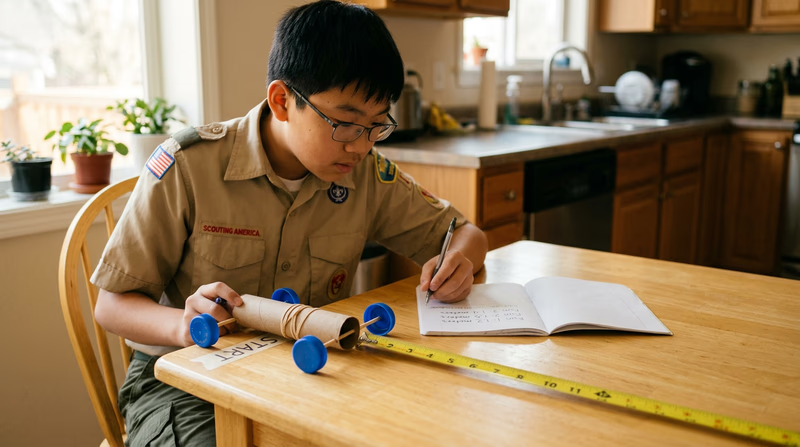
Simple: Rubber Band Car (Chemical → Mechanical)
A rubber band stores elastic potential energy (a form of mechanical energy) when twisted. When released, it converts to kinetic energy (motion). Build a simple car from a cardboard tube, wooden skewers for axles, bottle caps for wheels, and a rubber band for power. Wind the rubber band by rolling the car backward, then release.
Energy chain: Chemical energy (in the rubber’s molecular bonds) → Elastic potential energy (twisted rubber band) → Kinetic/mechanical energy (car moves forward) → Heat energy (friction slows the car)
Moderate: Solar Water Heater (Solar → Heat)
Line a small box with aluminum foil and place a sealed black container of water inside. Cover the top with clear plastic wrap to create a greenhouse effect. Place it in direct sunlight for an hour and measure the water temperature before and after.
Energy chain: Solar energy (sunlight) → Heat energy (water temperature rises)
Moderate: Mousetrap Car (Mechanical → Mechanical)
Build a car powered by a mousetrap. The spring stores elastic potential energy. When triggered, the spring arm pulls a string attached to the rear axle, converting stored energy into rotational motion.
Energy chain: Mechanical energy (compressed spring) → Mechanical energy (car moves) → Heat energy (friction)
Advanced: Thermoelectric Generator (Heat → Electrical)
A Peltier module (available online for a few dollars) generates a small electrical current when one side is heated and the other is cooled. Place one side on a cup of hot water and the other on a cup of ice water, then connect an LED light.
Energy chain: Heat energy (hot water) → Electrical energy (Peltier effect) → Light energy (LED glows)
Explaining Your Results
After your experiment, be prepared to answer these questions:
- What forms of energy were involved? Identify the starting form and the ending form(s).
- Was any energy “lost”? Energy is never truly lost, but it often converts to heat through friction or inefficiency. Identify where this happens in your experiment.
- How efficient was the conversion? Did most of the input energy convert to useful output, or was a lot lost as waste heat?
Energy Conversion in Your Surroundings
Look around your home and identify energy conversions happening right now:
- Stove burner: Chemical energy (natural gas) → Heat energy → Heat energy in food
- Ceiling fan: Electrical energy → Mechanical energy (spinning blades) → Kinetic energy (moving air)
- Phone charger: Electrical energy → Chemical energy (stored in battery)
- Solar garden lights: Solar energy → Electrical energy → Chemical energy (battery) → Electrical energy → Light energy
- Your body: Chemical energy (food) → Mechanical energy (muscle movement) + Heat energy (body warmth)
Every device in your home is an energy converter. The engineering challenge is always the same: convert energy from one useful form to another as efficiently as possible, with minimum waste.
Req 6f — Moving People
Every morning, millions of people across the country are solving the same problem at the same time: how do I get from where I am to where I need to be? Transportation engineers design the roads, traffic signals, transit systems, sidewalks, and bike lanes that make this possible. When traffic flows smoothly, people barely notice. When it doesn’t — gridlock, missed buses, dangerous intersections — the failure of engineering is painfully obvious.
Part 1: How People Get to Work
Start by researching the transportation options in your community. Not every community has all of these, and that is part of the story:
Personal Vehicles
Cars and trucks are the dominant mode of transportation in most American communities. According to the U.S. Census Bureau, about 76% of American workers drive to work alone. Another 9% carpool. Personal vehicles offer flexibility but create congestion, require parking infrastructure, and produce emissions.
Public Transit
Buses, subways, commuter trains, light rail, and streetcars serve denser communities. Public transit moves more people per lane of road than private cars and reduces congestion in urban areas. About 5% of American workers use public transit, but in cities like New York, that number exceeds 50%.
Active Transportation
Walking and cycling account for a small but growing share of commutes — about 3.5% nationally. Communities with good sidewalks, bike lanes, and shorter distances between homes and workplaces see higher rates. Active transportation produces zero emissions and improves public health.
Remote Work
Since 2020, working from home has become a significant factor in commuting patterns. Some workers have eliminated the commute entirely, reducing traffic for everyone else.
Part 2: Traffic Flow Study
This is where you do real engineering observation. You will measure traffic volume and speed at a specific location during heavy and light traffic periods.
Choosing Your Location
Pick a spot that is:
- Safe — You must be able to observe from a sidewalk, yard, or other safe location away from traffic
- Observable — You can see vehicles clearly and count them accurately
- Variable — Traffic volume changes noticeably between rush hour and off-peak times
Good choices: an intersection near your home, the road in front of your school, or a main road through your neighborhood.
What to Measure
Traffic volume: Count the number of vehicles passing your observation point in a fixed time period (15 minutes works well). Record separately for each direction if possible.
Relative speed: You don’t need a radar gun. Estimate whether vehicles are moving at full speed, slowing down, stop-and-go, or stopped. A simple scale works:
| Speed Rating | Description |
|---|---|
| Free flow | Vehicles moving at or near the speed limit |
| Light congestion | Slightly below speed limit, occasional slowing |
| Moderate congestion | Well below speed limit, frequent stops |
| Heavy congestion | Stop-and-go, long waits at intersections |
When to Observe
Do at least two observation sessions:
- Heavy traffic — Morning rush (7:00–8:30 AM) or evening rush (4:30–6:00 PM) on a weekday
- Light traffic — Weekend morning, mid-morning on a weekday, or early afternoon
Recording Your Data
| Time Period | Direction | Vehicles/15 min | Speed Rating | Notes |
|---|---|---|---|---|
| Mon 7:30 AM | Northbound | 87 | Moderate congestion | Long backup at Main St light |
| Mon 7:30 AM | Southbound | 34 | Free flow | |
| Sat 10:00 AM | Northbound | 22 | Free flow | |
| Sat 10:00 AM | Southbound | 18 | Free flow |
Part 3: Suggesting Improvements
Based on your observations, think about what could make transportation in your community work better. Consider these engineering solutions:
- Signal timing optimization — Are traffic lights efficiently managing the flow, or do they create unnecessary delays?
- Turn lanes or roundabouts — Would dedicated turn lanes or a roundabout reduce congestion at a busy intersection?
- Sidewalks and crosswalks — Are there safe, connected paths for pedestrians?
- Bike infrastructure — Would bike lanes encourage more cycling and reduce car traffic?
- Public transit access — Are bus stops conveniently located? Are schedules frequent enough to be useful?
- Speed management — Would speed bumps or narrower lanes improve safety on residential streets?

Req 6g — Building an Engineering Project
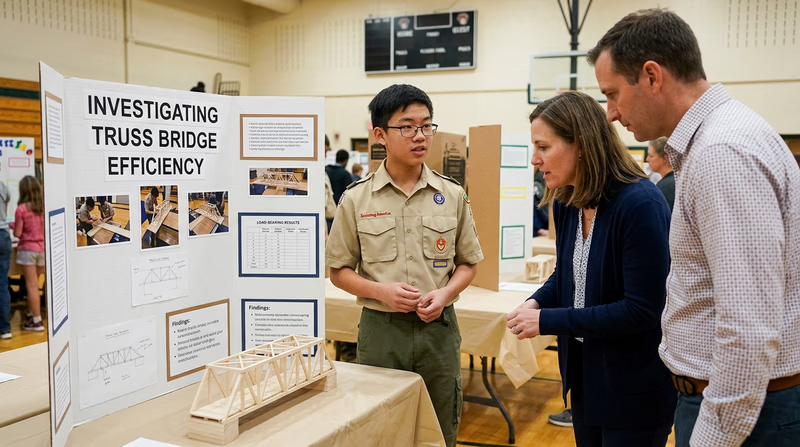
Science and engineering fairs are where you stop learning about engineering and start doing engineering. You identify a problem, design a solution, build it, test it, and then explain your work to judges and visitors. It is the same process professional engineers follow — just scaled to your level.
Finding a Competition
You have several options for meeting this requirement:
Science and Engineering Fairs
- School science fairs — Most middle and high schools hold annual fairs. Projects advance from school to district, regional, state, and even international levels.
- Regeneron International Science and Engineering Fair (ISEF) — The world’s largest pre-college STEM competition, affiliated with the Society for Science.
- Local and regional fairs — Many communities hold their own fairs open to all students.
Engineering Competitions
The requirement specifically allows participation on an engineering competition team. Popular options include:
- FIRST Robotics — Build and program robots to compete in annual challenges. Teams of 25+ students work with professional mentors.
- Science Olympiad — Teams compete in 23 events spanning engineering, biology, chemistry, physics, and earth science. Many events involve building devices.
- Destination Imagination — Teams solve open-ended challenges combining engineering, creativity, and teamwork.
- Model Bridge Building — Design and construct a bridge from balsa wood that holds the maximum weight.
- Mousetrap Vehicle — Build a vehicle powered solely by a mousetrap that travels the farthest distance.
Choosing a Project
If you are entering a science or engineering fair, your project should demonstrate a clear engineering concept. Strong projects share these traits:
- They solve a real problem — “How can I filter water using only materials found in nature?” is stronger than “I built a volcano.”
- They test a hypothesis or optimize a design — Engineering projects should involve testing different approaches and measuring which works best.
- They are original — Judges value creative thinking. Your project does not need to be groundbreaking, but it should show your own ideas.
Project Ideas
- Design and test a bridge made from spaghetti or popsicle sticks — optimize for maximum load
- Build a water filtration system and test its effectiveness with different filter materials
- Create an egg drop device and test different designs for impact absorption
- Design a solar oven and measure its cooking efficiency
- Build a wind turbine and test different blade designs for maximum power generation
Preparing for Questions
The second part of this requirement focuses on communicating your engineering work. At fairs and competitions, judges and visitors will ask questions to understand what you did and why.
Common Questions and How to Prepare
| Question Type | Example | How to Prepare |
|---|---|---|
| Purpose | “What problem does your project solve?” | Write a clear, one-sentence problem statement |
| Process | “How did you build this?” | Be ready to walk through your design steps |
| Results | “What did you find out?” | Have data and measurements ready to share |
| Challenges | “What was the hardest part?” | Reflect on setbacks and how you overcame them |
| Improvements | “What would you do differently?” | Every project has room to improve — be honest |
| Application | “How could this be used in the real world?” | Connect your project to real engineering applications |
Presentation Skills
- Practice explaining your project in 2 minutes — Visitors have short attention spans
- Use visual aids — Posters, diagrams, or the project itself help people understand quickly
- Speak with confidence — You know your project better than anyone in the room
- It is okay to say “I don’t know” — If a judge asks something you haven’t considered, say so honestly and explain how you would find out
Reflecting on the Experience
After the competition, think about what you will discuss with your counselor:
- What your project demonstrates — What engineering principle or concept does it show?
- Questions visitors asked — Which questions came up most often? Were any unexpected?
- How well you answered — Where were you confident? Where did you struggle to explain?
- What you learned — Not just about engineering, but about communicating technical ideas to non-experts
Competition Preparation
Get ready to compete- Identify a competition or fair to enter and note the registration deadline.
- Choose or develop your project concept.
- Follow the competition’s rules for project format, display, and safety.
- Build and test your project, documenting your process.
- Prepare a display board or presentation materials.
- Practice explaining your project in under 2 minutes.
- Anticipate questions and prepare answers.
- After the event, reflect on the experience for your counselor discussion.
Req 7 — Professional Engineer Registration
Anyone can call themselves a “software developer” or a “data scientist.” But you cannot legally call yourself a Professional Engineer without earning the title. The P.E. designation is a state-issued license — like a medical license for doctors or a bar admission for lawyers — that proves an engineer has met rigorous education, experience, and examination requirements. It is the engineering profession’s guarantee to the public that this person is qualified to do work that affects public safety.
What Is P.E. Registration?
A Professional Engineer (P.E.) is an engineer who has been licensed by a state board of registration. The license grants legal authority to:
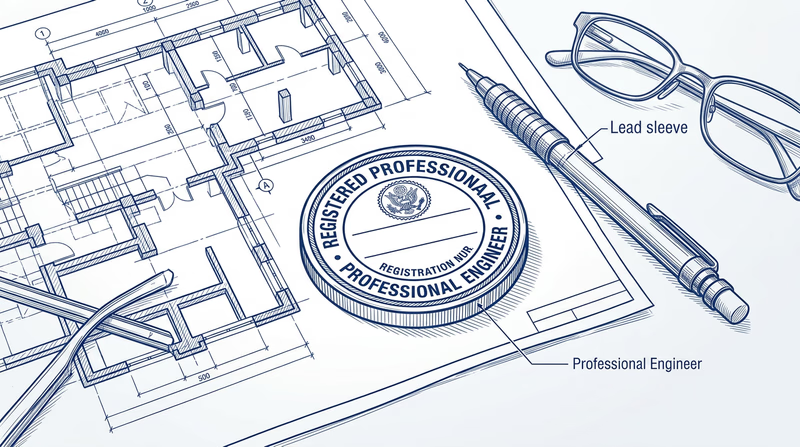
- Sign and seal engineering documents — P.E.s stamp drawings, reports, and plans to certify that the work meets professional standards and complies with codes
- Offer engineering services to the public — In most states, only a licensed P.E. can offer engineering services directly to the public
- Take legal responsibility — A P.E.’s stamp means they accept personal accountability for the engineering work. If a bridge fails or a building collapses, the P.E. who sealed the plans can be held legally liable.
The Path to P.E. Licensure
Becoming a P.E. is a multi-year process:
- Earn a degree — Complete a bachelor’s degree from an ABET-accredited engineering program (typically four years)
- Pass the FE exam — Take the Fundamentals of Engineering (FE) exam, usually during your senior year of college. This is a 6-hour test covering math, science, and engineering fundamentals. Passing it earns you the title Engineer Intern (EI) or Engineer-in-Training (EIT).
- Gain experience — Work under the supervision of a licensed P.E. for at least four years, gaining progressive engineering responsibility
- Pass the PE exam — Take the Principles and Practice of Engineering (PE) exam, an 8-hour test in your specific discipline. This exam tests advanced knowledge and real-world engineering judgment.
- Maintain the license — Complete continuing education requirements to keep the license current (requirements vary by state)
Where P.E. Registration Matters Most
Not all engineering work requires a P.E. license. The requirement is strongest in fields where engineering decisions directly affect public safety.
Civil Engineering
This is where P.E. registration is most critical. Civil engineers who design buildings, bridges, highways, dams, and water systems must be licensed. Every set of structural drawings submitted to a building department must bear a P.E. stamp. If you want to design a bridge that thousands of people cross daily, you must be a P.E.
Structural Engineering
Closely related to civil engineering, structural engineers analyze and design load-bearing structures. P.E. licensure is essentially mandatory — no one builds a skyscraper, stadium, or parking garage from plans that haven’t been sealed by a licensed structural engineer.
Environmental Engineering
Engineers who design water treatment plants, wastewater systems, and environmental remediation projects must typically be licensed. These systems directly affect public health.
Electrical Engineering (Power Systems)
Electrical engineers who design power distribution systems for buildings and facilities often need P.E. licensure, especially for commercial and industrial projects subject to building codes.
Fire Protection Engineering
Engineers who design sprinkler systems, fire alarm systems, and smoke control systems in buildings must be licensed in most jurisdictions.
Mechanical Engineering (Building Systems)
Mechanical engineers who design HVAC (heating, ventilation, and air conditioning) systems for commercial buildings frequently need licensure to stamp their designs.
Fields Where P.E. Is Less Common
In some engineering fields, P.E. licensure is less common — not because it is less valuable, but because the work is typically done within companies rather than offered directly to the public:
- Aerospace engineering — Work is primarily done within large companies (Boeing, NASA, SpaceX) under internal quality assurance systems
- Software engineering — Currently no state requires P.E. licensure for software, though some argue it should be required for safety-critical software
- Manufacturing engineering — Industrial work is generally regulated through company processes rather than individual licensure
Why P.E. Registration Matters
Beyond legal requirements, P.E. registration carries practical benefits:
- Career advancement — Many senior engineering positions, especially in consulting firms and government agencies, require P.E. licensure
- Higher earnings — Licensed P.E.s typically earn 10–15% more than unlicensed engineers with similar experience
- Independence — Only P.E.s can start their own engineering consulting firms and offer services directly to the public
- Professional recognition — The P.E. license is recognized across all 50 states through reciprocity agreements
Req 8 — The Engineer's Code of Ethics
In January 1986, engineers at Morton Thiokol told NASA that the rubber O-ring seals on the Space Shuttle Challenger’s solid rocket boosters could fail in cold temperatures. Launch morning was 36 degrees Fahrenheit — well below the seals’ tested range. Management overruled the engineers and launched anyway. Seventy-three seconds later, Challenger broke apart. Seven crew members died. The Challenger disaster became the defining case study in engineering ethics — a catastrophic example of what happens when ethical engineering judgment is compromised by schedule pressure.
Ethics are not abstract principles for engineers. They are life-and-death decisions.
The NSPE Code of Ethics for Engineers
The National Society of Professional Engineers (NSPE) maintains the most widely recognized code of ethics for the profession. Here are its six fundamental canons — the core rules every engineer is expected to follow:
- Hold paramount the safety, health, and welfare of the public.
- Perform services only in areas of their competence.
- Issue public statements only in an objective and truthful manner.
- Act for each employer or client as faithful agents or trustees.
- Avoid deceptive acts.
- Conduct themselves honorably, responsibly, ethically, and lawfully.
The first canon is the most important: public safety comes first, always. If an engineer discovers that a design is unsafe, they have an ethical obligation to speak up — even if it means delaying a project, losing a client, or facing professional consequences.
Connecting the Code to the Scout Oath
The Scout Oath states: “On my honor I will do my best to do my duty to God and my country and to obey the Scout Law; to help other people at all times; to keep myself physically strong, mentally awake, and morally straight.”
| Scout Oath Principle | Engineering Code Parallel |
|---|---|
| “On my honor” | Canon 6 — Conduct themselves honorably |
| “Do my duty to my country” | Canon 1 — Hold paramount public safety and welfare |
| “Help other people at all times” | Canon 1 — Engineers serve the public, not just their employers |
| “Morally straight” | Canon 5 — Avoid deceptive acts |
The Scout Oath’s commitment to being “morally straight” maps directly to the engineering code’s emphasis on honesty and integrity. Both recognize that trust is earned through consistent ethical behavior, not just good intentions.
Connecting the Code to the Scout Law
The twelve points of the Scout Law parallel specific engineering ethics principles:
Trustworthy
Engineers must be trusted with public safety. When a P.E. stamps a set of plans (as you learned in Req 7), they are saying “I stake my professional reputation on this being safe.” Trustworthiness is the foundation of the engineering profession.
Loyal
Canon 4 requires engineers to act as “faithful agents” for their employers and clients — but loyalty to the public always comes first. If an employer asks an engineer to cut corners on safety, the engineer’s loyalty to the public overrides loyalty to the employer.
Helpful
Engineers solve problems that help people. From designing clean water systems in developing countries to creating medical devices that save lives, the engineering profession exists to improve the human condition.
Obedient
Engineers must obey laws, building codes, and professional standards. Canon 6 explicitly requires engineers to conduct themselves “lawfully.”
Brave
Speaking up when you discover a safety problem takes courage — especially when it means disagreeing with your boss or delaying a profitable project. The Challenger engineers were brave enough to raise concerns; the tragedy happened because their managers were not brave enough to listen.
Clean
Engineers must avoid conflicts of interest and “deceptive acts” (Canon 5). A clean professional reputation means never accepting bribes, kickbacks, or gifts that might compromise your engineering judgment.
Ethics in Practice
Engineering ethics are not just rules on paper. Here are real scenarios where the code applies:
Preparing for Your Counselor Discussion
When explaining how the Engineer’s Code of Ethics connects to the Scout Oath and Law:
- Don’t just list parallels — Explain why they overlap. Both exist because trust matters. People trust that bridges won’t collapse and that Scouts will do the right thing.
- Use real examples — The Challenger disaster, building collapses from corrupt construction practices, or the Flint water crisis all illustrate why ethics in engineering matter.
- Show that you understand the priority — Both the Scout Oath and the Engineering Code put service to others above personal gain. A Scout helps other people; an engineer holds public safety paramount.
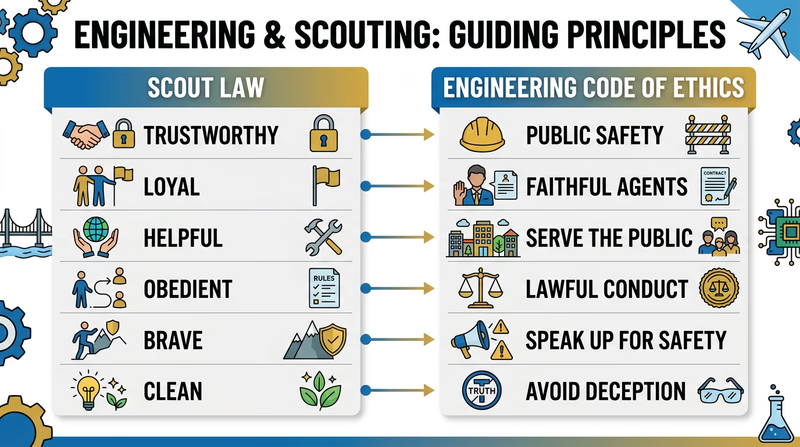
Req 9 — Exploring Engineering Careers
Engineering is consistently ranked among the most rewarding career paths in the country — combining strong salaries, job security, and the satisfaction of building things that matter. But “engineer” is not one career; it is dozens of specialties, each with its own education path, work environment, and career trajectory. This requirement asks you to research one specific engineering career in depth.
Choosing a Career to Research
In Req 3, you learned about different types of engineers. Now pick one to research in detail. Consider which activities you enjoyed most in this badge:
- Loved taking things apart? → Mechanical engineering or aerospace engineering
- Fascinated by electricity experiments? → Electrical engineering or computer engineering
- Enjoyed the traffic study? → Civil engineering or transportation engineering
- Interested in the materials experiments? → Materials science engineering or chemical engineering
- Drawn to the ethics discussion? → Biomedical engineering or environmental engineering (fields where ethical decisions are especially consequential)
What to Research
The requirement lists six specific areas. Here is how to find reliable information for each:
Training and Education
Most engineering careers require a bachelor’s degree in engineering (four years at a college or university). Key details to research:
- What specific degree is needed? (B.S. in Mechanical Engineering, B.S. in Electrical Engineering, etc.)
- Must the program be ABET-accredited? (For P.E. licensure, yes — as you learned in Req 7)
- Is a master’s degree common or required? (Some specialties, like structural engineering, strongly favor graduate degrees)
- What prerequisite courses are important in high school? (Math through calculus, physics, chemistry, computer science)
Costs
Research the cost of an engineering education:
- Public university tuition — Typically $10,000–$20,000 per year for in-state students
- Private university tuition — Can range from $40,000–$60,000+ per year
- Scholarships — Many engineering scholarships are available, including from professional societies like NSPE, ASME, and IEEE
- Return on investment — Engineering graduates typically have among the highest starting salaries of any bachelor’s degree, which helps offset education costs
Job Prospects
Look up employment outlook data:
- Is this field growing? How fast?
- How many job openings are projected in the coming decade?
- Are certain geographic regions stronger for this field?
- Is the field affected by automation or outsourcing?
Salary
Research typical compensation:
- Entry-level salary — What do new graduates earn?
- Median salary — What does a mid-career engineer in this field earn?
- Senior/leadership salary — What can experienced engineers or engineering managers earn?
Job Duties
Describe what a typical workday looks like:
- Where do they work? (Office, lab, factory floor, construction site, outdoors)
- What tools and software do they use?
- How much teamwork versus independent work?
- How much time is spent at a desk versus hands-on?
Career Advancement
How does a career in this field progress?
- Junior engineer → Senior engineer → Lead engineer → Engineering manager or Technical specialist
- Does P.E. licensure help advance? (In civil and structural engineering, absolutely)
- What about specialization versus management tracks?
Research Methods
Use at least two of these approaches:
Internet or Library Research
- Bureau of Labor Statistics (bls.gov/ooh) — Authoritative career data
- Professional society websites — ASME (mechanical), IEEE (electrical), ASCE (civil), AIChE (chemical)
- University engineering department websites — Curriculum details and career placement data
- Library databases — Ask a librarian about career research databases
Interview with a Professional
If you met an engineer during Req 4, ask follow-up questions about their career path. You might also reach out to:
- Engineers in your community
- University professors
- Professionals through LinkedIn (with parent/guardian supervision)
Workplace Visit
- Manufacturing plants and factories
- Construction sites (observation only, with permission)
- Engineering consulting offices
- Research laboratories
Example Career Profile: Civil Engineer
Here is an example to show the depth your counselor will expect:
| Category | Details |
|---|---|
| Education | B.S. in Civil Engineering (4 years, ABET-accredited) |
| Cost | ~$40,000–$100,000+ total (varies by school; many scholarships available) |
| Median Salary | ~$89,940 per year (2023 BLS data) |
| Entry-Level Salary | ~$62,000 per year |
| Job Outlook | 5% growth (2022–2032), about average for all occupations |
| Key Duties | Design infrastructure, analyze survey data, manage construction projects, ensure code compliance |
| Advancement | EIT → P.E. → Senior Engineer → Project Manager → Principal/Partner |
Career Research Checklist
Make sure you cover everything- Choose one specific engineering career to research.
- Research training and education requirements.
- Find out education costs and available scholarships.
- Look up job prospects and employment outlook.
- Research salary ranges (entry-level, median, senior).
- Describe typical job duties and work environment.
- Understand the career advancement path.
- Use at least two research methods (internet, interview, visit).
- Prepare to discuss what makes this career interesting to you.
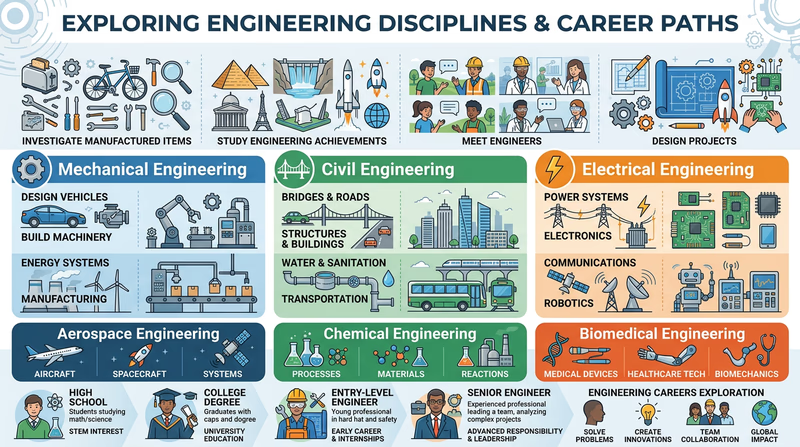
Extended Learning
A. Beyond the Badge
You have investigated how manufactured items work, researched engineering achievements that changed civilization, met a working engineer, designed your own project using the systems engineering approach, and explored ethics, careers, and hands-on engineering activities. That is a solid foundation in engineering thinking — the ability to look at any problem and ask, “How can I solve this systematically?”
But the Engineering merit badge is a starting line, not a finish line. The sections below take you deeper into areas where engineering meets real-world challenges.
B. 3D Printing and Rapid Prototyping
In Req 5, you learned the systems engineering approach and built a prototype. Rapid prototyping technology — especially 3D printing — has transformed how engineers move from concept to physical object. Instead of spending weeks machining a prototype in a workshop, an engineer can design a part on screen in the morning and hold it in their hands by afternoon.
How 3D Printing Works
The most common 3D printing method, Fused Deposition Modeling (FDM), works like a very precise hot glue gun. A spool of plastic filament (usually PLA or ABS) feeds through a heated nozzle that melts the plastic and deposits it layer by layer. Each layer is typically 0.1 to 0.3 millimeters thick — about the thickness of a sheet of paper. Hundreds or thousands of layers build up into a solid three-dimensional object.
Other methods include Stereolithography (SLA), which uses a UV laser to harden liquid resin layer by layer, and Selective Laser Sintering (SLS), which fuses powder material with a laser. Industrial versions can print in metal, ceramic, carbon fiber composites, and even food.
Getting Started
You do not need to own a 3D printer to start designing:
- Tinkercad (tinkercad.com) — Free, browser-based CAD software designed for beginners. Drag and drop shapes to build 3D models.
- Fusion 360 (autodesk.com) — Free for students and hobbyists. More powerful than Tinkercad, with simulation and analysis tools that professional engineers use.
- Library and maker space printers — Many public libraries now have 3D printers available for public use, often for free or a small materials fee.
3D printing teaches you the full engineering cycle in miniature: design, prototype, test, redesign. When your first print does not fit together properly, you adjust the dimensions and print again. That iterative process — the same one James Dyson used 5,127 times (as you read in Req 5) — is the heartbeat of engineering.
Tinkercad — Free 3D Design for Everyone Autodesk's free, browser-based 3D modeling tool designed for beginners — no download required. Perfect for learning CAD and preparing designs for 3D printing. Link: Tinkercad — Free 3D Design for Everyone — https://www.tinkercad.com/C. Engineering for Disaster Relief
When earthquakes, hurricanes, floods, or wildfires strike, engineers are among the first professionals called into action — not just to rebuild, but to save lives during the crisis itself. Disaster engineering is a field where every decision matters urgently and the consequences of mistakes are measured in human lives.
What Disaster Engineers Do
After a natural disaster, structural engineers assess damaged buildings to determine which are safe to enter and which must be demolished. Civil engineers design temporary bridges, roads, and water systems. Environmental engineers ensure drinking water is safe and sewage systems are functioning. Electrical engineers restore power infrastructure. Mechanical engineers deploy and maintain generators, water pumps, and heavy equipment.
Engineers Without Borders
Engineers Without Borders USA (EWB-USA) sends volunteer engineering teams to communities around the world to build sustainable infrastructure — clean water systems, sanitation facilities, bridges, and renewable energy installations. Student chapters at universities let college-age engineers participate in real projects during their studies.
Designing for Resilience
Modern disaster engineering focuses on resilience — designing structures and systems that survive disasters rather than just being rebuilt afterward. Examples include earthquake-resistant buildings in Japan that sway with seismic waves instead of fighting them, and levee systems in the Netherlands engineered to withstand 10,000-year flood events. Engineers are also designing early warning systems for tsunamis, volcanic eruptions, and severe weather that give communities precious minutes to evacuate.
This is engineering at its most meaningful — using technical skills to protect the most vulnerable people in their most desperate moments.
Engineers Without Borders USA A nonprofit that partners with communities worldwide to design and implement sustainable engineering projects — with opportunities for students and professionals. Link: Engineers Without Borders USA — https://www.ewb-usa.org/D. The Future of Engineering: AI, Robotics, and Beyond
Engineering is evolving faster than at any point in history. Three trends are reshaping what engineers do and how they do it:
Artificial Intelligence in Engineering
AI is not replacing engineers — it is making them faster and more capable. Generative design software can explore thousands of possible shapes for a structural component, finding solutions that no human would think of. AI-powered simulation tools can test a bridge design under millions of loading scenarios in hours instead of weeks. Machine learning algorithms can predict when machines will fail before they break, enabling preventive maintenance that saves billions of dollars annually.
Advanced Robotics
Robots are moving beyond factory floors into construction sites, operating rooms, and disaster zones. Construction robots can lay bricks three times faster than human masons. Surgical robots let surgeons operate through incisions smaller than a pencil eraser. Inspection robots crawl through pipes, fly over power lines, and explore environments too dangerous for humans. Designing and programming these systems is a rapidly growing engineering specialty.
Sustainable Engineering
Climate change is creating the largest engineering challenge in human history. Engineers are designing carbon-capture systems that pull CO2 from the atmosphere, developing next-generation nuclear reactors that produce zero emissions, creating offshore wind farms that generate electricity from ocean winds, and engineering buildings that produce more energy than they consume. The engineers who solve these problems will shape the future of civilization.
E. Real-World Experiences
Visit an Engineering Firm or Construction Site
Contact a local engineering consulting firm, construction company, or manufacturing plant and ask about tours or job shadowing. Seeing a bridge under construction, a factory production line, or an engineering office full of CAD workstations makes the profession tangible in a way that reading about it cannot.
Join a FIRST Robotics Team
FIRST (For Inspiration and Recognition of Science and Technology) runs robotics competitions for students at every age level — FIRST LEGO League for middle schoolers and FIRST Robotics Competition for high schoolers. Teams design, build, and program robots to complete annual challenges. The experience combines mechanical engineering, electrical engineering, programming, teamwork, and project management into one intense, rewarding season.
Explore a Maker Space
Maker spaces provide access to tools most people cannot afford at home — 3D printers, laser cutters, CNC routers, electronics workbenches, and woodworking equipment. Many offer classes and open shop time for young makers. Check your local library, community college, or search for maker spaces in your area.
Attend an Engineering Open House
Many universities hold annual engineering open houses or STEM days where departments showcase projects, run demonstrations, and let visitors try hands-on activities. These events are free and give you a taste of what studying engineering in college feels like. Some notable ones include the University of Illinois Engineering Open House and Purdue University’s Spring Fest.
Volunteer for a Habitat for Humanity Build
Habitat for Humanity builds affordable housing with volunteer labor. Working on a build site teaches you practical construction skills — framing, roofing, drywall, painting — while seeing engineering principles in action. You will understand why walls are framed the way they are, how plumbing and electrical systems are routed, and why building codes exist.
F. Organizations
National Society of Professional Engineers (NSPE)
The leading professional society for licensed engineers in the United States. NSPE advocates for the engineering profession, provides career resources, and maintains the Engineer’s Code of Ethics you studied in Req 8.
National Society of Professional Engineers Professional development, licensure resources, ethical guidance, and career support for engineers at every career stage. Link: National Society of Professional Engineers — https://www.nspe.org/DiscoverE (formerly National Engineers Week Foundation)
A coalition of engineering societies dedicated to increasing public understanding of engineering and attracting young people to the profession. They organize Engineers Week activities, the Future City Competition, and Introduce a Girl to Engineering Day.
DiscoverE Engineering outreach programs for young people — including the Future City Competition, Dream Big resources, and Introduce a Girl to Engineering Day. Link: DiscoverE — https://www.discovere.org/American Society of Mechanical Engineers (ASME)
One of the oldest and largest engineering societies, serving mechanical engineers worldwide. ASME develops the codes and standards that govern everything from pressure vessels to elevators. Student membership is available.
American Society of Mechanical Engineers Professional society for mechanical engineers — offering student programs, competitions, scholarships, and technical standards used worldwide. Link: American Society of Mechanical Engineers — https://www.asme.org/American Society of Civil Engineers (ASCE)
The professional home for civil engineers. ASCE publishes the annual Infrastructure Report Card that grades America’s infrastructure, and runs student competitions including steel bridge building and concrete canoe racing.
American Society of Civil Engineers The oldest national engineering society in the US — offering student chapters, competitions, career resources, and the Infrastructure Report Card. Link: American Society of Civil Engineers — https://www.asce.org/FIRST (For Inspiration and Recognition of Science and Technology)
Founded by inventor Dean Kamen, FIRST runs robotics programs for students of all ages. FIRST LEGO League, FIRST Tech Challenge, and FIRST Robotics Competition give hundreds of thousands of students hands-on engineering experience each year.
FIRST Robotics Robotics programs for students ages 4–18 — combining engineering, teamwork, and competition to inspire the next generation of innovators. Link: FIRST Robotics — https://www.firstinspires.org/