Req 2 — Engineering That Changed the World
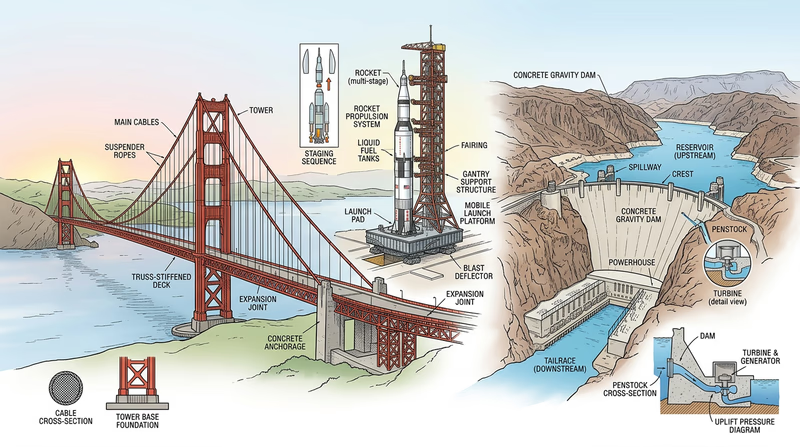
The Golden Gate Bridge almost wasn’t built. Critics said San Francisco Bay’s powerful tides, howling winds, and thick fog made a suspension bridge impossible at that location. Chief engineer Joseph Strauss and structural engineer Charles Ellis spent years proving them wrong — designing a bridge that could flex 27 feet sideways in high winds while supporting the weight of six lanes of traffic. When it opened in 1937, it was the longest suspension span in the world. Every great engineering achievement has a story like this — ambitious people overcoming obstacles that others called impossible.
Choosing Your Achievement
Pick an engineering feat that genuinely fascinates you. The best choice is something you want to learn more about, not just something easy to research. Here are ideas across different engineering fields:
Structural & Civil Engineering
- Hoover Dam — Tamed the Colorado River during the Great Depression
- Brooklyn Bridge — First steel-wire suspension bridge, built 1869–1883
- Channel Tunnel — 31-mile rail tunnel under the English Channel
- Panama Canal — Connected two oceans through miles of jungle and rock
Aerospace & Transportation
- Apollo 11 Moon Landing — Put humans on the Moon with 1960s technology
- The Wright Flyer — First powered, controlled aircraft
- Interstate Highway System — 48,000 miles of road that transformed American life
- The Space Shuttle — First reusable spacecraft
Electrical & Digital
- The Electric Power Grid — Delivers electricity to billions of people
- The Internet — Connected the world’s computers into one network
- The Transistor — The tiny switch that made modern electronics possible
- GPS (Global Positioning System) — Satellite-based navigation for everyone
Other Fields
- The Artificial Heart — Biomedical engineering keeping people alive
- The Haber Process — Chemical engineering that feeds half the world
- Water Purification Systems — Environmental engineering that prevents disease
What to Research
Your counselor will expect you to cover three areas. Here is how to approach each one.
The Engineers Behind It
Every great achievement has names behind it — and the stories behind those names are often fascinating.
- Who led the project? Find the chief engineer, lead designer, or key inventor
- What was their background? How did their education and experience prepare them?
- Who else contributed? Major engineering achievements are team efforts — look for other key contributors
- What personal challenges did they face? Many famous engineers overcame significant obstacles. Washington Roebling, who supervised the Brooklyn Bridge construction, was paralyzed by decompression sickness and directed work from his apartment window using a telescope.
The Obstacles They Overcame
This is often the most interesting part. Every major engineering project hits problems that seem unsolvable at first.
- Technical obstacles — Materials that didn’t exist yet, forces no one had calculated before, environments too extreme for existing technology
- Financial obstacles — Projects running over budget, losing funding, having to prove economic viability
- Natural obstacles — Geography, weather, geological surprises, environmental challenges
- Human obstacles — Political opposition, labor disputes, safety concerns, public skepticism
Impact on the World Today
Connect the achievement to modern life. How would the world be different without it?
- Direct impact — What does this achievement enable today? (e.g., the internet enables global communication, e-commerce, remote work)
- Indirect impact — What technologies or industries grew because of it? (e.g., the transistor led to computers, smartphones, and the entire digital age)
- Ongoing influence — Is the original achievement still in use, or did it inspire newer versions?
Organizing Your Presentation
When you tell your counselor what you learned, structure your presentation like a story:
- Hook — Start with a surprising fact or dramatic moment from the project
- The Vision — What were the engineers trying to accomplish and why?
- The People — Who were the key engineers and what made them qualified?
- The Obstacles — What nearly stopped the project? How were problems solved?
- The Result — What was achieved, and how did it change the world?
- Your Takeaway — What impressed you most? What engineering principles did you learn?