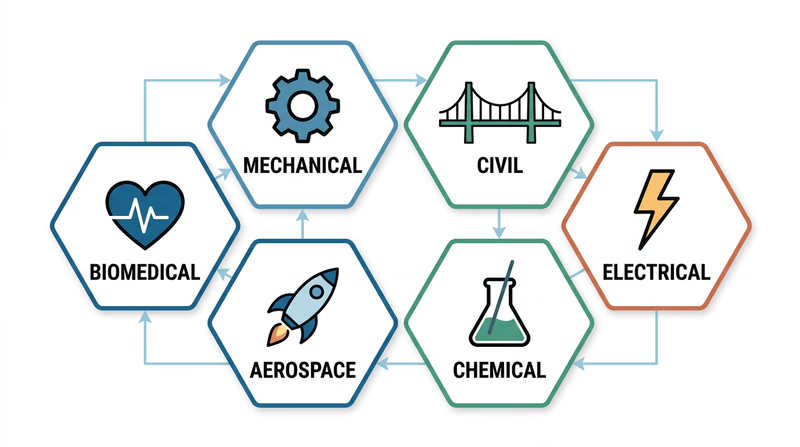
Req 3 — Six Fields of Engineering
A single skyscraper requires civil engineers to design the foundation, structural engineers to calculate the steel frame, mechanical engineers to plan the heating and cooling, electrical engineers to wire the power and lighting, environmental engineers to manage water and waste, and fire protection engineers to design the sprinkler systems. Engineering is not one profession — it is dozens of specialties that constantly overlap and collaborate.
This requirement asks you to learn about six types of engineers. The Introduction page covered several branches, so here you will go deeper and think about how different engineering fields connect.
Major Engineering Disciplines
Below are descriptions of the most common engineering fields. Choose six that interest you, and be ready to explain what each type of engineer does.
Mechanical Engineering
Mechanical engineers design, build, and test machines and mechanical systems. This is the broadest engineering field, covering anything with moving parts — from car engines and industrial robots to medical devices and HVAC systems. A mechanical engineer’s toolkit includes thermodynamics (heat and energy), fluid mechanics (how liquids and gases flow), and materials science (choosing the right materials for the job).
What they build: Engines, turbines, elevators, prosthetic limbs, manufacturing equipment, aircraft components
Civil Engineering
Civil engineers design and oversee the construction of infrastructure — the physical systems that communities depend on. Roads, bridges, water supply systems, sewage treatment plants, airports, and buildings all fall under civil engineering. Sub-specialties include structural engineering (making sure buildings and bridges can handle the loads placed on them), geotechnical engineering (understanding the soil and rock beneath structures), and transportation engineering (designing roads and transit systems).
What they build: Bridges, highways, dams, tunnels, water treatment facilities, building foundations
Electrical Engineering
Electrical engineers work with electrical systems at every scale — from continent-spanning power grids to circuits smaller than a grain of rice. Power engineers focus on generating, transmitting, and distributing electricity. Electronics engineers design the circuits, processors, and sensors inside devices. Control engineers create systems that regulate other systems automatically (like a thermostat that maintains room temperature).
What they build: Power grids, electric motors, computer processors, control systems, telecommunications equipment
Chemical Engineering
Chemical engineers design processes that transform raw materials into valuable products. They work at the intersection of chemistry, physics, and biology — scaling up reactions from laboratory beakers to industrial plants that produce millions of tons of product. Chemical engineers are essential in oil refining, pharmaceuticals, food processing, plastics manufacturing, and environmental remediation.
What they build: Refineries, pharmaceutical production lines, fertilizer plants, water purification systems, biodegradable materials
Aerospace Engineering
Aerospace engineers design vehicles and systems that operate in the atmosphere or in space. Aeronautical engineers work on aircraft — everything from commercial jets to drones. Astronautical engineers design spacecraft, satellites, and launch systems. Both sub-fields deal with extreme conditions: high speeds, intense vibrations, temperature swings, and (in space) the absence of air and gravity.
What they build: Commercial aircraft, fighter jets, rockets, satellites, space stations, drones
Biomedical Engineering
Biomedical engineers apply engineering principles to problems in medicine and biology. They design medical devices, artificial organs, imaging systems (MRI, CT, ultrasound), and drug delivery mechanisms. This field requires a strong understanding of both engineering and human biology. Biomedical engineering is one of the fastest-growing engineering fields as healthcare technology advances.
What they build: Prosthetic limbs, pacemakers, MRI machines, surgical robots, 3D-printed tissues
Computer Engineering
Computer engineers design the hardware that makes computing possible — processors, memory systems, circuit boards, and embedded systems. They bridge the gap between electrical engineering (the physical circuits) and computer science (the software that runs on them). Computer engineers are behind everything from the chip in your smartphone to the supercomputers used for weather forecasting.
What they build: Microprocessors, computer motherboards, embedded systems, networking hardware, IoT devices
Environmental Engineering
Environmental engineers protect human health and the natural world by designing systems that manage pollution, clean contaminated sites, and treat water and air. They work on wastewater treatment, solid waste management, air pollution control, and hazardous waste cleanup. As climate change and sustainability become more urgent, this field is growing rapidly.
What they build: Water treatment plants, air filtration systems, landfill containment, renewable energy integration
Industrial Engineering
Industrial engineers optimize complex systems and processes — making manufacturing, logistics, and operations more efficient, safer, and less wasteful. They study how people, machines, materials, and information interact, then find ways to improve. If you have ever wondered how Amazon delivers packages so fast or how a hospital schedules thousands of surgeries per year, industrial engineers designed those systems.
What they build: Manufacturing workflows, supply chains, quality control systems, hospital scheduling systems
How Engineering Fields Relate
The second part of this requirement asks you to pick two types and explain how their work is related. Here is the key insight: no engineering project happens in isolation. Every real-world product or system requires multiple engineering disciplines working together.
Finding the Connections
When you pick your two types, think about projects where both are needed. Ask yourself:
- Do they work on the same products? (Mechanical and electrical engineers both work on cars)
- Does one depend on the other? (Civil engineers build the power plants that electrical engineers design)
- Do they share tools or methods? (Chemical and biomedical engineers both use laboratory testing and process design)
- Do they solve overlapping problems? (Aerospace and materials engineers both need lightweight, heat-resistant materials)
Example: Mechanical + Electrical Engineering
These two disciplines overlap constantly. A modern car is a perfect example — the engine, transmission, and brakes are mechanical systems, while the ignition, sensors, battery management, and infotainment system are electrical. Neither discipline alone could design the whole car. Mechanical engineers need electrical engineers to power and control their machines; electrical engineers need mechanical engineers to build housings, cooling systems, and moving parts for their electronics.
Example: Civil + Environmental Engineering
Every major construction project has environmental implications. When civil engineers design a new highway, environmental engineers assess the impact on local waterways, wildlife habitats, and air quality. When environmental engineers design a water treatment plant, civil engineers build the physical structure. Both disciplines rely on understanding how water flows through landscapes and how human-built systems affect natural ones.