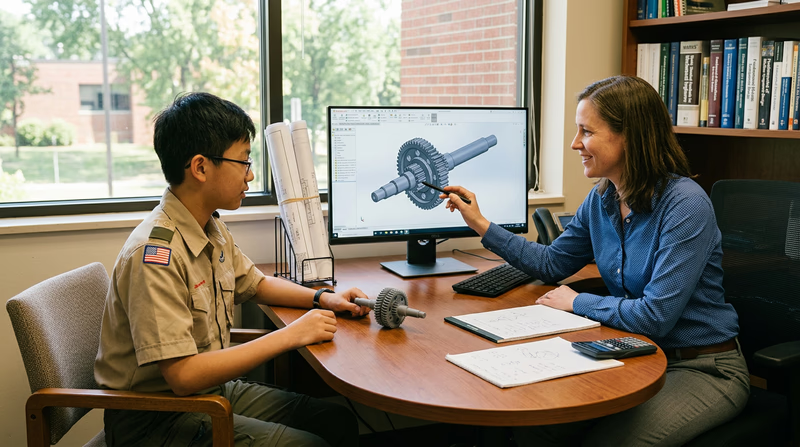
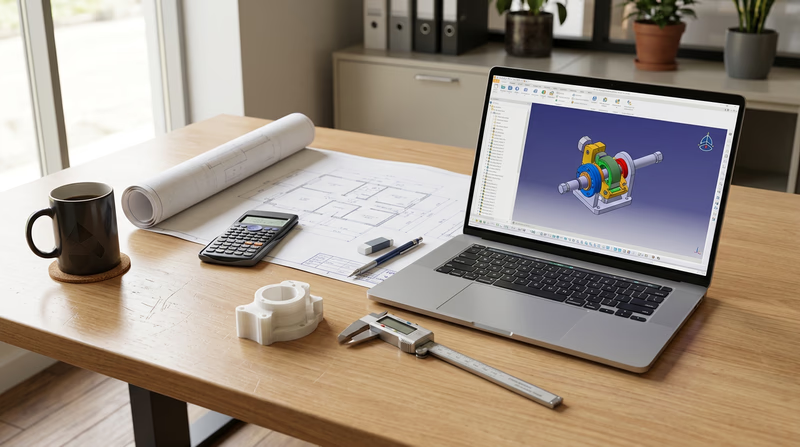
Req 4 — Interview with an Engineer
This requirement has five parts that together give you a real-world window into what engineers actually do every day:
- Req 4a — Discuss the engineer’s work and tools
- Req 4b — Discuss a current project and their role in it
- Req 4c — Find out how their work is done and how results are achieved
- Req 4d — Ask to see reports the engineer writes
- Req 4e — Discuss what you learned with your counselor
Talking to a working engineer is one of the most valuable parts of this merit badge. Books and websites can teach you what engineering is, but a conversation with someone who does it every day reveals what the job is really like — the daily challenges, the satisfying moments, and the parts that no textbook mentions.
Finding an Engineer to Visit
You have several options. The requirement specifically says the engineer may be your counselor, a parent, or a guardian — but you can also reach out more broadly:
- Your merit badge counselor — Many Engineering merit badge counselors are practicing engineers
- Family connections — Parents, guardians, aunts, uncles, or family friends who are engineers
- Troop network — Ask your Scoutmaster if any parents in the troop are engineers
- Local engineering firms — Some companies welcome student visits; have a parent help you reach out
- College engineering departments — University professors and graduate students are often happy to talk with interested young people
Preparing Great Questions
The difference between a forgettable visit and a genuinely useful one comes down to the questions you ask. Go beyond yes-or-no questions. Here are strong questions for each sub-requirement:
Req 4a — Their Work and Tools
- What type of engineering do you practice, and how did you end up in this specialty?
- Walk me through a typical day — what does your morning look like?
- What software tools do you use most often? (CAD, simulation, analysis tools?)
- What physical tools or lab equipment do you use regularly?
- Has your field changed significantly since you started your career?
Req 4b — A Current Project
- What project are you working on right now?
- What is your specific role on the project team?
- How many people are involved, and what other types of engineers are on the team?
- What is the most challenging part of this project?
- How long will the project take from start to finish?
Req 4c — How the Work Gets Done
- What is the process from initial idea to finished product or structure?
- How do you test whether your design will work before building it?
- What happens when something does not work as expected?
- How do you collaborate with engineers from other disciplines?
- What role do prototypes, simulations, or models play in your work?
Req 4d — Engineering Reports
- What kinds of reports or documentation do you write?
- Who reads your reports — other engineers, managers, clients, regulators?
- Can you show me an example of a report or drawing from a project?
- How important is writing and communication in engineering?
Req 4e — Your Takeaways
After the visit, reflect on what you learned and prepare to discuss these points with your counselor:
- What surprised you most about the engineer’s work?
- How does their daily work compare to what you expected?
- What skills (besides math and science) are important in their job?
- Could you see yourself doing this kind of work?
Visit Preparation Checklist
Get ready for your engineer visit
- Identify an engineer to visit (counselor, family member, or professional).
- Schedule the visit or call and confirm the date and time.
- Review the five sub-requirements (4a through 4e) so you know what to cover.
- Write down at least three questions for each sub-requirement.
- Bring a notebook and pen to take notes during the visit.
- Ask permission before taking photos of tools, reports, or workspaces.
- Send a thank-you note or email after the visit.
What to Look For During the Visit
Beyond your prepared questions, pay attention to details that reveal what engineering work is really like:
- The workspace — Is it an office, a lab, a construction site, or a factory floor? Engineering happens in many settings.
- Teamwork — Notice how the engineer interacts with colleagues. Engineering is rarely a solo activity.
- Problem-solving in action — If you are lucky, you might witness the engineer working through an actual problem. Watch how they approach it.
- Communication — Engineering involves far more writing, presenting, and discussing than most people expect. Notice how much time the engineer spends communicating versus calculating.
Engineering Reports: What to Expect
When you ask to see reports (Req 4d), you might see several types:
| Report Type | Purpose |
|---|---|
| Design report | Documents the engineering decisions behind a design, including calculations and alternatives considered |
| Test report | Records the results of testing a prototype or component, with data and conclusions |
| Progress report | Updates stakeholders on project status, milestones, and issues |
| Technical specification | Defines exact requirements a product or system must meet |
| Feasibility study | Analyzes whether a proposed project is technically and financially possible |
Do not worry if you do not understand every detail in the reports. The goal is to see that engineering involves careful documentation — not just building things, but recording why design decisions were made so others can understand and build on them.