Req 6a — Transforming Motion
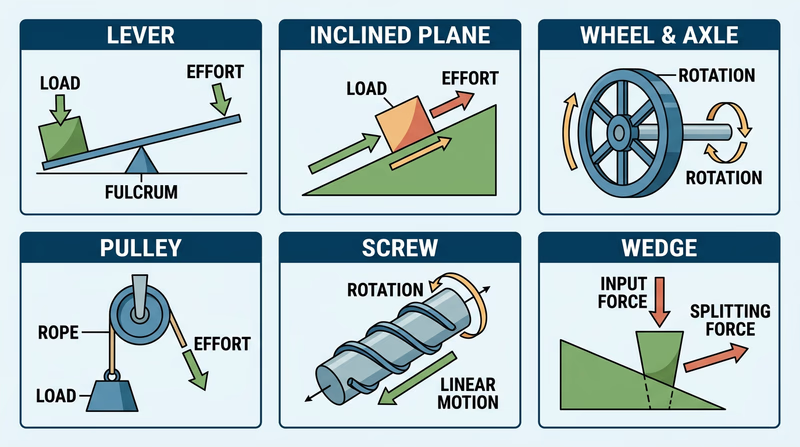
Every machine — from a bicycle to a crane to a car engine — transforms motion. It takes force applied in one direction and converts it into useful movement in another. The six simple machines that make this possible have been used by humans for thousands of years, and they are still the building blocks of every mechanical system today.
The Six Simple Machines
Before you build your model, understand the fundamental mechanisms that transform motion:
Lever
A rigid bar that pivots on a fixed point called a fulcrum. Levers multiply force or increase the distance of movement. A seesaw is a lever. So is a crowbar, a pair of scissors, and the handle on a water pump.
Inclined Plane
A flat surface tilted at an angle. It lets you raise heavy objects by spreading the effort over a longer distance. A ramp is an inclined plane. So is a loading dock, a wheelchair ramp, and a sloped driveway.
Wheel and Axle
A wheel attached to a smaller cylinder (the axle). When the wheel turns, the axle turns too — but with greater force. Doorknobs, steering wheels, and screwdrivers all use this principle.
Pulley
A wheel with a grooved rim that holds a rope or cable. A single pulley changes the direction of force (pull down to lift up). Multiple pulleys working together — called a block and tackle — multiply force, letting you lift loads much heavier than you could by hand.
Screw
An inclined plane wrapped around a cylinder. Each turn of a screw converts rotational motion into linear (straight-line) motion with great force. Jar lids, car jacks, and wood screws all use this principle.
Wedge
Two inclined planes joined back to back. Wedges convert motion in one direction into a splitting force in two directions. An axe, a knife blade, and a doorstop are all wedges.
Building Your Model
Your model should clearly show how at least two simple machines work together to transform motion. Here are project ideas:
Rube Goldberg Machine
A chain reaction device where each step triggers the next — a ball rolls down a ramp (inclined plane), hits a lever that releases a marble, which falls through a pulley system. This is a fun way to demonstrate multiple simple machines working in sequence.
Catapult or Trebuchet
A lever-based launching device. The throwing arm is a lever, and the sling acts as a force multiplier. You can build one from popsicle sticks, rubber bands, and a bottle cap.
Gear Train
Using a construction set (like LEGO Technic or K’NEX), build a gear train that shows how rotational motion can be sped up, slowed down, or reversed by connecting gears of different sizes.
Crane Model
Combine a pulley system with a lever arm and a wheel-and-axle winding mechanism. This demonstrates three simple machines working together to lift and move objects.
Model Building Steps
Follow this process
- Choose which simple machines your model will demonstrate (at least two).
- Gather materials — construction set pieces, craft sticks, cardboard, string, rubber bands, or household items.
- Sketch your design before building.
- Build the model and test it.
- Identify each simple machine in your model and explain what it does.
- Find a real product that uses the same mechanism.
Connecting to Real Products
The requirement asks you to describe a real product that uses the same mechanisms as your model. Here are examples:
| Simple Machine Combination | Real Product |
|---|---|
| Lever + fulcrum | Wheelbarrow (the wheel is the fulcrum, the handles are levers) |
| Pulley + wheel and axle | Construction crane (pulleys lift the load, wheel and axle swings the boom) |
| Inclined plane + wedge | Log splitter (the wedge splits the wood, guided along an inclined track) |
| Gear train | Bicycle transmission (gears convert pedaling into wheel rotation at different speeds) |
| Lever + spring (stored energy) | Stapler (lever compresses a spring that drives a staple — a wedge — through paper) |