Req 6e — Converting Energy
Rub your hands together vigorously for ten seconds. Your palms get warm. You just converted mechanical energy (the motion of your hands) into heat energy (the warmth you feel). Energy conversion is happening all around you, all the time — your body converts chemical energy from food into motion and heat, a light bulb converts electrical energy into light and heat, and a solar panel converts light energy into electrical energy.
What Is Energy?
Energy is the ability to do work — to make something move, change temperature, or change form. Energy cannot be created or destroyed (this is the First Law of Thermodynamics), but it can be converted from one form to another. Every machine, every engine, and every living thing is an energy conversion device.
Forms of Energy
| Form | What It Is | Examples |
|---|---|---|
| Mechanical | Energy of motion or position | A spinning wheel, a stretched rubber band, a ball at the top of a hill |
| Heat (Thermal) | Energy from the vibration of atoms and molecules | A campfire, body warmth, friction |
| Chemical | Energy stored in molecular bonds | Food, gasoline, batteries, wood |
| Electrical | Energy from the flow of electrons | Lightning, wall outlets, batteries powering devices |
| Solar (Radiant) | Energy carried by electromagnetic waves | Sunlight, infrared radiation, radio waves |
| Nuclear | Energy stored in atomic nuclei | Nuclear power plants, the sun |
Experiment Ideas
Choose an experiment that clearly demonstrates energy converting from one form to another. Here are options ranked by complexity:
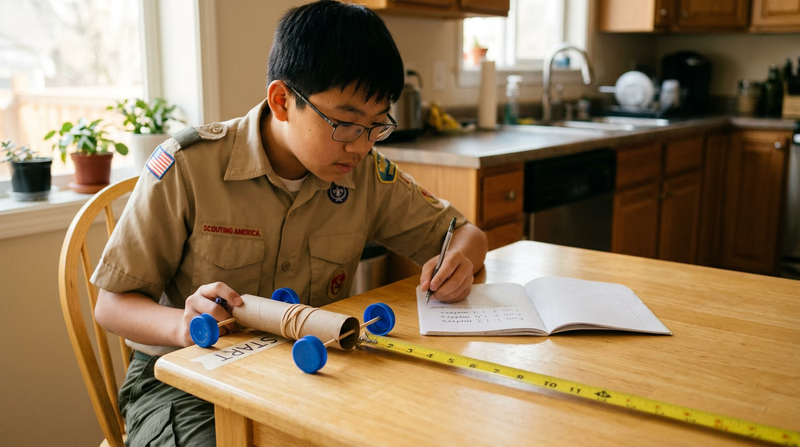
Simple: Rubber Band Car (Chemical → Mechanical)
A rubber band stores elastic potential energy (a form of mechanical energy) when twisted. When released, it converts to kinetic energy (motion). Build a simple car from a cardboard tube, wooden skewers for axles, bottle caps for wheels, and a rubber band for power. Wind the rubber band by rolling the car backward, then release.
Energy chain: Chemical energy (in the rubber’s molecular bonds) → Elastic potential energy (twisted rubber band) → Kinetic/mechanical energy (car moves forward) → Heat energy (friction slows the car)
Moderate: Solar Water Heater (Solar → Heat)
Line a small box with aluminum foil and place a sealed black container of water inside. Cover the top with clear plastic wrap to create a greenhouse effect. Place it in direct sunlight for an hour and measure the water temperature before and after.
Energy chain: Solar energy (sunlight) → Heat energy (water temperature rises)
Moderate: Mousetrap Car (Mechanical → Mechanical)
Build a car powered by a mousetrap. The spring stores elastic potential energy. When triggered, the spring arm pulls a string attached to the rear axle, converting stored energy into rotational motion.
Energy chain: Mechanical energy (compressed spring) → Mechanical energy (car moves) → Heat energy (friction)
Advanced: Thermoelectric Generator (Heat → Electrical)
A Peltier module (available online for a few dollars) generates a small electrical current when one side is heated and the other is cooled. Place one side on a cup of hot water and the other on a cup of ice water, then connect an LED light.
Energy chain: Heat energy (hot water) → Electrical energy (Peltier effect) → Light energy (LED glows)
Explaining Your Results
After your experiment, be prepared to answer these questions:
- What forms of energy were involved? Identify the starting form and the ending form(s).
- Was any energy “lost”? Energy is never truly lost, but it often converts to heat through friction or inefficiency. Identify where this happens in your experiment.
- How efficient was the conversion? Did most of the input energy convert to useful output, or was a lot lost as waste heat?
Energy Conversion in Your Surroundings
Look around your home and identify energy conversions happening right now:
- Stove burner: Chemical energy (natural gas) → Heat energy → Heat energy in food
- Ceiling fan: Electrical energy → Mechanical energy (spinning blades) → Kinetic energy (moving air)
- Phone charger: Electrical energy → Chemical energy (stored in battery)
- Solar garden lights: Solar energy → Electrical energy → Chemical energy (battery) → Electrical energy → Light energy
- Your body: Chemical energy (food) → Mechanical energy (muscle movement) + Heat energy (body warmth)
Every device in your home is an energy converter. The engineering challenge is always the same: convert energy from one useful form to another as efficiently as possible, with minimum waste.