Req 6f — Moving People
Every morning, millions of people across the country are solving the same problem at the same time: how do I get from where I am to where I need to be? Transportation engineers design the roads, traffic signals, transit systems, sidewalks, and bike lanes that make this possible. When traffic flows smoothly, people barely notice. When it doesn’t — gridlock, missed buses, dangerous intersections — the failure of engineering is painfully obvious.
Part 1: How People Get to Work
Start by researching the transportation options in your community. Not every community has all of these, and that is part of the story:
Personal Vehicles
Cars and trucks are the dominant mode of transportation in most American communities. According to the U.S. Census Bureau, about 76% of American workers drive to work alone. Another 9% carpool. Personal vehicles offer flexibility but create congestion, require parking infrastructure, and produce emissions.
Public Transit
Buses, subways, commuter trains, light rail, and streetcars serve denser communities. Public transit moves more people per lane of road than private cars and reduces congestion in urban areas. About 5% of American workers use public transit, but in cities like New York, that number exceeds 50%.
Active Transportation
Walking and cycling account for a small but growing share of commutes — about 3.5% nationally. Communities with good sidewalks, bike lanes, and shorter distances between homes and workplaces see higher rates. Active transportation produces zero emissions and improves public health.
Remote Work
Since 2020, working from home has become a significant factor in commuting patterns. Some workers have eliminated the commute entirely, reducing traffic for everyone else.
Part 2: Traffic Flow Study
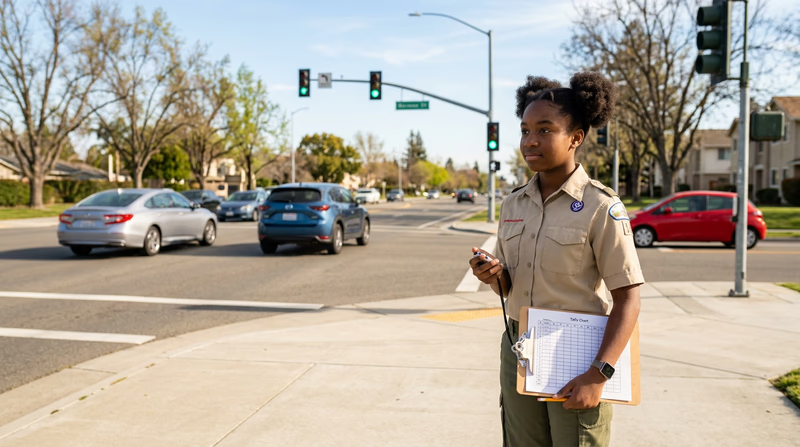
This is where you do real engineering observation. You will measure traffic volume and speed at a specific location during heavy and light traffic periods.
Choosing Your Location
Pick a spot that is:
- Safe — You must be able to observe from a sidewalk, yard, or other safe location away from traffic
- Observable — You can see vehicles clearly and count them accurately
- Variable — Traffic volume changes noticeably between rush hour and off-peak times
Good choices: an intersection near your home, the road in front of your school, or a main road through your neighborhood.
What to Measure
Traffic volume: Count the number of vehicles passing your observation point in a fixed time period (15 minutes works well). Record separately for each direction if possible.
Relative speed: You don’t need a radar gun. Estimate whether vehicles are moving at full speed, slowing down, stop-and-go, or stopped. A simple scale works:
| Speed Rating | Description |
|---|---|
| Free flow | Vehicles moving at or near the speed limit |
| Light congestion | Slightly below speed limit, occasional slowing |
| Moderate congestion | Well below speed limit, frequent stops |
| Heavy congestion | Stop-and-go, long waits at intersections |
When to Observe
Do at least two observation sessions:
- Heavy traffic — Morning rush (7:00–8:30 AM) or evening rush (4:30–6:00 PM) on a weekday
- Light traffic — Weekend morning, mid-morning on a weekday, or early afternoon
Recording Your Data
| Time Period | Direction | Vehicles/15 min | Speed Rating | Notes |
|---|---|---|---|---|
| Mon 7:30 AM | Northbound | 87 | Moderate congestion | Long backup at Main St light |
| Mon 7:30 AM | Southbound | 34 | Free flow | |
| Sat 10:00 AM | Northbound | 22 | Free flow | |
| Sat 10:00 AM | Southbound | 18 | Free flow |
Part 3: Suggesting Improvements
Based on your observations, think about what could make transportation in your community work better. Consider these engineering solutions:
- Signal timing optimization — Are traffic lights efficiently managing the flow, or do they create unnecessary delays?
- Turn lanes or roundabouts — Would dedicated turn lanes or a roundabout reduce congestion at a busy intersection?
- Sidewalks and crosswalks — Are there safe, connected paths for pedestrians?
- Bike infrastructure — Would bike lanes encourage more cycling and reduce car traffic?
- Public transit access — Are bus stops conveniently located? Are schedules frequent enough to be useful?
- Speed management — Would speed bumps or narrower lanes improve safety on residential streets?