Req 6g — Building an Engineering Project
Science and engineering fairs are where you stop learning about engineering and start doing engineering. You identify a problem, design a solution, build it, test it, and then explain your work to judges and visitors. It is the same process professional engineers follow — just scaled to your level.
Finding a Competition
You have several options for meeting this requirement:
Science and Engineering Fairs
- School science fairs — Most middle and high schools hold annual fairs. Projects advance from school to district, regional, state, and even international levels.
- Regeneron International Science and Engineering Fair (ISEF) — The world’s largest pre-college STEM competition, affiliated with the Society for Science.
- Local and regional fairs — Many communities hold their own fairs open to all students.
Engineering Competitions
The requirement specifically allows participation on an engineering competition team. Popular options include:
- FIRST Robotics — Build and program robots to compete in annual challenges. Teams of 25+ students work with professional mentors.
- Science Olympiad — Teams compete in 23 events spanning engineering, biology, chemistry, physics, and earth science. Many events involve building devices.
- Destination Imagination — Teams solve open-ended challenges combining engineering, creativity, and teamwork.
- Model Bridge Building — Design and construct a bridge from balsa wood that holds the maximum weight.
- Mousetrap Vehicle — Build a vehicle powered solely by a mousetrap that travels the farthest distance.
Choosing a Project
If you are entering a science or engineering fair, your project should demonstrate a clear engineering concept. Strong projects share these traits:
- They solve a real problem — “How can I filter water using only materials found in nature?” is stronger than “I built a volcano.”
- They test a hypothesis or optimize a design — Engineering projects should involve testing different approaches and measuring which works best.
- They are original — Judges value creative thinking. Your project does not need to be groundbreaking, but it should show your own ideas.
Project Ideas
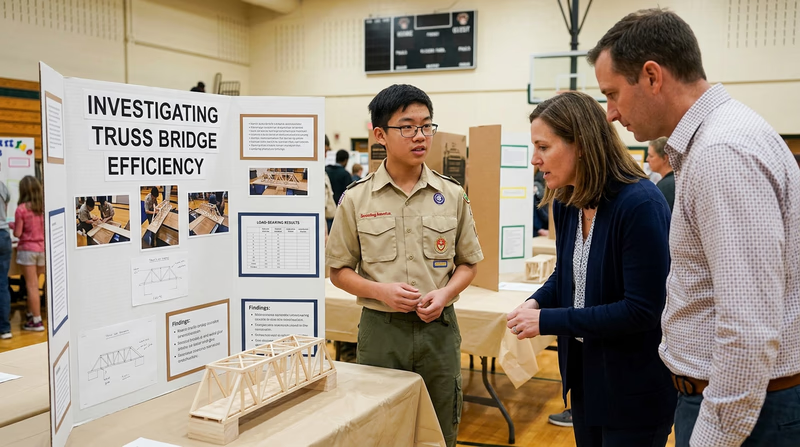
- Design and test a bridge made from spaghetti or popsicle sticks — optimize for maximum load
- Build a water filtration system and test its effectiveness with different filter materials
- Create an egg drop device and test different designs for impact absorption
- Design a solar oven and measure its cooking efficiency
- Build a wind turbine and test different blade designs for maximum power generation
Preparing for Questions
The second part of this requirement focuses on communicating your engineering work. At fairs and competitions, judges and visitors will ask questions to understand what you did and why.
Common Questions and How to Prepare
| Question Type | Example | How to Prepare |
|---|---|---|
| Purpose | “What problem does your project solve?” | Write a clear, one-sentence problem statement |
| Process | “How did you build this?” | Be ready to walk through your design steps |
| Results | “What did you find out?” | Have data and measurements ready to share |
| Challenges | “What was the hardest part?” | Reflect on setbacks and how you overcame them |
| Improvements | “What would you do differently?” | Every project has room to improve — be honest |
| Application | “How could this be used in the real world?” | Connect your project to real engineering applications |
Presentation Skills
- Practice explaining your project in 2 minutes — Visitors have short attention spans
- Use visual aids — Posters, diagrams, or the project itself help people understand quickly
- Speak with confidence — You know your project better than anyone in the room
- It is okay to say “I don’t know” — If a judge asks something you haven’t considered, say so honestly and explain how you would find out
Reflecting on the Experience
After the competition, think about what you will discuss with your counselor:
- What your project demonstrates — What engineering principle or concept does it show?
- Questions visitors asked — Which questions came up most often? Were any unexpected?
- How well you answered — Where were you confident? Where did you struggle to explain?
- What you learned — Not just about engineering, but about communicating technical ideas to non-experts
Competition Preparation
Get ready to compete
- Identify a competition or fair to enter and note the registration deadline.
- Choose or develop your project concept.
- Follow the competition’s rules for project format, display, and safety.
- Build and test your project, documenting your process.
- Prepare a display board or presentation materials.
- Practice explaining your project in under 2 minutes.
- Anticipate questions and prepare answers.
- After the event, reflect on the experience for your counselor discussion.