Req 7 — Professional Engineer Registration
Anyone can call themselves a “software developer” or a “data scientist.” But you cannot legally call yourself a Professional Engineer without earning the title. The P.E. designation is a state-issued license — like a medical license for doctors or a bar admission for lawyers — that proves an engineer has met rigorous education, experience, and examination requirements. It is the engineering profession’s guarantee to the public that this person is qualified to do work that affects public safety.
What Is P.E. Registration?
A Professional Engineer (P.E.) is an engineer who has been licensed by a state board of registration. The license grants legal authority to:
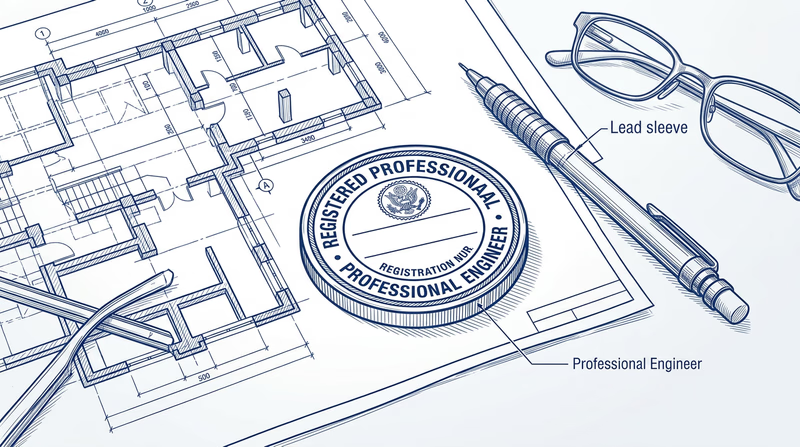
- Sign and seal engineering documents — P.E.s stamp drawings, reports, and plans to certify that the work meets professional standards and complies with codes
- Offer engineering services to the public — In most states, only a licensed P.E. can offer engineering services directly to the public
- Take legal responsibility — A P.E.’s stamp means they accept personal accountability for the engineering work. If a bridge fails or a building collapses, the P.E. who sealed the plans can be held legally liable.
The Path to P.E. Licensure
Becoming a P.E. is a multi-year process:
- Earn a degree — Complete a bachelor’s degree from an ABET-accredited engineering program (typically four years)
- Pass the FE exam — Take the Fundamentals of Engineering (FE) exam, usually during your senior year of college. This is a 6-hour test covering math, science, and engineering fundamentals. Passing it earns you the title Engineer Intern (EI) or Engineer-in-Training (EIT).
- Gain experience — Work under the supervision of a licensed P.E. for at least four years, gaining progressive engineering responsibility
- Pass the PE exam — Take the Principles and Practice of Engineering (PE) exam, an 8-hour test in your specific discipline. This exam tests advanced knowledge and real-world engineering judgment.
- Maintain the license — Complete continuing education requirements to keep the license current (requirements vary by state)
Where P.E. Registration Matters Most
Not all engineering work requires a P.E. license. The requirement is strongest in fields where engineering decisions directly affect public safety.
Civil Engineering
This is where P.E. registration is most critical. Civil engineers who design buildings, bridges, highways, dams, and water systems must be licensed. Every set of structural drawings submitted to a building department must bear a P.E. stamp. If you want to design a bridge that thousands of people cross daily, you must be a P.E.
Structural Engineering
Closely related to civil engineering, structural engineers analyze and design load-bearing structures. P.E. licensure is essentially mandatory — no one builds a skyscraper, stadium, or parking garage from plans that haven’t been sealed by a licensed structural engineer.
Environmental Engineering
Engineers who design water treatment plants, wastewater systems, and environmental remediation projects must typically be licensed. These systems directly affect public health.
Electrical Engineering (Power Systems)
Electrical engineers who design power distribution systems for buildings and facilities often need P.E. licensure, especially for commercial and industrial projects subject to building codes.
Fire Protection Engineering
Engineers who design sprinkler systems, fire alarm systems, and smoke control systems in buildings must be licensed in most jurisdictions.
Mechanical Engineering (Building Systems)
Mechanical engineers who design HVAC (heating, ventilation, and air conditioning) systems for commercial buildings frequently need licensure to stamp their designs.
Fields Where P.E. Is Less Common
In some engineering fields, P.E. licensure is less common — not because it is less valuable, but because the work is typically done within companies rather than offered directly to the public:
- Aerospace engineering — Work is primarily done within large companies (Boeing, NASA, SpaceX) under internal quality assurance systems
- Software engineering — Currently no state requires P.E. licensure for software, though some argue it should be required for safety-critical software
- Manufacturing engineering — Industrial work is generally regulated through company processes rather than individual licensure
Why P.E. Registration Matters
Beyond legal requirements, P.E. registration carries practical benefits:
- Career advancement — Many senior engineering positions, especially in consulting firms and government agencies, require P.E. licensure
- Higher earnings — Licensed P.E.s typically earn 10–15% more than unlicensed engineers with similar experience
- Independence — Only P.E.s can start their own engineering consulting firms and offer services directly to the public
- Professional recognition — The P.E. license is recognized across all 50 states through reciprocity agreements