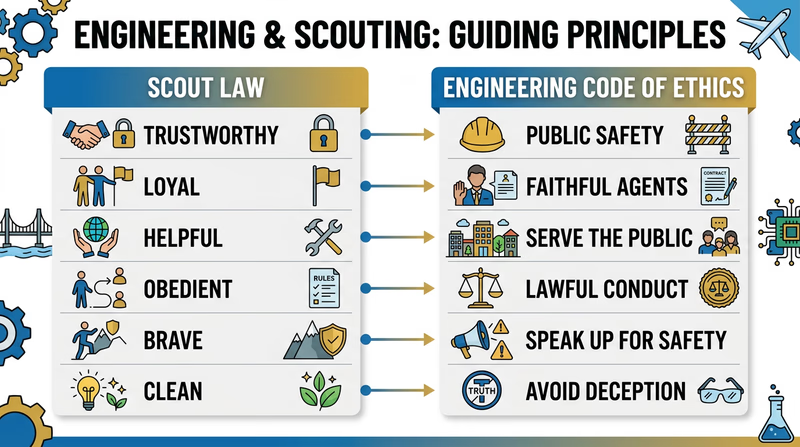
Req 8 — The Engineer's Code of Ethics
In January 1986, engineers at Morton Thiokol told NASA that the rubber O-ring seals on the Space Shuttle Challenger’s solid rocket boosters could fail in cold temperatures. Launch morning was 36 degrees Fahrenheit — well below the seals’ tested range. Management overruled the engineers and launched anyway. Seventy-three seconds later, Challenger broke apart. Seven crew members died. The Challenger disaster became the defining case study in engineering ethics — a catastrophic example of what happens when ethical engineering judgment is compromised by schedule pressure.
Ethics are not abstract principles for engineers. They are life-and-death decisions.
The NSPE Code of Ethics for Engineers
The National Society of Professional Engineers (NSPE) maintains the most widely recognized code of ethics for the profession. Here are its six fundamental canons — the core rules every engineer is expected to follow:
- Hold paramount the safety, health, and welfare of the public.
- Perform services only in areas of their competence.
- Issue public statements only in an objective and truthful manner.
- Act for each employer or client as faithful agents or trustees.
- Avoid deceptive acts.
- Conduct themselves honorably, responsibly, ethically, and lawfully.
The first canon is the most important: public safety comes first, always. If an engineer discovers that a design is unsafe, they have an ethical obligation to speak up — even if it means delaying a project, losing a client, or facing professional consequences.
Connecting the Code to the Scout Oath
The Scout Oath states: “On my honor I will do my best to do my duty to God and my country and to obey the Scout Law; to help other people at all times; to keep myself physically strong, mentally awake, and morally straight.”
| Scout Oath Principle | Engineering Code Parallel |
|---|---|
| “On my honor” | Canon 6 — Conduct themselves honorably |
| “Do my duty to my country” | Canon 1 — Hold paramount public safety and welfare |
| “Help other people at all times” | Canon 1 — Engineers serve the public, not just their employers |
| “Morally straight” | Canon 5 — Avoid deceptive acts |
The Scout Oath’s commitment to being “morally straight” maps directly to the engineering code’s emphasis on honesty and integrity. Both recognize that trust is earned through consistent ethical behavior, not just good intentions.
Connecting the Code to the Scout Law
The twelve points of the Scout Law parallel specific engineering ethics principles:
Trustworthy
Engineers must be trusted with public safety. When a P.E. stamps a set of plans (as you learned in Req 7), they are saying “I stake my professional reputation on this being safe.” Trustworthiness is the foundation of the engineering profession.
Loyal
Canon 4 requires engineers to act as “faithful agents” for their employers and clients — but loyalty to the public always comes first. If an employer asks an engineer to cut corners on safety, the engineer’s loyalty to the public overrides loyalty to the employer.
Helpful
Engineers solve problems that help people. From designing clean water systems in developing countries to creating medical devices that save lives, the engineering profession exists to improve the human condition.
Obedient
Engineers must obey laws, building codes, and professional standards. Canon 6 explicitly requires engineers to conduct themselves “lawfully.”
Brave
Speaking up when you discover a safety problem takes courage — especially when it means disagreeing with your boss or delaying a profitable project. The Challenger engineers were brave enough to raise concerns; the tragedy happened because their managers were not brave enough to listen.
Clean
Engineers must avoid conflicts of interest and “deceptive acts” (Canon 5). A clean professional reputation means never accepting bribes, kickbacks, or gifts that might compromise your engineering judgment.
Ethics in Practice
Engineering ethics are not just rules on paper. Here are real scenarios where the code applies:
Preparing for Your Counselor Discussion
When explaining how the Engineer’s Code of Ethics connects to the Scout Oath and Law:
- Don’t just list parallels — Explain why they overlap. Both exist because trust matters. People trust that bridges won’t collapse and that Scouts will do the right thing.
- Use real examples — The Challenger disaster, building collapses from corrupt construction practices, or the Flint water crisis all illustrate why ethics in engineering matter.
- Show that you understand the priority — Both the Scout Oath and the Engineering Code put service to others above personal gain. A Scout helps other people; an engineer holds public safety paramount.