Req 9 — Exploring Engineering Careers
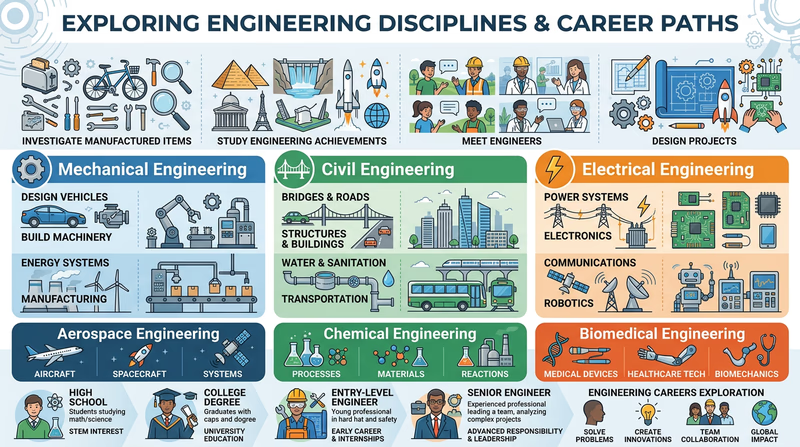
Engineering is consistently ranked among the most rewarding career paths in the country — combining strong salaries, job security, and the satisfaction of building things that matter. But “engineer” is not one career; it is dozens of specialties, each with its own education path, work environment, and career trajectory. This requirement asks you to research one specific engineering career in depth.
Choosing a Career to Research
In Req 3, you learned about different types of engineers. Now pick one to research in detail. Consider which activities you enjoyed most in this badge:
- Loved taking things apart? → Mechanical engineering or aerospace engineering
- Fascinated by electricity experiments? → Electrical engineering or computer engineering
- Enjoyed the traffic study? → Civil engineering or transportation engineering
- Interested in the materials experiments? → Materials science engineering or chemical engineering
- Drawn to the ethics discussion? → Biomedical engineering or environmental engineering (fields where ethical decisions are especially consequential)
What to Research
The requirement lists six specific areas. Here is how to find reliable information for each:
Training and Education
Most engineering careers require a bachelor’s degree in engineering (four years at a college or university). Key details to research:
- What specific degree is needed? (B.S. in Mechanical Engineering, B.S. in Electrical Engineering, etc.)
- Must the program be ABET-accredited? (For P.E. licensure, yes — as you learned in Req 7)
- Is a master’s degree common or required? (Some specialties, like structural engineering, strongly favor graduate degrees)
- What prerequisite courses are important in high school? (Math through calculus, physics, chemistry, computer science)
Costs
Research the cost of an engineering education:
- Public university tuition — Typically $10,000–$20,000 per year for in-state students
- Private university tuition — Can range from $40,000–$60,000+ per year
- Scholarships — Many engineering scholarships are available, including from professional societies like NSPE, ASME, and IEEE
- Return on investment — Engineering graduates typically have among the highest starting salaries of any bachelor’s degree, which helps offset education costs
Job Prospects
Look up employment outlook data:
- Is this field growing? How fast?
- How many job openings are projected in the coming decade?
- Are certain geographic regions stronger for this field?
- Is the field affected by automation or outsourcing?
Salary
Research typical compensation:
- Entry-level salary — What do new graduates earn?
- Median salary — What does a mid-career engineer in this field earn?
- Senior/leadership salary — What can experienced engineers or engineering managers earn?
Job Duties
Describe what a typical workday looks like:
- Where do they work? (Office, lab, factory floor, construction site, outdoors)
- What tools and software do they use?
- How much teamwork versus independent work?
- How much time is spent at a desk versus hands-on?
Career Advancement
How does a career in this field progress?
- Junior engineer → Senior engineer → Lead engineer → Engineering manager or Technical specialist
- Does P.E. licensure help advance? (In civil and structural engineering, absolutely)
- What about specialization versus management tracks?
Research Methods
Use at least two of these approaches:
Internet or Library Research
- Bureau of Labor Statistics (bls.gov/ooh) — Authoritative career data
- Professional society websites — ASME (mechanical), IEEE (electrical), ASCE (civil), AIChE (chemical)
- University engineering department websites — Curriculum details and career placement data
- Library databases — Ask a librarian about career research databases
Interview with a Professional
If you met an engineer during Req 4, ask follow-up questions about their career path. You might also reach out to:
- Engineers in your community
- University professors
- Professionals through LinkedIn (with parent/guardian supervision)
Workplace Visit
- Manufacturing plants and factories
- Construction sites (observation only, with permission)
- Engineering consulting offices
- Research laboratories
Example Career Profile: Civil Engineer
Here is an example to show the depth your counselor will expect:
| Category | Details |
|---|---|
| Education | B.S. in Civil Engineering (4 years, ABET-accredited) |
| Cost | ~$40,000–$100,000+ total (varies by school; many scholarships available) |
| Median Salary | ~$89,940 per year (2023 BLS data) |
| Entry-Level Salary | ~$62,000 per year |
| Job Outlook | 5% growth (2022–2032), about average for all occupations |
| Key Duties | Design infrastructure, analyze survey data, manage construction projects, ensure code compliance |
| Advancement | EIT → P.E. → Senior Engineer → Project Manager → Principal/Partner |
Career Research Checklist
Make sure you cover everything
- Choose one specific engineering career to research.
- Research training and education requirements.
- Find out education costs and available scholarships.
- Look up job prospects and employment outlook.
- Research salary ranges (entry-level, median, senior).
- Describe typical job duties and work environment.
- Understand the career advancement path.
- Use at least two research methods (internet, interview, visit).
- Prepare to discuss what makes this career interesting to you.