
Entrepreneurship Merit Badge — Complete Digital Resource Guide
https://merit-badge.university/merit-badges/entrepreneurship/guide/
Introduction & Overview
A teenager mows lawns every Saturday and earns enough to buy a new bike. Another designs custom phone cases and sells them at school. A third starts a dog-walking service in the neighborhood. Each of them saw a need, came up with a solution, and took the risk of putting their own time and energy on the line. That is entrepreneurship in action — and it does not require a corner office or a million-dollar idea.
The Entrepreneurship merit badge walks you through every step of launching a real business, from the spark of an idea all the way to a written business plan. Along the way, you will learn how to spot opportunities, talk to real entrepreneurs, analyze a market, crunch the numbers, and promote your product or service. These are skills you will use whether you start a Fortune 500 company, run a side hustle in college, or simply manage your own career.

Then and Now
Then: Entrepreneurship in America goes back to the colonial era, when Benjamin Franklin — printer, inventor, postmaster — embodied the self-made business owner. In the 1800s, entrepreneurs like Madam C.J. Walker built empires from scratch, and young people regularly started businesses as apprentices or farmstead operators. The lemonade stand became a cultural icon of childhood business instinct. Before the internet, launching a company meant renting a physical storefront, printing flyers, and relying on word of mouth.
Now: Today, a teenager can launch a global business from a laptop. Platforms like Etsy, Shopify, and YouTube let young entrepreneurs reach customers worldwide without spending a dime on rent. The gig economy, crowdfunding, and social media marketing have lowered the barriers to entry dramatically. In 2023, the U.S. Small Business Administration reported that small businesses make up 99.9% of all American businesses and employ nearly half the private workforce. The tools have changed, but the core spirit — spotting a need and filling it — remains the same.
Get Ready!
Kinds of Entrepreneurship
Entrepreneurship comes in many forms. Understanding the different types will help you figure out where your own business idea fits.
Product-Based Businesses
These businesses create or sell a physical item — handmade candles, custom T-shirts, birdhouses, baked goods, or 3D-printed accessories. If you like making things with your hands or creating something tangible, a product-based business might be your path. The key challenge is managing materials, production time, and inventory.
Service-Based Businesses
Service businesses sell your time and skills instead of a physical product. Think lawn care, pet sitting, tutoring, photography, or car washing. The startup costs are usually lower because you are the product. The challenge is that your income is limited by the number of hours you can work — unless you hire help.
Digital and Online Businesses
From YouTube channels to app development to selling digital art, online businesses let you reach customers far beyond your neighborhood. The startup costs can be nearly zero, but standing out in a crowded digital marketplace takes creativity and persistence.

Social Entrepreneurship
Social entrepreneurs start businesses that solve a community problem while also generating revenue. A Scout who starts a composting service that donates proceeds to a food bank is a social entrepreneur. These ventures blend the drive to help with the discipline of running a business.
Franchise and Licensing
Some entrepreneurs buy the rights to operate under an established brand (like a fast-food franchise) rather than building something from scratch. While this path is less common for young entrepreneurs, understanding it helps you see the full landscape of business ownership.
Req 1 — Defining Entrepreneurship
A corner bakery that has been open for forty years started because one person decided to take a chance. So did every tech giant, food truck, and neighborhood tutoring service. Entrepreneurship is what happens when someone identifies a problem or unmet need — and bets on their own ability to solve it.
What Is Entrepreneurship?
At its core, entrepreneurship is the process of creating, organizing, and running a business while taking on financial risk in the hope of earning a profit. An entrepreneur is the person who does this — someone who identifies an opportunity, gathers the resources needed, and takes action to bring a product or service to market.
But entrepreneurship is more than just “starting a business.” It involves:
- Identifying a need — seeing something people want or a problem that needs solving
- Taking initiative — acting on the idea rather than waiting for someone else to do it
- Accepting risk — putting your own time, money, or reputation on the line
- Creating value — providing something that people are willing to pay for
How Do Entrepreneurs Impact the U.S. Economy?
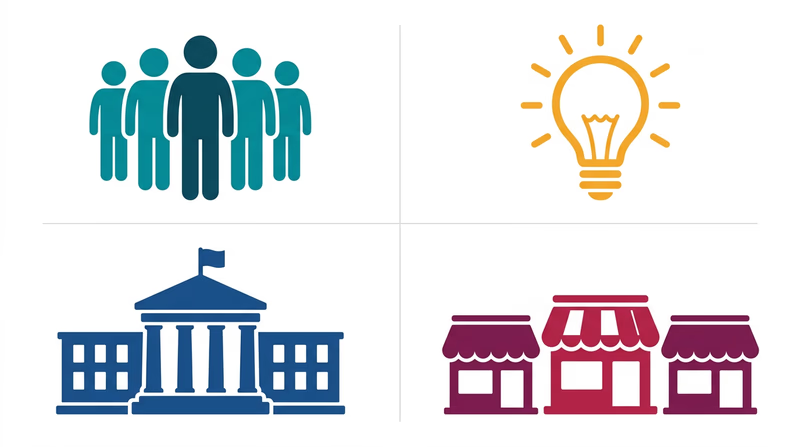
Entrepreneurs are not just business owners — they are one of the primary engines of the American economy. Here is how:
Job creation. Small businesses — the vast majority of which were started by entrepreneurs — employ about 46% of the private workforce in the United States. When an entrepreneur opens a dog-grooming shop and hires three employees, those are three jobs that did not exist before. Multiply that across millions of small businesses and the impact is enormous.
Innovation. Entrepreneurs bring new products, services, and technologies to market. The smartphone you carry was made possible by entrepreneurs who took risks on touchscreens, app stores, and mobile internet. Innovation drives competition, which keeps prices down and quality up for everyone.
Tax revenue. Every business that earns money pays taxes — income taxes, sales taxes, payroll taxes, and more. This revenue funds schools, roads, parks, and public services. Without entrepreneurs generating economic activity, government budgets would shrink dramatically.
Community development. Local entrepreneurs invest in their communities. A new coffee shop on Main Street attracts foot traffic, which helps the bookstore next door, which supports the print shop down the block. Economists call this the multiplier effect — one business’s success ripples outward.
Entrepreneurs You Already Know
You interact with the results of entrepreneurship every day. The grocery store where your family shops, the app you use to check the weather, the barber who cuts your hair — behind each of those is someone who took a risk and started something. Some entrepreneurs you might recognize:
- Sara Blakely started Spanx with $5,000 in savings and no business training. She is now a billionaire.
- Daymond John began selling hand-sewn hats on the streets of Queens, New York. That hustle grew into the FUBU clothing brand.
- Moziah Bridges started his bow-tie business, Mo’s Bows, at age nine. By fourteen, he had a deal with a major retailer.
These stories are not about luck. They are about seeing an opportunity, putting in the work, and not giving up when things got hard.
SBA Small Business Profile The U.S. Small Business Administration publishes annual profiles showing how small businesses impact each state's economy. Link: SBA Small Business Profile — https://advocacy.sba.gov/small-business-profiles/Req 2 — Essential Entrepreneur Skills
Nobody starts a business with just one skill. An entrepreneur who invents a brilliant product but cannot explain it to customers will struggle. Someone who can sell anything but cannot track expenses will run out of money. This requirement asks you to understand ten interconnected skills — and you probably already use most of them in Scouting.
The Ten Skills, Explained
Communication
An entrepreneur communicates constantly — pitching ideas to investors, describing products to customers, giving instructions to employees, writing emails, posting on social media, and listening to feedback. Poor communication leads to misunderstandings, lost sales, and frustrated teams. Good communication means being clear, concise, and knowing your audience. The way you describe your product to a teenager is different from how you describe it to a bank loan officer.
Planning
Starting a business without a plan is like hiking without a map. Planning means setting goals, identifying the steps needed to reach them, and anticipating obstacles before they appear. Entrepreneurs plan their finances, their marketing, their production schedules, and their growth strategies. Requirement 5 of this badge is entirely about building a business plan — that is how central planning is to entrepreneurship.
Organization
Organization is what keeps the plan on track. It means managing your time, keeping records, tracking inventory, and knowing where everything stands at any moment. A disorganized entrepreneur misses deadlines, loses receipts, double-books appointments, and eventually loses customers.
Problem Solving
Problems are guaranteed. Your supplier raises prices. A customer complains. Your website crashes on launch day. Entrepreneurs who survive are the ones who see problems as puzzles to solve, not reasons to quit. Good problem solving means gathering information, considering multiple solutions, and choosing the best option — even under pressure.

Decision Making
Entrepreneurs make dozens of decisions every day — some small (which social media post to publish), some enormous (whether to borrow money to expand). Good decision making means weighing the pros and cons, considering the risks, and being willing to commit once you have enough information. Waiting for perfect information means waiting forever.
Basic Math
You do not need advanced calculus, but you absolutely need to handle basic math. Entrepreneurs calculate costs, set prices, track revenue, estimate profits, manage budgets, and figure out whether they can afford to hire help. If you cannot do these calculations, you will not know whether your business is making money or losing it.
Adaptability
The business world changes fast. Customer preferences shift, new competitors appear, technology evolves, and unexpected events (like a pandemic) can upend everything overnight. Adaptable entrepreneurs pivot — they adjust their products, change their marketing, find new customers, or rethink their entire business model when necessary.
Technical Skills
“Technical skills” depends on your business. A web designer needs coding skills. A baker needs food preparation skills. A lawn care entrepreneur needs to know how to maintain equipment. Whatever your business does, you need to be competent at the core skill that delivers value to your customers.
Social Skills
Business is built on relationships. Social skills help you connect with customers, negotiate with suppliers, resolve conflicts with partners, and build a reputation in your community. Being polite, listening actively, showing empathy, and handling disagreements professionally are all social skills that directly affect your bottom line.
Teamwork
Even solo entrepreneurs rely on others — suppliers, mentors, family members, and eventually employees. Teamwork means collaborating effectively, respecting different perspectives, dividing responsibilities fairly, and supporting each other toward a shared goal. If you have ever worked on a patrol project, you know how important this is.
Leadership
Leadership ties all the other skills together. An entrepreneur leads by setting the vision, making tough decisions, motivating the team, and taking responsibility when things go wrong. Leadership is not about giving orders — it is about inspiring others to work toward a common goal and modeling the behavior you expect.

Skills Self-Assessment
Rate yourself honestly on each skill before meeting with your counselor- Communication: Can you clearly explain an idea to someone who knows nothing about it?
- Planning: Do you set goals and create steps to reach them?
- Organization: Can you find any document or item you need within two minutes?
- Problem solving: When something goes wrong, do you look for solutions or get stuck?
- Decision making: Can you weigh options and commit without overthinking?
- Basic math: Can you calculate percentages, profit margins, and simple budgets?
- Adaptability: When plans change, do you adjust or freeze?
- Technical skills: What is the core skill your business idea would require?
- Social skills: Are you comfortable talking to new people and handling disagreements?
- Teamwork: Can you collaborate effectively even with people you do not choose?
- Leadership: Do people look to you when decisions need to be made?
Req 3 — Interviewing an Entrepreneur
Reading about entrepreneurship in a book is one thing. Sitting across from someone who actually took the leap — who risked their savings, lost sleep over payroll, and figured things out on the fly — is something else entirely. This requirement puts you face-to-face with the real deal.
Finding an Entrepreneur to Interview
You probably know more entrepreneurs than you realize. Think about:
- Local business owners — the person who runs the pizza shop, hair salon, auto repair garage, or gym in your town
- Parents, relatives, or family friends who own businesses or freelance
- Your troop or pack community — ask around at meetings; many Scout families include business owners
- Farmers’ market vendors — these entrepreneurs are often happy to talk about their journey
- Small online sellers — someone who runs an Etsy shop, YouTube channel, or freelance business counts
Preparing for the Interview
Walking in with a plan makes the difference between a great interview and an awkward one. The requirement tells you exactly what topics to cover. Here is how to organize your questions:
Educational Background
- What is the highest level of education you completed?
- Did you study anything related to your business in school?
- Are there skills you wish you had learned earlier?
Early Work Experiences
- What jobs did you have before starting this business?
- How did those jobs prepare you for running your own company?
- Did you have any business experience as a teenager?
The Business Idea
- Where did the idea for your business come from?
- How did you know there was a market for it?
- Did the idea change or evolve before you launched?
Starting Up
- What were the first steps you took to start the business?
- How long did it take from idea to opening day?
- What was the biggest surprise during the startup process?
Raising Capital
- How much money did you need to get started?
- Where did that money come from? (Personal savings, loans, investors, family?)
- If you could do it again, would you raise money differently?
Successes and Challenges
- What is your proudest moment as a business owner?
- What was the hardest challenge you faced?
- Did you ever think about giving up? What kept you going?
Current Status
- How is the business doing today?
- How has it changed from your original vision?
- What advice would you give to a young person thinking about starting a business?

Interview Preparation Checklist
Complete these steps before your interview- Identify and contact the entrepreneur at least one week in advance.
- Confirm the date, time, and location (or video call link).
- Write out your questions in a notebook or on a printed sheet.
- Bring a pen and notebook for taking notes (or ask permission to record).
- Dress neatly — your Scout uniform is a great choice.
- Prepare a brief introduction of yourself and why you are conducting the interview.
- Plan to arrive five minutes early.
During the Interview
Listen more than you talk. Your job is to learn, not to impress. Take notes on key details — especially stories, numbers, and advice that surprise you. If the entrepreneur says something you do not understand, ask them to explain. That curiosity is a strength, not a weakness.
Follow up on interesting answers. If they mention a major challenge, ask “What did you do about it?” If they describe their first sale, ask “How did that feel?” The best interviews are conversations, not interrogations.
After the Interview
Within 24 hours, send a thank-you note — a handwritten card, email, or text. Then organize your notes into a summary you can share with your counselor. Focus on:
- The entrepreneur’s path from idea to launch
- How they funded the business
- The biggest challenge they faced and how they handled it
- The most surprising thing you learned
- How their story connects to the skills from Req 2
Req 4 — Brainstorming Business Ideas
The entrepreneur you interviewed in Req 3 started with a single idea. But that idea probably was not the first one they ever had — it was the one that survived scrutiny. This requirement puts you through the same process: generate many ideas, narrow them down, and defend your best pick.
How to Brainstorm Like an Entrepreneur
The worst thing you can do during brainstorming is judge your ideas too early. The goal of the first step is volume, not quality. Write down every idea that crosses your mind, no matter how silly or impractical it seems. You will filter later.
Here are four proven brainstorming techniques:
Problem-first thinking. Walk through a typical day and notice what annoys you, wastes your time, or could be done better. Every inconvenience is a potential business idea. Does your neighbor struggle to find a pet sitter on short notice? Is there no convenient way to get healthy snacks at school? Problems are opportunities in disguise.
Skills-first thinking. What are you genuinely good at? If you are great at math, a tutoring business could work. If you bake excellent cookies, a custom dessert service might be your path. If you can fix bikes, a mobile repair shop could fill a gap in your area.
Audience-first thinking. Pick a group of people — young kids, senior citizens, busy parents, fellow Scouts — and ask: “What does this group need that nobody is providing?” Sometimes the best ideas come from serving a specific audience rather than solving a general problem.
Trend-watching. Pay attention to what is popular right now. Sustainability is a growing trend — could you start a business that upcycles old materials? Remote work is widespread — could you offer a service that helps home offices?

Narrowing Down to Three
Once you have a long list (aim for at least 10–15 ideas), it is time to filter. Evaluate each idea against these criteria:
| Question | What It Tests |
|---|---|
| Is there a real demand for this? | Market — Will people actually pay for it? |
| Can I realistically deliver it? | Feasibility — Do I have (or can I learn) the skills and resources? |
| How much would it cost to start? | Capital — Can I afford to get this off the ground? |
| Who is the competition? | Competition — Is the space crowded, or is there room for me? |
| Am I excited about this? | Passion — Will I stick with it when it gets tough? |
Go through your full list and score each idea on these five questions. The three ideas that score highest across all five are your finalists.
Choosing Your One Best Idea
From your three finalists, pick the one you will develop into a full business plan in Req 5. When you explain your choice to your counselor, cover these points:
- Why this idea over the other two — What makes it the strongest opportunity?
- Who your customers are — Can you name specific people or groups who would buy?
- Why you believe it can succeed — What gives you confidence? Is there unmet demand? Do you have a competitive advantage?
- What makes you the right person — Do you have relevant skills, knowledge, or connections?
Ideas to Get You Started
If you are struggling to fill your brainstorming list, here are some categories to spark your thinking. Do not copy these directly — use them as springboards for ideas that fit your skills, your community, and your interests:
- Outdoor services: lawn mowing, leaf raking, snow shoveling, garden planting, pressure washing
- Pet services: dog walking, pet sitting, aquarium maintenance, homemade dog treats
- Tech services: website building, social media management, phone/tablet tutoring for seniors
- Creative products: custom artwork, handmade jewelry, photography, calligraphy cards
- Food products: baked goods, specialty snacks, meal prep kits, lemonade stand operations
- Educational services: tutoring, music lessons, sports coaching, homework help
Req 5a — Product or Service
This is the first section of your written business plan. In Req 4, you chose your best business idea. Now you need to describe it clearly enough that someone who has never heard of it can understand exactly what you are offering, why it matters, and how you will deliver it.
Requirement 5a covers five sub-topics:
- Describing your product or service — what exactly are you selling?
- Setting business goals — what does success look like?
- Meeting demand — can you produce enough?
- Liability risks — what could go wrong?
- Licensing requirements — do you need permission?
Describing Your Product or Service
The first line of any business plan answers a simple question: What do you sell? Your description should be clear enough that a stranger could read it and immediately understand your offering. Avoid vague language like “I help people” or “I make things.” Be specific.
Weak description: “I sell baked goods.”
Strong description: “I make and sell custom-decorated sugar cookies for birthdays, holidays, and special events. Each order includes one dozen cookies in a gift-ready box. Customers choose from five standard designs or request a custom design for an additional fee.”
Notice how the strong description tells you exactly what the product is, how it is packaged, and what options are available. That clarity matters — for customers, for investors, and for your own planning.
Setting Business Goals
Every business needs goals — concrete targets that tell you whether you are succeeding or just staying busy. Your goals should be SMART: Specific, Measurable, Achievable, Relevant, and Time-bound.
| Goal Type | Weak Example | SMART Example |
|---|---|---|
| Revenue | “Make a lot of money” | “Earn $500 in revenue in the first three months” |
| Customers | “Get some customers” | “Serve 20 unique customers by the end of month two” |
| Growth | “Grow the business” | “Expand from cookies to cupcakes by month six” |
| Quality | “Make good stuff” | “Maintain a 4.5-star average rating on all orders” |
Include at least two or three goals in your business plan. They give you something to measure yourself against — and they show your counselor that you are thinking beyond day one.
Meeting Demand
Can you actually deliver what you are promising? This section of your plan explains your capacity — how much product you can make or how many customers you can serve in a given timeframe.
Think about:
- Time: How many hours per week can you dedicate to the business? (Remember — school, Scouting, and other activities come first.)
- Materials and supplies: Can you get what you need reliably? What if demand spikes?
- Space and equipment: Where will you work? Do you have the tools you need?
- Bottlenecks: What is the one thing that limits how much you can produce?

Identifying Liability Risks
Liability means legal responsibility for harm your product or service might cause. This is not about being pessimistic — it is about being prepared. Every business carries some risk, and smart entrepreneurs think about it before problems arise.
Common liability risks for youth-run businesses:
- Food businesses: Allergic reactions, foodborne illness, health code violations
- Service businesses: Property damage (breaking a window while mowing), injury to yourself or others
- Pet businesses: A dog escaping, an animal bite, property damage
- Online businesses: Privacy violations, copyright infringement, misrepresenting your product
For your business plan, list two or three realistic risks and explain what you would do to minimize each one. For example, a cookie business might address allergens by clearly labeling every ingredient and asking customers about allergies before accepting an order.
Licensing Requirements
Some businesses require licenses or permits — even for young entrepreneurs. The requirements vary by state, county, and city. Here is what to research:
- Business license: Many cities require a basic business license for anyone selling goods or services.
- Food handler’s permit: If you sell food, your local health department may require a permit or inspection. Many states have “cottage food” laws that allow small-scale home baking with fewer regulations.
- Sales tax permit: If your state charges sales tax and you sell products, you may need to collect and remit it.
- Zoning laws: Some neighborhoods restrict home-based businesses — especially those with customer traffic or signage.
For your business plan, research whether any of these apply to your idea. You do not need to actually obtain them for the merit badge — just show that you understand the landscape.
SBA Business License and Permit Guide The U.S. Small Business Administration explains which licenses and permits you may need, with links to state-specific resources. Link: SBA Business License and Permit Guide — https://www.sba.gov/business-guide/launch-your-business/apply-licenses-permitsReq 5b — Market Analysis
This section of your business plan forces you to step outside your own enthusiasm and look at your idea through the eyes of the market. You might love your product, but the real question is: Will other people pay for it?
Requirement 5b covers three sub-topics:
- Target customers — who is going to buy?
- Competitors — who else is selling something similar?
- Unique value — why would customers choose you?
Identifying Your Target Customers
Your target market is the specific group of people most likely to buy your product or service. “Everyone” is never the right answer. Even the biggest companies in the world focus on specific customer segments. The more clearly you define your target customer, the better you can design, price, and market your offering.
To define your target market, answer these questions:
- Age range: Are your customers kids, teens, adults, or seniors?
- Location: Are they in your neighborhood, your town, or online?
- Need: What problem are you solving for them? Why would they care?
- Budget: How much can they afford to spend?
- Habits: Where do they already shop? How do they find new products?
Here is how to research whether your target customers actually exist in your area:
- Talk to people. Ask friends, family, neighbors, and classmates if they would buy your product and what they would pay.
- Observe. Visit local shops, browse online marketplaces, and see who is buying similar products.
- Count. Estimate how many potential customers are within your reach. A lawn care business in a neighborhood of 200 homes has a clear, measurable market.
- Survey. Create a simple survey (Google Forms is free) and share it with your target audience.
Analyzing Your Competitors
A competitor is anyone who offers a product or service that your target customers might buy instead of yours. Identifying your competitors is not about being scared of them — it is about understanding the landscape so you can position yourself strategically.
For each competitor, document:
| Factor | What to Assess |
|---|---|
| Who they are | Name, location, size |
| What they offer | Products/services, quality level |
| Pricing | How much they charge |
| Strengths | What they do well — reputation, convenience, variety |
| Weaknesses | Where they fall short — slow delivery, limited options, poor customer service |

Where to find competitors:
- Search Google for your product or service in your area
- Check local business directories and social media
- Ask potential customers who they currently buy from
- Visit farmers’ markets, craft fairs, or local shops
- Search Etsy, Amazon, or other online platforms
Describing Your Unique Value
Your unique value proposition (UVP) answers the question: Why should a customer choose you over the competition? This is the most important sentence in your market analysis — possibly in your entire business plan.
Your UVP might be based on:
- Price: You charge less than competitors (but be careful — competing on price alone is risky)
- Quality: Your product is better made, fresher, or more durable
- Convenience: You deliver, come to the customer, or offer faster service
- Customization: You offer options competitors do not
- Personal connection: You know your customers and their preferences
- Niche focus: You serve a specific audience that big competitors ignore
Putting It All Together
Your market analysis section in the business plan should flow logically:
- Define your target customer with specific detail
- Estimate market size — how many potential customers are within reach
- List 2–3 competitors with honest assessments of their strengths and weaknesses
- State your unique value proposition clearly and confidently
- Explain why customers will switch to you (or try you for the first time)
This section shows your counselor — and any future investor — that your idea is not based on wishful thinking. You have done the research, you understand the competition, and you have a clear reason why customers will choose you.
Census Bureau QuickFacts Look up population demographics for your city or county — useful for estimating your market size and understanding your local customer base. Link: Census Bureau QuickFacts — https://www.census.gov/quickfacts/Req 5c — Financial Plan
This is where your business plan goes from “good idea” to “real plan.” Numbers do not lie — they tell you whether your business can survive. The financial section answers three critical questions: How much do you need to start? How will you price your offering? Where does the money go?
Requirement 5c covers three sub-topics:
- Startup costs and funding — how much to launch, and where the money comes from
- Cost, pricing, and profit — the math behind making money
- Revenue allocation — what happens to the money you earn
Startup Costs and Funding
Startup costs are everything you need to spend before your first customer pays you. These fall into two categories:
One-time costs — things you buy once to get started:
- Equipment (tools, oven, computer, lawn mower)
- Supplies for your first batch of products
- Business cards, flyers, or a website
- Licenses or permits
- Initial inventory
Ongoing costs — expenses that repeat weekly, monthly, or per order:
- Materials and ingredients for each product
- Gas or transportation costs
- Website hosting or subscription fees
- Marketing and advertising
- Packaging and shipping supplies
Startup Cost Worksheet
List every expense you can think of — it is better to overestimate than be surprised- Equipment and tools: What do you need to buy?
- Supplies and materials: What goes into each unit of your product or each service visit?
- Marketing: Flyers, business cards, website, social media ads?
- Licenses and permits: Any fees required by your city or state?
- Transportation: How will you get to customers or get supplies?
- Packaging: Boxes, bags, labels, stickers?
- Miscellaneous: Anything else that costs money before you earn money?
Where does the startup money come from? For young entrepreneurs, common funding sources include:
- Personal savings — the most common and least risky
- Family loans — borrowing from parents or relatives (set clear repayment terms)
- Pre-orders — selling products before you make them to fund materials
- Small competitions or grants — some organizations offer seed money for youth businesses
- Earned income — saving money from a part-time job to fund your venture
Cost, Pricing, and Profit
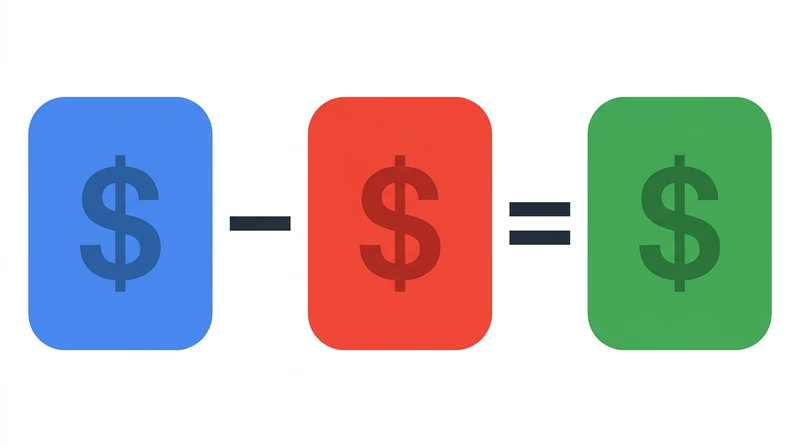
The most important math in any business is the relationship between three numbers:
Cost — what it takes to produce one unit of your product or deliver one session of your service.
Price — what you charge the customer.
Profit — the difference between price and cost.
The formula is simple: Profit = Price - Cost
But calculating your true cost requires attention to detail. Here is an example for a custom cookie business:
| Expense | Cost per Dozen |
|---|---|
| Flour, sugar, butter, eggs | $3.50 |
| Decorating supplies (icing, sprinkles) | $2.00 |
| Packaging (box, ribbon, label) | $1.50 |
| Gas for delivery | $1.00 |
| Total cost per dozen | $8.00 |
If you charge $25.00 per dozen, your profit per dozen is $17.00. But you also need to account for your time. If each order takes two hours to bake, decorate, and deliver, you are effectively paying yourself $8.50 per hour.
Revenue Allocation
Once money starts coming in, where does it go? Your business plan should explain how you will use your revenue. Common categories include:
Reinvestment. Putting money back into the business to buy more supplies, upgrade equipment, or expand your offerings. Most young businesses should reinvest a significant portion of early revenue to grow.
Savings. Setting aside a percentage for emergencies — unexpected expenses, slow months, or equipment repairs. Financial advisors often recommend saving at least 10–20% of revenue.
Personal income. Paying yourself for your work. You deserve compensation for your time and effort, but smart entrepreneurs resist the temptation to take out too much too early.
Taxes. Yes, even young entrepreneurs may owe taxes on business income. If you earn more than a certain threshold, you may need to file taxes on that income. Ask a parent or guardian to help you understand the basics.
Debt repayment. If you borrowed money to start the business, set a clear schedule for paying it back.
Practical Money Skills — Teen Budgeting Free financial literacy resources, including budgeting tools and calculators suitable for young entrepreneurs. Link: Practical Money Skills — Teen Budgeting — https://www.practicalmoneyskills.com/Req 5d — Personnel Plan
Even a one-person business has a personnel plan — it just happens to be a plan about you. This section of your business plan explains who does the work, what qualifications they need, and whether you will need to bring anyone else on board.
Requirement 5d covers two sub-topics:
- Your own role and qualifications — what parts you handle yourself
- Additional help — whether you need it, and what those roles look like
Your Role and Qualifications
Start by listing every task your business requires. Be thorough — even small tasks take time and energy. For a custom cookie business, the task list might look like this:
- Baking and decorating cookies
- Purchasing ingredients and supplies
- Taking and managing orders
- Communicating with customers
- Delivering orders
- Managing money and tracking expenses
- Marketing and social media
- Cleaning up the workspace
Now ask yourself: Which of these can you do well? Be honest. Your qualifications might include skills you have developed through school, Scouting, hobbies, family responsibilities, or previous jobs.
For your business plan, write a brief paragraph about your qualifications that sounds like this:
“As the owner and sole operator, I will handle all baking, decorating, customer communication, and delivery. I have been baking for five years, completed a food safety course through my school’s family and consumer sciences program, and have experience managing orders through my troop’s annual fundraiser.”
Do You Need Additional Help?
For many Scout-run businesses, the answer is “not yet.” But thinking about it now prepares you for growth. Consider these questions:
Volume question: Can you fill every order yourself, or will demand exceed your capacity? If you expect more than ten orders per week but can only bake five dozen cookies on a Saturday, you need help.
Skills question: Does your business require a skill you do not have? If you plan to sell products online but do not know how to build a website, you might need a tech-savvy partner or helper.
Time question: Can you run the business around your existing commitments? If school, sports, and Scouting already fill your schedule, you might need someone to handle deliveries or social media.
Defining Roles for Helpers
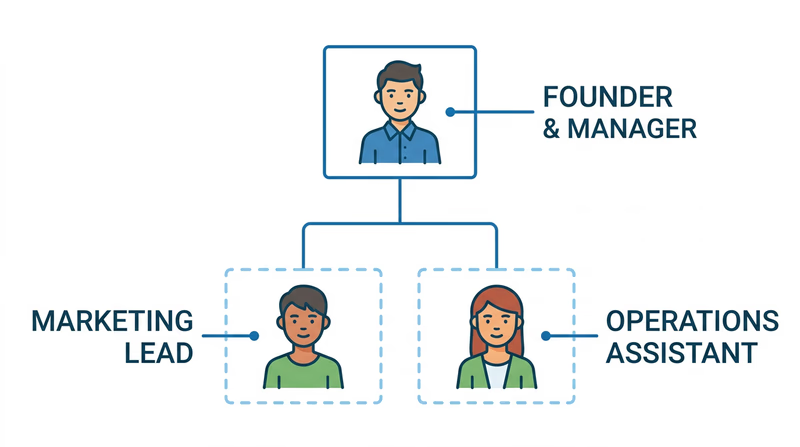
If you determine that you need additional help, your business plan should describe each role clearly:
| Element | What to Write |
|---|---|
| Job title | A clear, simple name (e.g., “Delivery Assistant”) |
| Responsibilities | Specific tasks this person would handle |
| Qualifications | Skills or traits they need |
| Time commitment | How many hours per week |
| Compensation | How they will be paid (hourly, per delivery, percentage of sales) |
For example:
“Delivery Assistant — Responsible for delivering completed orders to customers within a 5-mile radius on Saturdays between 10 AM and 2 PM. Must have a bicycle or access to a car (with a parent driver). Must be reliable, punctual, and comfortable interacting with customers. Compensation: $5 per delivery.”
Working with Friends and Family
Many young entrepreneurs recruit friends or siblings as helpers. This can work well, but it requires clear expectations from day one. Issues to discuss upfront:
- What exactly will each person do? Write it down so there are no misunderstandings.
- How will decisions be made? In a partnership, who has the final say? In a boss-helper arrangement, is that clear to both parties?
- How and when will they be paid? Agree on compensation before any work begins.
- What happens if someone wants out? Have a plan for transitions.
The personnel section of your plan does not need to be long. For a solo operation, a paragraph about your qualifications and a note about future hiring is sufficient. The point is to show that you have thought about who will do the work — and that the work will actually get done.
Youth Entrepreneurship Council A community for young entrepreneurs to connect, share ideas, and learn from experienced founders about building teams and growing businesses. Link: Youth Entrepreneurship Council — https://www.yec.co/Req 5e — Promotion & Marketing
You could have the best product in the world, but if nobody knows about it, you will not sell a single unit. Marketing is how you get your business in front of the right people. Promotion is how you convince them to buy.
Requirement 5e covers three sub-topics:
- Promotional methods — how you will spread the word
- Internet and social media — leveraging digital platforms
- Designing a flyer or poster — creating a tangible promotional piece
Methods of Promotion
Marketing is not just advertising. It includes every way you communicate your business to potential customers. Here are the most effective methods for a young entrepreneur:
Word of mouth. The most powerful marketing tool costs nothing. When a satisfied customer tells their friends about your business, that recommendation carries more weight than any ad. The catch: you earn word of mouth by delivering great products and great service consistently.
Social media. Platforms like Instagram, TikTok, Facebook, and Nextdoor let you showcase your work, interact with customers, and reach people beyond your immediate circle. More on this below.
Flyers and posters. Physical marketing still works, especially for local businesses. A well-designed flyer on a community bulletin board, at a local coffee shop, or in mailboxes can drive real traffic.
Community events. Setting up a booth at a farmers’ market, craft fair, school event, or community festival puts your product directly in front of potential customers. Face-to-face selling is one of the most effective ways to build trust and make sales.
Referral incentives. Offer existing customers a discount or bonus for referring new customers. For example: “Refer a friend and get $3 off your next order.” This turns your customers into your sales team.
Partnerships. Team up with a complementary business. If you sell custom cookies, partner with a local florist — they recommend you for birthday packages, and you recommend them for event flowers. Both businesses benefit.

Using the Internet and Social Media
The internet makes it possible for a teenager in a small town to reach customers across the country. Here is how to use digital tools effectively:
Choose the right platform. Not every platform is right for every business. Think about where your target customers spend time:
| Platform | Best For | Content Type |
|---|---|---|
| Visual products (food, crafts, art) | Photos, Reels, Stories | |
| TikTok | Demonstrations, behind-the-scenes | Short videos |
| Facebook / Nextdoor | Local services (lawn care, pet sitting) | Posts, reviews, local groups |
| YouTube | Tutorials, how-tos, product reviews | Longer videos |
| Etsy / Shopify | Selling products online | Product listings |
Content that works:
- Behind-the-scenes posts showing how you make your product — people love seeing the process
- Customer testimonials and photos of happy buyers
- Before-and-after shots for service businesses (a messy lawn vs. a freshly mowed one)
- Special offers and limited-time deals to create urgency
- Educational content that establishes you as knowledgeable about your field
Designing a Promotional Flyer or Poster
The requirement asks you to design a flyer or poster for your business. This is your chance to apply everything you have learned about marketing in a single, tangible piece.
An effective flyer includes:
- A headline that grabs attention. Not “Cookie Business” — try “Custom Cookies for Every Celebration” or “Your Lawn, Our Problem.”
- A clear description of what you offer. One or two sentences maximum.
- Your unique value. Why choose you? (“Handmade with organic ingredients” or “Same-day service, guaranteed.”)
- Pricing or a starting price. People want to know what it costs before they contact you.
- A call to action. Tell them exactly what to do: “Text 555-0123 to place an order” or “Visit our Instagram @CookiesByJordan.”
- Visual appeal. Use a clean layout, readable fonts, and a photo or illustration of your product.
Free design tools you can use:
- Canva (canva.com) — drag-and-drop templates for flyers, posters, and social media graphics
- Google Slides — works in a pinch for simple layouts
- Adobe Express (formerly Adobe Spark) — free templates with professional-quality design
Req 6 — Running the Business
Your business plan is written. The numbers work. The marketing strategy is ready. Now close your eyes and fast-forward three months — your business has launched, you have real customers, and real money is changing hands. What happens next?
This requirement asks you to think like an experienced entrepreneur: anticipate what could go right, what could go wrong, and how you would handle the hard choices that no business plan can fully predict.
Imagining Your Successes
Thinking about success is not just daydreaming — it helps you plan for growth. Consider these realistic early wins:
Your first paying customer. That first sale proves your concept is real. Someone valued your product enough to exchange money for it.
Repeat customers. When someone comes back for a second order, it means you delivered on your promise. Repeat customers are the foundation of a sustainable business.
Word-of-mouth referrals. A customer tells a friend, who tells another friend. Suddenly you have more orders than you expected. This is exciting — and it tests your capacity planning from Req 5a.
Revenue milestones. Crossing $100, $500, or $1,000 in total revenue feels significant. Each milestone proves your business is growing.
Anticipating Problems
Every business faces challenges. The entrepreneurs who survive are not the ones who avoid problems — they are the ones who have thought about problems in advance and respond calmly when they arrive.
Common problems for young entrepreneurs:
| Problem | Why It Happens | How to Respond |
|---|---|---|
| Not enough customers | Weak marketing, wrong target audience, too much competition | Revisit your market analysis; try a different promotional channel |
| Too many customers | Underestimated demand, viral word of mouth | Raise prices, set order limits, or recruit help (see Req 5d) |
| Running out of supplies | Poor inventory tracking, unreliable supplier | Keep a buffer stock; find a backup supplier |
| Cash flow crunch | Spending faster than revenue comes in | Cut non-essential expenses; require deposits on large orders |
| Quality complaints | Rushing to fill orders, inconsistent process | Slow down, create a quality checklist, and follow it every time |
| Time conflicts | School, sports, Scouting, family obligations | Set realistic business hours; learn to say “not this week” |
Overcoming Failures
Failure is not the opposite of success — it is part of the path to success. The question is not whether you will fail at something, but how you will respond.
A product flops. You invested time and materials into something nobody wants to buy. Painful, but informative. Ask yourself: Did I misread the market? Was the price wrong? Was the product quality lacking? Use the answers to pivot your offering.
A customer is unhappy. This stings, especially when you have put your heart into the work. But an unhappy customer is a learning opportunity. Listen to their complaint, fix the problem if you can, and use the feedback to prevent it from happening again. Many of the most loyal customers are people whose complaints were handled exceptionally well.
You lose money. Maybe your costs were higher than expected, or sales were slower than projected. Go back to the financial plan you built in Req 5c. Where did the numbers diverge from reality? Adjust your plan and try again.
Ethical Questions in Business
Ethics are the principles that guide your behavior when no one is watching — and when doing the wrong thing might be easier or more profitable than doing the right thing. Entrepreneurs face ethical questions regularly.
Honesty in marketing. Your flyer says “homemade with organic ingredients,” but you realize organic flour costs twice as much as regular flour. Do you switch to cheaper ingredients and keep the label? An ethical entrepreneur either uses the organic ingredients or changes the marketing to be accurate.
Fair treatment of customers. A customer orders cookies for a party and you accidentally mess up the decorations. Do you deliver them anyway, hoping the customer will not notice? Or do you call the customer, explain the situation, and offer to redo the order — even if it costs you time and money?
Handling mistakes. You accidentally charge a customer twice. Do you wait and see if they notice, or do you immediately refund the overpayment and apologize?
Competing fairly. A friend starts a similar business. Do you spread rumors about their product, or do you focus on making your own product better?
Environmental responsibility. Your packaging creates a lot of waste. Is it worth the extra cost to switch to biodegradable materials, even if customers do not seem to care?
Preparing for the Counselor Discussion
Your counselor will want to hear you think through these scenarios in your own words. To prepare:
- Pick 2–3 specific successes you would realistically expect in your first few months.
- Identify 2–3 realistic problems your particular business might face and explain your response.
- Describe at least one ethical dilemma relevant to your business and explain how you would handle it.
- Connect your answers to your business plan — show that you are thinking about your business, not generic examples.
The point of this requirement is not to have perfect answers. It is to show that you have thought deeply about what it takes to run a business with integrity, resilience, and foresight.
Better Business Bureau — Ethics Resources The BBB Standards for Trust outline ethical principles that businesses of all sizes can follow to build and maintain customer trust. Link: Better Business Bureau — Ethics Resources — https://www.bbb.org/all/bbb-standards-for-trustExtended Learning
A. Congratulations, Entrepreneur
You have worked through every stage of the entrepreneurship journey — from defining what an entrepreneur is, to building a complete business plan, to imagining the realities of running your own company. That is no small thing. The skills you practiced here — research, planning, financial analysis, marketing, and ethical reasoning — will serve you in any career, whether or not you ever start a business. Now let’s go deeper.
B. The Lean Startup Approach
Traditional business plans assume you can predict the market before you enter it. The lean startup methodology, popularized by Eric Ries, flips that assumption. Instead of spending months perfecting a plan, lean entrepreneurs build a minimum viable product (MVP) — the simplest version of their product that can be tested with real customers — and launch it as quickly as possible.
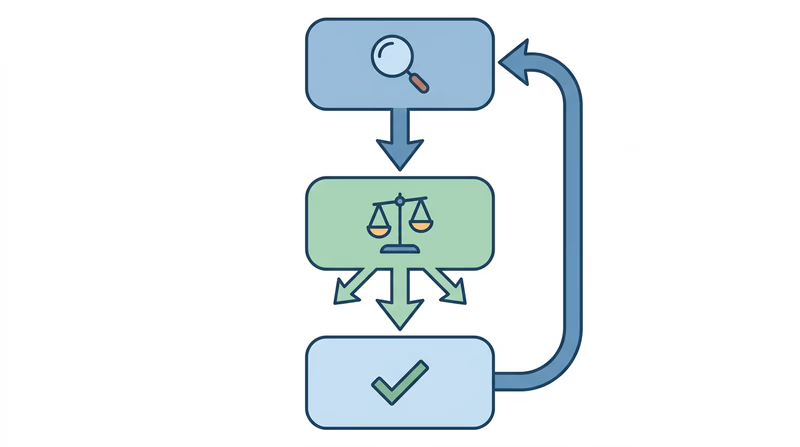
The cycle works like this: Build a basic version. Measure how customers respond. Learn from the results. Then repeat. Each cycle is fast — days or weeks, not months.
Why does this matter for you? Because the business plan you wrote in Requirement 5 is a hypothesis, not a guarantee. The lean startup approach gives you a framework for testing that hypothesis with real data. If you planned a custom cookie business, your MVP might be baking three different flavors and offering free samples to ten people, then tracking which flavor gets the most orders.
The key metric in lean thinking is validated learning — proving through real-world evidence that your assumptions about customers, pricing, and demand are correct (or discovering where they are wrong). A pivot is not a failure — it is a strategic decision to change direction based on what you learned.
Lean startups also emphasize the concept of the feedback loop. After every customer interaction, ask: What worked? What did the customer want that I did not expect? What should I change before the next round? This relentless focus on learning is what separates entrepreneurs who adapt from those who cling to a plan that is not working.
Some of the most successful companies in history started as something completely different. YouTube began as a video dating site. Slack started as an internal communication tool for a video game company that never launched. Twitter emerged from a failed podcasting platform called Odeo. In each case, the founders paid attention to what users actually wanted and pivoted accordingly.
The Lean Startup by Eric Ries The official site for the lean startup methodology, with articles, case studies, and resources for entrepreneurs at every level. Link: The Lean Startup by Eric Ries — https://theleanstartup.com/C. Financial Literacy Beyond the Basics
In Req 5c, you learned about startup costs, pricing, and profit. But real financial management goes much deeper — and the earlier you develop these skills, the bigger advantage you will have.
Cash flow vs. profit. A business can be profitable on paper and still fail. How? If your customers pay you 30 days after delivery but your suppliers demand payment upfront, you can run out of cash even while showing a positive profit margin. Cash flow — the timing of money coming in versus going out — is what keeps the lights on. Smart entrepreneurs track cash flow weekly, not just monthly.
Break-even analysis. Your break-even point is the number of units you need to sell (or services you need to perform) before your total revenue covers all your costs. Below that point, you are losing money. Above it, every sale generates real profit. The formula is: Break-even = Fixed Costs / (Price per Unit - Variable Cost per Unit). For example, if your monthly fixed costs are $50 and you earn $10 profit per dozen cookies, you need to sell five dozen cookies per month just to break even.
Understanding compound growth. If you reinvest your profits, your business can grow exponentially. Imagine you earn $200 in profit your first month and reinvest half of it into buying better supplies and marketing. That investment helps you earn $250 the next month. Reinvest again, and the growth compounds. This is the same principle behind compound interest in savings accounts — but in a business context, the returns can be much higher (and so can the risks).
Reading financial statements. As your business grows, you will eventually need to understand three basic financial documents: the income statement (revenue minus expenses over a period), the balance sheet (what you own versus what you owe at a point in time), and the cash flow statement (tracking money in and out). You do not need to master these now, but knowing they exist puts you ahead of most first-time entrepreneurs.
Tax basics for young entrepreneurs. If you earn more than $400 in self-employment income in a year, you are required to file a federal tax return. Self-employment taxes include both the employer and employee portions of Social Security and Medicare taxes (roughly 15.3%). Many young entrepreneurs are surprised by this. Keep records of all income and expenses from day one — it makes tax time much less stressful.
IRS Tax Tips for Students IRS guidance on tax obligations for young workers and self-employed individuals, including when and how to file. Link: IRS Tax Tips for Students — https://www.irs.gov/newsroom/tips-for-students-with-summer-jobsD. Building a Brand That Lasts
A brand is more than a logo. It is the total impression your business makes — the quality of your product, the consistency of your communication, the feeling customers get when they interact with you. Building a strong brand from the start gives your business a personality and makes it memorable.
Brand consistency means presenting the same image everywhere. Your social media posts, flyers, conversations with customers, and product packaging should all feel like they come from the same business. This does not mean being robotic — it means being intentional. If your brand voice is friendly and casual, your Instagram captions, email replies, and in-person interactions should all reflect that tone.
Brand trust takes time to build and seconds to destroy. Every interaction is a deposit or withdrawal from your customer’s trust account. Deliver on time? Deposit. Misrepresent your product? Major withdrawal. Respond quickly to a complaint? Deposit. Ignore a message for a week? Withdrawal. Over time, the businesses with the most trust deposits win — because trust converts into loyalty, referrals, and repeat sales.
Storytelling is one of the most powerful branding tools available. People do not just buy products — they buy stories. “Custom cookies baked by a local Scout who donates 10% to the food bank” is a far more compelling story than “Cookies for sale.” Your story as a young entrepreneur is inherently interesting — lean into it.
Reputation management matters even for small businesses. In the age of online reviews, one negative experience can be amplified. The best defense is consistently excellent service, but when a negative situation arises, respond publicly and graciously. Acknowledge the issue, explain what you will do to fix it, and follow through.
Professional branding does not require a professional budget. Free tools like Canva (for graphics), Namecheap (for domain names), and Google Workspace (for business email) can give your brand a polished, professional presence for little or no cost.
Canva Brand Kit Create a consistent visual brand identity with free tools for logos, color palettes, and templates. Link: Canva Brand Kit — https://www.canva.com/brand/E. Real-World Experiences
Attend a local business pitch competition. Many communities host pitch nights where entrepreneurs present their ideas to a panel of judges. Even if you do not compete, watching others pitch — and hearing the judges’ feedback — teaches you what makes a business idea compelling. Search for “youth pitch competition” or “startup weekend” in your area.
Visit a small business incubator or coworking space. Incubators help early-stage businesses grow by providing workspace, mentorship, and networking opportunities. Many welcome student visitors and offer tours. Seeing entrepreneurs in action — surrounded by whiteboards, prototypes, and coffee — makes the concept tangible.
Participate in Junior Achievement (JA) programs. JA runs hands-on entrepreneurship simulations where students create, fund, and operate a real business over the course of a school semester. If your school offers JA Company Program, it is the closest thing to running a real business in a supported environment.
Sell at a farmers’ market or craft fair. Nothing teaches you more about customers, pricing, and marketing than standing behind a table and selling your product face-to-face. Many markets have affordable booth fees for youth vendors, and some offer special “young entrepreneur” days.
Shadow a business owner for a day. Ask the entrepreneur you interviewed in Req 3 if you can spend a day watching them work. Seeing the behind-the-scenes reality — the emails, the decision-making, the problem-solving — gives you insight that no classroom can provide.
F. Organizations and Resources
SCORE — score.org A nonprofit that provides free mentoring from experienced business professionals. SCORE mentors can help you refine your business plan, troubleshoot problems, and develop your entrepreneurial skills. They offer both in-person and virtual mentoring.
Junior Achievement (JA) — jausa.ja.org The largest organization dedicated to giving young people hands-on experience in entrepreneurship, financial literacy, and work readiness. Programs are available for students of all ages.
Small Business Administration (SBA) — sba.gov The federal government’s primary resource for small business owners. The SBA website includes step-by-step guides for starting a business, loan programs, and free online courses.
Network for Teaching Entrepreneurship (NFTE) — nfte.com NFTE provides entrepreneurship education programs specifically designed for young people from under-resourced communities. Their curriculum covers everything from idea generation to business plan competitions.
Entrepreneur Magazine — entrepreneur.com A long-running publication with articles, guides, and inspiration for entrepreneurs at every stage. Their “Starting a Business” section is especially useful for first-time founders.
Khan Academy — Entrepreneurship — khanacademy.org Free online courses covering business fundamentals, economics, and personal finance — all essential knowledge for aspiring entrepreneurs.