Req 5a — Product or Service
This is the first section of your written business plan. In Req 4, you chose your best business idea. Now you need to describe it clearly enough that someone who has never heard of it can understand exactly what you are offering, why it matters, and how you will deliver it.
Requirement 5a covers five sub-topics:
- Describing your product or service — what exactly are you selling?
- Setting business goals — what does success look like?
- Meeting demand — can you produce enough?
- Liability risks — what could go wrong?
- Licensing requirements — do you need permission?
Describing Your Product or Service
The first line of any business plan answers a simple question: What do you sell? Your description should be clear enough that a stranger could read it and immediately understand your offering. Avoid vague language like “I help people” or “I make things.” Be specific.
Weak description: “I sell baked goods.”
Strong description: “I make and sell custom-decorated sugar cookies for birthdays, holidays, and special events. Each order includes one dozen cookies in a gift-ready box. Customers choose from five standard designs or request a custom design for an additional fee.”
Notice how the strong description tells you exactly what the product is, how it is packaged, and what options are available. That clarity matters — for customers, for investors, and for your own planning.
Setting Business Goals
Every business needs goals — concrete targets that tell you whether you are succeeding or just staying busy. Your goals should be SMART: Specific, Measurable, Achievable, Relevant, and Time-bound.
| Goal Type | Weak Example | SMART Example |
|---|---|---|
| Revenue | “Make a lot of money” | “Earn $500 in revenue in the first three months” |
| Customers | “Get some customers” | “Serve 20 unique customers by the end of month two” |
| Growth | “Grow the business” | “Expand from cookies to cupcakes by month six” |
| Quality | “Make good stuff” | “Maintain a 4.5-star average rating on all orders” |
Include at least two or three goals in your business plan. They give you something to measure yourself against — and they show your counselor that you are thinking beyond day one.
Meeting Demand
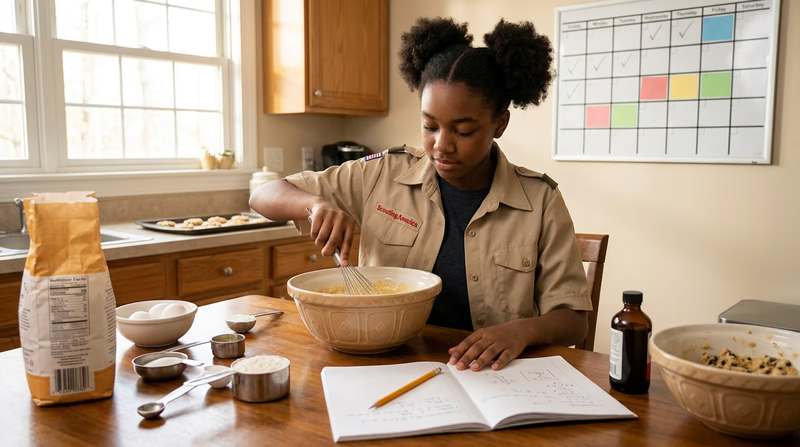
Can you actually deliver what you are promising? This section of your plan explains your capacity — how much product you can make or how many customers you can serve in a given timeframe.
Think about:
- Time: How many hours per week can you dedicate to the business? (Remember — school, Scouting, and other activities come first.)
- Materials and supplies: Can you get what you need reliably? What if demand spikes?
- Space and equipment: Where will you work? Do you have the tools you need?
- Bottlenecks: What is the one thing that limits how much you can produce?
Identifying Liability Risks
Liability means legal responsibility for harm your product or service might cause. This is not about being pessimistic — it is about being prepared. Every business carries some risk, and smart entrepreneurs think about it before problems arise.
Common liability risks for youth-run businesses:
- Food businesses: Allergic reactions, foodborne illness, health code violations
- Service businesses: Property damage (breaking a window while mowing), injury to yourself or others
- Pet businesses: A dog escaping, an animal bite, property damage
- Online businesses: Privacy violations, copyright infringement, misrepresenting your product
For your business plan, list two or three realistic risks and explain what you would do to minimize each one. For example, a cookie business might address allergens by clearly labeling every ingredient and asking customers about allergies before accepting an order.
Licensing Requirements
Some businesses require licenses or permits — even for young entrepreneurs. The requirements vary by state, county, and city. Here is what to research:
- Business license: Many cities require a basic business license for anyone selling goods or services.
- Food handler’s permit: If you sell food, your local health department may require a permit or inspection. Many states have “cottage food” laws that allow small-scale home baking with fewer regulations.
- Sales tax permit: If your state charges sales tax and you sell products, you may need to collect and remit it.
- Zoning laws: Some neighborhoods restrict home-based businesses — especially those with customer traffic or signage.
For your business plan, research whether any of these apply to your idea. You do not need to actually obtain them for the merit badge — just show that you understand the landscape.
SBA Business License and Permit Guide The U.S. Small Business Administration explains which licenses and permits you may need, with links to state-specific resources.