Req 5b — Market Analysis
This section of your business plan forces you to step outside your own enthusiasm and look at your idea through the eyes of the market. You might love your product, but the real question is: Will other people pay for it?
Requirement 5b covers three sub-topics:
- Target customers — who is going to buy?
- Competitors — who else is selling something similar?
- Unique value — why would customers choose you?
Identifying Your Target Customers
Your target market is the specific group of people most likely to buy your product or service. “Everyone” is never the right answer. Even the biggest companies in the world focus on specific customer segments. The more clearly you define your target customer, the better you can design, price, and market your offering.
To define your target market, answer these questions:
- Age range: Are your customers kids, teens, adults, or seniors?
- Location: Are they in your neighborhood, your town, or online?
- Need: What problem are you solving for them? Why would they care?
- Budget: How much can they afford to spend?
- Habits: Where do they already shop? How do they find new products?
Here is how to research whether your target customers actually exist in your area:
- Talk to people. Ask friends, family, neighbors, and classmates if they would buy your product and what they would pay.
- Observe. Visit local shops, browse online marketplaces, and see who is buying similar products.
- Count. Estimate how many potential customers are within your reach. A lawn care business in a neighborhood of 200 homes has a clear, measurable market.
- Survey. Create a simple survey (Google Forms is free) and share it with your target audience.
Analyzing Your Competitors
A competitor is anyone who offers a product or service that your target customers might buy instead of yours. Identifying your competitors is not about being scared of them — it is about understanding the landscape so you can position yourself strategically.
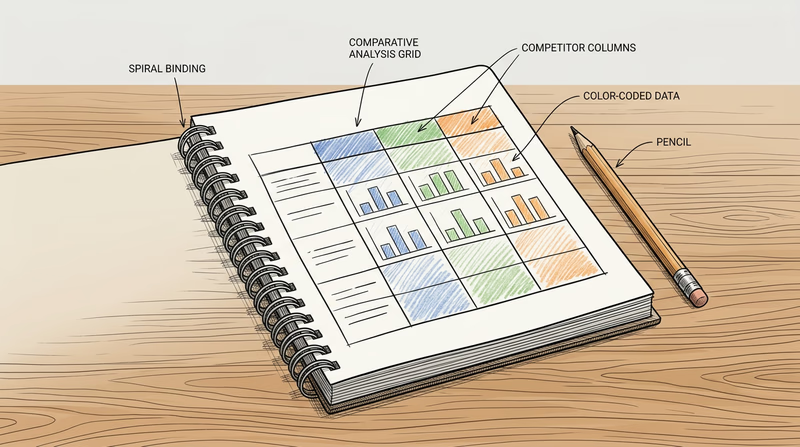
For each competitor, document:
| Factor | What to Assess |
|---|---|
| Who they are | Name, location, size |
| What they offer | Products/services, quality level |
| Pricing | How much they charge |
| Strengths | What they do well — reputation, convenience, variety |
| Weaknesses | Where they fall short — slow delivery, limited options, poor customer service |
Where to find competitors:
- Search Google for your product or service in your area
- Check local business directories and social media
- Ask potential customers who they currently buy from
- Visit farmers’ markets, craft fairs, or local shops
- Search Etsy, Amazon, or other online platforms
Describing Your Unique Value
Your unique value proposition (UVP) answers the question: Why should a customer choose you over the competition? This is the most important sentence in your market analysis — possibly in your entire business plan.
Your UVP might be based on:
- Price: You charge less than competitors (but be careful — competing on price alone is risky)
- Quality: Your product is better made, fresher, or more durable
- Convenience: You deliver, come to the customer, or offer faster service
- Customization: You offer options competitors do not
- Personal connection: You know your customers and their preferences
- Niche focus: You serve a specific audience that big competitors ignore
Putting It All Together
Your market analysis section in the business plan should flow logically:
- Define your target customer with specific detail
- Estimate market size — how many potential customers are within reach
- List 2–3 competitors with honest assessments of their strengths and weaknesses
- State your unique value proposition clearly and confidently
- Explain why customers will switch to you (or try you for the first time)
This section shows your counselor — and any future investor — that your idea is not based on wishful thinking. You have done the research, you understand the competition, and you have a clear reason why customers will choose you.
Census Bureau QuickFacts Look up population demographics for your city or county — useful for estimating your market size and understanding your local customer base.