Req 6 — Running the Business
Your business plan is written. The numbers work. The marketing strategy is ready. Now close your eyes and fast-forward three months — your business has launched, you have real customers, and real money is changing hands. What happens next?
This requirement asks you to think like an experienced entrepreneur: anticipate what could go right, what could go wrong, and how you would handle the hard choices that no business plan can fully predict.
Imagining Your Successes
Thinking about success is not just daydreaming — it helps you plan for growth. Consider these realistic early wins:
Your first paying customer. That first sale proves your concept is real. Someone valued your product enough to exchange money for it.
Repeat customers. When someone comes back for a second order, it means you delivered on your promise. Repeat customers are the foundation of a sustainable business.
Word-of-mouth referrals. A customer tells a friend, who tells another friend. Suddenly you have more orders than you expected. This is exciting — and it tests your capacity planning from Req 5a.
Revenue milestones. Crossing $100, $500, or $1,000 in total revenue feels significant. Each milestone proves your business is growing.
Anticipating Problems
Every business faces challenges. The entrepreneurs who survive are not the ones who avoid problems — they are the ones who have thought about problems in advance and respond calmly when they arrive.
Common problems for young entrepreneurs:
| Problem | Why It Happens | How to Respond |
|---|---|---|
| Not enough customers | Weak marketing, wrong target audience, too much competition | Revisit your market analysis; try a different promotional channel |
| Too many customers | Underestimated demand, viral word of mouth | Raise prices, set order limits, or recruit help (see Req 5d) |
| Running out of supplies | Poor inventory tracking, unreliable supplier | Keep a buffer stock; find a backup supplier |
| Cash flow crunch | Spending faster than revenue comes in | Cut non-essential expenses; require deposits on large orders |
| Quality complaints | Rushing to fill orders, inconsistent process | Slow down, create a quality checklist, and follow it every time |
| Time conflicts | School, sports, Scouting, family obligations | Set realistic business hours; learn to say “not this week” |
Overcoming Failures
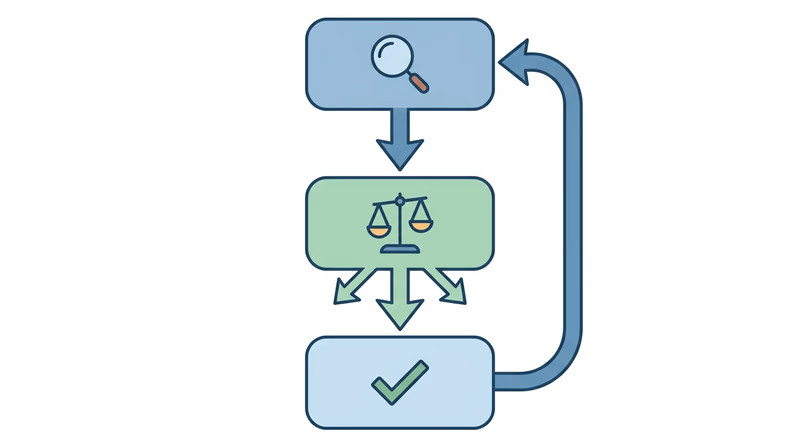
Failure is not the opposite of success — it is part of the path to success. The question is not whether you will fail at something, but how you will respond.
A product flops. You invested time and materials into something nobody wants to buy. Painful, but informative. Ask yourself: Did I misread the market? Was the price wrong? Was the product quality lacking? Use the answers to pivot your offering.
A customer is unhappy. This stings, especially when you have put your heart into the work. But an unhappy customer is a learning opportunity. Listen to their complaint, fix the problem if you can, and use the feedback to prevent it from happening again. Many of the most loyal customers are people whose complaints were handled exceptionally well.
You lose money. Maybe your costs were higher than expected, or sales were slower than projected. Go back to the financial plan you built in Req 5c. Where did the numbers diverge from reality? Adjust your plan and try again.
Ethical Questions in Business
Ethics are the principles that guide your behavior when no one is watching — and when doing the wrong thing might be easier or more profitable than doing the right thing. Entrepreneurs face ethical questions regularly.
Honesty in marketing. Your flyer says “homemade with organic ingredients,” but you realize organic flour costs twice as much as regular flour. Do you switch to cheaper ingredients and keep the label? An ethical entrepreneur either uses the organic ingredients or changes the marketing to be accurate.
Fair treatment of customers. A customer orders cookies for a party and you accidentally mess up the decorations. Do you deliver them anyway, hoping the customer will not notice? Or do you call the customer, explain the situation, and offer to redo the order — even if it costs you time and money?
Handling mistakes. You accidentally charge a customer twice. Do you wait and see if they notice, or do you immediately refund the overpayment and apologize?
Competing fairly. A friend starts a similar business. Do you spread rumors about their product, or do you focus on making your own product better?
Environmental responsibility. Your packaging creates a lot of waste. Is it worth the extra cost to switch to biodegradable materials, even if customers do not seem to care?
Preparing for the Counselor Discussion
Your counselor will want to hear you think through these scenarios in your own words. To prepare:
- Pick 2–3 specific successes you would realistically expect in your first few months.
- Identify 2–3 realistic problems your particular business might face and explain your response.
- Describe at least one ethical dilemma relevant to your business and explain how you would handle it.
- Connect your answers to your business plan — show that you are thinking about your business, not generic examples.
The point of this requirement is not to have perfect answers. It is to show that you have thought deeply about what it takes to run a business with integrity, resilience, and foresight.
Better Business Bureau — Ethics Resources The BBB Standards for Trust outline ethical principles that businesses of all sizes can follow to build and maintain customer trust.