 Getting Started
Introduction & Overview
The air you breathe, the water you drink, and the ground you walk on — environmental science studies all of it. It is the field that asks big questions: How do ecosystems work? What happens when pollution enters a river? How can we protect species from disappearing forever? As a Scout, you already spend time outdoors. This merit badge gives you the tools to understand and protect the world around you.
Environmental Science is one of the Eagle-required merit badges, and for good reason. The skills you develop here — observation, research, critical thinking, and problem-solving — will serve you far beyond Scouting.
Then and Now
Then — The Awakening
For most of human history, people assumed nature could handle whatever we threw at it. Forests seemed endless. Rivers could absorb any waste. Species would always be there. Then things started to change. In the 1800s, the bison that once numbered in the tens of millions were hunted to near extinction. Rivers in industrial cities ran thick with chemicals. Smog choked entire neighborhoods.
A few people sounded the alarm. President Theodore Roosevelt set aside millions of acres as national forests and parks. In 1962, marine biologist Rachel Carson published Silent Spring, revealing how the pesticide DDT was devastating bird populations and poisoning the food chain. Her book is often credited with launching the modern environmental movement.
- Key moment: The Cuyahoga River in Cleveland, Ohio, was so polluted it caught fire — multiple times. The last fire, in 1969, became a rallying cry for clean water laws.
- Mindset: Nature is tough enough to take care of itself — until it wasn’t.
Now — The Science of Solutions
Today, environmental science is a global field with millions of professionals and volunteers working to understand and solve environmental challenges. The U.S. Environmental Protection Agency (EPA), founded in 1970, enforces laws like the Clean Air Act and Clean Water Act. Citizen scientists use apps like iNaturalist and Merlin Bird ID to contribute real data to research projects. Satellites monitor deforestation, air quality, and ice melt in real time.
- Key moment: The bald eagle, once on the brink of extinction from DDT, was removed from the endangered species list in 2007 — one of conservation’s greatest success stories.
- Mindset: We caused many of these problems, and science gives us the tools to fix them.
Get Ready! This merit badge covers a lot of ground — literally. You will explore ecosystems, investigate pollution, study endangered species, and think about how your everyday choices affect the planet. Every section connects to the world right outside your door.
Kinds of Environmental Science
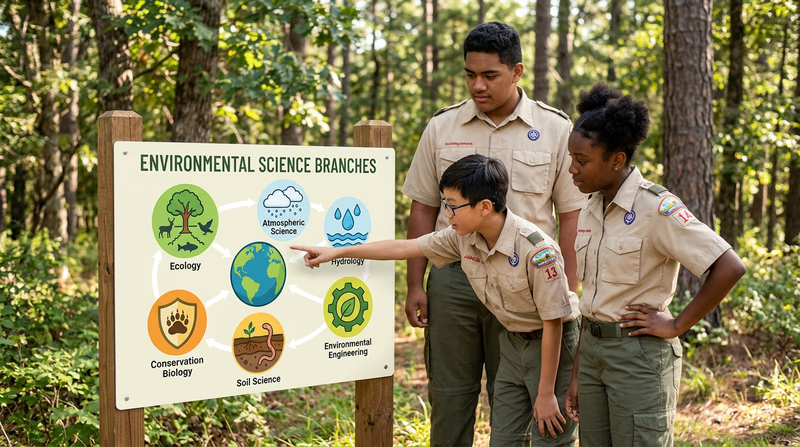
Environmental science is not just one subject — it is a collection of connected fields. Here are the major branches you will encounter as you work through this merit badge.
Ecology
Ecology is the study of how living things interact with each other and their surroundings. It covers everything from the relationship between a bee and a flower to the way an entire forest ecosystem recycles nutrients. When you observe a backyard ecosystem for Requirement 2, you are doing ecology.
Atmospheric Science
Atmospheric science focuses on the air around us — its composition, quality, and the weather patterns it creates. When you study air pollution in Requirement 3, you are exploring this branch. Scientists in this field track everything from smog in cities to the ozone layer high above Earth.
Hydrology
Hydrology is the study of water — where it comes from, where it goes, and what happens to it along the way. This includes rivers, lakes, groundwater, oceans, and even the water cycle itself. In Requirement 4, you will investigate water pollution and learn how your community manages its water supply.
Soil Science
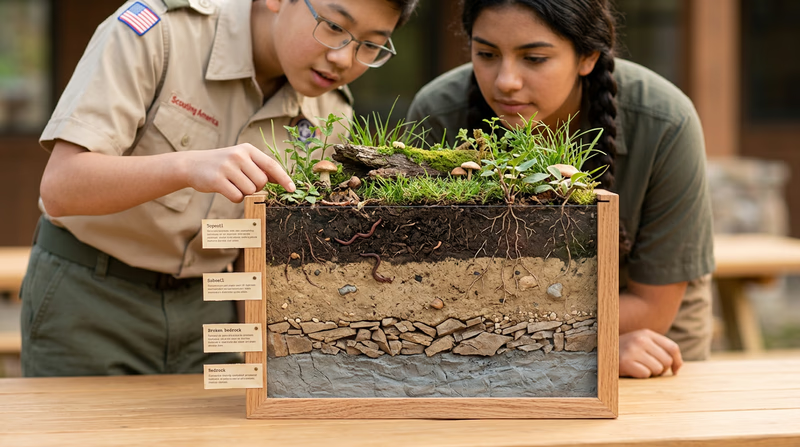
Soil science examines the ground beneath your feet. Soil is far more than dirt — it is a living system teeming with organisms, minerals, and organic matter. Erosion, contamination, and land management are all part of this field. Requirement 5 digs into land pollution, including pesticides, erosion, and toxic waste sites.
Conservation Biology
Conservation biology is the science of protecting species and their habitats. It asks: Why are species disappearing? What can we do to save them? How do we restore damaged ecosystems? Requirements 6, 8, and 9 all connect to this branch — from endangered species to pollinators to invasive species.
Environmental Engineering
Environmental engineers design practical solutions to environmental problems. They build water treatment plants, design systems to capture air pollutants, and figure out how to clean up contaminated land. Requirement 10, where you assess the environmental impact of a construction project, gives you a taste of this work.
Now let’s start with the first requirement and explore what environmental science really means.