Req 10 — Environmental Impact Assessment
What Is an Environmental Impact Assessment?
An Environmental Impact Assessment (EIA) is a formal process that evaluates how a proposed project might affect the natural environment. Before a highway is built, a building goes up, or a dam is constructed, experts study the potential effects on air, water, land, wildlife, and people.
In the United States, the National Environmental Policy Act (NEPA), signed in 1970, requires federal agencies to assess the environmental impact of major projects before they begin. Many states have similar laws for state and local projects.
You are not expected to write a professional EIA for this requirement. But you should think through the same questions a professional would ask.
Choosing Your Project
Pick a construction project you can evaluate. Good options include:
- Building a house on an undeveloped lot
- Adding a building to your Scout camp (a dining hall, shower house, or storage building)
- A road or trail extension in a park or community
- A school addition or new playground
- Any project your counselor approves
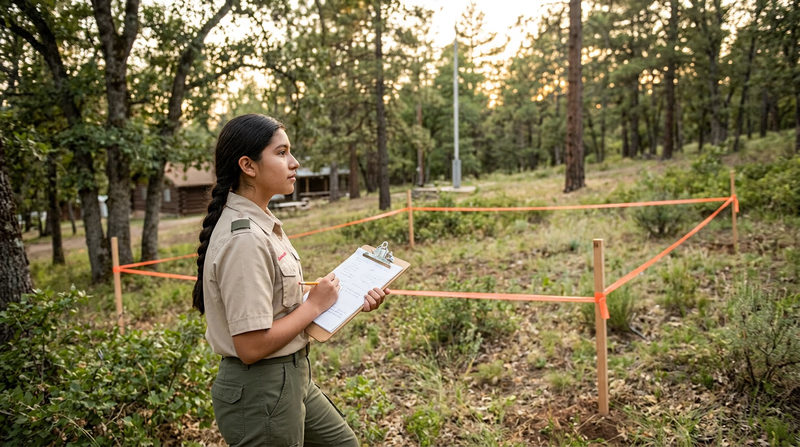
The best choice is a project you can actually visit or visualize clearly. If you pick a Scout camp addition, for example, you can walk the site and observe the existing environment firsthand.
The Three Parts of Your Evaluation
Part 1: Purpose and Benefit
Every project exists for a reason. Start by clearly stating:
- What is the project? Describe what would be built.
- Why is it needed? What problem does it solve or what need does it meet?
- Who benefits? Individuals, a community, a camp, a school?
Be specific. “We need a new dining hall at camp because the current one only seats 80 Scouts and camp attendance has grown to 150” is much stronger than “we need more space.”
Part 2: Alternatives — Including No Action
A critical part of any environmental assessment is considering alternatives — different ways to achieve the same goal, including doing nothing at all.
- The preferred alternative — the proposed project as designed
- Modified alternatives — Could the project be smaller? In a different location? Built with different materials? Could an existing structure be renovated instead?
- The no-action alternative — What happens if the project is not built? This is always considered. Sometimes the best decision is to do nothing.
Part 3: Environmental Consequences
This is the heart of the assessment. For your chosen project, consider the impact on each of these areas:
Environmental Impact Topics
Areas to evaluate for your project
- Land and soil: Will the project require clearing vegetation, grading, or excavation? Will it increase erosion?
- Water: Will the project affect streams, wetlands, or groundwater? Will it increase stormwater runoff?
- Air quality: Will construction or operation produce dust, emissions, or odors?
- Wildlife and habitat: Does the site provide habitat for any species? Will construction displace animals or destroy nesting sites?
- Vegetation: Will trees or native plants be removed? Can they be replaced?
- Noise: Will construction or operation create noise that disturbs wildlife or neighbors?
- Waste: What waste will the project generate during construction and operation? How will it be managed?
- Cultural and historical resources: Are there any historical, archaeological, or culturally significant features on or near the site?
- Visual impact: Will the project change the appearance of the landscape?
- Cumulative effects: How does this project add to the effects of other development in the area?
Putting It All Together
Your discussion with your counselor should follow a logical flow:
- Describe the project and its purpose
- Walk through the alternatives you considered
- Identify the environmental impacts — both positive and negative
- Suggest mitigation measures — things that could reduce the negative impacts (for example: planting trees to replace ones removed, using permeable pavement to reduce runoff, scheduling construction outside of bird nesting season)
- Make a recommendation — Based on your analysis, do you think the project should proceed? With modifications? Or should the no-action alternative be chosen?
You have learned to think like an environmental planner. Now let’s look at where this kind of thinking can take you as a career.