Req 11 — Career Exploration
Careers in Environmental Science
Environmental science is one of the fastest-growing career fields. As communities, businesses, and governments work to address pollution, climate change, and resource management, the demand for people with environmental skills continues to rise.
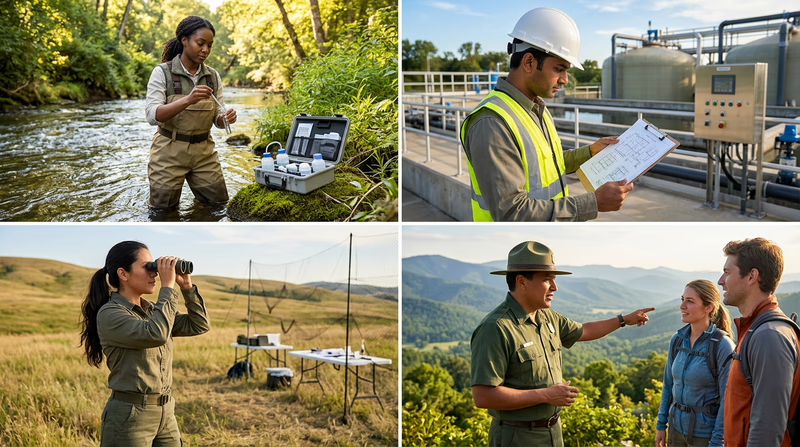
Here are career paths to consider when identifying your three options. Each uses the same skills you have been developing throughout this merit badge — observation, research, data analysis, and problem-solving.
Environmental Scientist
Environmental scientists study the natural world and investigate how human activities affect it. They collect soil, water, and air samples, analyze data, and recommend solutions to environmental problems.
- Education: Bachelor’s degree in environmental science, biology, chemistry, or a related field. Many positions prefer a master’s degree.
- Work settings: Government agencies (EPA, state environmental departments), consulting firms, research labs, nonprofit organizations.
- What they do: Conduct field studies, analyze samples, write environmental reports, advise on compliance with environmental laws.
Environmental Engineer
Environmental engineers design systems and solutions to environmental problems — water treatment plants, air pollution controls, waste management systems, and contaminated site cleanups.
- Education: Bachelor’s degree in environmental engineering, civil engineering, or chemical engineering. A Professional Engineer (PE) license is often required.
- Work settings: Engineering firms, government agencies, construction companies, industrial facilities.
- What they do: Design treatment systems, manage cleanup projects, ensure facilities meet environmental regulations.
Wildlife Biologist
Wildlife biologists study animal populations, their habitats, and the threats they face. They develop management plans to protect species and restore ecosystems.
- Education: Bachelor’s degree in wildlife biology, ecology, or zoology. Fieldwork experience is essential. Many positions require a master’s degree.
- Work settings: U.S. Fish & Wildlife Service, state wildlife agencies, national parks, conservation organizations, universities.
- What they do: Conduct population surveys, track species, manage habitats, develop recovery plans for endangered species.
Park Ranger / Natural Resource Manager
Park rangers and natural resource managers protect and manage public lands — national parks, state parks, forests, and wildlife refuges. They combine environmental knowledge with public outreach and land management.
- Education: Bachelor’s degree in natural resource management, forestry, environmental science, or a related field.
- Work settings: National Park Service, U.S. Forest Service, Bureau of Land Management, state parks departments.
- What they do: Manage trails and facilities, educate visitors, monitor wildlife, fight wildfires, enforce regulations.
Environmental Consultant
Environmental consultants are hired by businesses and developers to assess environmental risks and ensure projects comply with environmental laws. They are the professionals who conduct many of the environmental impact assessments you learned about in Requirement 10.
- Education: Bachelor’s degree in environmental science, geology, engineering, or a related field.
- Work settings: Private consulting firms (often working on-site at client locations).
- What they do: Conduct site assessments, perform environmental audits, advise clients on regulatory compliance, oversee remediation projects.
Conservation Scientist / Forester
Conservation scientists and foresters manage the overall quality of forests, parks, rangelands, and other natural resources. They balance environmental protection with human use — timber production, recreation, and watershed management.
- Education: Bachelor’s degree in forestry, conservation science, or natural resource management.
- Work settings: U.S. Forest Service, state forestry agencies, timber companies, land trusts.
- What they do: Develop land management plans, oversee timber harvests, restore degraded lands, prevent and manage wildfires.
Researching Your Chosen Career
After identifying three careers, pick one and dig deeper. Here is how to structure your research:
Career Research Checklist
What to investigate for your chosen career
- Education required: What degree do you need? What should you major in?
- Certifications or licenses: Are any special credentials required (like a PE license or GIS certification)?
- Experience: What kind of entry-level experience is expected? Internships? Fieldwork?
- Cost of education: What does the degree program cost? Are scholarships available for environmental fields?
- Starting salary: What can you expect to earn in your first position? (Check the Bureau of Labor Statistics at bls.gov.)
- Advancement: Where can you go after your first job? Management? Specialization? Starting your own consulting firm?
- Job outlook: Is the field growing? Are there geographic areas with more opportunities?
- Day-to-day work: What does a typical day look like? Office, field, lab, or a mix?
Where to Research
- Bureau of Labor Statistics Occupational Outlook Handbook (bls.gov/ooh) — salary data, job outlook, education requirements
- Professional associations — organizations like the National Association of Environmental Professionals or the Society for Conservation Biology publish career guides
- University program websites — look at what courses are required for a degree in your chosen field
- Informational interviews — ask a professional in the field about their career path (your merit badge counselor may know someone)
You have explored the full range of environmental science — from ecology to pollution, from endangered species to career paths. Now let’s go even further.