Req 2a — Observing an Ecosystem
What Is an Ecosystem?
An ecosystem is a community of living things (plants, animals, insects, microorganisms) interacting with each other and with their nonliving surroundings (soil, water, air, sunlight, temperature). Your backyard, a pond, a forest clearing, or even a crack in a sidewalk can be an ecosystem.
The key idea is interaction. Nothing in an ecosystem exists alone. A tree provides shade and shelter for birds. Fallen leaves decompose and feed the soil. Insects pollinate flowers. Predators keep prey populations in check. Everything is connected.
Choosing Your Observation Site
Your counselor needs to approve your site before you begin. Here are some good options to consider:
- A backyard or garden — easy to access, surprisingly rich in life
- A local park or nature trail — more variety of species
- A pond, stream, or wetland edge — water attracts a wide range of organisms
- A school campus or community green space — convenient and often underappreciated
- A section of forest or meadow — excellent biodiversity
The best site is one you can visit comfortably on two different days and spend at least 30 minutes observing each time. Pick a spot with a mix of features — some plants, some open ground, maybe a water source nearby.
How to Observe Like a Scientist
This requirement asks you to use three senses: sight, sound, and smell. Here is how to make the most of each.
Sight
Look carefully and look in layers. Start with the big picture — what does the landscape look like? Then zoom in. What is growing on the ground? What is crawling on a log? What is flying overhead?
- Look up: Birds, treetops, cloud cover, sky conditions
- Look around: Shrubs, grasses, rocks, water features, human-made structures
- Look down: Soil, leaf litter, insects, fungi, roots, animal tracks
- Look for movement: Squirrels, birds, insects, ripples in water
Sound
Sit still for at least five minutes with your eyes closed. The sounds of an ecosystem tell you things your eyes might miss. You might hear a bird you could not see, or the rustle of a small animal in the brush.
- Natural sounds: Birdsong, insect buzzing, wind in leaves, water flowing, frog calls
- Human-caused sounds: Traffic, aircraft, machinery, voices
- Note the absence of sound: Silence can tell you something too — areas near heavy traffic often have fewer bird calls
Smell
Smell is often overlooked, but it provides real data. Healthy soil has a rich, earthy scent. Stagnant water smells different from a flowing stream. Flowers in bloom have distinct fragrances that attract pollinators.
- Natural smells: Soil, flowers, decaying leaves, fresh rain, pine
- Warning smells: Chemical odors, sewage, or rot may indicate pollution or decay
Recording Your Observations
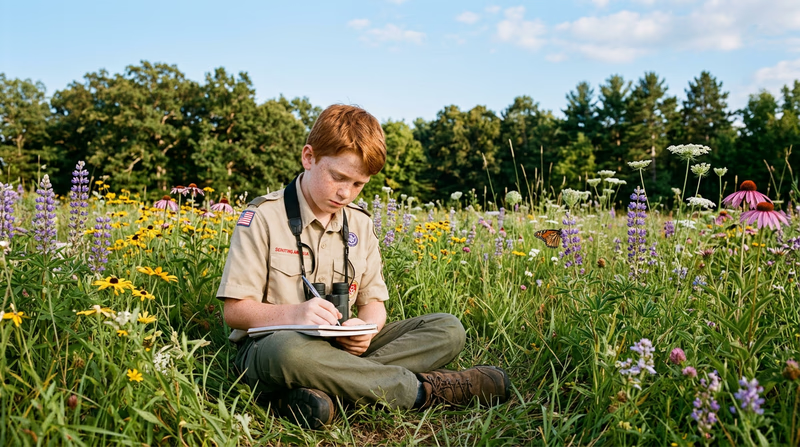
A good field notebook is your most important tool. Write down what you observe as you observe it — do not rely on memory. Include:
- Date and time of each visit
- Weather conditions (temperature, cloud cover, wind, recent rain)
- Location details (describe the exact spot)
- Observations organized by sense (what you saw, heard, and smelled)
- Sketches — even rough drawings help capture details words might miss
Field Observation Kit
What to bring to your observation site
- Notebook and pencil: Your primary recording tool.
- Watch or phone: To note the time of observations.
- Magnifying glass: To examine insects, leaves, and soil up close.
- Binoculars (optional): To observe birds and distant wildlife.
- Camera or phone camera: To document what you find.
- Field guide or nature app: To help identify species (try iNaturalist or Merlin Bird ID).
- Sit pad or small towel: So you can sit comfortably and observe for extended periods.
Now that you know how to observe, it is time to make sense of what you find.