Req 3 — Air Pollution
Choose one of the three options below. Each option explores a different angle of air pollution. Read through all three, pick the one that interests you most, and dive in.
Option A: Particulate Matter
What Is Particulate Matter?
Particulate matter (PM) is a term for tiny particles and droplets floating in the air. Some are large enough to see — like soot or dust. Others are so small they are invisible to the naked eye but can still enter your lungs.
Scientists divide PM into two main categories:
- PM10 — particles 10 micrometers or smaller (about 1/7 the width of a human hair). Examples: dust, pollen, mold spores.
- PM2.5 — particles 2.5 micrometers or smaller (about 1/30 the width of a human hair). These are the most dangerous because they can penetrate deep into your lungs and even enter your bloodstream. Examples: smoke, vehicle exhaust, industrial emissions.
Where Does PM Come From?
- Natural sources: Wildfires, volcanic eruptions, dust storms, pollen
- Human sources: Vehicle exhaust, power plants, construction sites, factories, agricultural burning, wood-burning stoves
Health Effects
PM2.5 is linked to asthma, bronchitis, heart disease, and even premature death. Children, older adults, and people with respiratory conditions are especially vulnerable.
Your Experiment
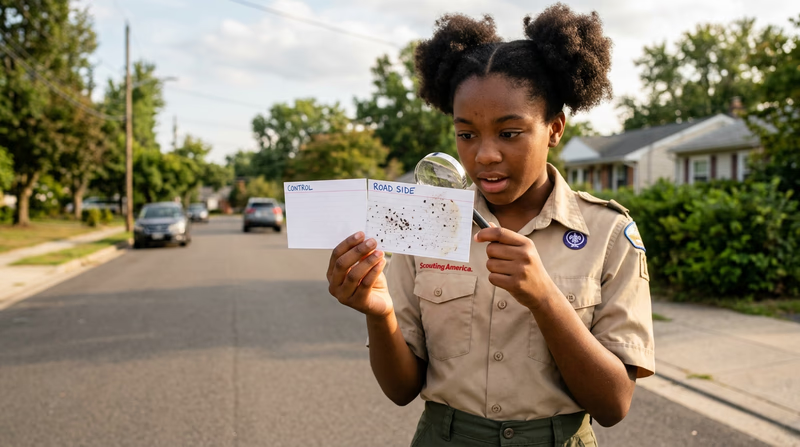
A simple but effective experiment is the sticky card test:
- Coat several index cards with a thin layer of petroleum jelly.
- Place them in different locations — near a road, in a park, inside your home, near a parking lot.
- Leave them exposed for 24–48 hours.
- Collect the cards and compare them. Use a magnifying glass to examine what settled on each one.
- Record which locations collected the most particles and describe what you see.
Option B: Air Pollution and Transportation
The Connection Between Transportation and Air Pollution
Transportation is one of the largest sources of air pollution worldwide. Burning fossil fuels in engines releases pollutants including carbon monoxide, nitrogen oxides, particulate matter, and volatile organic compounds.
Here are examples of how transportation and air pollution interact:
- Rush hour traffic creates concentrated zones of exhaust near highways, raising PM2.5 and ozone levels in surrounding neighborhoods.
- Diesel trucks and buses emit significantly more nitrogen oxides and particulate matter than gasoline vehicles, contributing to smog in urban areas.
- Airplane emissions release pollutants at high altitudes, including carbon dioxide and water vapor contrails that can affect climate patterns.
- Shipping ports concentrate emissions from cargo ships, which burn heavy fuel oil — one of the dirtiest fossil fuels available.
- Electric vehicles produce zero tailpipe emissions, but the electricity used to charge them may come from fossil fuel power plants, shifting the pollution source rather than eliminating it.
Comparing Two Modes
When you compare two modes of transportation, consider:
- Emissions per mile — How much pollution does each mode produce per passenger per mile traveled?
- Energy source — Fossil fuel, electricity, human power?
- Infrastructure impact — Roads and highways require land clearing and materials; bike paths are simpler.
- Lifecycle impact — Manufacturing, fuel production, and disposal all create pollution beyond what comes out of the tailpipe.
Option C: The Clean Air Act
What Is the Clean Air Act?
The Clean Air Act (CAA) is a federal law designed to protect air quality in the United States. The original version was passed in 1963, with major amendments in 1970 and 1990 that gave it real enforcement power.
Goals
- Set limits on how much of specific pollutants can be in the air (National Ambient Air Quality Standards, or NAAQS)
- Regulate emissions from factories, power plants, and vehicles
- Protect the ozone layer by phasing out chemicals like chlorofluorocarbons (CFCs)
- Reduce acid rain by limiting sulfur dioxide and nitrogen oxide emissions
Progress
Since 1970, the six most common air pollutants (called “criteria pollutants”) have decreased by about 78%, even as the U.S. population and economy grew significantly. Leaded gasoline was phased out. Acid rain has been dramatically reduced. The ozone hole is slowly healing.
What Remains
Ground-level ozone (smog) and fine particulate matter (PM2.5) remain problem areas, especially in large cities. Wildfires — increasing in frequency — create major air quality challenges that the law was not originally designed to address. Environmental justice concerns persist, as low-income communities and communities of color often bear a disproportionate pollution burden.
Benefits and Costs
The EPA estimates that the Clean Air Act’s benefits outweigh its costs by a ratio of more than 30 to 1. Benefits include fewer premature deaths, fewer hospital visits, higher crop yields, and better visibility. Costs include compliance expenses for industries and vehicle emission control systems.
Enforcement
The EPA sets the standards. State and local agencies monitor air quality, issue permits, and enforce regulations. Violations can result in fines, shutdowns, and legal action.
From the air above us, we move to the water around us.