Req 4 — Water Pollution
Choose one of the three options below. Each explores a different aspect of water and its environmental challenges.
Option A: Your Community’s Water Supply
Where Does Your Water Come From?
Every community gets its water from one of two main sources:
- Surface water — rivers, lakes, and reservoirs. Most large cities use surface water because it is available in large quantities.
- Groundwater — water stored underground in layers of rock and sediment called aquifers. Many rural areas and smaller towns rely on wells that tap into groundwater.
Some communities use a combination of both. Your local water utility can tell you exactly where your water originates.
How Is It Treated?
Before water reaches your tap, it goes through a treatment process:
- Coagulation and flocculation — chemicals are added that cause tiny particles to clump together
- Sedimentation — the clumps settle to the bottom of a tank
- Filtration — water passes through layers of sand, gravel, and charcoal to remove smaller particles
- Disinfection — chlorine or other disinfectants kill bacteria and viruses
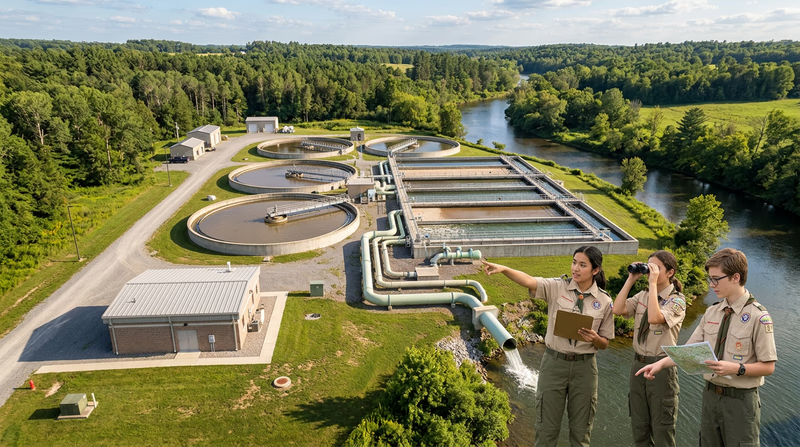
After you use water, it goes down the drain and enters the wastewater treatment system. Wastewater plants remove solids, break down organic material using bacteria, disinfect the water, and return it to a river or ocean.
Your Water Quality Report
Every public water system in the United States is required to publish an annual Consumer Confidence Report (also called a water quality report). You can usually find yours on your water utility’s website or by calling them.
The report lists contaminants found in your water, their levels, and whether those levels meet EPA safety standards. Look for:
- Contaminants detected and their measured levels
- Maximum Contaminant Levels (MCLs) — the highest level the EPA allows
- Sources of contamination — where pollutants may be entering the water supply
Option B: Flooding and Drought
Understanding Extreme Water Events
Flooding and drought are opposite extremes of the water cycle, but both can devastate ecosystems and communities.
Flooding occurs when water overwhelms the land’s ability to absorb or channel it. Causes include heavy rain, snowmelt, dam failures, and storm surges. Environmental impacts of flooding include:
- Erosion — fast-moving water strips away topsoil and reshapes riverbanks
- Habitat destruction — nesting sites, burrows, and dens can be swept away
- Water contamination — floodwaters pick up sewage, chemicals, and debris and spread them across the landscape
- Sediment displacement — deposits of mud and silt can smother aquatic habitats downstream
Drought occurs when an area receives significantly less precipitation than normal for an extended period. Environmental impacts include:
- Water stress — streams dry up, wetlands shrink, and groundwater levels drop
- Wildfire risk — dry vegetation becomes fuel for fires
- Species displacement — animals migrate or die when water sources disappear
- Soil degradation — dry soil erodes more easily and loses its ability to support plant life
How to Research Your Area
- FEMA Flood Maps — Search your address to see if you are in a flood zone
- U.S. Drought Monitor (droughtmonitor.unl.edu) — View current and historical drought conditions
- Local newspaper archives — Search for coverage of past flooding or drought events
- USGS Water Data — Stream gauge data showing water levels over time
Option C: The Clean Water Act
What Is the Clean Water Act?
The Clean Water Act (CWA) is the primary federal law governing water pollution in the United States. It was passed in 1972 (officially the Federal Water Pollution Control Act Amendments of 1972) in response to widespread pollution of the nation’s rivers, lakes, and coastal waters.
Goals
- Make all U.S. waters safe for swimming and fishing
- Eliminate the discharge of pollutants into navigable waters
- Establish water quality standards for all surface waters
- Regulate the discharge of pollutants through a permitting system (NPDES permits)
- Fund the construction of wastewater treatment facilities
Progress
Before the CWA, many rivers and lakes were essentially open sewers. Since its passage:
- Two-thirds of the nation’s waters now meet clean water goals (up from about one-third in 1972)
- Billions of pounds of pollutants have been prevented from entering waterways each year
- Wetland loss has slowed dramatically
- Iconic recoveries have occurred — the Chesapeake Bay, the Great Lakes, and the Potomac River are far healthier than they were in the 1970s
What Remains
- Nonpoint source pollution (runoff from farms, roads, and lawns) is now the largest source of water pollution and is harder to regulate than factory discharge
- Aging infrastructure — many sewage systems are old and overflow during heavy rain
- Emerging contaminants — pharmaceuticals, microplastics, and PFAS (“forever chemicals”) were not anticipated when the law was written
- Environmental justice — some communities still lack access to clean, safe drinking water
Benefits and Costs
The CWA has generated trillions of dollars in benefits through improved public health, recreation, fishing, and property values. Costs include municipal wastewater treatment upgrades and industrial compliance. Like the Clean Air Act, studies consistently show benefits far exceeding costs.
Enforcement
The EPA and state environmental agencies issue permits, monitor water quality, and enforce the law. The Army Corps of Engineers also plays a role in protecting wetlands. Citizens can file lawsuits under the CWA to enforce compliance.
From water, we move to the ground beneath our feet.