Req 8 — Pollination
Choose one of the three options below. Each explores pollination from a different angle — investigation, field observation, or agriculture.
What Is Pollination?
Before choosing an option, make sure you understand the basics. Pollination is the transfer of pollen from the male part of a flower (anther) to the female part (stigma). This transfer is essential for plants to produce seeds and fruit.
Some plants are pollinated by wind or water. But the vast majority of flowering plants depend on pollinators — animals that carry pollen from flower to flower as they feed on nectar, pollen, or other flower resources.
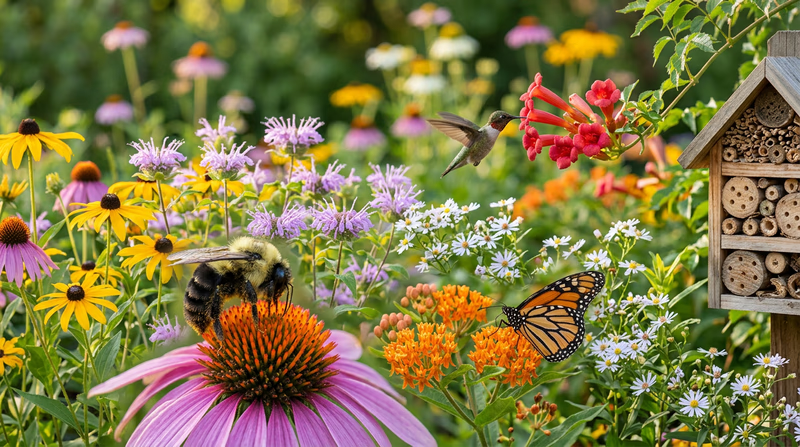
Common pollinators include:
- Bees — the most important pollinator group worldwide
- Butterflies and moths — attracted to colorful, fragrant flowers
- Hummingbirds — drawn to red, tubular flowers
- Bats — pollinate many tropical and desert plants (including agave and saguaro cactus)
- Flies, beetles, and wasps — often overlooked but important pollinators for many plant species
Option A: Investigating Pollination
Finding Pollinators in Your Region
To identify five pollinators and their associated plants, you will need to do some research about what is native to your area. Resources to help:
- Pollinator Partnership (pollinator.org) — search by zip code for a planting guide specific to your ecoregion
- Xerces Society (xerces.org) — offers regional pollinator conservation guides
- Your state’s cooperative extension service — provides native plant and pollinator information
- iNaturalist — photograph pollinators and the app will help identify them
How Scouts Can Help
There are practical, hands-on ways Scouts can support pollinators:
- Plant a pollinator garden at your home, school, or meeting place using native flowering plants
- Avoid pesticides — especially neonicotinoids, which are highly toxic to bees
- Leave natural areas undisturbed — ground-nesting bees need bare soil, and many butterflies need leaf litter
- Provide water — a shallow dish with pebbles and water gives pollinators a safe place to drink
- Build bee hotels — bundles of hollow stems or drilled wood blocks provide nesting sites for solitary bees
- Spread the word — teach your troop, family, and community about pollinator conservation
Option B: Field Observation of Pollination
Planning Your Observation
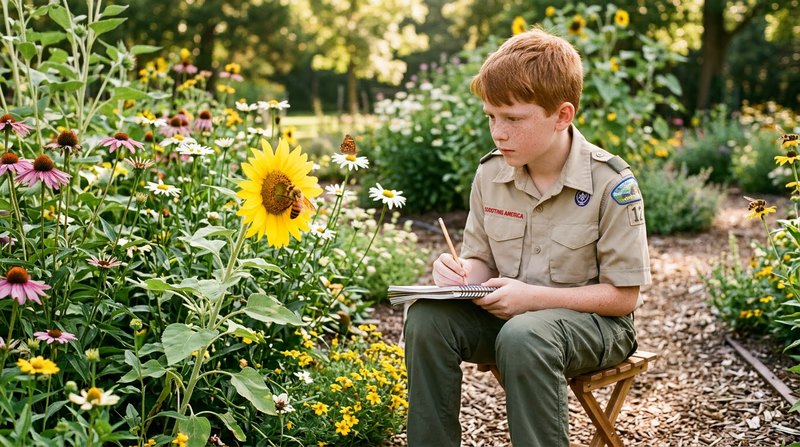
- When: Visit during peak pollination hours — typically mid-morning to early afternoon on a warm, sunny day. Pollinators are less active in cold, windy, or rainy weather.
- Where: A garden, wildflower meadow, park with flower beds, community garden, or botanical garden. Choose a spot with a variety of flowering plants.
- What to bring: Notebook, pencil, camera or phone, a watch, and optionally a magnifying glass.
What to Record
For each observation, note:
- The type of pollinator (bee, butterfly, moth, hummingbird, fly, beetle, wasp)
- The type of plant it visited
- The flower color, shape, and size
- How the pollinator interacted with the flower (landing on it, hovering, crawling inside)
- How long it stayed
- Whether it visited multiple flowers of the same type or different types
Patterns to Look For
- Color preferences — Bees are attracted to blue, purple, and yellow flowers. Hummingbirds prefer red. Moths are drawn to white or pale flowers that are fragrant at night.
- Flower shape — Tubular flowers attract hummingbirds and long-tongued insects. Open, flat flowers attract beetles and flies. Flowers with landing platforms attract bees.
- Timing — Some pollinators are most active in the morning. Others come out at dusk.
Pollination Observation Log
What to record during your hour of observation
- Date, time, and weather conditions: Temperature, cloud cover, wind.
- Location description: Garden, meadow, park — describe the setting.
- Plant species observed: List each flowering plant and its color.
- Pollinator species observed: Identify each visitor as specifically as you can.
- Plant-pollinator pairs: Which pollinators visited which plants.
- Behavioral notes: How pollinators interacted with flowers.
- Sketches or photos: Visual records of what you observed.
Option C: Pollination and Agriculture
Why Agriculture Depends on Pollinators
Without pollinators, many of the crops we rely on would produce little or no fruit. In the United States alone, pollinator-dependent crops are worth over $15 billion per year. Globally, the number is estimated at over $200 billion.
Some crops are almost entirely dependent on insect pollination. Others benefit from it but can also be pollinated by wind. And a few staple crops (wheat, rice, corn) are primarily wind-pollinated and do not need insect help.
Crop-Pollinator Pairs to Know
Here are examples of important crop-pollinator relationships:
| Crop | Primary Pollinator | Notes |
|---|---|---|
| Almonds | Honeybees | Nearly 100% dependent on bee pollination. California almond growers rent millions of beehives each spring. |
| Apples | Honeybees, bumblebees | Bees must visit each flower multiple times for full-sized fruit to develop. |
| Blueberries | Bumblebees | Bumblebees are especially effective because they “buzz pollinate” — vibrating at a frequency that releases pollen. |
| Chocolate (cacao) | Midges (tiny flies) | Cacao flowers are so small that only midges can pollinate them. No midges, no chocolate. |
| Vanilla | Orchid bees (or hand pollination) | Outside of Mexico, vanilla is almost entirely hand-pollinated — one flower at a time. |
| Squash and pumpkins | Squash bees | Specialized native bees that are active before dawn, perfectly timed for squash flowers. |
The Pollinator Crisis
Pollinator populations are declining worldwide due to:
- Habitat loss — fewer wildflowers and nesting sites
- Pesticide use — neonicotinoids are particularly harmful to bees
- Disease and parasites — Varroa mites devastate honeybee colonies
- Climate change — shifts in bloom timing can leave pollinators without food at critical moments
These declines have real economic consequences. Farmers who once relied on wild pollinators now pay to rent managed honeybee hives — a significant added cost.
From the helpful creatures that pollinate our crops, we shift to the harmful ones that invade our ecosystems.