 Getting Started
Introduction & Overview
Overview
Exploration is the human habit of going beyond what is already known. Sometimes that means crossing an ocean, climbing into a cave, or flying a rover to Mars. Sometimes it means asking a new question in a lab, mapping a wetland near home, or studying a place no one in your group has carefully observed before.
This merit badge is about more than travel. It is about curiosity with a purpose. You will learn how explorers think, how they plan, how they manage risk, and how they turn observations into knowledge that helps other people.
Then and Now
Then
For most of human history, exploration was tied to survival, trade, and power. People explored to find water, food, safer routes, new lands, and resources. Ancient Polynesian navigators crossed huge stretches of the Pacific using stars, currents, clouds, and bird behavior. Traders mapped caravan routes across deserts. Sailors pushed into unknown seas hoping to return with spices, gold, or strategic advantages.
Later, exploration became more systematic. Naturalists collected plants and animals. Surveyors mapped rivers and mountains. Polar expeditions measured weather, ice, and magnetic fields. Even when old expeditions were dangerous or poorly understood, they built the maps and records that later explorers could improve.
Now
Modern exploration still includes remote places, but it also includes places people cannot visit easily or directly: the deep ocean, other planets, microscopic worlds, and massive particle labs. Today an explorer might pilot an underwater robot, analyze satellite images, sequence DNA, or use sensors to study wildfire smoke.
What changed most is the method. Modern exploration depends on evidence. Explorers define objectives, gather data carefully, compare results, and share what they learn so others can build on it. That is why exploration belongs just as much in a research facility as on a mountaintop.
Get Ready!
You do not need to be a celebrity adventurer to think like an explorer. You need questions, preparation, observation, and the willingness to learn from what you find. As you work through this guide, picture yourself as part scientist, part planner, and part storyteller.
Kinds of Exploration
Ocean Exploration
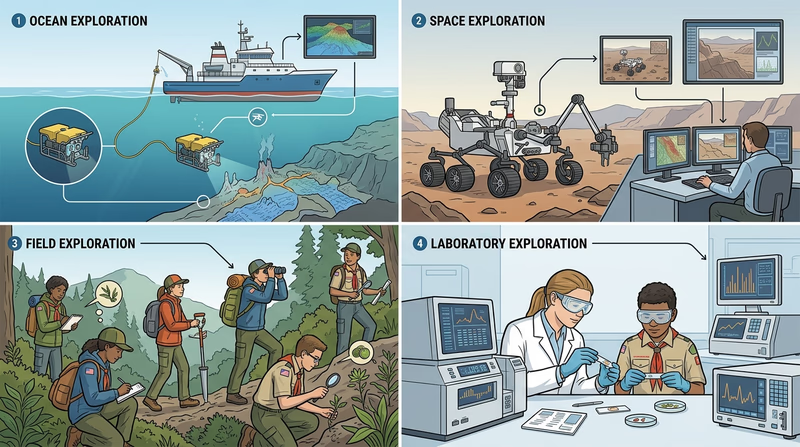
The ocean covers most of Earth, yet much of it is still poorly mapped and rarely seen by humans. Ocean explorers use ships, sonar, remotely operated vehicles, submersibles, and sampling tools to study trenches, coral reefs, underwater volcanoes, and marine life. Ocean exploration often depends on teamwork because one mission may need engineers, biologists, navigators, pilots, and data specialists.
Space Exploration
Space explorers work with rockets, telescopes, satellites, probes, rovers, and life-support systems. Because space is hostile to humans, many missions are robotic. A Mars rover mission, for example, is still exploration even though the rover does the traveling for us. The people designing the mission, selecting the landing site, interpreting the images, and testing the instruments are all part of the exploration team.
Field Exploration on Earth
Field exploration happens in mountains, forests, deserts, caves, rivers, coastlines, and cities. It often looks like hiking, climbing, diving, or surveying, but the key difference is purpose. A field team is not just visiting a place. It is asking a question, collecting evidence, documenting what it finds, and returning with information that matters.
Laboratory Exploration
Some of the biggest discoveries happen indoors. A scientist studying how a disease spreads, a chemist testing a new material, or an astronomer analyzing telescope data is exploring something unknown. The setting is different, but the explorer mindset is the same: observe carefully, test ideas, record results, and share conclusions.
Next Steps
The first step in this badge is getting clear about what exploration actually is. Once you can separate true exploration from ordinary travel or recreation, the rest of the badge starts to make sense.