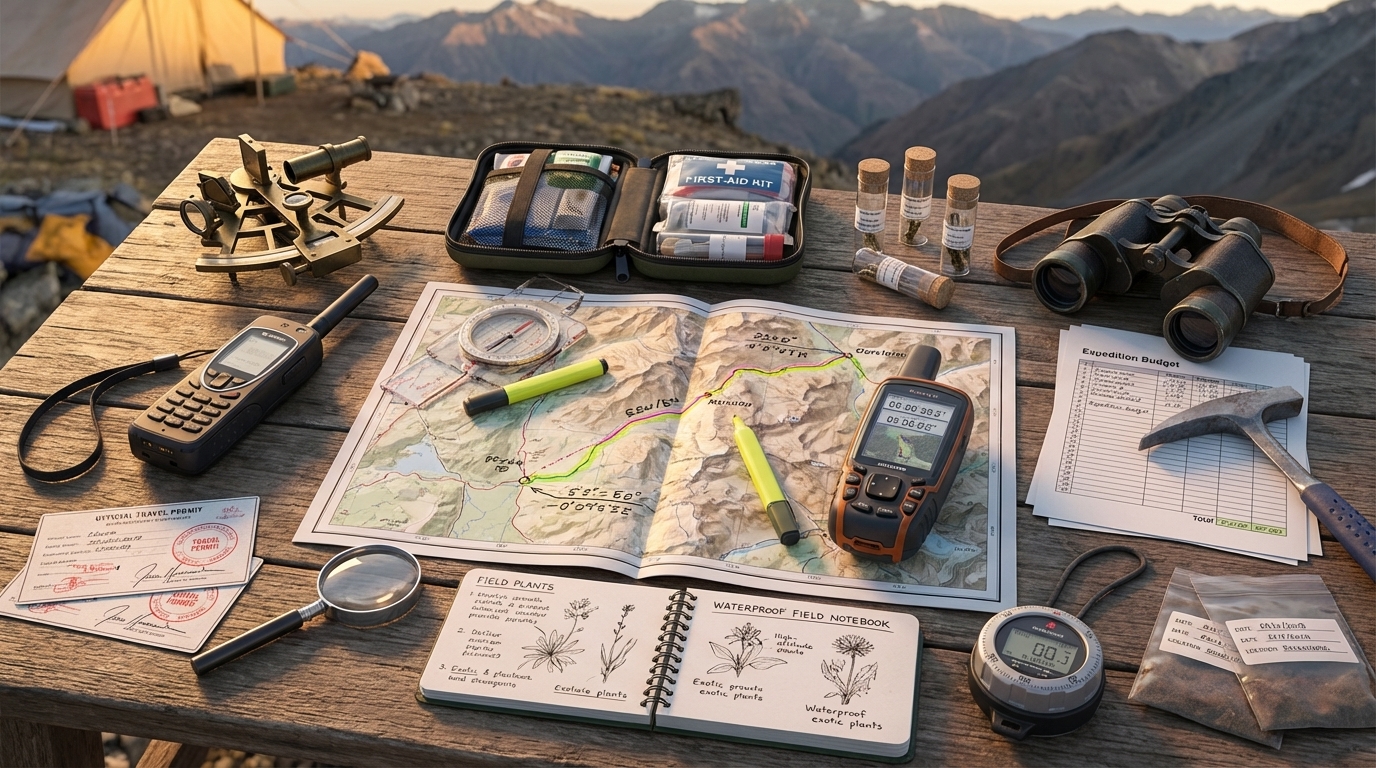
Exploration Merit Badge — Complete Digital Resource Guide
https://merit-badge.university/merit-badges/exploration/guide/
Introduction & Overview
Overview
Exploration is the human habit of going beyond what is already known. Sometimes that means crossing an ocean, climbing into a cave, or flying a rover to Mars. Sometimes it means asking a new question in a lab, mapping a wetland near home, or studying a place no one in your group has carefully observed before.
This merit badge is about more than travel. It is about curiosity with a purpose. You will learn how explorers think, how they plan, how they manage risk, and how they turn observations into knowledge that helps other people.
Then and Now
Then
For most of human history, exploration was tied to survival, trade, and power. People explored to find water, food, safer routes, new lands, and resources. Ancient Polynesian navigators crossed huge stretches of the Pacific using stars, currents, clouds, and bird behavior. Traders mapped caravan routes across deserts. Sailors pushed into unknown seas hoping to return with spices, gold, or strategic advantages.
Later, exploration became more systematic. Naturalists collected plants and animals. Surveyors mapped rivers and mountains. Polar expeditions measured weather, ice, and magnetic fields. Even when old expeditions were dangerous or poorly understood, they built the maps and records that later explorers could improve.
Now
Modern exploration still includes remote places, but it also includes places people cannot visit easily or directly: the deep ocean, other planets, microscopic worlds, and massive particle labs. Today an explorer might pilot an underwater robot, analyze satellite images, sequence DNA, or use sensors to study wildfire smoke.
What changed most is the method. Modern exploration depends on evidence. Explorers define objectives, gather data carefully, compare results, and share what they learn so others can build on it. That is why exploration belongs just as much in a research facility as on a mountaintop.
Get Ready!
You do not need to be a celebrity adventurer to think like an explorer. You need questions, preparation, observation, and the willingness to learn from what you find. As you work through this guide, picture yourself as part scientist, part planner, and part storyteller.
Kinds of Exploration
Ocean Exploration
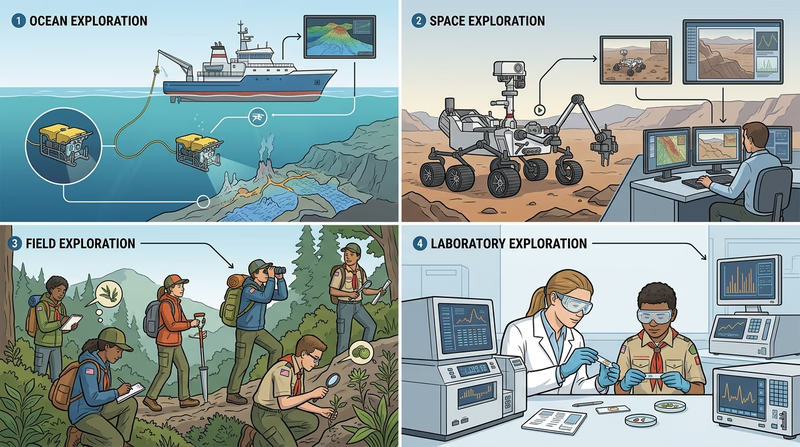
The ocean covers most of Earth, yet much of it is still poorly mapped and rarely seen by humans. Ocean explorers use ships, sonar, remotely operated vehicles, submersibles, and sampling tools to study trenches, coral reefs, underwater volcanoes, and marine life. Ocean exploration often depends on teamwork because one mission may need engineers, biologists, navigators, pilots, and data specialists.
Space Exploration
Space explorers work with rockets, telescopes, satellites, probes, rovers, and life-support systems. Because space is hostile to humans, many missions are robotic. A Mars rover mission, for example, is still exploration even though the rover does the traveling for us. The people designing the mission, selecting the landing site, interpreting the images, and testing the instruments are all part of the exploration team.
Field Exploration on Earth
Field exploration happens in mountains, forests, deserts, caves, rivers, coastlines, and cities. It often looks like hiking, climbing, diving, or surveying, but the key difference is purpose. A field team is not just visiting a place. It is asking a question, collecting evidence, documenting what it finds, and returning with information that matters.
Laboratory Exploration
Some of the biggest discoveries happen indoors. A scientist studying how a disease spreads, a chemist testing a new material, or an astronomer analyzing telescope data is exploring something unknown. The setting is different, but the explorer mindset is the same: observe carefully, test ideas, record results, and share conclusions.
Next Steps
The first step in this badge is getting clear about what exploration actually is. Once you can separate true exploration from ordinary travel or recreation, the rest of the badge starts to make sense.
Req 1 — What Counts as Exploration
This requirement gives you the foundation for the whole badge. You will first define exploration clearly, then compare how exploration changes in very different environments. Keep these two questions in mind as you read:
- What makes exploration different from recreation?
- How do goals, tools, and risks change from place to place?
Requirement 1a
A long bus ride, a hard backpacking trip, and a scientific expedition can all feel exciting, but they are not the same thing. Exploration means entering a subject, place, or problem with the goal of learning something not yet known to you or your team. It has a purpose beyond the experience itself.
A useful working definition is this: exploration is purposeful discovery in an unfamiliar area, guided by observation, evidence, and documentation. Notice what is built into that definition:
- Purpose — you are trying to answer a question or reach an objective.
- Unfamiliarity — the place, topic, or process is new to you or not fully understood.
- Evidence — you collect notes, samples, measurements, images, or other observations.
- Documentation — you record and share what happened so others can learn from it.
That is why exploration is different from ordinary adventure travel. Adventure travel is centered on the participant’s experience: the thrill, challenge, scenery, and personal story. Exploration may include those things, but they are not the main goal.
Exploration or Just an Adventure?
Use these clues to tell the difference- Exploration: Starts with a question or objective, such as mapping a cave passage, documenting bird species in a wetland, or testing a robot in rough terrain.
- Adventure travel: Starts with the experience, such as rafting a river, hiking for fun, or taking a scenic trek.
- Exploration: Produces records others can use later.
- Adventure travel: Produces memories, photos, and stories, but not necessarily new knowledge.
- Exploration: Often involves a method, schedule, safety plan, and assigned roles.
- Recreational trips: May have a plan, but the plan mainly supports enjoyment.
Trekking or hiking can become exploration if you add a real discovery goal. Imagine two crews hiking the same trail. One is there to enjoy the view. The other is comparing stream conditions above and below a recent burn scar, recording water clarity and erosion points. The route may be identical, but the second crew is exploring because it is collecting information with a purpose.
Tour-group travel is usually the opposite of exploration. A tour follows a known route, with known stops, known schedules, and guides who already understand the place. You can learn a lot on a tour, but you are learning what is already known and organized for visitors. Exploration deals with uncertainty.
The official article below is useful because it compares exploration and adventure directly. As you read it, look for the ideas of mission, evidence, and contribution.
What's the Difference Between Adventure and Exploration? (website) A short comparison that helps you separate personal adventure from mission-driven exploration. Link: What's the Difference Between Adventure and Exploration? (website) — https://medium.com/@idee-explores/whats-the-difference-between-adventure-and-exploration-eb1a4628f925Requirement 1b
Exploration always starts with questions, but the way you answer those questions changes with the environment. The tools, safety issues, team structure, and timeline for an ocean mission are very different from those for a lab study.
Ocean
Ocean exploration is shaped by pressure, depth, weather, and limited visibility. Teams often depend on ships, sonar, cameras, and remotely operated vehicles because humans cannot safely reach many places. Ocean explorers have to think about fuel, communication delays, crew fatigue, and what happens if equipment fails far from shore.
Space
Space exploration is even less forgiving. Missions are expensive, highly technical, and carefully tested because mistakes can end the mission before it begins. Space explorers must deal with launch windows, radiation, extreme temperatures, signal delay, and the fact that repairs may be impossible. That is why so much space exploration is robotic.
Jungle
Jungle exploration is usually more direct and physical. Dense plants, rain, mud, insects, heat, and navigation challenges slow everything down. Equipment has to survive moisture and rough terrain. Teams may need local guides, medical planning, waterproof storage, and careful route choices.
Science Lab in a City
A laboratory may look less dramatic, but the approach can be just as demanding. Instead of dealing with storms or cliffs, lab explorers deal with precision, contamination, calibration, repeatability, and controlled variables. A biologist studying new cells or a physicist testing a detector still explores the unknown. The difference is that the environment is controlled so the data can be trusted.
A good way to explain these differences is to compare four categories:
| Setting | Main Challenge | Common Tools | What Success Looks Like |
|---|---|---|---|
| Ocean | Depth, weather, access | Ships, sonar, ROVs, sensors | Mapping or observing places humans rarely see |
| Space | Distance, launch risk, hostile environment | Rockets, probes, rovers, telescopes | Reliable data returned from extreme conditions |
| Jungle | Terrain, heat, navigation, logistics | GPS, sample kits, notebooks, machetes, radios | Good records collected safely in a hard-to-reach place |
| Lab | Precision, contamination, controlled testing | Microscopes, detectors, computers, instruments | Repeatable results that answer a focused question |
This official video is a good reminder that exploration is broader than famous journeys. As you watch, notice how often the speaker talks about questions, evidence, and preparation.
🎬 Video: What Is Exploration (video) — https://www.youtube.com/watch?v=7u2QqMSjroQ
Before you move on, practice explaining exploration in one sentence of your own. If you can define it simply and compare how it changes across different environments, you will be ready to understand why exploration has mattered throughout history.
Req 2 — The Story of Human Discovery
The history of exploration is really the history of people pushing past the edge of what they knew. Sometimes they crossed oceans. Sometimes they descended into caves, drilled into ice, looked through stronger telescopes, or built tools that could detect things no human eye can see. Every time explorers asked a better question or reached a new place, the field they worked in changed.
Your job for this requirement is not to memorize every famous expedition. It is to show your counselor how exploration helped a field grow. Pick one area — space, paleontology, oceanography, medicine, archaeology, climate science, or another field that interests you — and trace how discoveries in that field changed what people understood.
A Quick History Pattern
Most fields of exploration follow a similar pattern:
- People notice a mystery. There is something they do not understand.
- They build tools. Better ships, sensors, microscopes, submersibles, or software make new observations possible.
- They gather evidence. Maps, samples, measurements, photos, and records start replacing guesses.
- The field changes. New evidence leads to new questions, better models, and sometimes entirely new branches of science.
That pattern works for voyages across the Atlantic, dives to the seafloor, rover missions on Mars, and lab experiments that reveal new particles.
Choosing a Field to Discuss
Pick a field that gives you enough interesting examples to talk about. Good choices usually have three parts:
- A big question — What were people trying to understand?
- A breakthrough tool or expedition — What made progress possible?
- A lasting impact — What changed because of that work?
Good Fields for This Requirement
Choose one that gives you a clear discovery story- Aerospace: From early rocketry to satellites, moon landings, and Mars rovers.
- Oceanography: From coastal charts to deep-sea mapping and underwater robotics.
- Paleontology: From scattered fossil finds to careful excavation and ancient climate clues.
- Medicine and biology: From microscopes to DNA sequencing and disease tracking.
- Physics: From simple observation to giant laboratories that test the basic structure of matter.
How to Build Your Discussion
A strong counselor discussion sounds like a story with a point. Try this structure:
1. Start with the mystery
What did people not understand yet? In oceanography, maybe it was what the deep sea looked like. In aerospace, maybe it was whether humans could survive spaceflight. In paleontology, maybe it was what ancient environments were like.
2. Name key explorers, missions, or institutions
You do not need a giant list. Two or three important examples are enough if you explain them well. Focus on what each expedition or discovery added.
3. Explain the tools
Many discoveries happen because the tools improve. Telescopes reveal more detail. Remotely operated vehicles let scientists see deep underwater. Better dating methods help paleontologists place fossils in time.
4. Show the impact
This is the most important part. What did the field gain? Better maps? New theories? Safer technology? A better understanding of life, climate, disease, or geology?
Example: Space Exploration
Space is a strong example because the history is easy to follow. Early rockets showed that leaving Earth might be possible. Satellites changed weather forecasting, communication, and mapping. Human missions proved that crews could work in orbit and on the Moon. Robotic probes and rovers now explore places humans cannot reach safely.
The field grew because each mission answered one question and raised new ones. Could we launch reliably? Could humans survive? Is there water on Mars? Could a rover collect rock samples for future return? Exploration pushed aerospace from dream to engineering discipline.
🎬 Video: 50 Years of Space Exploration (video) — https://youtu.be/Bj3n1BIq_5I?si=v6V_FbNTqTU5P4FF
Example: Ocean Exploration
For a long time, people knew more about the Moon’s surface than the deep ocean floor. Improved sonar, underwater cameras, crewed submersibles, and remotely operated vehicles changed that. Ocean exploration revealed hydrothermal vents, strange deep-sea life, seafloor mountains, and the structure of trenches and ridges.
That matters because oceanography is not just about curiosity. It affects climate science, fisheries, hazard planning, and our understanding of how Earth works.
🎬 Video: Into the Abyss: How Humans Became the Astronauts of the Deep Sea (video) — https://youtu.be/-7xB6BT13nw?si=guCs4QMUPYQPiixG
Example: The Classic Age of Exploration
Older voyages also matter, but talk about them carefully. They expanded maps and trade routes, but they were also connected to colonization, conflict, and exploitation. A thoughtful Scout can recognize both sides: explorers increased geographic knowledge, yet their journeys were not automatically good for everyone they encountered.
🎬 Video: The Age of Exploration (video) — https://www.youtube.com/watch?v=sGeXtUZQScc
Example: Exploration Inside Physics
Physics may seem less adventurous, but it still fits the pattern. Scientists built larger and more precise instruments to explore what matter is made of. The search for the Higgs boson, for example, required enormous detectors, international teamwork, and careful analysis. That is exploration of the unseen.
🎬 Video: How the Higgs Boson Was Discovered (video) — https://youtu.be/1XpCnCVfuYk?si=XrohO26RBxWr9Epg
The next requirement asks a bigger question: not just how exploration happened, but why it matters at all.
Req 3 — Why Exploration Matters
This requirement asks you to move from definitions and history to meaning. Exploration matters because it turns curiosity into understanding. On this page, you will look at three connected ideas:
- why exploration needs a scientific basis
- how explorers improve human knowledge
- what personal qualities help someone become an explorer
Requirement 3a
Without a scientific basis, exploration can become guesswork, rumor, or storytelling without proof. A scientific basis means explorers ask clear questions, gather evidence carefully, and check whether their conclusions match the data. That does not remove wonder. It makes the wonder trustworthy.
Imagine two people visiting the same cave. One says, “This place feels ancient and unusual.” The other measures temperature, maps passages, notes rock formations, photographs formations from fixed points, and records water flow. Both are curious, but only the second approach creates information other people can test and use.
A scientific basis matters for three big reasons:
Reliability
Good exploration records what actually happened, not just what someone hoped to find. Measurements, repeated observations, and careful notes reduce mistakes.
Safety and planning
Science helps explorers choose the right tools, estimate risks, and understand the environment. Weather models, medical research, engineering tests, and habitat studies all make expeditions safer and smarter.
Useful results
An exploration that produces reliable data can help other people. It can guide future missions, support conservation, improve technology, or answer questions that matter beyond the expedition team.
🎬 Video: What It Takes to Be an Adventurer (video) — https://www.youtube.com/watch?v=aoq6jNBtNtw
Requirement 3b
Explorers have changed the way people understand geography, weather, oceans, disease, ecosystems, geology, and space. Maps became more accurate because explorers measured coastlines and routes. Species were described because naturalists documented what they found. Climate scientists understand ancient weather better because teams drilled ice cores and studied sediments.
Exploration often turns unknowns into better questions. That is an important point. A mission does not have to solve everything to be valuable. Sometimes its biggest contribution is showing what we should study next.
Here are a few ways explorers help the world understand itself:
- They reveal what exists — species, landforms, patterns, or processes.
- They connect places and systems — oceans influence climate, forests influence water, dust in one region can affect ecosystems in another.
- They test ideas — a mission can support or challenge an earlier theory.
- They share evidence — reports, maps, samples, and data help future teams go farther.
🎬 Video: Why We Explore (video) — https://www.youtube.com/watch?v=6_SRZiU9EuI
Requirement 3c
You do not have to be fearless, famous, or rich to be an explorer. You do need a certain set of habits. The strongest explorers usually combine curiosity with discipline.
Curiosity
Explorers notice what other people walk past. They ask, “Why is it like that?” and then keep following the question.
Patience
Real discovery is rarely fast. Weather delays happen. Instruments fail. Data has to be checked. Sometimes the most important result is proving that an idea was wrong.
Observation
An explorer needs to see details clearly and record them honestly. That means paying attention when nothing dramatic seems to be happening.
Adaptability
Plans change. Routes close. Conditions shift. Strong explorers adjust without losing sight of the objective.
Teamwork
Most modern exploration is not a solo act. Missions rely on leaders, specialists, logistics support, communicators, and safety planning.
Integrity
This may be the most important trait of all. Exploration only helps others if the record is honest. You cannot leave out bad data just because it is inconvenient.
What Makes an Explorer
Use these points in your discussion with your counselor- Curious enough to ask real questions
- Prepared enough to plan carefully
- Skilled enough to use tools well
- Honest enough to record what actually happened
- Resilient enough to keep working when conditions get hard
🎬 Video: Why Great Scientists Ask Great Questions? w/ Neil deGrasse Tyson (video) — https://youtu.be/1B9q2eS78Tw?si=BM2e4T2u7pBcTTXq
A strong answer for this requirement brings all three parts together: exploration matters because it helps people learn reliably, it expands what humans understand, and it depends on character as much as equipment.
The next requirement turns those big ideas into real examples by asking you to choose one path and study exploration in action.
Req 4 — Choose a Real-World Exploration Path
You must choose exactly one option from this requirement. Each option lets you study exploration in a different way: through a person, through a mission, or through a research setting.
Your Options
- Req 4a — Profile a Living Explorer: Study a real person who is exploring right now or in recent years. You will learn how explorers set goals, lead teams, deal with setbacks, and communicate their work.
- Req 4b — Study a Scientific Expedition: Focus on one major mission, such as a rover project, river expedition, or deep-sea mission. You will see how objectives, discoveries, and evidence fit together.
- Req 4c — Explore Discovery in the Lab: Look at exploration that happens in labs and research facilities. You will compare indoor research to field exploration and see why both matter.
How to Choose
Choosing Your Option
Think about what kind of story you want to tell- Best if you like personal stories: Req 4a lets you focus on one explorer’s motivation, leadership, and achievements.
- Best if you like missions and big discoveries: Req 4b highlights one expedition from objective to outcome.
- Best if you like science and problem-solving: Req 4c shows how discovery can happen in controlled research settings.
- Time and preparation: Req 4a is often easiest if you can find good interviews and articles. Req 4b works well if a mission has a strong website and clear results. Req 4c is great if you already know a local scientist, teacher, observatory, or lab.
- What you will gain: Req 4a teaches you about people, Req 4b teaches you about mission design, and Req 4c teaches you how scientific method connects lab and field work.
Whichever path you choose, aim for the same core idea: explain the objective, describe what was discovered, and show why it mattered.
Req 4a — Profile a Living Explorer
This option works best when you choose someone whose work is clear, specific, and recent enough that you can find interviews, articles, mission reports, or talks. You are not just making a biography. You are explaining what this person set out to do and what one expedition achieved.
What to Look For in a Good Explorer Profile
Choose a person with a mission, not just a famous name. A strong example usually has:
- a clear field of exploration
- one expedition or project you can describe in detail
- evidence of what was achieved
- enough trustworthy sources to support your report
Jane Goodall is a great choice if you want field science and animal behavior. Ranulph Fiennes fits if you want extreme endurance and leadership. Someone like Levison Wood can work if you want journey-based exploration with a strong storytelling side. You might also choose a scientist, marine explorer, astronaut, cave explorer, or polar researcher you discover on your own.
Build Your Report Around Four Questions
1. What was the explorer trying to accomplish?
Do not start with where they were born. Start with the mission. Were they trying to document chimpanzee behavior, cross a polar region, map a river system, or collect data from a remote ecosystem?
2. Why was the expedition difficult?
Every real expedition has obstacles. Those might include weather, distance, funding, permits, altitude, political boundaries, equipment limits, or physical danger. Explaining these challenges makes the achievement more meaningful.
3. What did the expedition achieve?
Be specific. Did it produce scientific observations, complete a route, collect samples, create images, inspire conservation, or answer an important question?
4. Why does the work matter?
This is the part many reports miss. Help your audience understand why the expedition was worth doing. Did it expand knowledge, change attitudes, improve methods, or open the door to later work?
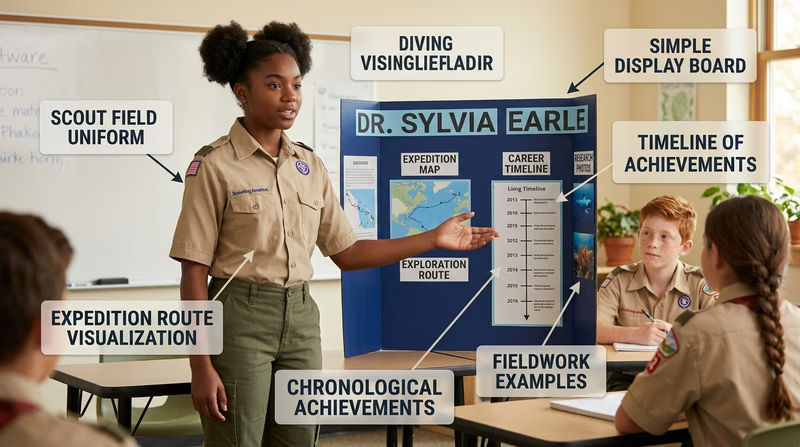
A Strong Explorer Presentation Includes
Use this to organize your notes- Explorer’s name and field
- One main expedition
- Mission objective
- Major obstacles
- Important achievements
- Why the work matters
- One or two details that make the story memorable
Presentation Formats That Work
You can meet this requirement in more than one way:
- Verbal talk: best if you like speaking and can keep your points organized.
- Written report: best if you want to explain details carefully with a clear beginning, middle, and end.
- Slide presentation: best if photos, maps, and timelines will help your audience follow the story.
Official Resources
These videos give you several very different kinds of living explorers to study.
🎬 Video: 50 Years of Discovery | Jane Goodall and The Leakey Foundation (video) — https://www.youtube.com/watch?v=I4ivrfIOKjw
🎬 Video: The World's Greatest Living Explorer | Ranulph Fiennes (video) — https://youtu.be/ePOa2OpRQ2g?si=uN7djyhK_Zylurjq
🎬 Video: Levison Wood / Walking the Nile / Himalayas / Americas / Arabia Badlands & Beyond (video) — https://youtu.be/MkOV5Ex6puA?si=aq81Mw_U2hC6LRnl
🎬 Video: Unsung Heroes of Everest | Nat Geo Live (video) — https://youtu.be/ihmfkdEcDyk?si=2aIG3YmL5YzTaVhC
Make the Achievement Easy to See
A simple timeline often helps:
- preparation and goal
- expedition itself
- biggest challenge
- main outcome
- long-term importance
That structure keeps your report focused on exploration, not random life details.
If you would rather focus on a mission than a person, the next page may be a better fit.
Req 4b — Study a Scientific Expedition
This option is all about the mission itself. Instead of centering your report on one person, center it on the expedition’s goal, the tools it used, the discoveries it made, and the questions those discoveries helped answer.
A great scientific expedition has a clear before-and-after story. Before the mission, scientists had questions. After the mission, they had better evidence.
What Makes a Good Expedition Choice?
Pick a mission that has:
- a clear objective
- a known place or target
- documented discoveries
- enough public information for you to explain it well
Mars 2020 is a strong choice because NASA explains the mission clearly. A deep-river or deep-ocean expedition can also work well because it shows how field conditions shape discovery.
Four Parts of a Strong Expedition Report
Mission objective
What was the team trying to learn or accomplish? For Mars 2020, that includes studying geology, searching for signs of ancient life, and collecting samples for possible future return.
Mission method
How did the expedition explore? Did it use a rover, sonar, divers, cameras, weather instruments, sampling tools, drones, or lab analysis?
Main discoveries
What was found? Try to name two or three discoveries or important observations instead of listing everything.
Scientific importance
How did those findings help scientists answer a bigger question? That answer is the heart of the requirement.
Mars 2020: Perseverance Rover (website) NASA's mission page explains the rover's objectives, instruments, milestones, and major findings in one place. Link: Mars 2020: Perseverance Rover (website) — https://science.nasa.gov/mission/mars-2020-perseverance/The Mars 2020 mission is a good example because the rover is not wandering randomly. It is following a scientific plan. Scientists chose Jezero Crater because they believe it once held water. That makes it a promising place to look for signs of ancient habitability. Every drive, image, and rock sample connects back to that question.
🎬 Video: Expedition Amazon - Into the Waters | National Geographic (video) — https://youtu.be/Tg27pdTvG4s?si=5MzaADOB_JRPdB2B
A river expedition like the Amazon example shows a different style of science. Instead of one rover and a distant control room, you see field teams moving through a real environment, adapting to conditions, observing ecosystems, and bringing back information about life and landscape.
Questions to Ask About Any Expedition
Use these when gathering information:
- What problem or mystery led to the mission?
- Why was this location chosen?
- What equipment made the mission possible?
- What were the most important discoveries?
- How did the new information improve scientific understanding?
A Helpful Way to Explain Impact
Use this sentence pattern:
“Before this expedition, scientists were unsure about ____. After the expedition, they had evidence that ____.”
That pattern keeps your report centered on knowledge gained, which is exactly what scientific exploration is for.
If indoor research interests you more than field missions, the next option shows how labs and observatories explore the unknown too.
Req 4c — Explore Discovery in the Lab
A lab may not look like an expedition base camp, but it can still be a place of real exploration. In a research facility, scientists are often working at the edge of what people know. They ask questions, test ideas, collect evidence, and revise their understanding based on results. That is exploration.
What Counts as Laboratory Exploration?
Laboratory exploration includes many kinds of work:
- Medicine: testing how diseases spread, how cells behave, or how treatments work
- Biology: studying DNA, microbes, ecosystems, and tissue samples
- Chemistry: exploring how materials react, combine, or change
- Physics: using detectors and instruments to study matter, energy, and forces
- Astronomy: analyzing telescope data, images, and signals collected from space
In each case, the explorer is not just repeating known facts. They are using methods to uncover something new.
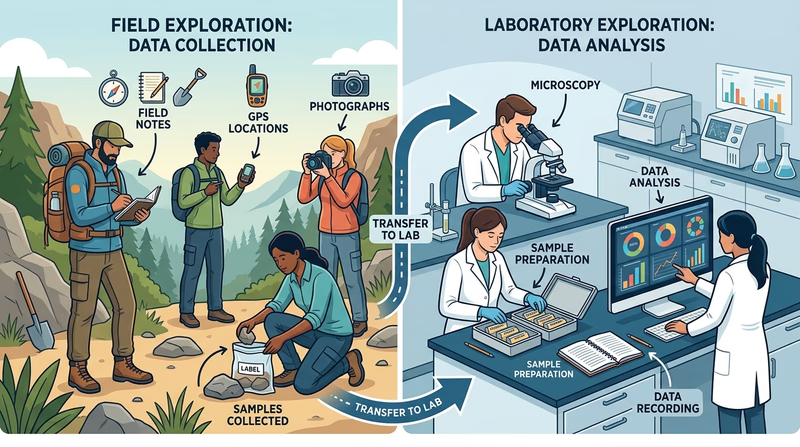
How Labs and Field Exploration Are Similar
At first, a jungle expedition and a lab experiment may seem unrelated. But they share the same core structure.
| Field Exploration | Laboratory Exploration |
|---|---|
| Starts with a question about a place, species, or system | Starts with a question about a process, material, or phenomenon |
| Needs planning, equipment, and roles | Needs planning, equipment, and roles |
| Collects samples, images, or observations | Collects measurements, samples, or test results |
| Records data carefully | Records data carefully |
| Interprets findings and shares conclusions | Interprets findings and shares conclusions |
The environment is different, but the mindset is the same.
How They Are Different
The biggest difference is control. In the field, explorers work with weather, distance, terrain, wildlife, and other conditions they cannot fully manage. In the lab, scientists try to control as many variables as possible so they can isolate what is happening.
That means field exploration is often messier but broader, while lab exploration is often narrower but more precise. Good science needs both.
Official Resources
🎬 Video: Research Scientist (video) — https://www.youtube.com/watch?v=uRreC41dGz4
🎬 Video: Inside the World's Largest Science Experiment (video) — https://youtu.be/nrXhK3Gh5EE?si=xSgNbNGvMNmaBl22
🎬 Video: Day in the Life of a Research Scientist (video) — https://www.youtube.com/watch?v=biS7e79xZcs
These resources are useful because they show different scales of scientific exploration. One scientist may work with benches, samples, and instruments in a smaller lab. Another may be part of a huge international physics project that uses giant machines and massive teams. Both are still exploring.
Once you understand the people and places that make exploration possible, you are ready to choose a real organization or facility to learn from in Requirement 5.
Req 5 — Choose a Place to Learn
You must choose exactly one option from this requirement. Both choices put you in contact with real organizations that support discovery, but they emphasize different parts of the exploration world.
Your Options
- Req 5a — Visit an Exploration Organization: Learn how a larger organization funds, supports, promotes, or coordinates exploration. This option helps you see the big picture behind expeditions and research.
- Req 5b — Visit a Research Facility: Focus on a specific working place such as a lab, observatory, or research center. This option helps you see exploration happening up close through tools, people, and daily work.
How to Choose
Choosing Between 5a and 5b
Pick the option that gives you the clearest learning experience- Choose 5a if you want to understand how exploration is sponsored, organized, and supported across many projects.
- Choose 5b if you want to see one working environment in detail and understand what exploration looks like day to day.
- Time and access: Option 5a is often easier online because many organizations have strong websites. Option 5b may be better if you already know a teacher, lab, museum, observatory, or clinic willing to show you around.
- What you will gain: Option 5a teaches the network behind exploration; Option 5b teaches the practice of exploration in one place.
Use the option you choose to gather notes you can actually discuss. Your counselor will care more about what you observed and learned than about how impressive the name of the place sounds.
Req 5a — Visit an Exploration Organization
This requirement is about the support system behind exploration. Expeditions and research projects rarely happen because one person decides to go. They happen because organizations provide funding, training, equipment, experts, publications, networks, and public attention.
What to Look For
When you visit an organization website or location, do not just skim the homepage. Try to answer these questions:
- What kinds of exploration does the organization support?
- Does it fund field expeditions, lab work, education, conservation, or public outreach?
- Who benefits from its work: scientists, students, explorers, the public, or wildlife?
- How does it share discoveries with other people?
Official Resources
The Explorers Club (website) Shows how a long-running organization supports expeditions, honors explorers, and connects people doing discovery work around the world. Link: The Explorers Club (website) — https://www.explorers.org/ National Geographic Society (website) Explains how grants, storytelling, science, and education work together to support exploration and conservation. Link: National Geographic Society (website) — https://www.nationalgeographic.org/society/ Smithsonian Institution (website) Highlights museums, research centers, and collections that support exploration across history, science, culture, and nature. Link: Smithsonian Institution (website) — https://www.si.edu/ World Wildlife Federation (website) Shows how conservation organizations support fieldwork, habitat protection, and science-based understanding of ecosystems. Link: World Wildlife Federation (website) — https://www.worldwildlife.org/Ways Organizations Support Exploration
Different groups help in different ways:
- Funding: grants and fellowships help teams travel, buy equipment, and analyze results.
- Training: workshops, publications, and networks help explorers learn methods and safety practices.
- Public communication: articles, exhibits, films, and talks turn discoveries into shared knowledge.
- Conservation and policy: some organizations use discoveries to protect places and species.
Good Notes to Take During Your Visit
These details will help your counselor discussion- Name of the organization
- Main mission
- Types of exploration supported
- One project or expedition that stood out to you
- How the organization helps explorers succeed
- Why this organization matters
Share What You Learned
When you report back, try this format:
- name the organization
- explain its mission
- describe the kinds of exploration it supports
- give one memorable example
- explain why that support matters
That structure will help your counselor see that you understand not only what the organization does, but why exploration often depends on institutions working behind the scenes.
If you want a closer look at the day-to-day place where research happens, the next page shows how to approach a lab or observatory visit.
Req 5b — Visit a Research Facility
This option gives you a close-up view of where exploration work actually happens. A research facility may not have the drama of a summit camp or a research ship, but it is often where raw observations turn into knowledge.
What Counts as a Good Facility?
You do not need access to a world-famous institution. A university lab, planetarium, observatory, museum collection room, wildlife center, hospital research program, water-testing lab, or engineering workshop could all work if real investigation happens there.
The best visit is one where you can learn three things clearly:
- what questions the facility is trying to answer
- what tools or methods it uses
- how its work connects to exploration
What to Observe During the Visit
Pay attention to the environment itself. What kinds of instruments do you see? How do people record results? Are there safety rules, protective equipment, or carefully controlled work areas? Those details show you that exploration is a process, not just a destination.
Questions to Ask During a Visit
Use these to gather useful notes- What kinds of research or exploration happen here?
- What tools are most important?
- What problem or mystery is the team trying to understand?
- How is data recorded and checked?
- How do people share what they discover?
No Official Resource Link for This Page
This requirement does not come with a specific official link, so your own observation matters most. A strong visit summary should describe what the facility explores and why that work counts as exploration.
Compare the Facility to Fieldwork
Your counselor will also want you to connect the visit back to the rest of the badge. Use comparison language like this:
- “In the field, explorers deal with weather and terrain. In this lab, researchers control the environment so their measurements are more precise.”
- “Both field teams and lab teams rely on planning, records, and careful methods.”
- “The observatory studies distant objects the same way an expedition studies a remote landscape: by using tools to gather evidence from a place humans cannot reach directly.”
A strong summary for this page should make your counselor feel like they visited with you. Describe the place, the work, and the kind of exploration it supports.
The next requirement shifts from learning about exploration to planning one yourself.
Req 6 — Plan an Expedition That Works
This requirement is the planning backbone of the badge. Each part covers a step that turns a vague idea into a real expedition. Think of it as a mission checklist built in the right order:
- set the objective
- build the plan
- budget the mission
- choose equipment
- organize communication and travel
- prepare for hazards
- select the right team
- decide how you will document and share results
Requirement 6a
A mission without a clear objective is just a trip. Your objective tells the team what success looks like. It also helps you decide where to go, what tools to bring, who needs to come, and how much time to allow.
Good objectives are specific. “Explore the creek” is weak. “Document three signs of erosion upstream from the bridge and photograph them from fixed points” is much better.
🎬 Video: EXPEDITIONS | How to Get Started! (video) — https://www.youtube.com/watch?v=80_ltIRYjd0
Requirement 6b
Mission schedule and agenda
A schedule turns objectives into action. It answers questions like: When do we travel? When do we collect data? When do we check in? What happens if weather or delays force a change?
Documents and permits
Some expeditions need permission before they begin. That might include park permits, landowner approval, museum access, school permission, medical forms, or transportation paperwork. If you ignore this step, your mission may stop before it starts.
Why this step matters
A written plan keeps the team organized and reduces confusion in the field. It also shows your counselor that you are thinking ahead instead of improvising everything on the spot.
🎬 Video: How to Plan an Expedition (video) — https://www.youtube.com/watch?v=qcLKcFrnzlk&t=8s
🎬 Video: Plan Your DREAM ADVENTURE: Expert Tips From a Pro Expedition Leader (video) — https://youtu.be/WahqTpIFAhs?si=lGt65nOwLExTvtbJ
🎬 Video: How to Plan an Adventure | Plan a Camping Trip (video) — https://youtu.be/79WYqkiExZU?si=eSNcCQUrJ53JlcRL
Requirement 6c
Budgeting the mission
Every expedition uses resources, even a local one. Transportation, entry fees, meals, replacement batteries, maps, printing, and safety gear all cost money. A simple budget helps you avoid surprises.
Why this step matters
Budgeting is not just about saving money. It helps you see whether the mission is realistic. A team that cannot afford a needed permit or proper safety equipment is not fully prepared.
🎬 Video: How to Plan for Permits and Reservations (video) — https://youtu.be/nup-uvbAfuU?si=CeutkSlZvOuJ81hU
Requirement 6d
Personal gear
Clothing, food, water, first aid items, sun protection, and weather layers support the people on the mission.
Mission gear
Notebooks, measuring tools, cameras, sample containers, batteries, charging gear, maps, and navigation tools support the objective.
Why this step matters
The wrong gear can ruin a mission. Too much gear slows a team down. Too little gear can make the mission unsafe or incomplete.
Requirement 6e
Transportation
How will you get there, move around on-site, and return safely? Transportation planning includes routes, drivers, timing, weather backup plans, and fuel or charging needs.
Communication
Explorers need both outside communication and on-site communication. Cell phones may work in town but fail in the backcountry. A group may need radios, prearranged meeting points, or check-in times.
Why this step matters
A team can be well supplied and still fail if it cannot coordinate or call for help.
Requirement 6f
Hazards and prevention
List real hazards, not vague ones. Heat, cold, slips, traffic, wildlife, lightning, contaminated water, allergic reactions, and fatigue are all examples depending on the expedition.
First aid and evacuation
If something goes wrong, who provides first aid? Where is the nearest help? How will the team get an injured person out? That is medical evacuation planning.
Why this step matters
Safety planning protects both people and the mission. It shows you are serious about responsible exploration.
🎬 Video: Wilderness Primary Care Kit Walkthrough | Essential Expedition Essentials Medical Kit Guide (video) — https://www.youtube.com/watch?v=A-pbC5aDBY0
Requirement 6g
Team roles
A small expedition may still need clear roles: leader, navigator, recorder, photographer, safety watcher, or gear manager. One person may hold more than one role, but the roles should still be named.
Leadership skills
An expedition leader needs more than enthusiasm. Good leaders make decisions, manage time, communicate clearly, watch for risk, and keep the team focused on the objective.
Why this step matters
The right people can solve problems before they grow. The wrong team mix can turn a simple outing into confusion.
🎬 Video: Flight of the Osprey Media Team Selection (video) — https://youtu.be/pDJHtE3BB_c?si=W6oyFePTcGnXQSM1
Requirement 6h
Recordkeeping
Decide in advance what you will record, who will record it, and how. Will you use a notebook, phone photos, voice memos, sketches, checklists, or a shared spreadsheet later?
Interpretation and sharing
Collecting information is not enough. You also need a plan for what happens afterward. How will you explain the results? Who needs to hear them? A counselor? Your unit? A teacher? A local group?
Why this step matters
Documentation is what turns an experience into exploration. Without records, discoveries are easy to forget, misremember, or lose.
The 7 Fundamentals of Documenting Your Travels (website) Offers practical ideas for recording what happens so you can share a clear story and useful evidence afterward. Link: The 7 Fundamentals of Documenting Your Travels (website) — https://matadornetwork.com/notebook/the-7-fundamentals-of-documenting-your-travels/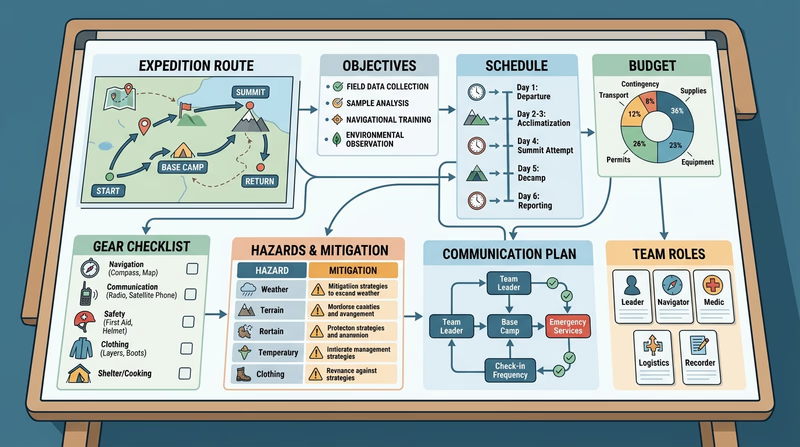
If Requirement 6 feels long, that is because real exploration depends on strong planning. The next requirement asks you to turn these ideas into preparations for your own expedition.
Req 7 — Prepare for the Real Thing
This requirement is where planning becomes real. You are no longer talking about a hypothetical expedition. You are preparing for one that you will actually carry out. That means adult supervision, practical decisions, and an honest look at whether your plan is safe and workable.
Requirement 7a
Choose a qualified adult
This person should know more than you do about the kind of expedition you are planning. That could be a science teacher, outdoor leader, park naturalist, museum educator, observatory staff member, or another adult with relevant experience.
Use their experience well
A qualified adult can help you notice weaknesses in your plan, spot hazards, and adjust your goal so it fits your team’s skill level.
Why this step matters
Exploration is safer and smarter when younger explorers learn from experienced people. Supervision is not a formality. It is part of responsible preparation.
Requirement 7b
This is your full preparation checkpoint. Every major planning step from Requirement 6 should now appear in your real expedition plan.
Build a useful gear list
Do not just make a long list. Organize it by purpose.
- Safety: first aid kit, water, weather layers, sun protection, flashlight
- Navigation and communication: map, compass, phone, radios, check-in plan
- Mission needs: notebook, pencils, camera, measuring tools, sample containers if approved
- Personal support: food, gloves, boots, rain gear
Explain each item’s value
Your counselor may ask, “Why are you bringing this?” Have a real answer. “Because it is on a camping list” is weak. “Because our objective includes fixed-point photos and this camera lets us compare locations later” is much stronger.
Determine who should go
Choose people who make the mission safer and more effective. That includes required adults, but it may also include Scouts with helpful skills, such as navigation, observation, photography, or note-taking.
Pre-Expedition Preparation Checklist
Make sure your plan is ready before you go- Clear objective and route
- Adult supervision confirmed
- Gear list complete and checked
- Transportation and communication plan ready
- Team roles assigned
- Hazards reviewed
Requirement 7c
A pre-expedition check is your last chance to find weaknesses before they become problems. Treat it like a launch check, not a casual conversation.
What to review
Go back through the full plan:
- objectives
- schedule
- budget
- equipment
- transportation
- communication
- safety and first aid
- team roles
- documentation plan
If one part feels vague, fix it now.
Use the SAFE Checklist seriously
The SAFE Checklist helps you evaluate supervision, assessment, fitness, and skill. It is a useful way to test whether your expedition plan matches the team’s age, experience, and conditions.
Scouting America SAFE Checklist (PDF) A practical checklist for reviewing supervision, assessment, fitness, and skill before your expedition begins. Link: Scouting America SAFE Checklist (PDF) — https://www.scouting.org/wp-content/uploads/2021/06/680-11421_SAFE.pdf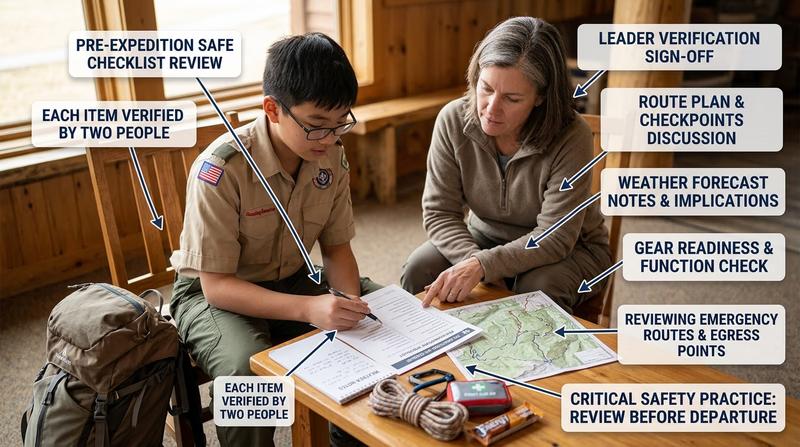
A strong pre-expedition check shows maturity. It proves you understand that good exploration depends on preparation, not luck.
The next requirement is the one you have been building toward: actually going on the expedition.
Req 8 — Carry Out the Expedition
This is where the badge becomes real. A plan on paper matters, but now you have to carry it out, make decisions in real conditions, practice outdoor ethics, and come home with useful records.
Requirement 8a
Your expedition does not have to be extreme to count. What matters is that it takes you to a place you have not previously explored and that you approach it with an explorer’s mindset. That means you have an objective, use a plan, gather observations, and work under proper supervision.
A nearby wetland, a new cave system, a research forest, a different shoreline, an observatory program, or a part of your community you have never carefully studied could all qualify if your counselor approves the plan.
What to do during the expedition
- follow the route or schedule unless changing it is safer
- keep notes as things happen, not only from memory later
- take photos, sketches, or measurements that support your objective
- pay attention to problems, surprises, and changes in conditions
Requirement 8b
Exploration should increase knowledge without carelessly damaging the place being explored. Outdoor ethics matter because discovery is not an excuse to leave a mess, disturb wildlife, damage habitat, or make the experience worse for other people.
Outdoor Code
The Outdoor Code reminds Scouts to be clean, careful, and conservation-minded. It shapes attitude as much as action.
Leave No Trace
Leave No Trace helps you reduce impact through route choice, waste management, respect for wildlife, and camp or travel habits.
Tread Lightly!
Tread Lightly! is especially helpful for travel and recreation involving roads, trails, and motorized access because it emphasizes protecting access, respecting property, and minimizing damage.
Apply ethics specifically
Do not tell your counselor only that you “followed Leave No Trace.” Explain what you actually did. Maybe you stayed on durable surfaces, packed out trash, avoided disturbing nests, kept noise down, or changed your route to protect a fragile area.
Leave No Trace Basics (video) A quick introduction to the habits that help explorers reduce their impact on the places they study and enjoy. Link: Leave No Trace Basics (video) — https://vimeo.com/1115216743/63b20c0b33?share=copy🎬 Video: Leave No Trace Outdoor Ethics (video) — https://youtu.be/jXO1uY0MvmQ?si=_UhIOYBkw69c87ug
Requirement 8c
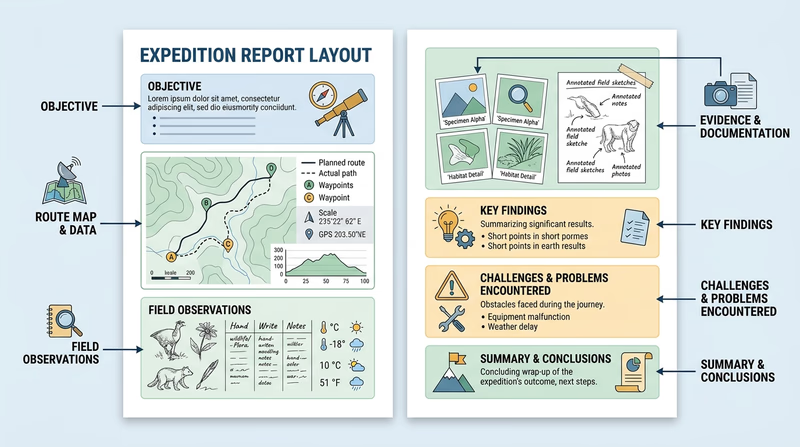
The report is where your expedition becomes a finished exploration project. A good report is honest, specific, and organized.
A Simple Report Structure
1. Objective
State what you set out to do.
2. Location and conditions
Say where you went, who supervised, and what conditions were like.
3. Findings and observations
Summarize what you saw, measured, or learned.
4. Problems or adverse events
This section matters. If weather changed, equipment failed, or the route had to change, say so.
5. Conclusion
Did you reach the objective fully, partly, or not yet? All three answers can be honest and acceptable if you explain them clearly.
Post-Expedition Report Must Include
Make sure your report covers every required element- Statement of objectives
- Findings and observations
- Photos, graphs, or figures
- Any discoveries
- Problems or adverse events
- A conclusion about the objective
By the time you finish this requirement, you will have done something many people only talk about: planned, completed, and documented a real exploration activity.
Req 9 — Choose Your Next Path
You must choose exactly one option from this requirement. Both options ask you to look beyond the badge, but they point in different directions.
Your Options
- Req 9a — Research an Exploration Career: Study a profession connected to exploration, including training, cost, job duties, salary, and advancement. This option is best if you want to think about long-term work.
- Req 9b — Turn Curiosity into a Hobby: Explore how the skills from this badge could become a hobby such as astronomy, scuba, caving, paddling, wildlife observation, or orienteering. This option is best if you want a practical next step you can start sooner.
How to Choose
Choosing Between Career and Hobby
Think about what kind of future question you want to answer- Choose 9a if you want to know what jobs in exploration really require.
- Choose 9b if you want to grow a personal interest into regular practice.
- Time horizon: 9a is about years of preparation; 9b is about near-term goals and experiences.
- What you will gain: 9a helps you understand professions and pathways; 9b helps you build a life outside school around curiosity and skill.
Whichever option you choose, try to connect it to what you enjoyed most in this badge. That makes your discussion more genuine and more useful.
Req 9a — Research an Exploration Career
This option asks you to treat a profession like an expedition target. You are trying to find out what the job really involves, not just whether it sounds exciting.
Good Career Choices for This Badge
Exploration-related careers include many more jobs than “explorer.” A career might focus on discovery directly or support it behind the scenes.
Examples include:
- marine scientist
- field biologist
- geologist
- archaeologist
- astronomer
- research scientist
- cartographer or GIS specialist
- park naturalist
- expedition leader
- environmental engineer
What to Research
Your counselor will expect details, so organize your notes around the exact things the requirement asks for.
Training and education
What degree, certification, apprenticeship, or specialized training is needed?
Costs
How much might education, gear, travel, or licensing cost?
Job prospects
Is the field growing? Is it competitive? Is it seasonal or full time?
Salary
Look for a reasonable pay range, not just one headline number.
Job duties
What does this person actually do in a normal week?
Career advancement
What can someone do after gaining experience?
Ocean Exploration Careers (website) Introduces a wide range of ocean exploration careers and shows that missions depend on many different kinds of professionals. Link: Ocean Exploration Careers (website) — https://oceanexplorer.noaa.gov/careers/🎬 Video: Unlocking Space Careers: Beyond Astronauts and Rocket (video) — https://youtu.be/ljlpqd1Mjjs?si=V3Yaz18BvlIVnDpQ
🎬 Video: How I Became a Researcher (video) — https://youtu.be/vOhyZ8FYCmw?si=9XLnEqu1IJIin0CH
Best Research Methods
A career page or salary site can help, but the strongest answers usually combine sources.
Strong Career Research Mix
Use more than one method if you can- Read a trustworthy career or organization page
- Watch or listen to a professional explain their work
- Interview someone in the field if possible
- Compare education requirements with actual daily job duties
What Makes a Career Interesting to You?
The last part of the requirement is personal. Be ready to tell your counselor what about the profession appeals to you. Maybe it is the problem-solving, the fieldwork, the teamwork, the science, or the chance to work outdoors. It is also okay to say that you admire the field but do not think it fits you.
That kind of honest reflection is useful too.
The final option on the next page shows how exploration can shape your life even if it never becomes your job.
Req 9b — Turn Curiosity into a Hobby
A hobby is one of the best ways to keep exploration alive after the badge is finished. Hobbies give you repeated chances to practice the habits you have been learning: planning, observation, documentation, and reflection.
Hobbies That Fit This Badge Well
A good exploration hobby usually has three parts:
- a place or subject to discover
- skills that improve with practice
- a community or organization that can help you grow
Examples include astronomy, scuba, birding, paddling, orienteering, caving, fossil collecting where permitted, geocaching with ethics, backpacking with a research goal, and local natural history observation.
Official Resources
🎬 Video: Ready to Dive Into the Adventure of a Lifetime? Become a PADI Scuba Diver (video) — https://youtu.be/XTeCkxJkUuE?si=VmbO1gpifOVW0QBF
🎬 Video: Astronomy for Beginners (video) — https://youtu.be/XLgPe_f-QCc?si=d_gbZFB7Spvr-vog
🎬 Video: Permanent Orienteering Course (video) — https://youtu.be/y4yfyUwkUxw?si=zGblxCqx7N5R4_W9
These resources are useful because they show hobbies with very different entry points. Some need training and equipment. Others can start with simple tools and local practice.
Research the Hobby Honestly
Your counselor will want more than “This looks fun.” Research the practical side:
- What training or coaching is needed?
- What does beginner equipment cost?
- Are there local clubs, parks, or organizations that support it?
- How easy is it to practice often?
Set Goals for the Hobby
Use one short-term goal and one long-term goal- Short-term goal: something you can do soon, such as attending a star party, visiting an orienteering course, taking an intro scuba class, or joining a local nature outing.
- Long-term goal: something that takes growth, such as earning a certification, building strong identification skills, completing a larger trip, or helping lead an activity for others.
Why Hobbies Matter
Hobbies often become the bridge between a merit badge and a lifelong interest. Even if you never work as a scientist or expedition leader, a hobby can keep you learning, noticing, and asking better questions about the world.
If you enjoyed this badge, that may be the biggest lesson of all: exploration is not only for famous people in documentaries. It can become a habit in your own life.
Extended Learning
A. Congratulations
You have finished a badge that asks you to think, plan, observe, and report like a real explorer. That is a bigger achievement than it may seem at first. Exploration is not just about reaching interesting places. It is about building the habits that turn curiosity into dependable knowledge.
If this badge clicked with you, keep going. The best explorers do not stop when the patch is earned. They keep asking better questions.
B. Deep Dive: Tools Change What Humans Can Discover
Every era of exploration is shaped by its tools. Better ships made longer sea voyages possible. Better maps made routes safer. Better microscopes revealed cells and microbes. Better satellites changed weather forecasting and Earth observation. Better robotics let people study the deep ocean and other planets without sending humans into the most dangerous environments.
This matters because exploration is not only about courage. It is also about capability. A new tool can reveal something that no one could have seen before, and once that happens, entire fields can change. Think about sonar mapping in the ocean, DNA sequencing in biology, or space telescopes in astronomy. In each case, new tools did not just make old work faster. They made new kinds of questions possible.
A useful way to keep learning is to notice the connection between technology and discovery. When you hear about a new mission or breakthrough, ask what instrument, platform, or method made it possible. That question helps you understand how exploration actually advances.
C. Deep Dive: Exploration and Responsibility
Exploration has a complicated history. Some expeditions expanded knowledge. Others were tied to conquest, extraction, or disrespect for local people and environments. A thoughtful modern explorer should know that discovery is not automatically ethical just because it is exciting.
Responsible exploration asks harder questions. Who benefits from this work? Who might be harmed? Are we respecting local communities, landowners, and cultural sites? Are we minimizing environmental damage? Are we sharing results honestly and fairly? Those questions matter in archaeology, ecology, mountaineering, tourism, research, and even citizen science.
Scouts are in a good position to practice better habits. Outdoor ethics, careful observation, and respect for place all fit naturally with exploration. If you continue in this field, try to become the kind of explorer who leaves both the landscape and the human story better understood, not more damaged.
D. Deep Dive: Small Explorations Count Too
It is easy to think exploration only matters when it is remote or dramatic. But many meaningful discoveries begin close to home. A creek behind a school, a migration stopover in a neighborhood park, a local cave survey, a night-sky observation log, or a biodiversity count in a city green space can all lead to real learning.
Small explorations are powerful because they are repeatable. You can return to the same place in different seasons, compare notes over time, improve your methods, and notice changes that one-time visitors would miss. That kind of repeated observation is how many citizens contribute real value to science.
If you want to keep exploring, start where access is easiest. A place you can visit again and again may teach you more than a faraway place you only see once.
E. Real-World Experiences
Visit an observatory or planetarium
A public sky program can show you how astronomy combines technology, patient observation, and interpretation. Ask how data from telescopes becomes useful knowledge.
Join a guided nature survey or bioblitz
Many parks, nature centers, and conservation groups host species counts and observation events. These are great examples of structured exploration close to home.
Tour a museum collection or science center
Collections rooms, labs, and exhibits show how discoveries are preserved, studied, and explained to the public.
Try a map-and-compass orienteering event
Orienteering builds navigation, planning, and observation skills that support many kinds of exploration.
Attend a public lecture by a scientist or explorer
Museums, universities, and outdoor organizations often host talks that reveal what current exploration work looks like in the real world.