Req 4c — Explore Discovery in the Lab
A lab may not look like an expedition base camp, but it can still be a place of real exploration. In a research facility, scientists are often working at the edge of what people know. They ask questions, test ideas, collect evidence, and revise their understanding based on results. That is exploration.
What Counts as Laboratory Exploration?
Laboratory exploration includes many kinds of work:
- Medicine: testing how diseases spread, how cells behave, or how treatments work
- Biology: studying DNA, microbes, ecosystems, and tissue samples
- Chemistry: exploring how materials react, combine, or change
- Physics: using detectors and instruments to study matter, energy, and forces
- Astronomy: analyzing telescope data, images, and signals collected from space
In each case, the explorer is not just repeating known facts. They are using methods to uncover something new.
How Labs and Field Exploration Are Similar
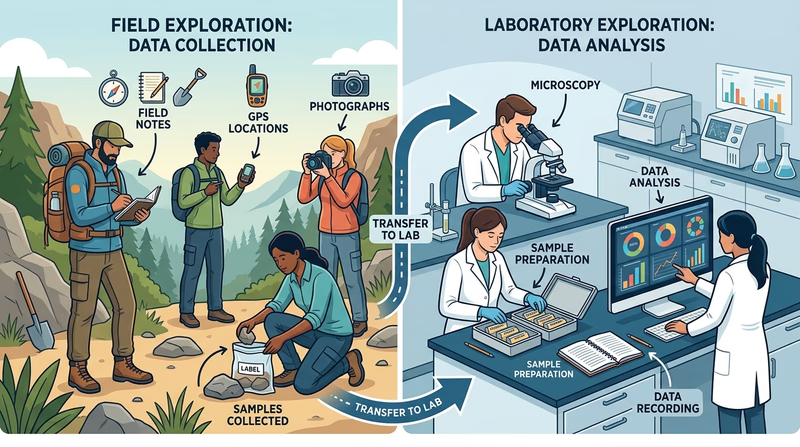
At first, a jungle expedition and a lab experiment may seem unrelated. But they share the same core structure.
| Field Exploration | Laboratory Exploration |
|---|---|
| Starts with a question about a place, species, or system | Starts with a question about a process, material, or phenomenon |
| Needs planning, equipment, and roles | Needs planning, equipment, and roles |
| Collects samples, images, or observations | Collects measurements, samples, or test results |
| Records data carefully | Records data carefully |
| Interprets findings and shares conclusions | Interprets findings and shares conclusions |
The environment is different, but the mindset is the same.
How They Are Different
The biggest difference is control. In the field, explorers work with weather, distance, terrain, wildlife, and other conditions they cannot fully manage. In the lab, scientists try to control as many variables as possible so they can isolate what is happening.
That means field exploration is often messier but broader, while lab exploration is often narrower but more precise. Good science needs both.
Official Resources
🎬 Video: Research Scientist (video) — https://www.youtube.com/watch?v=uRreC41dGz4
🎬 Video: Inside the World's Largest Science Experiment (video) — https://youtu.be/nrXhK3Gh5EE?si=xSgNbNGvMNmaBl22
🎬 Video: Day in the Life of a Research Scientist (video) — https://www.youtube.com/watch?v=biS7e79xZcs
These resources are useful because they show different scales of scientific exploration. One scientist may work with benches, samples, and instruments in a smaller lab. Another may be part of a huge international physics project that uses giant machines and massive teams. Both are still exploring.
Once you understand the people and places that make exploration possible, you are ready to choose a real organization or facility to learn from in Requirement 5.