Extended Learning
A. Introduction
Congratulations — you’ve completed the Family Life merit badge! You’ve explored what family means, contributed to your household through chores and projects, led family meetings on important topics, and thought deeply about parenting. These aren’t just merit badge skills — they’re life skills that will shape every relationship you build from here on out.
B. Deep Dive: Communication That Actually Works
The biggest difference between families that thrive and families that struggle often comes down to one thing: communication. Not just talking — real communication, where everyone feels heard and understood. Mastering this skill now will benefit you in every relationship for the rest of your life.
Active listening is the foundation. Most people listen while thinking about what they’re going to say next. Active listening means focusing entirely on the other person — their words, their tone, and their body language. When they finish, you reflect back what you heard before responding. “It sounds like you’re frustrated because…” is a powerful phrase. It tells the speaker that you genuinely understood them, and it often de-escalates tense situations immediately.
“I” statements are your best tool for expressing difficult feelings without starting a fight. Instead of “You never listen to me,” try “I feel unheard when I’m talking and you’re looking at your phone.” The first version attacks. The second version shares a feeling and describes a specific behavior. The difference in how people respond is dramatic.
Timing matters more than most people realize. Bringing up a sensitive topic when someone is tired, hungry, or stressed almost guarantees a bad outcome. Wait for a calm moment. Say, “Can we talk about something when you have a minute?” This shows respect for the other person’s state of mind and increases the chances of a productive conversation.
Nonverbal communication accounts for more than half of what we actually communicate. Eye contact, facial expressions, posture, and tone of voice all carry meaning. Crossed arms, eye-rolling, and sighing send messages just as clearly as words do — sometimes more clearly. Being aware of your own body language helps you communicate more effectively.
C. Deep Dive: Conflict Resolution at Home
Every family has conflict. It’s not a sign that something is wrong — it’s a natural result of different people with different needs living together. What matters is how you handle it. Scouts who learn conflict resolution at home become leaders who can handle disagreements anywhere.
The difference between healthy and unhealthy conflict is important to understand. Healthy conflict stays focused on the issue, treats everyone with respect, and moves toward a solution. Unhealthy conflict involves personal attacks, yelling, bringing up old grievances, and trying to “win” instead of resolve. You can disagree passionately while still being respectful.
The cool-down period is one of the most underused tools in family conflict. When emotions run high, your brain shifts into fight-or-flight mode, and rational thinking goes out the window. Taking a break — even ten minutes — lets your heart rate return to normal and your prefrontal cortex come back online. Saying “I need a few minutes to think before we continue” is not running away from the problem. It’s the smartest move you can make.
Finding common ground is the key to resolution. In almost every family argument, both sides want the same underlying thing — respect, fairness, safety, or connection. When you identify that shared goal, the specific disagreement becomes much easier to resolve. “We both want the weekend to be fun — let’s figure out a plan that works for everyone” reframes the conversation from adversarial to collaborative.
Apologizing and forgiving are skills, not weaknesses. A genuine apology has three parts: acknowledging what you did, expressing regret for its impact, and committing to do better. “I’m sorry I snapped at you. That wasn’t fair, and I’ll work on handling my frustration differently.” Forgiveness doesn’t mean forgetting or condoning — it means choosing to move forward rather than holding a grudge.
D. Deep Dive: Building Family Traditions
Family traditions are the glue that holds generations together. They create a sense of identity, belonging, and continuity. You don’t have to wait for your parents to create traditions — you can start them yourself.
Why traditions matter: Traditions give families a shared history and something to look forward to. Children who grow up with family traditions report a stronger sense of identity and emotional security. Traditions can be as elaborate as an annual vacation or as simple as pizza night every Friday.
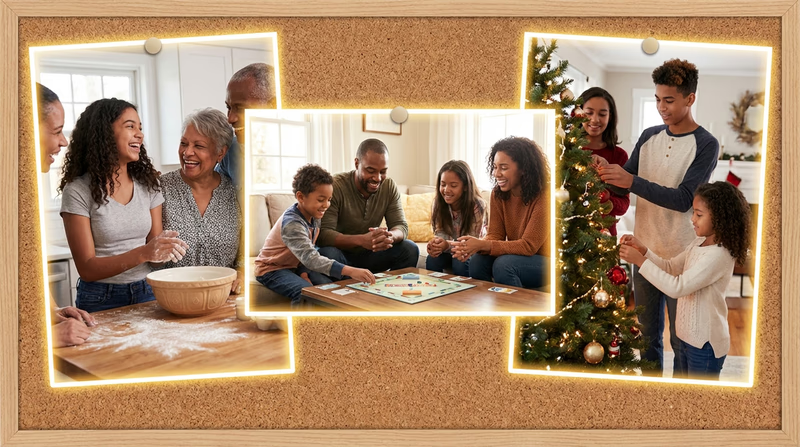
Everyday traditions are just as powerful as holiday rituals. A bedtime routine, a weekend breakfast tradition, a monthly game night, or a Sunday phone call with grandparents — these small, repeated moments create the fabric of family life. They become the things you remember most fondly when you look back.
Creating new traditions is a great way to put your Family Life merit badge skills into practice. Talk to your family about starting something new. It could be tied to a season (planting a garden every spring), a milestone (a special dinner for every report card), or just a regular rhythm (hiking together on the first Saturday of each month). The best traditions are ones everyone enjoys and looks forward to.
Honoring old traditions is equally important. Ask your grandparents or older family members about traditions from their childhood. Some may have been lost over the generations. Reviving an old tradition — whether it’s a recipe, a game, or a way of celebrating — connects you to your family’s history in a meaningful way.
E. Real-World Experiences
Family Volunteer Day
Intergenerational Interview Project
Family Budget Challenge
Tech-Free Weekend
Family Heritage Meal
F. Organizations
The nation’s largest grassroots mental health organization, offering education, support groups, and advocacy for individuals and families affected by mental illness.
Provides programs and services for young people to help them reach their full potential, with a focus on academic success, healthy lifestyles, and character development.
A nonpartisan professional organization focused on understanding and strengthening families through research, education, and practice.
Works to build a brighter future for children and families through research, policy, and community initiatives focused on child well-being.
A federal agency providing resources, treatment locators, and information about mental health and substance use prevention for individuals and families.