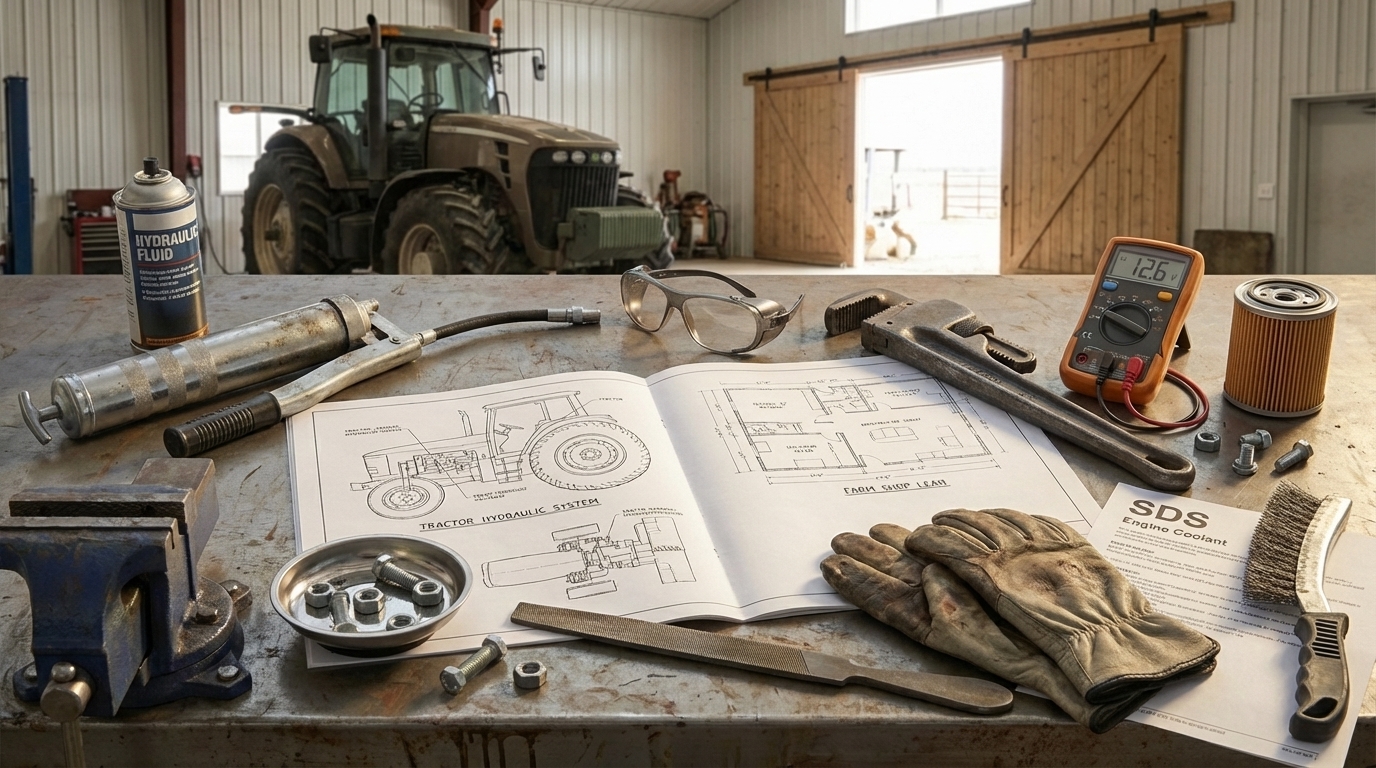
Farm Mechanics Merit Badge — Complete Digital Resource Guide
https://merit-badge.university/merit-badges/farm-mechanics/guide/
Introduction & Overview
Farm equipment represents the backbone of modern agriculture — massive machines that move tons of earth, plant millions of seeds, harvest crops, and power operations that feed our nation. Behind every running tractor, every combine in the field, and every efficient grain auger is the knowledge of someone who understands how these machines work and how to keep them running. The Farm Mechanics merit badge is your invitation into that world.
This badge teaches you real skills: how to read safety labels, diagnose what’s wrong with equipment, perform routine maintenance, and understand the mechanical systems that make farming possible. Whether you grow up to farm full-time, work in agricultural equipment sales, or simply want to maintain your own equipment with confidence, the knowledge you gain here will pay dividends for decades.
Then and Now
Then — Farm Mechanics as Survival
A century ago, a farmer who couldn’t fix their equipment was in serious trouble. Farm implements broke often. Parts were expensive or didn’t exist. A broken baler during hay season meant lost crops and financial disaster. Farmers had to be part mechanic, part engineer, and part problem-solver. They learned by doing, apprenticing under older, experienced farmers, and figuring things out through trial and error.
- Purpose: Keep expensive equipment running in remote, resource-limited conditions
- Mindset: Master the machine or the machine masters you
Now — Farm Mechanics as Professional Expertise
Today, farm equipment is more reliable and complex. Diesel engines with computerized controls, hydraulic systems with pressure gauges and proportional valves, transmissions with multiple gears — modern equipment demands serious knowledge. But this also means farm mechanics has become a skilled profession with good jobs, decent pay, and real career advancement. Implement dealers employ service technicians, equipment manufacturers hire engineers, and custom applicators depend on people who know how to maintain and troubleshoot machines.
- Purpose: Keep high-value equipment operational while maintaining safety and compliance
- Mindset: Combine practical know-how with systematic troubleshooting and preventive thinking
Get Ready! You are about to learn skills that most farmers and rural landowners wish they had mastered earlier. Whether you work on equipment just once or build an entire career around it, this badge will give you the confidence to approach a machine, understand what it does, and keep it safe and running.
Kinds of Farm Work
Farm mechanics applies to diverse equipment and environments. Here is what you might work on.
Powered Farm Equipment
Tractors, combines, balers, grain drills, sprayers, and countless other machines use diesel engines (or occasionally gasoline engines) to power their work. Each type has its own operating schedule, maintenance intervals, and specific repair needs. A combine might operate intensely for just a few weeks during harvest, while a tractor might work year-round.
Tools & Hand Equipment
Beyond the big machines, farms rely on hundreds of hand tools and smaller implements: wrenches, hammers, chisels, files, drill presses, and storage systems. Knowing how to maintain these tools — keeping blades sharp, handles intact, and storage organized — is foundational to professional farm mechanics work.
Shop Setup & Organization
A well-equipped farm shop is organized, safe, and efficient. You will learn to set up a workspace that prevents accidents, stores hazardous materials properly, and makes your work easier. A good farm shop has good organization, clear labeling, and easy access to the tools you need.
Preventive Maintenance Culture
The difference between a machine that breaks down unexpectedly (and costs thousands in emergency repairs) and one that runs reliably for decades is preventive maintenance. This badge introduces you to the mindset: greasing fittings on schedule, changing oil on time, checking fluids before each use, and addressing small problems before they become big ones.
Engine & Power System Fundamentals
Diesel engines, hydraulic systems, and transmissions are the heart of farm equipment. You do not need to be an expert mechanic, but you do need to understand how power is produced, transferred, and controlled. This knowledge helps you diagnose problems, perform maintenance safely, and respect what the machine can do.
You now have a foundation in why farm mechanics matters. Let’s begin with the most important topic: keeping yourself safe while working around farm equipment and hazardous materials.
Req 1a — Safety Equipment & Clothing
Before you touch a wrench or step near a running engine, you need the right protective gear. Farms are unforgiving environments — heavy equipment, sharp edges, rotating parts, and hazardous chemicals demand respect. Personal protective equipment (PPE) is not optional; it is the difference between a safe day and a trip to the emergency room.
🎬 Video: Personal Protective Equipment in the Farm (PPE) — Learn from Ern — https://www.youtube.com/watch?v=Yjl1rqqjosU
Personal Protective Equipment (PPE)
Think of PPE as your armor. Different tasks require different protection, and part of becoming a competent farm mechanic is knowing which gear to wear for which job.
Eyes & Face
Eye protection is non-negotiable. When you are grinding, drilling, prying, or working near flying debris, your eyes are in danger.
- Safety glasses: Clear plastic lenses that protect against dust and flying debris. Wear these whenever you are in a workshop.
- Face shield: A clear plastic shield that covers your entire face. Use this when grinding or when there is a risk of splashing (coolant, hydraulic fluid, acid).
- Welding helmet: If you are cutting or welding metal, a welding helmet protects your eyes from the intense light and flying sparks.
Hands & Arms
Your hands are exposed to sharp edges, hot surfaces, caustic chemicals, and rotating machinery.
- Work gloves: Leather or synthetic gloves protect against cuts, abrasions, and heat. Choose leather for general work; nitrile for chemical/hydraulic fluid contact.
- Cut-resistant gloves: Synthetic fiber gloves (often called “cut sleeves”) are rated for specific cut levels. Use these when working with sharp metal or broken equipment.
- Heat-resistant gloves: Heavy leather or Kevlar gloves protect against heat when handling hot parts or working near welding.
Feet & Lower Legs
Steel-toed boots are the standard in farm shops for a reason: dropping a wrench, having equipment roll, or stepping on a sharp object can crush unprotected toes.
- Steel-toed work boots: Rated to withstand crushing force. Wear these every time you work in a shop or around equipment.
- Rubber or slip-resistant soles: Farm shops are oily and wet. Slip-resistant soles prevent falls.
- Pant legs: Wear full-length pants that cover your ankles. Long pants protect against oil splashes, hot metal, and minor cuts.
Respiratory Protection
Diesel fumes, welding smoke, and dust are hazards you breathe in if you do not protect your lungs.
- Dust mask (N95): Filters dust and pollen. Use when grinding, sanding, or sweeping dusty areas.
- Respirator (half-face or full-face): Rated cartridges filter chemical vapors, welding fumes, and particles. Use when working with solvents, cutting fluids, or in enclosed spaces with engine exhaust.
Hearing Protection
Tractors, combines, and power tools produce noise at levels that cause permanent hearing damage.
- Foam earplugs: Inexpensive and effective if inserted correctly. Roll them small, insert deeply into the ear canal, and allow them to expand.
- Over-ear earmuffs: Easy to put on and remove. Rate them for the noise levels you will encounter (usually 85–100 dB on a farm).
- Double protection: For extremely loud tasks (like running a grain dryer or operating a combine at full throttle), use both earplugs and earmuffs together.
Specialized Protective Gear
Depending on the task, you might need additional protection:
- Apron (leather): Protects your torso and legs from welding sparks, hot metal, and splashing fluids.
- Sleeve covers: Protect your arms from UV exposure if you are welding or working outdoors in bright sun.
- Head protection: Hard hats or bump caps protect against head injuries if something falls or if you are working under equipment.
When & How to Use PPE
The right gear is only useful if you actually wear it. Here is the practical rule: When in doubt, gear up.
Pre-Work PPE Checklist
Before you start any task:
- What are you touching? (Rotating parts? Hot surfaces? Sharp edges? Chemicals?)
- What am I breathing? (Engine exhaust? Dust? Welding smoke? Fumes?)
- What could splash or fly? (Hydraulic fluid? Hot coolant? Metal shavings?)
- What could fall on me? (Heavy tools? Parts? Equipment?)
Common Scenarios
Changing oil and filters: Wear gloves (the old oil is dirty) and safety glasses. Old oil can splash — a splash guard and a towel help catch drips.
Grinding or cutting metal: Safety glasses or face shield (mandatory), apron if you have hot sparks, hearing protection if the grinder is loud.
Working with hydraulic hoses: Gloves, safety glasses, and ideally a towel to catch any spillage. Hydraulic fluid is toxic if ingested and can cause skin irritation.
Operating a power tool like a drill press: Safety glasses, closed-toe shoes, no loose clothing, no jewelry. Tie back long hair. Loose sleeves and necklaces can catch on spinning bits.
Welding: Welding helmet (to protect eyes from arc light), leather apron, heat-resistant gloves, closed-toe boots, long-sleeved shirt.
Summary
The message is simple: Proper PPE + consistent use = safe hands, safe eyes, safe lungs, and a long career in farm mechanics. Your counselor will expect to see you use the appropriate gear when you are working on equipment throughout this merit badge. Make it a habit now, and it will protect you for life.
Req 1b — Design a Safe Farm Shop
A well-designed farm shop is not just about having tools — it is about creating an environment where people work safely, efficiently, and confidently. Your plan does not need to be an architectural drawing; it just needs to show that you understand the safety principles that make a farm shop functional and compliant.
🎬 Video: Managing Farm Safety and Health: Workshop Safety — Teagasc — https://www.youtube.com/watch?v=PmYwlEnnh9Y
Essential Farm Shop Layout Principles
Think about the flow of work. People should be able to move around without tripping over tools or walking in front of rotating machinery. Materials should be stored so they are easy to access but do not block exits. Hazardous materials should be locked away from curious hands (especially important if children visit the farm).
Zones Within a Farm Shop
A well-organized farm shop has distinct zones:
Work Zone: Where equipment is serviced or repaired. This is the heart of the shop. It needs space around the equipment so you can walk around, access fasteners, and have room for tool carts.
Tool & Parts Storage: Hand tools stored in a tool rack or cabinet. Fasteners (bolts, nuts, washers) organized in labeled drawers. Parts organized by equipment type.
Fluid & Chemical Storage: Engine oil, hydraulic fluid, antifreeze, solvents, welding rod, and any flammable liquids locked in a cabinet. These must be kept away from ignition sources.
Power Tool Area: Drill press, grinder, welder, compressor — machines that stay in one place and are used frequently. These should be positioned away from the main walkway to avoid distracting other workers.
Cleanliness & Washup: A work sink with clean water and hand soap. Paper towels or clean rags. A place to dispose of oily rags safely (in a metal bin, not loose in the shop).
Emergency & First Aid: First-aid kit mounted on a wall where everyone can find it. Fire extinguisher(s) positioned where they can be reached quickly.
Mandatory Safety Devices & Features
Every farm shop must include these non-negotiable items:
Fire Suppression
Fire extinguishers: Every farm shop must have at least one Class B (for flammable liquid) fire extinguisher rated for the size of your shop. A 5-10 lb ABC multi-purpose extinguisher is typical for a home or small farm shop. Larger commercial shops may need multiple extinguishers.
- Mount extinguishers on a wall near an exit, at eye level, so they are immediately visible in an emergency.
- Know which extinguisher is which: Class A (ordinary combustibles like wood), Class B (flammable liquids like gasoline and oil), Class C (electrical fires).
- For a farm shop, Class B is mandatory; ABC multi-purpose is best because it handles most farm workshop fires.
No smoking rule: Post a “No Smoking” sign. Gasoline, diesel, and hydraulic fluid vapors are extremely flammable. One spark can cause an explosion.
Ventilation
Exhaust fans or windows: Engine exhaust, welding fumes, and solvent vapors accumulate in enclosed spaces and become hazardous. A good farm shop has either windows that can be opened or mechanical exhaust fans that pull fumes out.
- If you run an engine inside the shop (for testing or warming up), always position it so the exhaust points toward a window or fan.
- Natural ventilation (open door and window) is the simplest solution for small shops.
- Larger shops with welding or engine work benefit from a ceiling exhaust fan and makeup air inlet.
Electrical Safety
GFCI outlets: Ground Fault Circuit Interrupter outlets detect unusual current and shut off power instantly, preventing electrocution. Install GFCI outlets in any area near water (washup sink area) and in damp locations.
Adequate lighting: A well-lit shop is a safe shop. You cannot see what you are working on if you are squinting in shadows. Install overhead lights (fluorescent or LED), plus movable work lights for detailed tasks.
Grounding for power tools: All corded power tools should be three-pronged (grounded) or double-insulated. Do not use a three-pronged tool with a two-pronged adapter — this defeats the grounding protection.
Floor Safety
Non-slip flooring: Concrete is the standard, but it gets slippery when wet or oily. Paint the shop floor with anti-slip epoxy paint, or apply stick-on non-slip tape to walkways.
Clear walkways: Mark the main pathways with yellow paint so people do not trip over hoses, cables, or tools left on the floor. Keep walkways at least 3 feet wide.
Drain for spills: If you are doing work that involves liquids (draining oil, flushing radiators), a floor drain or sloped floor directing fluids toward a collection point prevents them from accumulating and becoming a slip hazard.
Access & Emergency Exits
Two exits minimum: In case of fire or emergency, people need an alternative way out. A farm shop should have at least two exits — typically a main door and a side or back door.
Exit signs and emergency lighting: Exits should be marked and lit so people can find them in an emergency. Even a simple glow-in-the-dark arrow pointing to the exit is better than nothing.
First Aid & Injury Response
First-aid kit: Mounted on a wall in an easily accessible location. The kit should include bandages, antiseptic, gauze, tape, tweezers (for splinters), and pain relief medicine. Keep it stocked — people actually use it.
Emergency contact numbers: Post the farm shop phone number, poison control, the nearest hospital, and your local emergency number (911) on a wall so they are immediately available if someone is injured.
Material Safety & Hazard Communication
Safety Data Sheets (SDS): Keep SDS documents for every hazardous material in your shop — oil, coolant, solvents, welding flux, diesel fuel. Store them in a binder or cabinet where workers can access them if they need information quickly.
Proper storage for hazardous materials: Locked cabinet (or separate locked building) for flammable liquids. Keep them away from heat sources and ignition sources. Store incompatible materials separately (oxidizers away from flammable liquids, acids away from bases).
Labeling: Every container should be clearly labeled with its contents. Do not store diesel in an old gasoline can — confusion like this causes fires or poisoning.
Design Your Farm Shop Plan
Your plan should show:
Overall layout: Roughly rectangular or L-shaped outline showing the boundaries of the shop.
Work zones: Label areas for equipment service, tool storage, chemical storage, and power tool area.
Mandatory safety devices: Mark on your plan where you would place:
- Fire extinguisher (with the type labeled: e.g., “10 lb ABC”)
- First-aid kit
- Emergency exits (doors with arrow and label “EXIT”)
- Ventilation (windows or exhaust fan)
- GFCI outlets or electrical panel
- Eyewash station (if applicable)
Walkways: Draw main traffic patterns and label them as clear pathways.
Storage: Show where hand tools, parts, and hazardous materials would be stored.
Lighting: Note where overhead and work lights would be located.
Your plan does not need to be fancy — it can be drawn on plain paper. But it should demonstrate that you understand the function of each area and why each safety device is positioned where it is. Be ready to explain your choices to your counselor.
Summary
A safe farm shop is a reflection of the person who runs it. It says: “I respect my tools. I care about the people who work here. I take safety seriously.” When you design your plan, think about what a counselor or a farm safety inspector would want to see. Cover the mandatory items, show that you understand the layout principles, and be ready to explain why each safety device is important.
Req 1c — Safety Symbols & Warnings
Equipment manufacturers put warning symbols on machines for one reason: to keep you alive. A tractor, a combine, a baler, a grain auger — each one has a collection of stickers and labels that communicate hazards in a language that works even if you do not speak English. Learning to read these symbols is one of your most important skills.
🎬 Video: ANSI Standards: Safety Signs and Labels — Clarion Safety Systems — https://www.youtube.com/watch?v=VBY1lI9SUOw
🎬 Video: ISO Symbols for Safety Signs and Labels — Clarion Safety Systems — https://www.youtube.com/watch?v=izeWHwDCUes
Why Warning Symbols Matter
Manufacturers are legally required to warn users about hazards. But beyond the legal requirement, they genuinely want users to be safe. A machine that injures or kills someone creates lawsuits, bad publicity, and financial liability. So they label hazards clearly. Your job is to take those warnings seriously, not dismiss them as boilerplate safety talk.
Universal Hazard Symbols
The international hazard symbols you find on farm equipment follow a simple color and shape system:
Red — Stop / Fire Hazard
A red symbol or a red background indicates danger, an emergency condition, or fire hazard.
- Flammable materials: Red label with a flame symbol. Common on diesel cans, oil containers, and near fuel tanks.
- Fire extinguisher location: Red background with a fire extinguisher symbol. This tells you where the nearest fire extinguisher is mounted.
- Emergency stop: A large red circle or red X on a lever or button. This stops all machine operation immediately.
Yellow with Black — Warning / Caution
Yellow and black stripes or a yellow background indicate caution — potential hazard ahead.
- Rotating parts: Yellow and black diagonal stripes with a symbol of rotating machinery or a hand caught in gears. This warns you not to touch rotating parts, not to wear loose clothing, and not to insert fingers, hair, or tools into the machinery while it is running.
- Hot surface: Yellow and black with a hand being burned. This warns you that surfaces may be very hot — engine block, muffler, hydraulic fluid lines. A burn from touching a hot engine can happen in milliseconds.
- Pinch point: Yellow and black with two fingers being pinched. This warns you about areas where moving parts can crush your fingers or hands. Hydraulic cylinders extending or retracting are classic pinch points.
- Crushing hazard: Yellow and black with a hand or foot being crushed under weight. This warns you not to work under machinery that is not properly supported on jack stands.
Blue — Instruction / Required Action
A blue background typically indicates that you must do something — wear protective equipment or perform a required action.
- Wear safety glasses: Blue circle with a safety glasses symbol. This means PPE is required in this area.
- Wear hearing protection: Blue circle with an ear symbol and earmuffs. Loud equipment requires hearing protection.
- Wear gloves: Blue circle with a glove symbol. Certain tasks require hand protection.
Black & White — Information / No Entry
Black and white symbols communicate information or prohibition.
- Danger — High voltage: Black and white symbol of a lightning bolt and hand. This warns you about electrical hazard — do not touch.
- No entry: A red circle with a white bar across it. This means do not enter this area or do not perform this action.
- Prohibit: Black and white symbols indicating what you should NOT do — do not touch, do not run the engine in the building, do not weld while the fuel tank is full.
Common Farm Equipment Warning Symbols
When you find equipment for your requirement, look for these typical hazards:
Tractor Hazards
Engine compartment:
- Rotating cooling fan (yellow and black rotating symbol)
- Hot engine and muffler (yellow and black hot surface symbol)
- Pinch point where the fan belt runs
- Electrical hazard from the battery (high amperage can cause burns)
Loader and bucket:
- Crushing hazard when the bucket is raised (yellow and black crushing symbol)
- Pinch point between the boom and the bucket
- Never go under a raised bucket without it properly supported
Power takeoff (PTO):
- Fast-rotating shaft hazard (yellow and black, often showing a hand being caught)
- The PTO shaft rotates at extremely high speed — loose clothing can wrap around it in an instant
- Always shield the PTO or disconnect it before you work near it
Hydraulic hoses:
- Pinch point where cylinders extend and retract
- Hot fluid hazard if pressurized fluid escapes
- Eye protection required if you disconnect or inspect pressurized hoses
Combine Harvester Hazards
Header and cutterbar:
- Rotating blade hazard (yellow and black rotating symbol)
- Pinch point where crop is conveyed toward the cutterbar
- Never reach into the header while the engine is running
Feederhouse:
- Rotating auger or conveyor (yellow and black)
- Pinch point between rotating parts
- Loose clothing and long hair can catch — tie them back before entering the combine cab area
Grain tank:
- Hazard of being drawn into the unloading auger if grain is flowing
- Never stand near the grain tank spout while grain is being unloaded
Grain Auger Hazards
Rotating auger flight:
- Extremely dangerous — the auger can catch a glove, rope, or pant leg in a split second
- Yellow and black rotating symbol showing a hand being pulled in
- Always stop the auger before approaching it
Pinch points at the motor:
- Pinch point between the auger tube and the motor
- Pinch point where guards meet the rotating shaft
Hydraulic System Hazards
High-pressure hose:
- Pressurized fluid can escape and penetrate skin (causing injection injuries that require surgery)
- Temperature hazard — hydraulic fluid can be extremely hot (140°F or hotter)
- Always relieve pressure before disconnecting a hose
Cylinder pinch points:
- Areas where the rod enters and exits the cylinder
- Areas under the bucket or boom where your hand can be caught
How to Locate and Document Symbols on Your Equipment
For this requirement, you need to find a piece of farm equipment and identify all warning symbols. Here is how to approach it:
Choose your equipment: A tractor is ideal because it has many different hazards and symbols. A combine, baler, or grain auger works too.
Examine systematically: Start at the front and work backward, looking at every side and area:
- Engine compartment (if accessible)
- Loader and controls (if present)
- Running boards and steps
- Hydraulic cylinders
- PTO shaft (if present)
- Any rotating machinery
Document what you find: Take photos or make sketches of each symbol. Write down:
- Where it is located (engine, loader, PTO, etc.)
- What the symbol looks like (shape, colors)
- What hazard it warns about
- What action you should take to stay safe
Compare with a standard symbol reference: The American National Standards Institute (ANSI) publishes standard symbols. You can find these online or in safety manuals. Check whether the symbols you found match the standard.
Be ready to explain: Your counselor will want to hear you explain the meaning and importance of several of these symbols. Be able to say things like:
- “This yellow and black rotating symbol warns me that the cooling fan rotates at high speed. I should never reach into this area while the engine is running.”
- “This yellow and black pinch point symbol warns me that the hydraulic cylinder can crush my hand. I need to keep hands away from this area when the cylinder is moving.”
Understanding Symbol Language
Warning symbols are a universal language designed to work without words. But understanding the principles behind them helps you recognize hazards even if you encounter a symbol you have never seen before:
- Red = danger, emergency, stop
- Yellow with black = caution, potential hazard
- Bright orange = chemical hazard or electrical hazard
- Blue = required action, must do something
When you see an unfamiliar symbol, use these color meanings to figure out what the hazard probably is. If you are still unsure, ask someone who knows the equipment or consult the equipment manual.
Summary
Warning symbols are there for you. They represent lessons learned the hard way — often from real injuries. When you see a symbol, pause and respect it. Ask yourself: “What is this warning me about? What should I NOT do? What PPE do I need? Where should I position my hands and body to stay safe?” Building the habit of reading and respecting warning symbols now will protect you for your entire life.
Req 1d — Safety Data Sheets
A Safety Data Sheet (SDS) is your chemical instruction manual. Every hazardous material in your shop — from engine oil to hydraulic fluid to diesel fuel — comes with an SDS that tells you exactly what the chemical is, what hazards it poses, and how to use it safely. If you get a splash, if you spill it, or if someone breathes fumes, the SDS tells you what to do.
🎬 Video: A Crash Course on Chemical Safety Data Sheets (SDS) — Safelyio — https://www.youtube.com/watch?v=-1qFlEXqI30
What Is a Safety Data Sheet?
An SDS is a standardized document created by the manufacturer of a chemical product. In the United States, the Occupational Safety and Health Administration (OSHA) requires that every hazardous chemical have an SDS. Internationally, these documents follow the Globally Harmonized System (GHS) standard, which means they have a consistent format no matter what product you are looking at or what country you are in.
The SDS is not a marketing brochure — it is a technical safety document written by the manufacturer (or by a toxicologist hired by the manufacturer) based on scientific testing and knowledge of the chemical.
Why Safety Data Sheets Matter
Imagine you are working on a tractor and you accidentally splash hydraulic fluid in your eyes. What do you do? Do you flush with water? Do you go to the hospital? What if you swallowed some? The SDS tells you the answer.
Or imagine a co-worker faints while working in a poorly ventilated shop where engine coolant is being mixed. What are the symptoms of coolant exposure? What is the emergency treatment? Again, the SDS has that information.
SDSs exist because chemicals can be dangerous in ways that are not obvious. Some are flammable. Some are toxic if you breathe the vapors. Some can burn your skin. Some can damage your lungs or kidneys over time. The SDS communicates all of this.
The Standard SDS Format (16 Sections)
Every SDS follows the same 16-section format. Learning what each section contains helps you find the information you need in an emergency.
Section 1: Product Identification
- Product name: The chemical name and any common names
- Manufacturer: Who makes it
- Recommended use: What it is designed for (e.g., “engine lubricant”)
- Hazards: A quick summary of the main dangers
Section 2: Hazard Identification
- Hazard classification: What types of hazards this chemical poses:
- Flammable (catches fire easily)
- Acute toxicity (poisonous in small doses)
- Chronic toxicity (harmful with repeated exposure)
- Skin irritant or sensitizer (causes rashes or allergic reactions)
- Eye irritant (causes burning or inflammation)
- Respiratory sensitizer (causes breathing problems)
- Environmental hazard (harms fish or aquatic life)
- Signal word: Either “Danger” (more serious) or “Warning” (less serious)
- Hazard statements: Specific warnings (e.g., “Combustible liquid and vapor,” “Causes skin irritation,” “Harmful if swallowed”)
- Precautionary statements: Actions you should take to prevent problems
Section 3: Composition / Information on Ingredients
- What is actually in the product
- The chemical name and percentage of each ingredient
- For mixtures, which ingredients are hazardous
Why this matters: Some products contain chemicals you might not expect. An engine oil might contain a trace of a heavy metal. A cutting fluid might contain a biocide that can cause allergic reactions. This section tells you what you are actually handling.
Section 4: First-Aid Measures
This is critical if someone is injured:
- If inhaled: Symptoms of breathing the vapor, and what to do
- If skin contact: What happens, how to treat it (usually “wash with soap and water,” but sometimes seek medical help)
- If eye contact: What to do immediately (usually “flush with water for 15 minutes,” then get medical help)
- If swallowed: Never induce vomiting — some chemicals are more dangerous coming back up. The SDS tells you whether to call poison control or get emergency care
Section 5: Fire-Fighting Measures
- Is this chemical flammable?
- What type of fire extinguisher should you use? (Class A, B, C, or D)
- What type of fire extinguisher should you NOT use?
- What hazardous byproducts are created if the chemical burns?
For farm shops: Most oils, hydraulic fluids, and diesel are Class B flammables. The SDS tells you to use a Class B extinguisher (foam, CO2, or dry powder) — not water.
Section 6: Accidental Release Measures
- What to do if you spill it
- How to clean it up (absorbent material? Solvents?)
- Ventilation needed
- Protective equipment for cleanup
- Disposal instructions
Section 7: Handling and Storage
- How to store the chemical safely
- Temperature range
- Keep away from incompatible materials (e.g., keep oxidizers away from flammables)
- How to handle the container
- Static electricity precautions (some solvents are flammable and can ignite from a spark)
Section 8: Exposure Controls / Personal Protective Equipment
- Recommended PPE when handling: gloves, eye protection, respirator?
- Exposure limits: How much vapor or dust is safe to breathe?
- Ventilation: Should you work outdoors or in a ventilated area?
Section 9: Physical and Chemical Properties
- What does it look like? (color, odor, appearance)
- Is it a liquid or solid?
- Viscosity (thickness)
- Boiling point and melting point
- Flash point (the temperature at which it ignites if exposed to a spark or flame)
Flash point matters: Engine oil has a flash point around 400°F. Gasoline has a flash point around -40°F. The lower the flash point, the more flammable the product.
Section 10: Stability and Reactivity
- Is the chemical stable under normal storage and use conditions?
- What conditions should you avoid (heat, light, pressure)?
- What other chemicals should you NOT mix it with?
- What hazardous decomposition products might form if it is burned?
Section 11: Toxicological Information
- What happens if you are exposed to the chemical?
- Short-term (acute) effects: nausea, dizziness, burns?
- Long-term (chronic) effects: organ damage, cancer risk?
- Lethal dose (if known) — how much would kill someone
- LD50 (the dose that kills 50% of test animals) — a scientific measure of toxicity
Section 12: Ecological Information
- How does this chemical affect the environment?
- Is it toxic to fish or aquatic organisms?
- Does it persist in soil?
Matters for farm shops: If you spill hydraulic fluid into a stream or groundwater, you have an environmental problem. The SDS tells you how serious it is.
Section 13: Disposal Considerations
- How to dispose of the chemical safely
- Whether it can go in the trash or if it requires special hazardous waste disposal
- Contact information for waste disposal companies (if necessary)
Never pour hazardous chemicals down the drain. Oil, hydraulic fluid, solvents, and other materials must be disposed of properly. The SDS tells you how.
Section 14: Transport Information
- How to ship the product safely
- UN hazard classification for transportation
- Shipping name and class
Relevant if you order bulk quantities.
Section 15: Regulatory Information
- Which government agencies have jurisdiction (EPA, DOT, OSHA, etc.)
- Relevant regulations and laws
Section 16: Other Information
- SDS preparation date
- Contact information for the manufacturer
- Any additional information the manufacturer wants to include
How to Obtain SDSs
You are required to have access to SDSs for every hazardous material in your shop. Here is how to get them:
From the Supplier
- When you buy a product: Request the SDS at the point of sale. Many retailers (farm supply stores, auto parts stores) have a binder or file of SDSs.
- Digital copies: Ask the supplier if they can email you the SDS. Keep PDFs on your phone or computer.
- Print and file: Print the SDS and keep it in a binder in your shop, in a location where everyone knows to find it.
Online
If you cannot get an SDS from the supplier, you can find one online:
- Manufacturer’s website: Search “[Product Name] + SDS” on Google. Most manufacturers post their SDSs online.
- Safety data sheet repositories: Websites like SafetyData.com and ChemicalBook.com index SDSs for thousands of products.
OSHA Requirements
OSHA requires that:
- Your employer (or you, if you run your own shop) must have an SDS for every hazardous chemical in the workplace.
- The SDS must be in a format that employees can easily access (printed or digital).
- Employees must be trained on how to find and read the SDS.
- The SDS must be in a language that employees understand.
Reading an SDS in an Emergency
In a crisis, you do not have time to read all 16 sections. Focus on these:
- Section 2 (Hazard Identification): Quickly see what the main hazards are.
- Section 4 (First-Aid Measures): Get the emergency treatment instructions.
- Section 5 (Fire-Fighting): If there is a fire, see what type of extinguisher to use.
- Section 8 (PPE): See what protection you should have worn.
Keep SDSs organized and easy to find. If someone is injured and you need medical information, seconds matter. A well-organized SDS file means you can answer the paramedic’s question: “What chemical did they get exposed to, and what are the health effects?”
Creating Your SDS Collection
For this requirement, you need to collect SDSs for materials you will actually use while completing this merit badge. You will likely need:
- Engine oil: If you change oil on an engine-powered machine (Req 4a)
- Oil filter: Some filters have hazard information
- Hydraulic fluid: If you work with hydraulic systems (Req 2b, 4b, 6a)
- Diesel fuel: If you work with diesel equipment
- Grease: If you grease fittings or joints
- Air filter: Some filters have cardboard or plastic components with adhesives
- Any solvents or cleaners: If you use degreaser or parts cleaner
Summary
The Safety Data Sheet is a powerful document. It represents the manufacturer’s knowledge of how their chemical behaves, what dangers it poses, and what to do if something goes wrong. Respecting the SDS — reading it, understanding it, and using its guidance — is a sign of a professional, safety-conscious mechanic. Make it a habit to check the SDS for every hazardous material you use. Your future self (and your coworkers) will thank you.
Req 2a — Diesel Engines
The diesel engine is the workhorse of agriculture. Nearly every tractor, combine, grain auger, and skid steer on a modern farm runs on diesel fuel. Understanding how a diesel engine produces power gives you a foundation for everything else in farm mechanics — maintenance, troubleshooting, and safe operation.
🎬 Video: How Diesel Engine Actually Works? (Animation) — AutoExpose Global — https://www.youtube.com/watch?v=8ruuieWiXT4
How a Diesel Engine Differs from a Gasoline Engine
Both diesel and gasoline engines are internal combustion engines — they burn fuel inside cylinders to produce power. But they ignite that fuel in very different ways:
- Gasoline engine: A spark plug creates a spark that ignites a mixture of fuel and air. The engine needs an electrical ignition system.
- Diesel engine: There is no spark plug. Instead, air is compressed so tightly inside the cylinder that it becomes extremely hot — hot enough to ignite diesel fuel the instant it is injected. This is called compression ignition.
Compression ignition is what makes diesel engines special. Because they compress air to much higher pressures than gasoline engines, they extract more energy from each unit of fuel, making them more efficient and more powerful for heavy work.
The Four-Stroke Cycle
A diesel engine produces power through a repeating four-stroke cycle. Each stroke is one movement of the piston — either up or down — inside the cylinder. A complete cycle takes two full rotations of the crankshaft.
Stroke 1: Intake
- The piston moves down inside the cylinder.
- The intake valve opens, allowing fresh air (not a fuel mixture — just air) to flow into the cylinder.
- The intake valve closes at the bottom of the stroke, sealing the cylinder.
Key point: Unlike a gasoline engine, a diesel engine only draws in air during the intake stroke — no fuel is added yet.
Stroke 2: Compression
- The piston moves up, compressing the air trapped in the cylinder.
- Diesel engines compress air to a ratio of about 15:1 to 25:1 — meaning the air is squeezed into a space 15 to 25 times smaller than it started.
- This extreme compression heats the air to about 900°F–1,000°F (480°C–540°C).
- At the top of the compression stroke, the air is incredibly hot and under tremendous pressure.
Key point: This is the step that makes a diesel engine a diesel engine. The compression ratio is much higher than in a gasoline engine (which compresses at about 8:1 to 12:1), and it is the heat from compression — not a spark — that ignites the fuel.
Stroke 3: Power (Combustion)
- At the top of the compression stroke, a fuel injector sprays a precise amount of diesel fuel into the superheated, compressed air.
- The fuel ignites instantly on contact with the hot air — compression ignition.
- The burning fuel expands rapidly, pushing the piston down with tremendous force.
- This downward force turns the crankshaft, which is the rotating output shaft of the engine.
Key point: The power stroke is where the engine does its work. The force of the expanding gases pushes the piston down, and the crankshaft converts that linear (straight-line) motion into rotational motion — spinning the flywheel, which drives the transmission, hydraulic pump, and PTO.
Stroke 4: Exhaust
- The piston moves up again.
- The exhaust valve opens.
- The piston pushes the burned gases (exhaust) out of the cylinder through the exhaust valve.
- The exhaust valve closes at the top of the stroke.
The cycle then repeats: intake, compression, power, exhaust — over and over, hundreds of times per minute.
Key Engine Components
Cylinders and Pistons
Most farm diesel engines have 3, 4, or 6 cylinders. Each cylinder contains a piston that moves up and down. The cylinders fire in a specific sequence (called the firing order) so that the engine produces smooth, continuous power rather than a series of jerky pulses.
Crankshaft
The crankshaft is a heavy steel shaft at the bottom of the engine. Connecting rods link each piston to the crankshaft. As the pistons push down during the power stroke, they rotate the crankshaft. The crankshaft spins at the engine’s operating speed — typically 1,500–2,200 RPM (revolutions per minute) on a farm tractor.
Fuel Injectors
Each cylinder has a fuel injector that sprays diesel fuel at extremely high pressure — often 20,000–30,000 PSI (pounds per square inch) on modern engines. The injector controls the exact timing and amount of fuel delivered. Proper injector function is critical — a clogged or leaking injector wastes fuel and reduces power.
Turbocharger
Many farm diesel engines have a turbocharger — a device that uses exhaust gases to spin a turbine, which forces more air into the cylinders. More air means more fuel can be burned, which means more power. A turbocharged engine can produce significantly more horsepower than a naturally aspirated (non-turbo) engine of the same size.
Cooling System
Diesel engines generate enormous heat. The cooling system circulates coolant (a mixture of water and antifreeze) through passages in the engine block and cylinder head, carrying heat away to the radiator. The radiator dissipates heat into the air. Without the cooling system, the engine would overheat and destroy itself within minutes.
Lubrication System
Engine oil is pumped through the engine to lubricate moving parts — pistons, bearings, crankshaft, camshaft. The oil also helps cool internal components and carries away metal particles from normal wear. Regular oil changes are one of the most important maintenance tasks on a diesel engine.
How Power Is Transferred
Once the diesel engine produces rotational power at the crankshaft, that power needs to get to the wheels, hydraulic pump, and implements:
Crankshaft → Flywheel: The crankshaft connects to a heavy flywheel that stores rotational energy and smooths out the power pulses from individual cylinder firings.
Flywheel → Clutch → Transmission: The clutch connects the flywheel to the transmission, allowing the operator to engage or disengage power. The transmission adjusts the gear ratio to match the task (low gear for heavy pulling, high gear for road travel).
Transmission → Driveshaft → Wheels: The transmission output drives the wheels through a driveshaft, differential, and axles.
Engine → Hydraulic Pump: A gear on the engine drives the hydraulic pump, which pressurizes hydraulic fluid to power cylinders and motors (loader buckets, boom arms, etc.).
Engine → PTO: The power takeoff shaft connects to the engine and runs at a standardized speed (540 or 1,000 RPM) to power implements like balers, mowers, and grain augers.
Why Diesel Engines Dominate Agriculture
Diesel engines are the standard for farm equipment because of several advantages:
- Fuel efficiency: Diesel engines extract more energy per gallon of fuel than gasoline engines. On a farm where equipment runs for hours every day, this saves significant money.
- Torque: Diesel engines produce high torque (turning force) at low RPM, which is exactly what you need for pulling plows, driving through heavy soil, and powering hydraulic systems.
- Durability: Diesel engines are built heavier and stronger to handle the high compression pressures. A well-maintained farm diesel engine can run for 10,000–20,000 hours — decades of service.
- Fuel safety: Diesel fuel is less volatile than gasoline. It does not explode as easily, making it safer to store and handle on a farm.
Diesel Engine Maintenance Basics
Keeping a diesel engine running reliably requires consistent maintenance:
- Oil changes: Follow the manufacturer’s schedule (usually every 100–250 hours of operation). Dirty oil loses its ability to protect engine internals.
- Fuel filters: Change regularly to prevent dirt and water from reaching the injectors. Water in diesel fuel causes corrosion and injector damage.
- Air filter: A clean air filter ensures the engine gets enough air for efficient combustion. A clogged filter reduces power and increases fuel consumption.
- Coolant: Check the level and condition regularly. Old coolant loses its corrosion-protection properties and can damage the engine.
- Fuel quality: Use clean, fresh diesel fuel. Store fuel in clean containers and keep water out of the fuel tank.
Summary
A diesel engine produces power through compression ignition — compressing air until it is hot enough to ignite fuel without a spark. The four-stroke cycle (intake, compression, power, exhaust) repeats continuously, turning the crankshaft and producing the rotational force that powers everything on a farm machine. Understanding this process helps you maintain the engine, diagnose problems, and appreciate why diesel power has been the backbone of agriculture for over a century.
Req 2b — Hydraulic Systems
Hydraulic systems are the muscle of farm equipment. While the diesel engine provides the raw power, hydraulic systems transfer and control that power — lifting a loader bucket, raising a grain auger, extending a spray boom. Understanding hydraulics is understanding how modern farm equipment works.
🎬 Video: What Is Hydraulics and How Does It Work? — STEM KIDS — https://www.youtube.com/watch?v=rGg6eUt_tcM
The Basic Principle
Hydraulics relies on a simple fact: fluids are incompressible. If you have a closed container filled with oil, and you push on one end with a piston, the oil has nowhere to go except to push back with equal force on another piston. This principle — discovered and formalized by French scientist Blaise Pascal — allows you to multiply and control forces with remarkable precision.
Think of it this way: if you push a small piston with 100 pounds of force over a large piston, the large piston pushes back with much greater force. This is how a small hydraulic pump can lift a multi-ton loader bucket.
The Main Components
Every hydraulic system has the same basic parts:
The Pump
The pump is the heart of the system. Powered by the engine, the pump takes in hydraulic oil and forces it into pressurized lines. On a tractor, the hydraulic pump is typically mounted on the back of the engine and runs constantly while the engine is running.
- Fixed displacement pump: Pumps the same amount of fluid on every stroke. Common on older equipment.
- Variable displacement pump: Adjusts the volume of fluid based on system demand. More efficient — the pump only works as hard as needed.
Hydraulic pumps are precision machines that cost hundreds or thousands of dollars to replace. They wear out over time if hydraulic fluid is contaminated with dirt, water, or metal particles. This is why clean hydraulic fluid and a good filter are critical.
Pressure Lines & Hoses
The pump pushes oil through high-pressure hoses (they look like thick rubber tubes with metal fittings) to cylinders and motors. These hoses are rated for specific pressures — typically 1,500–3,000 PSI (pounds per square inch) on farm equipment.
A ruptured hydraulic hose is dangerous. Pressurized oil can inject through skin and cause serious injuries requiring surgery. This is why you wear eye protection and gloves when working with hydraulic systems — and why you always relieve pressure before disconnecting a hose.
Cylinders
Hydraulic cylinders convert the pressure of the fluid into linear (straight-line) motion. A cylinder has a piston rod that extends and retracts as oil is forced into and out of the chamber.
Single-acting cylinders: Oil pressure pushes the piston in one direction; a spring returns it. Used for smaller movements.
Double-acting cylinders: Oil can be routed to either end of the piston, allowing precise control of both extension and retraction. Most loader buckets and boom cylinders are double-acting.
Examples:
- Loader bucket cylinders: extend to lift the bucket, retract to dump the load
- Boom cylinders: extend to raise the boom, retract to lower it
- Grain auger cylinders: extend to tilt the auger, retract to return to normal position
Control Valves
Valves control the direction and volume of hydraulic fluid, much like a water faucet controls water flow. Different types include:
- Directional control valve: Routes oil to different cylinders. Moving the joystick left sends oil to the left boom cylinder; moving it right sends oil to the right.
- Pressure relief valve: If pressure exceeds a safe level, the valve opens and returns excess oil to the tank. Without this, dangerously high pressures could burst hoses or cylinders.
- Flow control valve: Limits the speed at which a cylinder moves by restricting oil flow.
The operator controls these valves using hydraulic spool levers, mechanical linkages, or (on modern equipment) electronic controls. The skill is making smooth, coordinated movements — extending one cylinder while retracting another, for example.
The Reservoir (Tank)
The hydraulic tank stores the oil and allows it to cool and settle before being recirculated. The tank also has room for a filter and a breather (to allow air in and out as the oil level changes).
Tank size matters: a larger tank allows the oil to spend more time cooling, which keeps the system running efficiently. Overheating hydraulic oil damages seals and accelerates wear.
Filter
The filter removes dirt and metal particles from the hydraulic oil. A contaminated filter clogs and reduces flow. Regular filter changes (usually every 500–1,000 hours of operation) are a key part of preventive maintenance.
How Hydraulic Power Works: Step by Step
Let’s trace the flow of power when a tractor operator lifts a loader bucket:
- Engine runs the pump: The tractor engine turns the hydraulic pump at a constant speed.
- Pump pressurizes oil: The pump forces oil into the main pressure line at high pressure (maybe 2,000 PSI).
- Operator moves joystick: The operator pulls back on the loader control joystick.
- Directional valve routes oil: The valve moves and directs pressurized oil to the bucket lift cylinders.
- Cylinders extend: Oil enters the bottom of the cylinders, pushing the pistons upward.
- Bucket rises: The bucket tilts or lifts as the cylinders extend.
- Operator releases joystick: The valve returns to neutral, stopping oil flow to the cylinders.
- Cylinders hold position: The bucket stays where it is because oil is trapped in the cylinders.
- Operator pushes joystick forward: The valve directs oil to the opposite end of the cylinders, pushing the pistons downward.
- Bucket lowers: As the cylinders retract, the bucket lowers or tilts.
- Return oil flows to tank: Oil from the return side of the cylinders flows back through return hoses to the tank.
This happens smoothly and almost instantaneously. The operator feels immediate response from the controls because hydraulics respond faster than mechanical linkages would.
Key Advantages of Hydraulics
Hydraulic systems dominate farm equipment because they offer unique advantages:
- Compact force multiplication: A small pump can generate enormous forces through large cylinders.
- Smooth, controlled motion: Hydraulic systems allow smooth acceleration and deceleration, unlike mechanical systems which can be jerky.
- Easy to control: Proportional control — moving a lever partially engages motion proportionally.
- Multiple simultaneous operations: Using multiple valves, an operator can extend one boom while retracting another.
- Self-cooling: Oil circulates and dissipates heat naturally.
Maintenance of Hydraulic Systems
Hydraulic systems are reliable if maintained properly:
- Keep hydraulic fluid clean: Dirt and water are the enemies. Use a high-quality hydraulic oil and change the filter regularly.
- Check fluid level regularly: Low fluid levels introduce air, which makes the system spongy and unpredictable.
- Inspect hoses for leaks or cracks: A small leak now becomes a blown hose later.
- Relieve pressure before disconnecting lines: This protects both you and the equipment.
- Never leave equipment with raised buckets or booms unattended: If a seal fails and pressure is lost, the boom can drop with no warning.
Real-World Example: Loader Operation
A front-end loader (like the bucket on a tractor) is a perfect example of hydraulic power in action:
- The pump runs continuously, pressurizing oil.
- The main boom cylinder extends when the operator pulls back, lifting the boom.
- The bucket cylinder extends when the operator pulls the bucket control, tilting the bucket up to scoop.
- The directional valve allows both cylinders to operate independently.
- The operator uses two hydraulic controls: one for boom height, one for bucket tilt.
This system is so effective that a single operator can load a truck with soil, grain, or manure in minutes — a task that would take a crew of laborers shoveling for hours.
Safety Reminders
Hydraulic systems are powerful and can hurt you:
- Never disconnect a pressurized hose: Always shut down the engine and operate the controls to relieve pressure before disconnecting.
- Pressurized fluid can penetrate skin: A pinhole-sized leak can inject fluid through your skin at high velocity, causing serious injury. Always wear gloves and eye protection.
- Never position your hands near pinch points: Areas where cylinders extend and retract can crush fingers in an instant.
Summary
Hydraulic systems are elegant solutions to the problem of transferring and controlling power on farm equipment. A small engine can lift tons through the principle of incompressible fluids and controlled pressure. Understanding how hydraulics work — the pump, the cylinders, the valves, the flow of oil — gives you insight into why a tractor can do so much with a relatively small engine. Respect the system, maintain it properly, and it will serve you reliably for decades.
Req 2c — Transmissions & Power
A transmission is the connection between the engine and the wheels. It takes the rotational power produced by the engine and transfers it to the ground, while allowing the operator to adjust speed and torque. Without a transmission, a tractor would either crawl at a snail’s pace or stall when trying to pull a heavy load.
🎬 Video: Which Transmission Should I Choose? — Kubota of Lynchburg — https://www.youtube.com/watch?v=MODEmA5q0TU
The Core Problem: Engine Power & Speed
A diesel engine operates most efficiently within a narrow range of speeds — typically 1,200–2,200 RPM (revolutions per minute). Outside this range, the engine either stalls (too slow) or wastes fuel and overheats (too fast).
But a tractor needs to do many different tasks at different speeds:
- Plowing: Slow and powerful. You might travel 3 mph while pulling a heavy plow.
- Road travel: Fast and efficient. You might cruise at 15 mph to get from one field to another.
- PTO work: The power takeoff shaft (PTO) must rotate at a standardized speed (usually 540 RPM or 1,000 RPM) to power a combine, baler, or grain auger — regardless of ground speed.
A transmission makes all of this possible by adjusting the gear ratio — the relationship between engine speed and output speed.
How Gears Work
Gears are wheels with teeth. When two gears mesh:
- If a small gear drives a large gear, the large gear rotates slower but with more torque (turning force).
- If a large gear drives a small gear, the small gear rotates faster but with less torque.
A simple gear ratio: if a small gear with 20 teeth drives a large gear with 60 teeth, the output gear rotates 1/3 as fast but with 3 times the turning force.
Gear Ratios in a Transmission
A transmission contains multiple gears in different combinations:
- Low gear (1st): Small input gear, large output gear. Slow movement, maximum torque. Used for starting, pulling heavy loads, or climbing hills.
- Mid gears (2nd, 3rd): Moderate gear ratios. Used for general work and moderate-speed travel.
- High gear (4th, 5th, 6th or more): Large input gear, small output gear. Fast movement, less torque. Used for highway travel with a light load.
Modern farm tractors often have 16–24 gears (or more with a power shuttle or continuously variable transmission) to optimize efficiency across many different tasks.
Types of Farm Transmissions
Manual Transmission
A traditional manual transmission uses a clutch and a gear shift:
- Clutch pedal: Disconnects the engine from the transmission. Press the clutch to shift gears.
- Gear shifter: A mechanical lever that selects which gear combination is engaged.
- Synchromesh (or synchronizer): Helps the gears spin at the same speed before they engage, making shifts smoother.
Advantages:
- Simple and durable
- Operator has full control
- Easy to repair
Disadvantages:
- Requires coordination (clutch, shift, throttle)
- Can stall if you shift wrong
- Older tractors with manual transmissions can be tiring to operate
Power Shift / Powerglide Transmission
A power shift transmission allows you to change gears without using a clutch or stopping the machine.
- Multiple clutches (instead of a single clutch) engage different gear combinations.
- Gears overlap slightly, allowing seamless transitions.
- The operator shifts using buttons or a lever while the tractor continues moving.
Advantages:
- Faster gear changes
- Less operator effort
- Can maintain motion while shifting
Disadvantages:
- More complex
- More expensive to repair
- Requires hydraulic power to operate
Continuously Variable Transmission (CVT)
The newest transmission technology uses a belt or chain running on cone-shaped pulleys that can continuously change the ratio from one extreme to another.
- No discrete gears or shifts.
- The transmission automatically adjusts to keep the engine running at its most efficient speed.
- The operator simply pulls a lever forward or backward for speed.
Advantages:
- Smooth, seamless acceleration
- Maximum fuel efficiency
- Reduced operator fatigue
- Automatic optimization for different loads
Disadvantages:
- Extremely complex and expensive
- Requires skilled service technicians
- Parts are proprietary to the manufacturer
Power Takeoff (PTO) Systems
Many farm implements (combines, balers, spreaders, augers) are powered by the tractor’s PTO shaft — a rotating shaft that runs at a standardized speed.
Standard PTO Speeds
- 540 RPM: The most common speed for older equipment
- 1,000 RPM: Common on larger equipment and high-speed implements
The PTO shaft connects to the implement via a driveline (a shaft with universal joints). This driveline transfers power from the tractor to the implement.
How PTO Power Is Transmitted
Independent or live PTO: The PTO can be engaged or disengaged without disengaging the transmission. “Live” means the PTO continues spinning even if you press the clutch (useful for synchronized tasks like baling while moving).
Mechanical driveline: A shaft with U-joints connects the tractor PTO to the implement.
Implement operation: The implement’s gears and belts convert PTO shaft rotation into the specific motion needed — a combine’s auger spins, a baler’s belts and pistons operate, a spreader’s beater spins.
How Power Flows Through a Tractor
Let’s trace the path of power from the diesel engine to the wheels:
Engine produces rotational power: The diesel engine burns fuel and converts the explosion into rotational force at the crankshaft (typically 1,500–2,200 RPM).
Flywheel and clutch: A heavy flywheel stores rotational energy. The clutch connects and disconnects the engine from the transmission.
Transmission selects gear ratio: The selected gear adjusts the ratio of rotational speed. A low gear might reduce engine RPM to 200 RPM at the output, but multiply the torque by 10.
Driveshaft transfers power: The transmission output drives the tractor’s driveshaft, which connects to the rear axle.
Differential and axles: The differential allows the rear wheels to rotate at different speeds when turning (the outside wheel rotates faster than the inside wheel). The axles transfer power to the wheels.
Wheels turn the ground: The wheels grip the ground and move the tractor forward. The torque and speed depend on the gear selected.
PTO Power Path
Simultaneously, the PTO shaft is connected to the engine through a separate driveline and spins at a standardized speed to power implements.
Transmission Fluid & Maintenance
Many modern transmissions use automatic transmission fluid (ATF) or hydraulic fluid for:
- Power transmission: Some transmissions (like the power shuttle) use hydraulic pressure to engage gears.
- Cooling: Fluid circulates to cool the transmission.
- Lubrication: Fluid reduces friction between moving parts.
Maintenance is critical:
- Check fluid level regularly: Low fluid can cause harsh shifting or transmission failure.
- Change fluid on schedule: Old fluid loses its properties and may contain metal particles from wear.
- Keep the filter clean: A clogged filter reduces pressure.
- Monitor for leaks: A slow leak under the tractor might mean the transmission seal is failing.
Other Power Transfer Systems
Beyond the main transmission, farm equipment uses other systems to transfer power:
Belt Drives
Belts and pulleys transfer power from one spinning shaft to another. Used in:
- Hay balers (belts spin the baling chamber)
- Grain augers (belts may be part of the drive)
- Threshers and combines
Belts wear out, can slip (losing power), and can break. They need tension adjustment and regular inspection.
Chain Drives
Chains and sprockets (toothed wheels) transfer power more efficiently than belts:
- Snowmobiles and ATVs use chain drives
- Some agricultural implements use chain drives for high-load applications
Chains require lubrication and tension adjustment.
Gear Boxes & Reduction Systems
Gearboxes with multiple gears allow further speed adjustment:
- A combine’s gearbox might reduce PTO shaft speed from 1,000 RPM down to 400 RPM for the threshing cylinder.
- A grain auger’s gearbox might reduce input speed to match the auger’s optimal operating speed.
Fluid Couplings & Torque Converters
Some transmissions use fluid couplings instead of mechanical clutches:
- A fluid coupling uses pressurized oil to transfer power smoothly.
- A torque converter (more advanced) actually multiplies torque at low speeds, helping the tractor pull heavy loads from a standstill.
Real-World Transmission Selection
Choosing the right gear for the task is part of skilled farm equipment operation:
Plowing (low speed, heavy load):
- Low gear (1st or 2nd)
- Engine throttled to 1,200–1,500 RPM
- Maximum torque to pull the plow
- Tractor moving 2–4 mph
Road travel (high speed, light load):
- High gear (5th or 6th)
- Engine throttled to 2,000+ RPM
- Fuel-efficient cruising
- Tractor moving 15–25 mph
PTO work (combine, baler):
- Mid-range gear
- Tractor moving 4–6 mph
- PTO shaft at standardized 540 or 1,000 RPM
- Power balanced between ground movement and implement operation
Summary
A transmission is a critical link between engine power and practical work. It allows a tractor to be both powerful (pulling heavy loads at low speed) and efficient (cruising at high speed with light loads). Understanding how gears, clutches, and power flows work helps you operate equipment skillfully, maintain it properly, and troubleshoot problems. Whether it is a manual transmission, a power shift, or a continuously variable transmission, the principle is the same: match the engine’s power output to the task at hand.
Req 3 — Tool Maintenance Skills
Do TWO of the following:
- Replace the handle of any tool found on the farm
- Organize a tool rack or a storage system for nails, bolts, nuts, and washers
- Using a hand file, properly dress the mushroomed head of a chisel or punch
- Using a hand file, correctly dress a screwdriver tip
This requirement is about hands-on tool maintenance. You will complete TWO of the four options listed. Choose tasks that match your skills and the equipment you have access to.
🎬 Video: How to Care for and Sharpen Gardening Tools — GrowVeg — https://www.youtube.com/watch?v=M1KSqC1yEeU
Understanding Your Options
Option A: Replace a Tool Handle
Many farm tools have wooden or plastic handles that wear out, crack, or break. Replacing a handle is a practical skill that keeps old tools in service instead of throwing them away.
Tools you might repair:
- Hammer or mallet (wooden handle that has cracked)
- Axe or hatchet (split or splintered handle)
- Shovel or spade (handle broken at the socket)
- Pick or mattock (broken handle)
- Hoe or rake (damaged wooden handle)
The skill:
- Removing the old handle (driving it out of the socket or unscrewing it)
- Fitting a new handle (sanding to size if needed)
- Securing the handle (tightening fasteners or driving a wedge into a split to lock it in place)
Option B: Organize a Tool & Fastener Storage System
Farms accumulate thousands of loose fasteners. A well-organized storage system saves time and frustration.
What you might organize:
- Nails (sorted by size: 2", 3", etc.)
- Screws (wood screws vs. machine screws, organized by length)
- Bolts (sorted by diameter and length)
- Nuts and washers (sorted to match bolt sizes)
The system:
- Drawer cabinet or wall-mounted organizer
- Labeled compartments
- Easy-to-read labels so anyone can find what they need
- Quantities organized for quick visual inventory
Option C: Dress a Chisel or Punch Head
Chisels and punches develop mushroomed heads over time from being struck with a hammer. The enlarged head can splinter or break, creating metal shards.
The skill:
- Using a hand file to carefully grind down the mushroomed edges
- Maintaining the shape of the tool
- Creating a clean, square edge that is safe to strike
Option D: Dress a Screwdriver Tip
Screwdriver tips flatten, chip, or split when they slip inside the screw head or are used as a pry bar. A damaged tip will not grip the screw properly and may damage the screw head.
The skill:
- Using a hand file to reshape the tip
- Creating parallel sides and a flat bottom
- Ensuring the tip fits snugly into the screw head
Which Two Should You Choose?
Think about what tools you have access to and what skills interest you:
- If you have broken tools lying around: Option A (handle replacement) is practical and immediately useful.
- If you work in a shop or farm with loose fasteners scattered everywhere: Option B (organizing storage) is a long-term skill that improves every future project.
- If you have access to chisels or punches that need maintenance: Option C is a focused hand-filing skill.
- If you have damaged screwdrivers: Option D teaches the same filing technique in a smaller, easier-to-manage project.
Recommendation: Start with Option B (organizing fasteners) because it does not require access to damaged tools and results in a useful system for your shop. Then pair it with either Option C or D (filing practice), which builds confidence with hand tools.
Detailed Instructions by Option
Option A: Replacing a Tool Handle
Removing the old handle:
- Examine how the old handle is attached. Is it wedged into a socket? Bolted? Glued?
- For wooden handles in sockets: carefully drive the old handle out using a punch and hammer, tapping from the thin end.
- For bolted handles: unbolt and remove.
- Clean out any splinters or dried glue from the socket.
Installing the new handle:
- Obtain a replacement handle designed for that tool (hardware stores carry replacement handles for common tools).
- If the new handle is slightly oversized, carefully sand it to fit the socket.
- Insert the handle into the socket, testing the fit.
- For wooden handles, drive a wedge into the end to lock the handle in place permanently.
- For bolted handles, insert bolts and tighten securely.
- Test the tool to ensure it is secure and balanced before using it.
Option B: Organizing Fastener Storage
Planning your system:
- Inventory what fasteners you have: nails (sizes), screws (types and sizes), bolts, nuts, washers.
- Decide on a storage solution:
- Clear plastic drawer organizer with adjustable dividers
- Wall-mounted pegboard with labeled containers
- Wooden drawer cabinet with custom-sized compartments
- Create a labeling system (hand-written or printed labels).
Organizing:
- Sort each fastener type by size.
- Place them in the organizer.
- Label each compartment clearly with size (e.g., “3/8 in. bolt”, “2 in. wood screw”).
- Consider adding quantities so you know when to reorder.
- Keep the system near your work area for easy access.
Tips:
- Use see-through containers so you can quickly find what you need.
- Group related items together (all bolts together, all nuts together).
- Reserve space for new fasteners — do not cram everything in too tightly.
Option C: Dressing a Chisel Head
What you will need:
- A chisel with a mushroomed head
- A mill bastard hand file or a bench grinder
- Clamping or holding method
- Safety glasses
Steps:
- Secure the chisel in a vise so the head is accessible.
- Put on safety glasses.
- Using firm, steady strokes, file away the mushroomed edges.
- Work on all sides, keeping the head roughly square and symmetrical.
- Stop frequently to check your progress — you do not want to remove too much material.
- Once the head is dressed (no more mushroom), ensure the edges are slightly beveled so they will not splinter.
- The finished head should be smooth, safe to strike, and roughly the same diameter as the shaft.
Safety: File away from your body. Keep your hands clear of the file’s path.
Option D: Dressing a Screwdriver Tip
What you will need:
- A screwdriver with a damaged or worn tip
- A hand file or rotary tool
- Clamping or holding method
- Safety glasses
Steps:
- Secure the screwdriver in a vise or clamp.
- Put on safety glasses.
- Using a hand file, carefully file the tip to restore the original shape:
- For a flat-head driver: create parallel sides and a flat bottom
- For a Phillips driver: this is harder by hand — seek help or use a small rotary tool if available
- Test the fit: the tip should slide into the screw head smoothly with no wiggle.
- The goal is a tight fit so you have full control and do not strip the screw head.
Document Your Work
For each option you complete, be ready to show your counselor:
- Option A: The tool with the new handle installed, working smoothly and securely
- Option B: The organized storage system with labeled compartments
- Option C: The chisel with the dressed head, no mushroom, safe to use
- Option D: The screwdriver with the restored tip, tested in actual screws
Bring photos or show your counselor the finished products. Explain the techniques you used and why the work is important for tool longevity and safety.
Req 4 — Equipment Maintenance Tasks
Do ONE of the following:
- On an engine-powered machine: Grease all fittings, change the oil and oil filter, clean the air filter, clean the radiator fins, and replace the fuel filters.
- For any engine-powered machine, create a preoperational checklist; include checking the engine coolant, engine oil, hydraulic and/or transmission fluid, and battery voltage (using a voltmeter). Using your checklist, conduct a preoperational check of that machinery or equipment.
- Prepare any farm machine for winter storage.
This requirement asks you to perform ONE of three maintenance tasks on an engine-powered machine. Choose the task that matches your access to equipment and your comfort level.
🎬 Video: Routine Tractor Service — Tractor Mike — https://www.youtube.com/watch?v=yPJt7L9SaAw
Option A: Full Maintenance Service
Perform a complete maintenance routine on a single piece of equipment. This is the most comprehensive option and teaches you the full scope of seasonal or regular maintenance.
What You Will Need
- An engine-powered machine (tractor, combine, grain auger, skid steer, etc.)
- Grease and a grease gun
- New engine oil and an oil filter (appropriate for the machine)
- New air filter or supplies to clean it
- New fuel filter(s)
- Jack stands and safety equipment if you need to access underside fittings
- Rags and absorbent material for spills
- A drain pan for old oil
- Access to the machine manual (for capacities and specifications)
Step-by-Step Instructions
1. Locate All Grease Fittings
Modern farm equipment has grease fittings (also called zerks or grease nipples) at joints, pivot points, and pivot pins.
- Check the equipment manual to find all fittings.
- Common locations: wheel bearings, steering components, bucket pivot points, boom pivot pins.
- Count them — you might find 10–20 or more.
Safety note: Before you start, ensure the engine is OFF, keys are removed, and the equipment is parked on level ground with wheels chocked (blocked) to prevent accidental movement.
2. Grease All Fittings
- Attach a grease gun to the first fitting.
- Pump until fresh grease comes out around the fitting (you should see the old, dark grease being displaced).
- Typically, 2–4 pumps per fitting is enough.
- Move to the next fitting and repeat.
- Wipe away excess grease with a rag.
Why this matters: Grease protects joints from rust and reduces friction. Under-greased joints wear out quickly; over-greased joints can create excessive heat and attract dirt.
3. Change the Engine Oil
- Locate the oil drain plug on the engine (usually at the lowest point of the oil pan).
- Place a drain pan underneath.
- Using a wrench, loosen and remove the drain plug. Be careful — the oil may be warm, even if the engine has been off for a while.
- Allow the old oil to drain completely (10–15 minutes).
- Wipe the drain plug clean and reinstall it. Tighten snugly but do not over-tighten.
4. Change the Oil Filter
- Locate the oil filter (cylindrical container on the side of the engine).
- Place the drain pan underneath (some oil will spill when you remove the old filter).
- Using an oil filter wrench, loosen the old filter and unscrew it by hand.
- Clean the filter mounting surface on the engine.
- Install a new filter (the same make and model as specified in the manual).
- Tighten the new filter by hand until it is snug, then turn it an additional 3/4 turn. Do not over-tighten.
5. Add Fresh Engine Oil
- Locate the oil fill cap on top of the engine.
- Remove the cap and set it aside (do not lose it).
- Pour the appropriate amount and type of fresh oil (check the manual for capacity and type, e.g., “15 quarts of SAE 15W-40”).
- Install the new oil cap.
6. Check Oil Level
- Wait 2–3 minutes for the new oil to settle.
- Pull out the dipstick, wipe it clean, reinsert it fully, then pull it out again to check the level.
- The oil should reach the “full” mark on the dipstick.
- Add more oil if needed.
7. Clean or Replace the Air Filter
- Locate the air filter housing (usually a large plastic or metal box near the top of the engine).
- Remove the old filter or cartridge.
- If it is a disposable filter: replace it with a new one of the same size.
- If it is a reusable filter: wash it with soap and water, let it dry completely, and reinstall it (some filters require a light coating of oil on the foam).
8. Clean the Radiator Fins
- Locate the radiator (a metal grid-like component in front of the engine or to the side).
- Radiator fins accumulate dust and chaff from field work.
- Using a stiff brush or compressed air, gently clean the fins to remove accumulated debris.
- Do not use water pressure (too much pressure can damage fins) unless it is low-pressure rinse.
- Work carefully — bent fins reduce cooling efficiency.
9. Document Your Work
- Take photos of your work.
- Note the date, the machine (tractor model, serial number), and the supplies used (oil type and amount, filter models, etc.).
- Keep records so your counselor can verify what you did.
Option B: Create and Execute a Preoperational Checklist
A preoperational check is done before every day of work to catch problems early and ensure safe operation. This option teaches you systematic inspection.
Creating Your Checklist
Design a checklist form that includes these mandatory items:
Engine Oil:
- Check level (dipstick at full mark)
- Look for leaks under the engine
Engine Coolant:
- Check level (radiator or overflow tank at proper level)
- Look for leaks or discoloration
Hydraulic Fluid (if applicable):
- Check level in hydraulic reservoir
- Look for leaks in hoses or cylinders
- Test controls for smooth, responsive operation
Transmission/Differential Fluid (if applicable):
- Check level on sight glass or dipstick
- Look for leaks
Battery:
- Battery connections are clean and tight
- Battery cables are not cracked or worn
- Battery voltage (using a voltmeter): should be 12V when engine is off, 13.5–14.5V when running
Fuel System:
- Fuel level adequate for the day’s work
- No visible fuel leaks
- Fuel cap is secure
Belts and Hoses:
- No visible cracks in belts
- No soft spots or leaks in hoses
- Belts have appropriate tension (typically 1/2 inch deflection when pressed)
Lights and Gauges:
- All lights (headlights, running lights, warning lights) function
- Gauges (oil pressure, temperature, fuel) are readable
Safety Equipment:
- Operator’s seat is secure
- Safety bars or ROPS (roll-over protective structure) are intact
- Fire extinguisher is present and accessible
PTO Shaft (if applicable):
- Guard is in place and undamaged
- Shaft rotates freely with no wobble
- Connection to implement is secure
Using Your Checklist
- Print or write multiple copies of your checklist.
- At the start of each work day, go through the entire checklist.
- Mark items as “OK” or note any problems.
- If you find a problem, fix it before operating the equipment (change a belt, add fluid, etc.).
- After 2–3 uses, show your counselor the completed checklists and explain what you look for and why each item matters.
Benefits of this approach:
- Catches small problems before they become big failures.
- Creates accountability — you have documentation of when checks were done.
- Trains your eye to notice subtle changes in the equipment.
Option C: Winter Storage Preparation
Farm equipment is often idle for 3–6 months during winter. Proper storage prevents rust, extends fuel system life, and ensures the equipment starts reliably in spring.
Winter Storage Steps
1. Clean the Equipment
- Wash away mud, chaff, and debris using a garden hose (avoid high-pressure washing, which can force water into bearings).
- Use a stiff brush to remove stuck-on material.
- Dry with rags or allow to air dry.
- Why: Dirt and moisture accelerate rust.
2. Drain or Stabilize Fuel
- Option A (safest): Drain the fuel tank completely into a proper fuel container. This eliminates the risk of stale fuel or water condensation in the tank.
- Option B: Add a fuel stabilizer to the fuel tank, then run the engine for 5–10 minutes to circulate the treated fuel through the system. This preserves the fuel during storage.
- Why: Diesel fuel can absorb moisture (which causes microbial growth and fuel system corrosion) and can oxidize (turning to varnish) during long storage.
3. Change the Oil and Filter (Optional but Recommended)
- Old oil accumulates acidic combustion byproducts that promote rust from the inside.
- If you are performing full storage, change the oil and filter before putting the equipment away.
- Why: Fresh oil protects internal engine surfaces during idle periods.
4. Fill Antifreeze/Coolant
- Check the coolant level and top up if needed.
- Ensure the mix ratio is appropriate for winter temperatures (50/50 mix of antifreeze and water is typical).
- Why: Prevents the cooling system from freezing and cracking.
5. Service Air Filter
- Clean or replace the air filter.
- Remove the filter cover and install a clean filter or filter wrap to prevent dust from entering during storage.
- Why: Prevents dust and insects from clogging the system during idle months.
6. Grease All Fittings
- Use fresh grease to displace moisture at all joints and pivot points.
- Why: Fresh grease protects against rust and corrosion during storage.
7. Inspect and Protect Hydraulic System
- Check hydraulic fluid level and top up if low.
- Inspect hoses for cracks or leaks.
- Activate all hydraulic controls briefly to ensure smooth operation, then lower all raised components (bucket, boom) to neutral position.
- Why: Prevents crystallization of hydraulic fluid during cold storage and ensures seals remain lubricated.
8. Protect Against Rodents
- Inspect around the engine compartment and cab for rodent entry points.
- Use rodent-deterrent tape or hardware cloth to block obvious gaps.
- Leave the engine compartment hood open slightly (or with a loose cover) to discourage rodents from nesting inside.
- Why: Mice and rats can chew wiring and damage fuel systems.
9. Battery Care
- Option A (best): Remove the battery, clean the terminals, and store it in a warm location indoors on a trickle charger.
- Option B: If leaving the battery in the equipment, disconnect the negative terminal and ensure the battery is clean and dry.
- Why: Cold temperatures reduce battery output. A removed and charged battery will start the equipment reliably in spring.
10. Document and Store
- Create a list of everything you did: date, maintenance performed, any problems found.
- Store equipment in a dry location if possible (covered with a tarp if necessary).
- Keep this documentation with the equipment so the spring start-up crew knows what has been done.
Which Option Should You Choose?
Option A (Full Maintenance) is best if:
- You have consistent access to equipment
- You want a comprehensive, hands-on learning experience
- You want to complete the most thorough maintenance option
Option B (Preoperational Checklist) is best if:
- You use equipment regularly during the badge season
- You want to learn systematic inspection habits
- You prefer documentation-based work
Option C (Winter Storage) is best if:
- You are reading this in fall or early winter
- You have equipment that needs to be stored
- You want to learn long-term preservation techniques
Summary
Maintenance is the difference between equipment that runs reliably for decades and equipment that breaks down at critical moments. Whichever option you choose, you will be learning one of the most valuable skills in farm mechanics: keeping equipment in safe, reliable working condition.
Req 5 — Interview an Implement Dealer
Implement dealers are goldmines of knowledge. They see dozens of pieces of equipment every year in all states of repair — from brand-new machines to ones that have been abused, neglected, or maintained religiously. A service manager or technician can tell you exactly what happens when maintenance is skipped and how much it costs to fix.
🎬 Video: Career Profiles: Agriculture Equipment Technician — Agriculture for Life — https://www.youtube.com/watch?v=yXuKZZpXtWc
Planning Your Dealer Visit
Finding a Dealer
Choose a dealer that serves equipment you are interested in:
- John Deere, AGCO, Bobcat, Kubota: These brands have widespread dealer networks. Search “[brand name] dealer near me” to find locations.
- Local farm equipment stores: Often stock a mix of brands and have service departments.
- Implement specialists: Dealers specializing in specific equipment (combines, hay equipment, etc.).
Call ahead and ask:
- “Can I schedule 30–45 minutes to talk with your service manager or a technician about preventive maintenance?”
- “Is there a good time to visit when the shop is not too busy?”
- “Would it be helpful if I brought a list of questions?”
Most dealers are happy to talk. Farm equipment service is a relationship business, and technicians enjoy teaching people about proper maintenance.
Questions to Ask
Prepare a list of 8–10 questions like these:
On Preventive Maintenance
- “What are the most common maintenance tasks you recommend for [specific equipment]?”
- “How often should owners perform maintenance? (daily, weekly, monthly, seasonal?)”
- “What do you see happen when owners skip preventive maintenance?”
- “What is the most important thing an owner can do to extend equipment life?”
On Costs
- “How much does a typical maintenance service cost? (oil change, filter replacement, etc.)”
- “What happens if maintenance is delayed? How much do repairs cost compared to preventive work?”
- “Have you seen situations where skipped maintenance turned a small repair into a major failure? Can you give an example?”
On Wear and Damage
- “What parts wear out first on [specific equipment], and how can owners slow that wear?”
- “What are the most common reasons equipment breaks down during the season?”
- “Are there any modifications or add-ons you recommend to reduce wear?”
Follow-Up Questions (Based on Their Answers)
- “How can someone know if a bearing is failing before it completely breaks?”
- “Why do hydraulic hoses fail, and how can you prevent it?”
- “What is the most expensive repair you have done recently, and would preventive maintenance have prevented it?”
What to Bring
- A notebook or tablet to take notes
- Your prepared questions
- Photos of equipment you work on (to show the dealer what you are learning about)
- A professional attitude — thank them for their time, be respectful of their busy schedule
What to Observe During Your Visit
While you are there, notice:
- The workshop setup: How is the service area organized? What tools and equipment do they have?
- Current repairs: What equipment is in for service? What problems are being fixed?
- Parts inventory: What replacement parts do they stock? (This tells you what fails most often.)
- Customer communication: How does the dealer explain problems to customers?
Take Detailed Notes
Write down the key points the technician shares:
- Specific maintenance recommendations
- Real failure examples
- Cost comparisons (preventive vs. repair)
- Safety tips
- Industry trends
Write Your Report
After your visit, write a 1-2 page report covering:
- Dealer visited: Name, location, equipment brands serviced
- Person interviewed: Name and title (service manager, technician, etc.)
- Summary of preventive maintenance recommendations: What tasks did they emphasize?
- Why preventive maintenance is important: Based on what you learned, explain the connection between maintenance and reliability
- Cost implications: How much more expensive are repairs compared to preventive work?
- Wear and damage insights: What parts fail most often? Why?
- One specific example: Describe a real situation the dealer shared about maintenance gone wrong (or right)
- Your takeaways: What surprised you? What will you remember?
Typical Topics a Dealer Will Discuss
Oil & Fluid Management
- Changing oil on schedule is the single most important maintenance task
- Using the correct oil grade (the dealer can show you why — oil viscosity charts, engine specifications)
- Cost: an oil change might be $50–$150; an engine rebuild due to oil sludge can cost $3,000–$8,000
Filters
- Air filters clogged with dust reduce power and increase fuel consumption
- Hydraulic filters clogged with metal particles destroy expensive pumps and cylinders
- Fuel filters contaminated with water or sediment cause startup problems
- Cost comparison: $20 filter change vs. $2,000 fuel system repair
Cooling System
- Neglected radiators clog with chaff and dust, causing the engine to overheat
- Overheating damages engine head gaskets and can crack the engine block
- Antifreeze breaks down over time and loses its corrosion-inhibiting properties
- Cost: $50 radiator flush vs. $1,500 head gasket replacement
Hydraulic System
- Clean hydraulic fluid is absolutely critical
- Contamination (dirt, water, metal) destroys expensive cylinders and motors
- One hour of unfiltered operation can destroy a system that took years to build
- Cost: $100 filter change vs. $5,000 pump replacement
Belts & Hoses
- Worn belts slip and lose power transfer efficiency
- Cracked hoses can rupture during operation, leaving you stranded
- Most dealers recommend inspection every 100–200 hours of operation
- Cost: $30 belt vs. $500 emergency towing and rental
Bearings & Lubrication
- Bearings require consistent greasing (tractor wheel bearings, steering components, pivot pins)
- Over-greased bearings create excess heat; under-greased bearings fail quickly
- Cost: $2 grease fitting service vs. $800 wheel bearing replacement
Real-World Example
A typical dealer conversation might sound like this:
You: “What is the most common thing you see that could have been prevented?”
Dealer: “Hands down, it is people not changing their hydraulic filter. We have customers who run their equipment for 1,000 hours without changing the filter. Then the hydraulic pump starts making noise, and we have to overhaul it. That costs $2,000. If they had changed the filter for $30 every 250 hours, they would never have had the problem.”
You: “How do you know when the filter needs changing?”
Dealer: “The equipment manual tells you — usually around 250–500 hours depending on the machine. But here is the thing: most people do not keep track of hours. So I recommend changing it twice a season — spring and fall. That way you know it is done.”
This is the kind of practical wisdom dealers share. Write it down, remember it, and use it.
Summary & Next Steps
Your dealer interview is not just a merit badge requirement — it is connecting with a professional who can be a resource for years to come. After your visit, you might:
- Ask the dealer for a card and contact information
- Follow up with any clarification questions by email or phone
- Visit again when you have other equipment questions
Dealers respect people who take equipment seriously and ask smart questions. Show your enthusiasm for learning, and you might develop a valuable relationship.
Req 6 — Maintenance Procedures
Explain each step in ONE of the following maintenance procedures:
- Tightening hydraulic fittings
- Checking the air filter
- Cleaning a work piece with a wire-brush wheel
This requirement asks you to master ONE specific maintenance procedure. Pick the task that matches your equipment access and your interests. You will perform the task, then explain each step to your counselor.
🎬 Video: Tractor Tip Tuesday: Connecting Quick Couplers — Good Works Tractors — https://www.youtube.com/watch?v=yJzpgqVPSrY
Option A: Tightening Hydraulic Fittings
Hydraulic hoses connect cylinders, motors, and valves to the main pump. Over time, vibration and thermal expansion can loosen fittings. A loose fitting can lead to a slow leak (wasting fluid) or a catastrophic rupture (dangerous pressurized fluid injection).
Why This Matters
- Loose hydraulic connections can spray or inject pressurized fluid
- Fluid leaks degrade system performance and cause fluid loss
- Tightening fittings regularly prevents major failures
- Pressure-related injuries from hydraulic fluid injection are serious and require surgery
What You Will Need
- The equipment with hydraulic fittings (tractor, loader, excavator, etc.)
- A wrench or socket set that fits the hydraulic fitting nuts
- A second wrench to hold the fitting body steady
- Clean rags or towels
- Safety glasses and gloves
- Optional: hydraulic fitting wrench set (specialized wrenches for tight spots)
Pre-Work Safety
- Park the equipment on level ground with wheels chocked (blocked).
- Shut off the engine and remove the keys.
- Relieve hydraulic pressure by activating all controls once to release trapped pressure. Listen for the hiss of pressure being released.
- Wait 5 minutes for pressure to fully dissipate.
- Put on safety glasses and gloves. Hydraulic fluid can splash when you loosen a fitting.
Step-by-Step Procedure
Step 1: Locate the Hydraulic Fittings
- Identify all hydraulic connections on the equipment (hose-to-cylinder, hose-to-valve, hose-to-pump).
- Start with easily accessible fittings and work toward more difficult ones.
- Check the equipment manual for a schematic of the hydraulic system if available.
Step 2: Identify the Fitting Type
There are two common types:
- JIC (Joint Industry Council) fittings: Have a conical 37-degree cone angle. Most common on farm equipment.
- ISO (SAE) fittings: Have a different angle. Using the wrong size wrench can round off the nut.
Know which type you are working with so you select the correct wrench size.
Step 3: Use Two Wrenches
This is critical:
- Place one wrench on the fitting body (the larger, stationary part).
- Place a second wrench on the fitting nut (the part that tightens and loosens).
- Turn the nut wrench clockwise to tighten, while the body wrench holds the fitting steady.
Why? If you turn both the nut and the body, you can twist the entire hose or damage the fitting internally. The body wrench prevents rotation of the fitting itself.
Step 4: Tighten to Snug
- Turn the nut wrench slowly and steadily.
- Tighten until the fitting is snug — you should feel slight resistance.
- A properly tightened fitting should NOT leak, but it should not be so tight that you strip the threads.
- Typical tightness: about 1/4 turn past finger-tight, or about 20–25 foot-pounds of torque if you have a torque wrench.
Do NOT over-tighten. Over-tightening can:
- Strip the threads
- Damage the sealing cone
- Make the fitting impossible to disconnect later
- Create stress that causes future leaks
Step 5: Check for Leaks
- Visually inspect the fitting for any drips or seepage.
- Let it sit for 30 seconds to ensure no oil is escaping.
- If it is still leaking, you may need to re-tighten slightly or the fitting may need to be replaced.
Step 6: Move to the Next Fitting
- Repeat steps 1–5 for each fitting.
- Work systematically (one cylinder at a time, for example) so you do not miss any.
Step 7: Clean Up
- Wipe away any spilled hydraulic fluid with rags.
- Dispose of rags properly (hydraulic fluid rags are a fire hazard if not stored correctly — store them in a metal container).
What to Tell Your Counselor
Be ready to explain:
- Why you need two wrenches — to prevent damage to the fitting body
- How tight is “tight enough” — snug, but not over-tightened
- How to identify loose fittings — regular inspection, looking for drips
- What happens if a fitting is loose — fluid leaks, pressure loss, potential injection injury
- Safety considerations — relieving pressure before working, wearing protection
Option B: Checking the Air Filter
The air filter prevents dust, chaff, and dirt from entering the engine. A clogged air filter reduces air flow, making the engine work harder and burn more fuel. Checking and cleaning the air filter is one of the simplest and most important maintenance tasks.
Why This Matters
- A clogged air filter reduces engine power and fuel efficiency
- Dirty air can damage engine components if it bypasses the filter
- Regular checks catch problems early
- Air filter maintenance takes 10 minutes and costs almost nothing compared to engine damage
What You Will Need
- The engine-powered equipment
- Air filter wrench or screwdriver (depending on filter housing design)
- New air filter (optional, if the old one is very dirty)
- Clean rags
- Compressed air (optional, for cleaning reusable filters)
Pre-Work Safety
- Shut off the engine and remove the keys.
- Allow the engine to cool for 5–10 minutes before opening the air filter housing. Hot engines can burn you.
- Work in a clean area if possible. Shaking out a dusty air filter in a windy spot spreads dirt everywhere.
Step-by-Step Procedure
Step 1: Locate the Air Filter Housing
- The air filter housing is a large plastic or metal box, usually near the top of the engine.
- On most equipment, it is clearly labeled or obviously a separate component from the engine.
- Consult the equipment manual if you cannot find it.
Step 2: Remove the Housing Cover
- Unbolt or unclamp the top of the housing (usually 2–4 fasteners).
- Lift the cover straight up and set it aside.
Step 3: Examine the Air Filter
Look at the condition:
- Clean (white or light yellow foam/paper): No action needed; reinstall and close the housing.
- Lightly soiled (tan or light gray): Can be cleaned and reused.
- Very dirty (dark gray or black, clogged with debris): Should be replaced with a new filter.
Step 4: Clean a Reusable Filter (if applicable)
Some filters are designed to be cleaned and reused:
- Foam filters: Wash with soap and water, let dry completely (important!), then reinstall.
- Paper cartridge filters: Tap gently to dislodge loose dust, or use light compressed air (low pressure) to blow dust away. Do NOT wash paper filters; water damages them.
- Dry foam or mesh filters: Use compressed air or gentle tapping to clean.
Step 5: Replace with New Filter (if needed)
If the filter is very dirty:
- Remove the old filter and dispose of it properly.
- Install a new filter of the same make and model (check the equipment manual or old filter for the part number).
- Ensure the new filter seats properly against the rubber seals in the housing.
Step 6: Reinstall the Housing Cover
- Place the cover back on the housing.
- Tighten all fasteners snugly (do not over-tighten, as you might crack the plastic).
- Ensure the seal is secure so air cannot bypass the filter.
Step 7: Clean the Work Area
- Wipe up any dust with a damp rag.
- Dispose of the old filter and any dust properly.
What to Tell Your Counselor
Be ready to explain:
- Why air filter checks matter — impacts engine power and efficiency
- How to tell if a filter is dirty — color and buildup appearance
- The difference between cleaning and replacing — some filters can be cleaned, others are disposable
- How often to check — daily at the start of heavy-use periods, weekly during normal operation
- What happens if you ignore it — engine power decreases, fuel consumption increases, dirt can damage the engine
Option C: Cleaning a Work Piece with a Wire-Brush Wheel
A wire-brush wheel (attached to a bench grinder, rotary tool, or electric drill) removes rust, paint, corrosion, and light contamination from metal parts. This is useful before reassembling or inspecting equipment, or before painting.
Why This Matters
- Rust weakens metal and can hide cracks or damage
- Cleaning reveals the true condition of parts
- Wire-brush cleaning is a first step before welding or painting
- It is a practical skill for equipment repair
What You Will Need
- A wire-brush wheel (cup brush or cylindrical brush)
- Power source (bench grinder, rotary tool, or electric drill)
- Safety glasses (mandatory!)
- Gloves (optional but recommended)
- The metal work piece to be cleaned
- Clamp or vise to hold the work piece
- A clean work surface
Pre-Work Safety
Wire-brush wheels are dangerous! Take these precautions seriously:
- Always wear safety glasses. Wire bristles can fly off and embed in your eye.
- Tie back long hair. Hair can wrap around the spinning brush.
- Wear gloves, but not loose ones. Tight leather gloves are fine; loose fabric can catch.
- Ensure the work piece is clamped. A spinning brush can grab a loose piece and throw it or twist your wrist.
- Start the tool and let it reach full speed before contacting the work piece.
- Keep hands clear of the brush. Let the brush do the work; do not force contact.
Step-by-Step Procedure
Step 1: Set Up the Work Station
- Clamp the work piece securely in a vise or work holder.
- Ensure the clamp is positioned so the area to be cleaned is easily accessible.
- Position yourself so sparks and debris fly away from your face.
Step 2: Put on Safety Gear
- Safety glasses (non-negotiable)
- Gloves if desired
- Tie back long hair
- Roll up loose sleeves
Step 3: Start the Wire-Brush Wheel
- Turn on the power tool at low speed first, then gradually increase to full speed.
- Let the brush reach full rotational speed before contacting the work piece.
Step 4: Apply the Brush to the Work Piece
- Gently contact the work piece with the spinning brush.
- Use steady, even pressure — do not force the brush into the work.
- Move the brush across the surface in overlapping strokes.
- Work until the rust, paint, or corrosion is removed.
Step 5: Inspect Progress
- Periodically stop and examine the work piece.
- Check for remaining rust or corrosion.
- Adjust technique if needed (angle of contact, pressure, speed of stroke).
Step 6: Clean Completely
- Continue brushing until the surface is clean to your satisfaction.
- The goal is typically to remove rust and loose material while preserving the underlying metal.
- Do NOT over-brush, which wastes the brush bristles and removes too much material.
Step 7: Clean Up
- Stop the tool and allow the brush to stop spinning completely.
- Inspect the cleaned work piece.
- Wipe away any remaining dust with a rag.
- If the part will be stored or transported, apply a light coating of oil or paint to prevent new rust.
Common Work Pieces to Clean
- Rusty bolts or fasteners
- Corroded battery terminals
- Painted or rusted machine parts before welding
- Bearing surfaces before inspection
- Equipment frames or supports with accumulated rust or buildup
What to Tell Your Counselor
Be ready to explain:
- Safety precautions — why each one is important
- Types of wire brushes — cup brushes vs. cylindrical, and when to use each
- How to apply pressure — steady, controlled contact
- What you are removing — rust, paint, corrosion, or contamination
- When to use a wire brush vs. other cleaning methods — when wire-brush cleaning is appropriate and when other methods are better
Which Option Should You Choose?
Hydraulic fittings (Option A) if:
- You have access to tractors or hydraulic equipment with accessible fittings
- You want to learn a critical safety skill
- You are comfortable working with pressurized systems
Air filter (Option B) if:
- You have easy access to engines
- You want the quickest, simplest option
- You prefer the least complex procedure
Wire-brush wheel (Option C) if:
- You have access to a bench grinder, rotary tool, or power drill
- You want to develop tool skills
- You prefer learning a safety-focused power tool technique
Summary
Any of these three procedures teaches valuable maintenance skills. Pick the one that best matches your resources and interests. Master the procedure, explain it clearly to your counselor, and you will be demonstrating professional-level equipment maintenance knowledge.
Req 7 — Careers in Farm Mechanics
Farm mechanics is not just a skill — it is the foundation for real careers with good pay, job security, and advancement opportunities. This requirement asks you to explore three different paths and then dive deep into one that excites you.
🎬 Video: Introduction to Ag Careers: Agricultural Engineer — Farmamerica — https://www.youtube.com/watch?v=etOu2zu3i2I
Three Major Career Paths in Farm Mechanics
Path 1: Equipment Service Technician (Dealership)
The Job: Work at a John Deere, AGCO, Kubota, Bobcat, or other equipment dealer, diagnosing and repairing customer equipment.
Day-to-day work:
- Customers bring equipment in with problems (“My tractor is running rough,” “The hydraulics are slow”)
- You diagnose the issue using tools, knowledge, and sometimes dealer technical support
- You repair or replace the faulty parts
- You test the equipment to ensure it works properly
- You communicate with customers about the problem, the repair, and the cost
Education & Training:
- High school diploma or GED (required)
- Equipment manufacturer training programs: John Deere, AGCO, Kubota, and others offer official certification programs (1–2 years)
- Community college programs: Many offer 2-year associate degrees in farm equipment technology or diesel mechanics
- On-the-job apprenticeship: Many dealers hire high school graduates and train them over 3–5 years
- Voluntary certification: ASE (Automotive Service Excellence) certification, though less common for farm equipment than for autos
Starting salary: $30,000–$40,000 per year (varies by region and dealer)
Career path: Technician → Lead Technician → Service Manager → Service Director (management)
Why it might appeal to you:
- Regular schedule, stable employment
- Dealers in most rural areas always need technicians
- Problem-solving — every day is different
- Tangible results — you fix something and it works
- Indoor work, though you interact with field equipment
Path 2: Custom Equipment Operator / Field Service
The Job: Operate specialized equipment that serves farmers who do not own the equipment themselves, or provide mobile repair services to farms.
Examples:
- Custom applicator: Operates a high-tech spraying rig that applies fertilizer and herbicides to large farms
- Custom harvester: Operates a combine or cotton picker for farmers who do not own equipment
- Grain handling specialist: Operates grain augers, dryers, and storage systems
- Mobile repair technician: Travels to farms with a truck full of tools and parts, diagnosing and fixing equipment at the farm
Day-to-day work:
- Operate specialized equipment in fields or at farm locations
- Diagnose equipment problems and perform repairs
- Maintain the equipment daily (checking fluids, greasing, inspecting)
- Manage schedules (planting season, harvest season, application season)
- Interact directly with farmers
- Work outdoor during variable weather
Education & Training:
- High school diploma or GED
- Equipment manufacturer training: Many custom applicators take factory training to understand the chemical application equipment
- Experience-based: Many start as general farm workers and move into specialized equipment operation
- Specialized certifications: Some custom applicators need pesticide applicator licenses (varies by state)
Starting salary: $25,000–$35,000 per year (seasonal work)
Career path: Equipment operator → Supervisor → Custom applicator owner (self-employed)
Why it might appeal to you:
- Outdoor work and independence
- Strong seasonal income (planting and harvest seasons pay well)
- Business potential — many custom applicators eventually own their own equipment
- Hands-on work with machinery in real-world conditions
- Direct farmer interaction and problem-solving
Path 3: Equipment Sales Representative
The Job: Sell farm equipment, either at a dealership or as a manufacturer’s field representative.
Day-to-day work:
- Meet with farmers to understand their equipment needs
- Demonstrate equipment (tractor, combine, implement)
- Explain features, benefits, and financing options
- Negotiate deals and close sales
- Provide technical knowledge to support the sale
- Follow up with customers for satisfaction and future sales
- Attend trade shows and farm events
Education & Training:
- High school diploma or GED (required)
- Dealership sales training: Most dealers have structured training programs
- Equipment knowledge: Understanding how equipment works (your farm mechanics knowledge helps!)
- Communication skills: Taking sales training courses
- Voluntary certification: Many sales reps pursue ASE certification to build credibility
- Networking: Building relationships with farmers and farming communities
Starting salary: $25,000–$40,000 per year (base) + commission (commission can be substantial)
Career path: Sales representative → Sales manager → Dealership general manager → District manager (manufacturer level)
Why it might appeal to you:
- Mix of technical knowledge and people skills
- Income potential: top sales reps earn $75,000–$150,000+ (base + commission)
- Relationship-building — you develop long-term customer relationships
- Business acumen — you learn negotiation and finance
- Flexibility — some territory-based roles offer independence
- Seasonal peaks aligned with customer needs
Other Career Paths to Consider
Equipment Engineer (Manufacturer)
Design and develop farm equipment. Requires a degree in mechanical engineering or agricultural engineering. Work at John Deere, AGCO, CNH, Kubota headquarters or engineering centers.
Field Service Manager (Equipment Manufacturer)
Represent a manufacturer in the field, supporting dealers, troubleshooting complex problems, and providing technical training. Requires experience as a technician plus some additional training.
Parts Manager
Manage dealership parts inventory, help customers find the right parts, order supplies. Career path from technician or sales background.
Hydraulic Specialist
Specialize in hydraulic system diagnosis and repair. High skill, high demand, good pay.
Exploring Your Chosen Career
Pick one of the three main paths (or another farm mechanics career) and research it thoroughly. Find answers to these questions:
Education Required
- What is the minimum education level?
- What certifications or licenses are needed?
- Where can you get training? (Community college, manufacturer program, employer apprenticeship?)
- How long does training typically take?
- What does it cost?
Experience Required
- Do employers require prior experience, or will they hire entry-level?
- What skills do employers look for?
- How long does it typically take to become fully competent in the role?
Working Conditions
- Indoor or outdoor? (or both?)
- Regular schedule or seasonal?
- Travel required?
- Physical demands?
- Safety hazards?
Earning Potential
- Starting salary range?
- Typical salary after 5–10 years?
- Opportunities for income growth?
- Overtime or seasonal bonus potential?
Job Market
- How many positions exist in your state or region?
- Is demand growing or declining?
- Are there seasonal or cyclical employment patterns?
- What are employers looking for?
How to Research Your Career Choice
Talk to Professionals
Visit local dealers or farms and ask:
- Service technicians: “How did you get started in this field? What training helped you most?”
- Sales representatives: “What drew you to equipment sales? What does a typical day look like?”
- Custom equipment operators: “How do you keep up with equipment technology?”
Explore Educational Programs
Contact local community colleges and ask about:
- Farm equipment technology programs
- Diesel mechanics programs
- Agricultural technology programs
- Internship or apprenticeship opportunities
Research Online
- Bureau of Labor Statistics (bls.gov): Search “agricultural equipment technicians” or “farm equipment mechanics”
- Manufacturer websites: John Deere, AGCO, CNH have career pages explaining job opportunities and training
- Trade associations: The Equipment Manufacturers Institute (EMI) publishes information on careers
Attend Agricultural Events
- County fairs
- Equipment dealer open houses
- Agricultural conferences or trade shows
- Farm expos
Professionals at these events are often happy to talk about their work.
Write Your Career Exploration
In your report or discussion with your counselor, cover:
- Three careers you explored: Give a brief description of each and why you looked into them
- Your chosen career: Name it and explain why it interests you
- Education and training required: Be specific
- Experience required: Entry-level expectations and advancement path
- Working conditions: What a typical day looks like, physical environment, challenges
- Earning potential: Starting salary, growth potential, any notable perks
- Why this career interests you: What aspects appeal to you? How does it align with your skills and interests?
- Next steps: If you wanted to pursue this path, what would you do now? (Finish high school, research community colleges, talk to local professionals?)
Example: Equipment Service Technician Deep-Dive
Let’s say you choose equipment service technician:
Three careers explored:
- Service technician at an equipment dealer
- Custom equipment operator
- Equipment sales representative
Why I chose technician work: Problem-solving appeals to me. I like diagnosing what is wrong with something and fixing it. I also prefer working on my own without constant customer interaction, and I like having a stable, year-round job rather than seasonal work.
Education and training required:
- High school diploma (I have this)
- Dealer training program (1–2 years) offered by John Deere and others
- OR community college associate degree in farm equipment technology (2 years)
- Some dealers also offer on-the-job apprenticeships while you earn a paycheck
Experience required:
- Entry-level position: high school diploma plus willingness to learn
- Build experience over 3–5 years to become a qualified technician
- Can advance to lead technician or service manager roles
Working conditions:
- Mostly indoor work in a climate-controlled shop
- 40–50 hour weeks, potentially overtime during harvest season
- Can be physically demanding (crawling under equipment, lifting parts)
- Direct customer interaction (discussing problems and solutions)
- Problem-solving every day — never the same issue twice
Earning potential:
- Starting salary: $30,000–$40,000
- Experienced technician: $50,000–$70,000
- Lead technician or manager: $60,000–$90,000+
- No typical seasonal unemployment
Why this interests me: I enjoy working with my hands and solving mechanical problems. I like being able to see the result of my work immediately. Farmers depend on their equipment to earn a living, so there is real satisfaction in getting their equipment running again. The job also offers stability and good income.
Next steps:
- Research nearby community colleges for farm equipment technology programs
- Talk to technicians at local John Deere dealers
- Attend a summer camp or technical program if available
- Consider a part-time farm job to build foundational knowledge
Summary
The skills you are learning in this merit badge are foundational to real careers. Farm mechanics professionals are in demand, earn respectable salaries, and contribute meaningfully to agriculture and rural communities. Take time to explore careers carefully, talk to professionals, and choose a path that aligns with your interests and strengths.
Extended Learning
Earning the Farm Mechanics merit badge is just the beginning. The skills you have learned — understanding engine power, maintaining hydraulic systems, diagnosing equipment problems, performing preventive maintenance — are skills that professionals build over decades. This extended learning section points you toward deeper expertise and broader perspectives.
A. Advanced Diesel Engine Fundamentals
Beyond the basic combustion cycle, modern diesel engines are engineered with remarkable precision. If engine mechanics fascinate you, dive deeper:
Fuel injection systems: Modern diesels use high-pressure common rail fuel injection (2,000+ PSI) that allows precise control of injection timing and quantity. The system can adjust injection in milliseconds to optimize power, efficiency, and emissions. Study how fuel injectors work, how common rail pressure is maintained, and how fuel quality affects engine performance.
Turbochargers and superchargers: These force more air into the combustion chamber, increasing power without increasing engine size. A turbo uses exhaust gas pressure to spin a turbine that forces air into the intake. Understanding boost pressure, intercoolers, and lag helps you appreciate why engine breathing matters. Test driving a turbocharged tractor versus a naturally-aspirated one reveals the dramatic difference.
Emission control systems: Modern farm equipment meets strict EPA standards for nitrogen oxides (NOx) and particulate matter. Diesel Exhaust Fluid (DEF), selective catalytic reduction (SCR), and exhaust gas recirculation (EGR) systems are complex but critical. Learning about these systems prepares you for equipment you will encounter in modern agriculture.
Fuel quality and fuel treatment: Poor fuel causes more problems than you might think — water in the tank, microbial growth, sediment, and fuel oxidation. Understanding fuel standards, how to test fuel quality, and how fuel additives work prevents costly failures. This is especially important if you store fuel over the winter or use equipment intermittently.
B. Hydraulic System Troubleshooting
Basic hydraulic knowledge tells you how systems work. Advanced knowledge lets you diagnose why they fail:
Pressure testing: Using a pressure gauge, you can measure hydraulic system pressure and identify problems. Low pressure might indicate a failing pump, a stuck relief valve, or an internal leak in a cylinder. High pressure might indicate a stuck directional valve. Learning to interpret pressure readings is a technician’s skill.
Flow measurement: Understanding flow rate (gallons per minute) helps you diagnose slow movements or weak control. A flow meter can identify whether a problem is a pump issue (wrong flow) or a valve issue (wrong pressure).
Fluid analysis: Hydraulic fluid tells a story. A fluid analysis test measures:
- Particle count (dirt and metal contamination)
- Moisture content (water in the system)
- Viscosity (whether the oil has thinned or thickened)
- Acid number (whether the oil is breaking down)
These tests reveal problems developing inside the system before they cause failure.
Common rail failure patterns: Certain combinations of symptoms point to specific failures:
- Slow extension with normal pressure = internal cylinder leak
- Loss of pressure with no visible leak = relief valve stuck open
- Jerky, unpredictable motion = air in the system
Seal and bearing failure: Hydraulic cylinders fail because seals wear out. Pumps fail because bearings wear. Learning what causes accelerated wear (contamination, cavitation, improper installation) helps you prevent failures.
C. Transmission & Driveline Specialization
If power transmission systems intrigue you:
Clutch operation and wear patterns: Manual transmission clutches engage and disengage the engine from the transmission. Understanding how clutches wear — pressure plate wear, disk glazing, release bearing failure — helps you diagnose transmission problems and operate equipment more efficiently. Hard, jerky shifts might indicate a worn clutch.
Synchromesh and gear synchronization: Modern transmissions use synchronizers to ease gear engagement. If you hear grinding noises during shifts or experience hard shifts, the synchronizers might be failing.
Transmission fluid analysis: Like hydraulic fluid, transmission fluid should be analyzed periodically. Metal content indicates bearing wear. Fluid color indicates temperature history (burned fluid is dark).
Power shuttle operation: Power shuttle transmissions (used on some tractors) allow direction changes without the clutch. Understanding how direction reversal works and how clutches manage the transition improves your ability to operate and troubleshoot.
PTO shaft dynamics: The PTO shaft is a critical component that must be matched to the implement it powers. Understanding shaft speeds, universal joint angles, and driveline balancing helps you understand why a driveline might vibrate or fail.
D. Real-World Case Studies
Learn from others’ equipment failures and successes:
The hydraulic pump that failed after 100 hours: A farmer bought a used combine and ran it for just 100 hours before the hydraulic pump failed catastrophically. Investigation revealed the hydraulic filter had never been changed. Metal particles from internal wear circulated through the system, damaging the pump. Lesson: Whenever you acquire used equipment, change the hydraulic filter immediately.
The tractor that would not start in winter: A farmer left diesel fuel over the winter without treating it. When spring came, the fuel was cloudy and would not flow through the fuel filter. The solution: drain old fuel, clean the fuel tank, and start fresh with treated diesel. Lesson: Winter storage includes fuel management.
The expensive repair that was just a thermostat: A farmer complained that his tractor was overheating. The dealer replaced the thermostat for $50, and the problem vanished. Before paying for a new radiator ($1,500), the technician diagnosed the real problem. Lesson: Always check the simplest explanation first.
The boom that dropped without warning: A loader operator was loading grain when the boom suddenly dropped, dropping 500 pounds of grain on the ground. Investigation revealed the hydraulic cylinder seal had failed, causing the pressure to drop. The operator had not been checking hydraulic fluid level daily. Lesson: Pre-operation checks catch problems before they become dangerous.
E. Specialty Equipment Categories
Different equipment families have specialized knowledge requirements:
Combine harvesters: Understanding concave spacing, cylinder speed, fan airflow, and grain quality settings requires knowledge of physics and agricultural science. Top-tier combine operators can diagnose problems by listening to the machine.
Hay equipment: Balers, mowers, and rakes have their own maintenance rhythms aligned with the hay season. Understanding tension, timing, and wear patterns specific to hay equipment is a specialization.
Grain handling systems: Augers, dryers, grain legs, and storage systems involve grain flow dynamics, temperature control, and material handling engineering.
Sprayer equipment: Modern variable-rate sprayers use GPS, computers, and precision nozzles. Understanding application rate, boom pressure, and drift control is a specialized skill set.
Forestry equipment: Skidders, feller-bunchers, and processors require understanding of hydraulic power, durability under extreme load, and safety in challenging environments.
F. Digital Diagnostics and Telematics
Modern farm equipment is increasingly computer-controlled. If you want to stay current:
On-board diagnostics (OBD): Farm equipment now has diagnostic systems similar to car OBD. A digital scan tool can read fault codes and help pinpoint problems. Understanding what codes mean (e.g., “Fuel Injection Pressure Too Low”) helps you communicate with service technicians.
Telematics and remote monitoring: Some equipment now reports operational data back to the manufacturer or owner — fuel consumption, engine temperature, productivity metrics. Understanding how to use this data to optimize performance and predict maintenance needs is a future-facing skill.
Precision agriculture integration: Modern tractors integrate with GPS, yield monitors, and mapping systems. Understanding how these systems work with the mechanical systems helps you maintain precision ag equipment.
G. Organizations and Resources
American Society of Agricultural and Biological Engineers (ASABE): ASABE sets standards for farm equipment design and safety. Their website (asabe.org) provides technical resources and standards documents.
Equipment Manufacturers Institute (EMI): EMI represents farm equipment manufacturers. Their website (emi.org) has information on careers, technical standards, and industry trends.
Community and Technical Colleges: Many offer two-year degree programs in farm equipment technology, diesel mechanics, or agricultural technology. These programs go far beyond this merit badge.
Manufacturer Training Centers: John Deere, AGCO, Kubota, and CNH offer advanced training programs for technicians and operators. Many are free or low-cost for dealers and their customers.
Online Technical Resources: YouTube channels from dealers and technicians, manufacturer technical manuals, and equipment-specific forums offer free knowledge.
H. Certification Paths
If you want to formalize your knowledge:
ASE Certification: Though more common for automotive work, some farm equipment technicians pursue ASE certification (ase.com).
Manufacturer Certifications: John Deere, AGCO, Kubota, and others offer official certification programs for service technicians. These are valuable credentials employers recognize.
Professional Development: Many dealers and manufacturers offer continuing education courses for technicians. These keep you current on the latest equipment and diagnostic techniques.
I. Building a Specialization
After earning this merit badge, you have choices:
Become a generalist technician: Maintain broad knowledge across all equipment types and systems. This is the path to service manager roles.
Specialize deeply in one area: Become the expert in hydraulic systems, diesel engines, or a particular equipment type. Specialists often command higher pay because their knowledge is valuable.
Move into sales or management: Use your technical knowledge to lead a team or manage customer relationships.
Start your own business: Custom service, equipment restoration, parts sales, or consulting are all possibilities for someone with solid technical knowledge.
J. Safety as a Lifelong Learning Priority
As you advance your farm mechanics knowledge, remember that safety knowledge must advance alongside technical knowledge. Every system gets more powerful and more dangerous as you work with larger equipment and higher pressures.
Stay current on safety standards. OSHA publishes updated guidelines. Equipment manufacturers issue safety bulletins. Farm safety organizations publish incident reports.
Learn from others’ mistakes. Farm equipment accidents are preventable in most cases. When you hear about an incident, ask yourself: “How would better knowledge or better procedures have prevented this?”
Mentor others. As your knowledge grows, share it with younger Scouts and farm workers. Safety culture — where everyone takes hazards seriously — saves lives.
K. The Future of Farm Equipment
Farm equipment is evolving rapidly:
Electrification: Electric and hybrid farm equipment is coming. Understanding battery technology, electric motors, and power electronics will be important.
Autonomous equipment: Self-driving tractors and combines are being developed. Understanding automation, sensors, and controls will define the future of farm mechanics.
Sustainability: Equipment will increasingly need to be efficient, have lower emissions, and support sustainable farming practices. Understanding soil health, water use, and precision agriculture will be part of future farm mechanics knowledge.
Connectivity: Equipment will be connected to networks, sharing data, and enabling remote diagnostics and control. Understanding cybersecurity, data management, and digital systems will matter.
Summary: Your Farm Mechanics Journey
This merit badge is a beginning. The most skilled farm mechanics are those who remain curious, keep learning, and respect the power and complexity of the machines they maintain. Whether you pursue a career in farm mechanics or apply these skills to your own farming or ranching, the knowledge you have gained here will serve you well. Keep learning, stay safe, and remember that every machine you maintain represents someone’s livelihood.
Congratulations on completing the Farm Mechanics merit badge. You have learned skills that will serve you for a lifetime — and you have opened doors to careers and knowledge that most people never explore. Keep that curiosity alive, stay safe, and keep learning.