 Getting Started
Introduction & Overview
Overview
Fingerprints are nature’s signature. No two people have ever been found with identical fingerprints—not even identical twins. For over a century, law enforcement has relied on fingerprints to solve crimes, and today, biometric fingerprint technology has become so common that you probably unlock your phone with yours every day. This merit badge explores the fascinating history of fingerprinting, the science behind why your prints are unique, and the modern technology that uses fingerprints to keep people safe and secure.
History: Then and Now
Then
The story of fingerprinting begins in the late 1800s, long before computers or smartphones existed. In the 1880s, an Argentine official named Juan Vucetich noticed something remarkable: the patterns of ridges on fingertips seemed to be unique to each person. Around the same time, Scottish physician Henry Faulds published a paper suggesting fingerprints could be used to identify criminals. The idea was revolutionary.
By 1901, Scotland Yard—the famous London police force—decided to try fingerprinting instead of a measurement system called anthropometry. The results were so promising that fingerprinting quickly spread to police departments around the world. For the next 80 years, officers kept millions of fingerprint cards filed in cabinets, manually searching through them when they needed to match a print found at a crime scene. It was tedious, slow work, but it solved thousands of cases.
Now
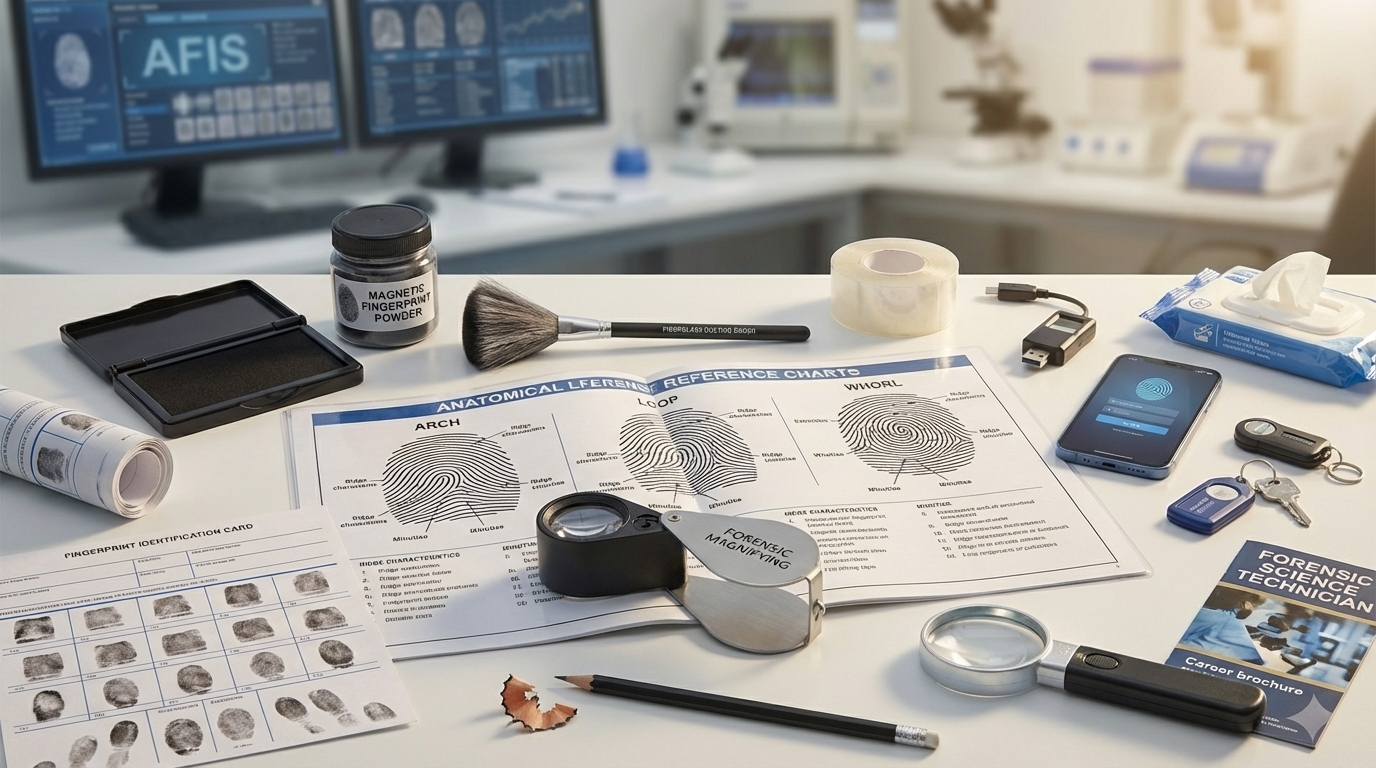
Today, fingerprinting has entered the digital age. The FBI and police agencies around the world use AFIS—the Automated Fingerprint Identification System—which can scan a latent fingerprint (one left behind at a crime scene) and search millions of records in seconds. Meanwhile, your smartphone, laptop, and even some credit cards use fingerprint readers for security. Banks, airports, and government buildings protect their spaces with biometric fingerprint scanners. Fingerprinting has evolved from a detective’s tool into a cornerstone of modern security and personal identification.
Get Ready!
You’re about to discover why your fingerprints make you one of a kind—and how forensic scientists and security experts use that uniqueness to solve crimes and protect people. You’ll learn the history, master the science, and get your hands (literally!) into taking real fingerprints. By the end of this badge, you’ll understand a skill that has captivated investigators for over 100 years.
Kinds of Fingerprinting
Criminal Fingerprinting
Criminal fingerprinting is the original use—identifying suspects and criminals. Police collect fingerprints at crime scenes and compare them to databases of known criminals and people arrested in the past. A match can place a suspect at a location, confirm identity, or help link crimes to a single person. Criminal fingerprinting requires precision: even a single point of comparison can be crucial in a courtroom.
Civil Fingerprinting
Civil fingerprinting is different. It’s used for background checks, driver’s licenses, passports, employment screening, and adoption agencies. Instead of matching a print to a database of criminals, civil fingerprinting confirms your identity or verifies you don’t have a criminal history. Millions of people are civilly fingerprinted every year for jobs, licenses, and travel.
Forensic Fingerprinting
Forensic fingerprinting is the detective work. When police find a fingerprint at a crime scene—on a window, a doorknob, a weapon—forensic examiners develop and enhance it using powders, chemicals, or advanced imaging. Then they compare it to known prints. A match can be key evidence in solving a case.
Biometric Fingerprinting
Biometric systems use your fingerprint as a key, not as evidence. Your smartphone’s fingerprint sensor reads your fingertip, converts it into a digital code, and compares that code to the one you enrolled when you set it up. If they match, you unlock the phone. Airports use biometric fingerprint readers for border control. Banks use them for authentication. Biometric systems are about convenience and security in everyday life.
Latent Fingerprints
Latent prints are invisible fingerprints left behind on surfaces when you touch them—oils and sweat from your skin create an impression. Unlike rolled prints or palm prints (which are intentional), latent prints are accidental. Developing and analyzing latent prints is one of the most important skills in forensic science. Examiners use powders, chemicals, and light sources to make the invisible visible.