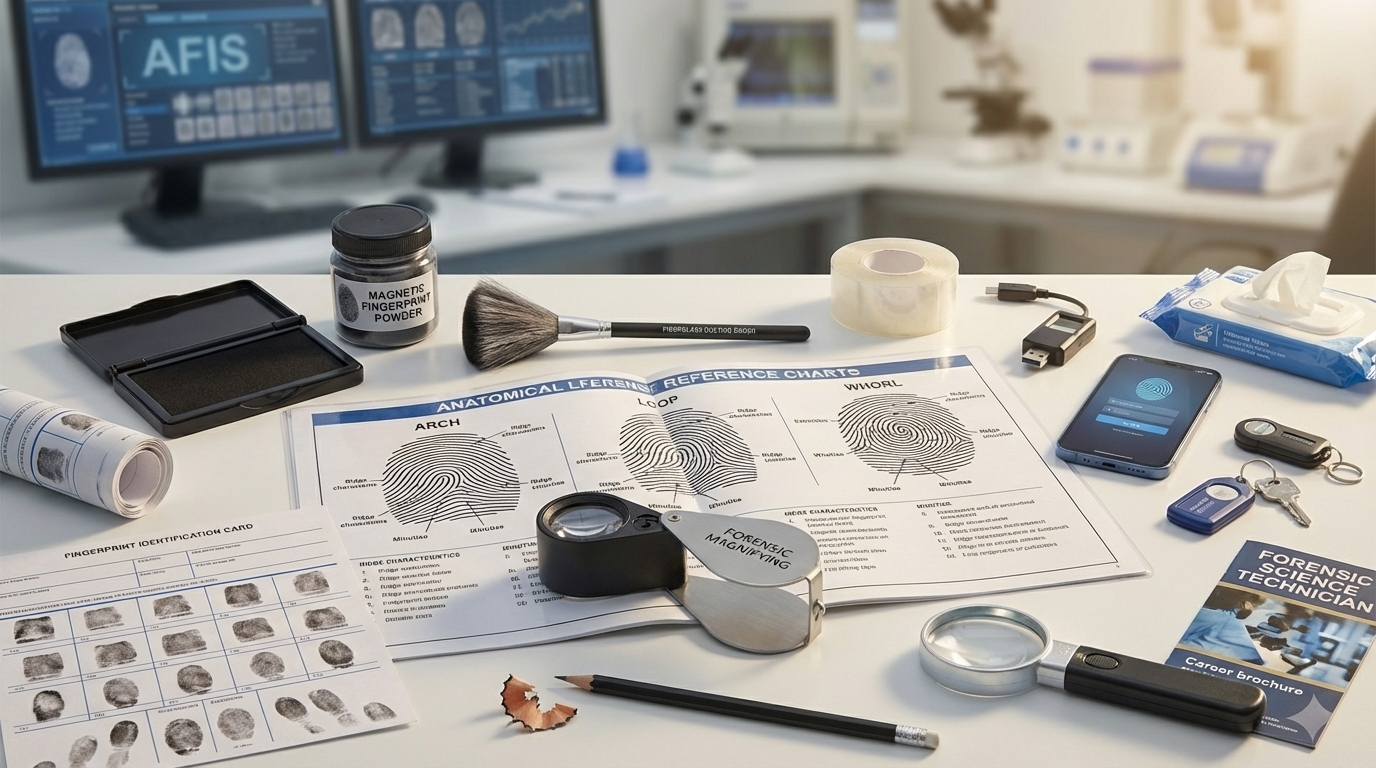
Fingerprinting Merit Badge — Complete Digital Resource Guide
https://merit-badge.university/merit-badges/fingerprinting/guide/
Introduction & Overview
Overview
Fingerprints are nature’s signature. No two people have ever been found with identical fingerprints—not even identical twins. For over a century, law enforcement has relied on fingerprints to solve crimes, and today, biometric fingerprint technology has become so common that you probably unlock your phone with yours every day. This merit badge explores the fascinating history of fingerprinting, the science behind why your prints are unique, and the modern technology that uses fingerprints to keep people safe and secure.
History: Then and Now
Then
The story of fingerprinting begins in the late 1800s, long before computers or smartphones existed. In the 1880s, an Argentine official named Juan Vucetich noticed something remarkable: the patterns of ridges on fingertips seemed to be unique to each person. Around the same time, Scottish physician Henry Faulds published a paper suggesting fingerprints could be used to identify criminals. The idea was revolutionary.
By 1901, Scotland Yard—the famous London police force—decided to try fingerprinting instead of a measurement system called anthropometry. The results were so promising that fingerprinting quickly spread to police departments around the world. For the next 80 years, officers kept millions of fingerprint cards filed in cabinets, manually searching through them when they needed to match a print found at a crime scene. It was tedious, slow work, but it solved thousands of cases.
Now
Today, fingerprinting has entered the digital age. The FBI and police agencies around the world use AFIS—the Automated Fingerprint Identification System—which can scan a latent fingerprint (one left behind at a crime scene) and search millions of records in seconds. Meanwhile, your smartphone, laptop, and even some credit cards use fingerprint readers for security. Banks, airports, and government buildings protect their spaces with biometric fingerprint scanners. Fingerprinting has evolved from a detective’s tool into a cornerstone of modern security and personal identification.
Get Ready!
You’re about to discover why your fingerprints make you one of a kind—and how forensic scientists and security experts use that uniqueness to solve crimes and protect people. You’ll learn the history, master the science, and get your hands (literally!) into taking real fingerprints. By the end of this badge, you’ll understand a skill that has captivated investigators for over 100 years.
Kinds of Fingerprinting
Criminal Fingerprinting
Criminal fingerprinting is the original use—identifying suspects and criminals. Police collect fingerprints at crime scenes and compare them to databases of known criminals and people arrested in the past. A match can place a suspect at a location, confirm identity, or help link crimes to a single person. Criminal fingerprinting requires precision: even a single point of comparison can be crucial in a courtroom.
Civil Fingerprinting
Civil fingerprinting is different. It’s used for background checks, driver’s licenses, passports, employment screening, and adoption agencies. Instead of matching a print to a database of criminals, civil fingerprinting confirms your identity or verifies you don’t have a criminal history. Millions of people are civilly fingerprinted every year for jobs, licenses, and travel.
Forensic Fingerprinting
Forensic fingerprinting is the detective work. When police find a fingerprint at a crime scene—on a window, a doorknob, a weapon—forensic examiners develop and enhance it using powders, chemicals, or advanced imaging. Then they compare it to known prints. A match can be key evidence in solving a case.
Biometric Fingerprinting
Biometric systems use your fingerprint as a key, not as evidence. Your smartphone’s fingerprint sensor reads your fingertip, converts it into a digital code, and compares that code to the one you enrolled when you set it up. If they match, you unlock the phone. Airports use biometric fingerprint readers for border control. Banks use them for authentication. Biometric systems are about convenience and security in everyday life.
Latent Fingerprints
Latent prints are invisible fingerprints left behind on surfaces when you touch them—oils and sweat from your skin create an impression. Unlike rolled prints or palm prints (which are intentional), latent prints are accidental. Developing and analyzing latent prints is one of the most important skills in forensic science. Examiners use powders, chemicals, and light sources to make the invisible visible.
Requirement 1 — Understanding Fingerprint History
A Brief History of Fingerprinting
The idea that your fingerprints are unique is so common today that it’s easy to forget how revolutionary it was. For thousands of years, people identified each other by face, voice, and name. But in the 1880s, scientists realized something remarkable: the pattern of ridges on your fingertips never changes and never repeats—not even between identical twins.
The Early Pioneers
The story begins with a Scottish doctor named Henry Faulds, who in 1880 published a paper proposing that fingerprints could identify criminals. Around the same time in Argentina, an official named Juan Vucetich was experimenting with the same idea. In 1891, Vucetich made history by solving the first crime using fingerprint evidence—a murder case in Buenos Aires. It was the moment fingerprinting proved itself in real life.
By 1901, Scotland Yard—the famous police force in London—adopted fingerprinting as their official identification method. They replaced an older system called anthropometry, which measured body parts like arm length and head width. Fingerprinting was faster and more accurate. The British approach, called the Henry Classification System, organized fingerprints into categories so officers could search files more efficiently. It worked so well that police departments around the world copied it.
The Manual Era
For the next 70 years, fingerprinting stayed mostly unchanged. Police departments kept millions of fingerprint cards in filing cabinets. When officers found a fingerprint at a crime scene, forensic examiners would manually search through boxes of cards, looking for a match. It was slow—a search might take weeks. But it worked. By the 1970s, fingerprinting had solved hundreds of thousands of cases.
The Digital Revolution
In the 1980s and 1990s, computers changed everything. The FBI developed AFIS—the Automated Fingerprint Identification System—which could scan a fingerprint, convert it into a digital template, and compare it against millions of records in seconds. Today, a match that took weeks to find in 1970 takes less than a minute. Law enforcement agencies around the world use AFIS. When you’re arrested or fingerprinted for a job background check, your print gets scanned into a digital database.
Civil vs. Criminal Identification
Fingerprinting serves two very different purposes, and understanding the difference is crucial.
Criminal Identification
Criminal fingerprinting is about solving crimes and protecting public safety. Police collect fingerprints from crime scenes—off a doorknob, a window, a weapon—and compare them to known prints in their database. If a match is found, it can prove a suspect was at the scene. Criminal fingerprinting also includes recording the prints of people arrested or convicted, so future crime scenes can be matched against them.
Criminal prints are kept in law enforcement databases like the FBI’s National Crime Information Center (NCIC). These databases are only accessible to police and authorized law enforcement agencies. A criminal fingerprint record stays in the system permanently, even if charges are later dropped or the person is found not guilty—though some jurisdictions allow expungement under certain conditions.
Criminal fingerprinting works because it’s uniqueness as evidence. “This fingerprint from the crime scene matches the suspect’s fingerprint on file. They were there.”
Civil Identification
Civil fingerprinting serves a different purpose: confirming your identity and verifying your background. When you apply for a driver’s license, passport, teaching job, or adoption background check, you may be fingerprinted. The prints are scanned and compared to criminal databases to confirm you don’t have a disqualifying criminal history. If you’re not in the criminal database, you pass.
Civil fingerprints are held by government agencies like the FBI, state police, or the Department of State. They may be kept for different periods depending on why they were taken. For employment, a civil fingerprint background check usually happens once. For law enforcement jobs, renewing teaching licenses, or certain government positions, you may need periodic fingerprinting.
Civil fingerprinting is about background verification. “This person says they’re John Smith, and our fingerprint check confirms they have no disqualifying criminal history.”
Key Differences at a Glance
| Aspect | Criminal | Civil |
|---|---|---|
| Purpose | Solve crimes, identify suspects | Confirm identity, verify background |
| Who fingerprints you | Police, FBI, or authorized law enforcement | Employer, government agency (licensing, passport, adoption) |
| Database | Law enforcement databases (NCIC, AFIS) | Government databases, employer records |
| Access | Police and law enforcement only | Government agencies and authorized employers |
| Kept indefinitely? | Yes, typically permanent | Varies by agency and reason for fingerprinting |
🎬 Video: The Origins of Fingerprinting and How They Became a Staple in Modern Forensic Science — https://www.youtube.com/watch?v=fMLGROOcvWQ
🎬 Video: How Did Detectives Solve the Case of the Bloody Fingerprints? — https://youtu.be/__nlupHISg0?si=YZ6NXUgVMs4VwfFJ
🎬 Video: History of Fingerprinting — https://www.youtube.com/watch?v=wg-lgiPV4rw
Requirement 2a — AFIS and Biometric Systems
Both AFIS and biometric fingerprint systems use your fingerprints to identify or verify you. But they work differently, are used for different purposes, and operate in completely different environments. Let’s explore what makes each one special.
AFIS: Law Enforcement’s Power Tool
AFIS stands for Automated Fingerprint Identification System. It’s the technology that revolutionized criminal investigations starting in the 1980s. When police find a fingerprint at a crime scene—a latent print on a window, a weapon, or a doorknob—they photograph it, scan it, and feed it into AFIS. The system converts the print into a mathematical template and searches millions of fingerprints on file, looking for matches.
How AFIS Works
An AFIS computer analyzes specific features of your fingerprint—the ridge patterns, the ridge endings, the way loops and whorls form—and assigns coordinates and characteristics to each unique feature. This creates a digital “fingerprint” that’s much more efficient to search than an actual image. When a latent print from a crime scene is scanned, AFIS finds the top candidates (say, the 20 most likely matches) in seconds. A human examiner then carefully compares the latent print to each candidate print to confirm a match.
What AFIS Needs
AFIS is designed for high-quality prints—the kind law enforcement collects. When you’re arrested or fingerprinted for a job background check, you’re typically rolled through ink or scanned with a digital fingerprint reader to create a “known print” that goes into the database. These prints are clear, complete, and standardized. A crime scene latent print might be smudged, partial, or overlapping with other prints, but AFIS can still compare it to the clear prints in its database.
The AFIS Advantage
The real power of AFIS is speed and scale. In 1970, matching a fingerprint meant manually searching thousands of cards. Today, AFIS eliminates that manual search by narrowing millions of possibilities down to a manageable list for human review. It’s especially valuable for unsolved cold cases—law enforcement can now compare old fingerprints from crime scenes against modern databases and solve cases that were impossible before digital technology.
Biometric Fingerprint Systems: Everyday Security
Biometric fingerprint systems are everywhere. Your smartphone might unlock with your fingerprint. Your company’s office door might have a fingerprint reader. Airports use fingerprint scanners at immigration. Banks use them for withdrawals. These systems all work on a similar principle: scan your fingerprint, compare it to the one you enrolled, and grant access if they match.
How Biometric Fingerprint Systems Work
When you enroll in a biometric system, you scan your finger (usually the index or thumb) multiple times. The system captures images of your fingerprint and creates a digital template—similar to AFIS, but much simpler. That template is encrypted and stored locally (on your phone) or securely (on a server). Later, when you want to unlock your phone or enter a building, you place your finger on the scanner again. The system captures a new image, creates a new template, and compares the two. If they match with sufficient confidence (the threshold is set by the system), you’re granted access.
The Biometric Advantage
Biometric systems are fast, convenient, and secure. You can’t lose your fingerprint (unlike a password or a key). You can’t forget it. And it’s very difficult to fake—you’d need a high-quality mold of someone’s actual finger to spoof most modern biometric readers, and even then, many systems include “liveness detection” to ensure they’re scanning an actual finger, not a photograph or mold.
Key Differences: AFIS vs. Biometric Systems
| Aspect | AFIS | Biometric Fingerprint System |
|---|---|---|
| Primary Use | Match crime scene prints to known criminals | Grant access or verify identity |
| Scope | Compares against millions of known prints | Compares against one enrolled print (or a small list) |
| Data Source | Database of thousands/millions of prints | Single enrolled template |
| Response Time | Minutes to hours (human review required) | Instant (milliseconds) |
| Accuracy Needed | Very high; used as evidence in court | High but not court-grade |
| Environment | Controlled (police lab) | Everyday (phone, door, airport) |
| Print Quality | Ideally high-quality; can work with partial prints | User scans intentionally; usually clear |
Why Both Systems Exist
AFIS and biometric systems serve different missions. AFIS solves crimes by comparing a latent print from a crime scene to millions of known prints. It needs to search broadly and with forensic precision. Biometric systems grant access by confirming you are who you claim to be—they only need to compare your new scan to your enrolled template.
Think of it this way: AFIS asks, “Who is this person?” Biometric systems ask, “Are you who you say you are?” The questions are different, so the systems are different.
🎬 Video: AFIS - Automated Fingerprint Identification System — https://www.youtube.com/watch?v=VRdGtGYQ7WE
Requirement 2b — Authentication in Daily Life
Every day, you prove who you are dozens of times. You unlock your phone. You log into email. You swipe a student ID card. You might even use your fingerprint to access your parents’ computer. Modern society relies on three main ways to verify identity: tokens (physical objects), passwords (secret knowledge), and biometrics (your body). Let’s explore each one and see how they fit into your daily life.
Tokens: The Physical Key
A token is a physical object that proves you are who you say you are. The most common tokens are:
ID Cards and Credentials Your school ID, driver’s license, passport, and employee badge are all tokens. They have your photo, signature, and official seal from an authority (your school, the government, your employer). When you show your driver’s license to prove your age or your passport to enter a country, you’re using a token. The token proves you were authorized by that institution to have one.
Key Cards and Fobs Many office buildings, apartment complexes, and gyms use card readers. You tap a plastic card or fob to a scanner and the door unlocks. That card is a token—it’s a physical proof that you’re authorized to enter. If you lose the card, someone else could use it to enter. If the institution knows you’re no longer authorized, they can deactivate the card.
Physical Keys A traditional key is the simplest token. It fits a specific lock and only people with that key can open it. A car key, a house key, a locker key—all tokens.
The Token Weakness Tokens have a big problem: they can be lost, stolen, or forgotten. If you lose your car key, someone who finds it could steal your car. If you lose your access card, someone could impersonate you at work. For this reason, modern systems often combine tokens with passwords or biometrics for extra security.
Passwords: The Secret Knowledge
A password is something only you know. It’s the most common security method in the digital world. Your email password, your social media password, your banking PIN—these are all secrets that only you should know.
Why Passwords Work If only you know your password, then only you can log in. It’s simple and it works. When you enter your password, the computer compares it to the stored password and grants you access if they match.
The Password Problem Passwords have serious weaknesses. People reuse passwords across multiple sites. People write them down. People share them. Hackers use software to guess weak passwords quickly. “123456” is the most common password in the world—it’s essentially useless as security. And as your digital life grows (email, social media, banking, games, streaming services), remembering dozens of unique, strong passwords becomes impossible.
Password Best Practices
- Use passwords with mix of uppercase, lowercase, numbers, and symbols
- Never reuse passwords across different sites
- Use a password manager to store complex passwords securely
- Enable two-factor authentication when available (a second security layer beyond just the password)
- Never share your password with anyone, not even friends or family
Biometrics: Your Body as a Key
Biometrics use a measurable feature of your body to verify your identity. The most common biometric identifiers are:
Fingerprints Your fingerprints are unique and permanent. They don’t change throughout your life. Biometric fingerprint readers are now standard on smartphones, laptops, and access control systems. They’re fast, convenient, and secure.
Facial Recognition Your face is as unique as your fingerprint. Many modern phones and airports use facial recognition. A camera captures your face and compares it to an enrolled image. If they match, you’re granted access.
Iris Scans Your iris (the colored part of your eye) has complex patterns unique to you. High-security facilities sometimes use iris scanners because they’re extremely difficult to fool and can be done from a distance.
Voice Recognition Your voice pattern is unique. Some banking apps use voice recognition to verify you when you call. The system listens to your speech patterns and compares them to a voice sample you recorded when you enrolled.
Hand Geometry Some facilities use hand scanners that measure the length and width of your fingers and palm. It’s less common than fingerprints or facial recognition but still used in secure locations.
How Society Uses All Three
In reality, organizations combine these three methods to create layered security. Here are real examples:
Your Smartphone
- Token: The phone itself. If someone steals your phone, they have a token.
- Password: Your PIN or password to unlock the phone.
- Biometric: Your fingerprint or face to unlock it without typing the password.
Most phones let you choose: unlock with just your PIN, just your biometric, or both.
Your Bank Account
- Token: Your debit card.
- Password: Your PIN or password.
- Biometric: Some banks now allow fingerprint login.
When you withdraw money from an ATM, you use your card (token) and PIN (password). When you log in online, you might use your password and a code sent to your phone (multifactor).
Airport Immigration
- Token: Your passport.
- Password: Not typically used at immigration.
- Biometric: Your fingerprints and/or face scan.
The officer checks your passport (token) and your biometric data to confirm you are who the passport says you are.
Your School or Office
- Token: Your ID badge or access card.
- Password: May be required for sensitive areas or computer systems.
- Biometric: Newer facilities might use fingerprint or facial recognition readers.
The Future of Authentication
Society is slowly moving away from passwords because they’re weak and burdensome. The trend is toward passwordless authentication—using tokens and biometrics instead.
Companies like Apple, Google, and Microsoft are pushing “passkeys”—a modern approach that combines cryptography (mathematical security) with biometrics. Instead of remembering passwords, you verify who you are with your fingerprint or face, and the system confirms your identity cryptographically. It’s more secure and more convenient than passwords.
🎬 Video: What Is Multifactor Authentication — https://youtu.be/L3alw3iXaio?si=JYHojryXMcsBnHmz
🎬 Video: Token Authentication — https://www.youtube.com/watch?v=UBUNrFtufWo
🎬 Video: Biometric Authentication Technology — https://youtu.be/uRwh0t7RabA?si=mm9nKjMZX-eSkGtc
🎬 Video: Science of Innovation -- Biometrics — https://www.youtube.com/watch?v=IlThIvXn2Hk
Authentication in Your Daily Life
Where do you encounter tokens, passwords, and biometrics?- Phone unlock (password, biometric, or both?)
- Email login (password? two-factor authentication?)
- School ID card (token)
- Locker combination (password/PIN)
- Bank account (password, card, PIN?)
- Video game account (password)
- Social media (password, biometric, two-factor?)
- Computer at home or school (password, biometric?)
Requirement 3a — Friction Ridges on the Body
Look at the skin on your fingertips right now. You’ll notice parallel lines running across your fingers. Those lines are friction ridges, also called papillary ridges. They cover more of your body than most people realize, and they all serve the same basic purpose: grip.
What Are Friction Ridges?
Friction ridges are small, parallel grooves and ridges in the outer layer of your skin. Under a magnifying glass, they look like tiny railroad tracks. They’re called “friction” ridges because they increase friction—they help you grip objects better, just like the tread on a tire. If your skin were completely smooth, a wet glass would slip right out of your hand. Friction ridges prevent that.
Friction ridges are also called papillary ridges because they sit on top of small bumps called papillae (the word comes from Latin meaning “small pimple”). Beneath these ridges is a layer of tissue containing blood vessels and nerves. That’s why your fingerprints are slightly sensitive—the ridges protect the sensitive tissue underneath.
Where Friction Ridges Are Found
Friction ridges appear on several parts of your body where grip is important. Here’s the complete list:
Fingertips (Volar Surface)
The most famous location. All ten of your fingertips have friction ridges. These are the ridges you use to create fingerprints when you press your finger on paper or a fingerprint scanner.
Palms (Volar Surface of the Hand)
Your entire palm—not just your fingertips—is covered in friction ridges. Palm prints are used in forensics just like fingerprints. In fact, a palm print can be more distinctive than a fingerprint because it covers a larger area with more ridge detail. Some crime scenes yield palm prints that are more useful than finger prints for identification.
Soles of the Feet
The bottom of your foot, including the heel, arch, and ball of your foot, has friction ridges. Newborn babies have unique footprints, and hospitals use footprints (sometimes along with fingerprints) to identify newborns. The pattern of ridges on your sole is as unique as your fingerprints.
Toes (Volar Surface)
Your toes have friction ridges similar to your fingers. While toe prints are less commonly used in forensics than fingerprints, they are equally unique and can be used for identification purposes.
The Inner Forearm (Volar Surface)
The inside of your arm, from your wrist partway up toward your elbow, also has friction ridges. This is less commonly discussed because fingerprints and palm prints are more distinctive, but the forearm does have ridge patterns.
The Volar Surface: A Key Term
All the locations where friction ridges are found are called the “volar surface” of the body. “Volar” comes from the Latin word for palm, and it refers to the inner surfaces of hands and feet—the surfaces that face inward when your arms are at your sides and your palms are facing forward. These are the surfaces most involved in gripping and handling objects, which is why they developed friction ridges.
Why Only These Locations?
Friction ridges are found only on the volar surfaces because these are the areas that make contact with objects when you grip, hold, or manipulate them. Your fingers, palms, and soles are your primary contact points with the world around you. Your back, your forehead, and your legs don’t need extra grip, so they don’t have friction ridges.
During fetal development, friction ridges form in specific patterns at these locations. The ridges develop randomly, influenced by small variations in pressure and blood flow in the womb. Even identical twins—who share the same DNA—develop different ridge patterns because the conditions in the womb are slightly different for each twin.
Using Knowledge of Ridge Location in Forensics
Forensic examiners and crime scene investigators understand that friction ridges can appear on any volar surface. A burglar who broke a window with a bare hand might leave a palm print on the glass. A suspect who walked barefoot through a crime scene might leave footprints. An examiners looks for ridge patterns anywhere on the volar surface—not just on the ten fingers.
🎬 Video: Fingerprint Ridge Patterns — https://www.youtube.com/watch?v=FPHOJ-0ljV8
Friction Ridge Locations Checklist
Can you name all the body surfaces where friction ridges are found?- Ten fingertips (volar surface of fingers)
- Two palms (volar surface of hands)
- Two soles of feet
- Ten toes
- Inner forearms
- Any other locations?
Requirement 3b — Principles of Fingerprint Science
The entire science of fingerprinting rests on two simple but powerful ideas. Every match made by law enforcement, every phone unlocked by biometric, every criminal caught through fingerprint evidence—all of it depends on these two principles. Let’s learn them.
Principle 1: Uniqueness (Individuality)
The Principle: Every fingerprint is unique. No two people have ever been found with identical fingerprints, not even identical twins. And your fingerprints never change throughout your entire life.
Why It Matters
Uniqueness is the foundation of everything. If your fingerprint was the same as someone else’s, fingerprints would be useless for identification. But because your fingerprints are truly one-of-a-kind, they can prove who you are. A fingerprint found at a crime scene that matches your fingerprint on file can place you there.
How We Know It’s True
For over 100 years, forensic scientists have examined billions of fingerprints. No two have ever been found to be identical. Fingerprint examiners use specific ridge characteristics—the ridge endings, ridge dots, splits in ridges, and patterns of loops and whorls—to compare fingerprints. When an examiner says two prints match, they’ve found enough matching characteristics to rule out everyone else in the world.
Modern studies using digital fingerprint technology confirm this. The FBI’s AFIS system has searched fingerprints from millions of people and never found two people with identical prints.
The Physics Behind Uniqueness
Your fingerprints form during fetal development, around 10 to 20 weeks into pregnancy. The ridges develop randomly, shaped by tiny variations in the amniotic fluid, pressure, and blood flow. Even microscopic differences in the womb create unique patterns. Once formed, your fingerprints stay exactly the same throughout your life. They don’t change due to age, injury, or anything else—although severe burns or cuts might temporarily obscure them, the underlying ridge pattern remains unchanged.
Principle 2: Permanence
The Principle: Your fingerprints remain exactly the same from birth until death. They are permanent and unchanging.
Why It Matters
Permanence means fingerprints are reliable for a lifetime. A fingerprint you left on a crime scene 20 years ago will still match your fingerprints today. This allows cold cases to be solved decades later when new technology makes it possible to extract and analyze old evidence. Permanence also means your biometric fingerprint template (the digital version stored on your phone or in a security system) will work for your entire life.
How We Know It’s True
Scientists have studied fingerprints across entire lifespans. People fingerprinted as children 60 years ago, when fingerprinted again as elderly adults, have identical fingerprints. Burn victims who lost their fingerprints temporarily during extreme heat still had their original ridge patterns underneath. People who suffered severe injuries and scarring still had unchanged fingerprint patterns.
What Does and Doesn’t Change Your Fingerprints
| What DOESN’T Change Your Fingerprints | What CAN Temporarily Obscure Them |
|---|---|
| Age (they’re the same at 5, 25, 65, and 95) | Severe burns (pattern unchanged underneath) |
| Scars or injuries to your fingertips | Extreme dryness or moisture |
| Work or calluses from manual labor | Dirt or ink buildup |
| Skin condition or dermatitis | Temporary swelling or inflammation |
| DNA or genes (even in identical twins) | Medical conditions affecting skin texture |
How These Two Principles Work Together
Uniqueness means your fingerprints are different from everyone else. Permanence means your fingerprints are the same today as they were yesterday and will be tomorrow. Together, these principles create a perfect identification system:
- For Law Enforcement: A fingerprint from a crime scene can be matched to a suspect’s fingerprints on file with certainty that only one person in the world has those ridge patterns.
- For Biometrics: Your enrolled fingerprint will match your finger every time you scan it, for your entire life.
- For Civil Identification: Your fingerprints at age 8 will match your fingerprints at age 80, making them suitable for background checks and licensing across decades.
The Exceptions That Prove the Rule
Scientists have found a few rare conditions where fingerprints can be slightly affected:
Adermatoglyphia is an extremely rare genetic condition where people are born without fingerprints at all. Only a few families worldwide have this condition. It proves that fingerprints are controlled by genetics, even though the exact pattern is not inherited—it’s random.
Leprosy and certain skin diseases can temporarily obscure fingerprints by damaging the skin surface, but the underlying ridge pattern remains unchanged.
Advanced scar tissue from severe burns might affect the outer skin layer, but forensic examiners can still identify ridge patterns in the deeper layers of skin.
These exceptions are so rare that they actually strengthen the rule: for virtually all people, your fingerprints are unique to you and unchanged throughout your life.
🎬 Video: Principles of Fingerprint Science — https://www.youtube.com/watch?v=qX6hFXHDmk4
🎬 Video: Why Are Your Fingerprints Unique? — https://www.youtube.com/watch?v=iCRy8voU5dE
The Two Principles
Can you explain each one?- Uniqueness (Individuality): Every fingerprint is different; no two people have identical prints
- Permanence: Your fingerprints never change throughout your lifetime
- Why Uniqueness Matters: It allows identification of a specific person
- Why Permanence Matters: Fingerprints can be used reliably across a lifetime
- How They Work Together: They make fingerprints a perfect biometric identifier
Requirement 3c — Positive Identification
Saying “two fingerprints match” sounds simple, but in reality, positive identification is a sophisticated process. It requires skill, specific criteria, and often multiple points of comparison. Let’s explore what forensic examiners actually need to say, “Yes, this is definitely the same person.”
What “Positive Identification” Means
Positive identification means that a fingerprint examiner has compared two fingerprints (usually a latent print from a crime scene and a known print from a suspect or database) and concluded with certainty that they came from the same person. This conclusion is reliable enough to present as evidence in court.
The key word is certainty. In forensics, examiners don’t say “probably the same person” or “likely the same person.” They say, “This is the same person,” or they say, “No match.” There’s no middle ground.
The ACE-V Method
Most fingerprint examiners use a systematic process called ACE-V:
A - Analysis
The examiner carefully studies the latent fingerprint from the crime scene. They document:
- The quality of the print (is it clear, smudged, partial, or complete?)
- The ridge characteristics visible (loops, whorls, arches, ridge endings, ridge divergences, dots)
- Which parts of the print are clear enough to be useful for comparison
- Any damage or obscuring marks
C - Comparison
The examiner compares the latent print side by side with the known print (usually from a database or from a suspect who was arrested). They look for matching ridge characteristics:
- Do the overall patterns match (loop vs. whorl vs. arch)?
- Do the ridge endings align?
- Are the ridge divergences (where ridges split) in the same locations?
- Do dots or other unique features match?
E - Evaluation
The examiner decides what the comparison means:
- Individualization (Match): “These two prints came from the same person.”
- Exclusion (Non-match): “These two prints came from different people.”
- Inconclusive: “The print is too damaged or partial to reach a conclusion.”
In criminal casework, examiners need to reach a definitive conclusion—match or non-match. Inconclusive prints are set aside.
V - Verification
This is the quality-control step. A second independent examiner (who doesn’t know the first examiner’s conclusion) repeats the Analysis, Comparison, and Evaluation. If both examiners independently reach the same conclusion, the match is verified. This prevents mistakes and increases certainty.
The Standards for a Match
Different fingerprint systems have slightly different standards, but law enforcement in the United States generally accepts these guidelines:
No Minimum Point Rule
The FBI and most U.S. law enforcement agencies don’t have a rigid “you need at least 12 matching points” rule anymore. Instead, examiners consider:
- The quality of the print (a clear, high-quality latent print might match with fewer points)
- The uniqueness of the matching characteristics (some ridge features are rarer than others)
- The amount of ridge area available for comparison
- The absence of any conflicting characteristics (no features that contradict a match)
A match might be established with as few as 5-8 high-quality, unique characteristics, or it might require 15-20 characteristics if the print is lower quality.
The Exclusion is Absolute
If even ONE ridge characteristic doesn’t match—even one ridge ending or split that’s in a different location—then the prints are NOT from the same person. Exclusion is absolute. One mismatch rules it out completely.
What Makes a Print Identifiable?
Not every fingerprint at a crime scene can lead to positive identification. Some prints are too smudged, partial, or obscured. Examiners assess several factors:
Clarity and Quality
A clear, high-quality latent print (like one lifted from a smooth surface like glass or plastic) is easier to match than a smudged print on a rough surface like a brick. If the ridges are clear and distinct, matching is more reliable.
Completeness
A complete print showing all ridge patterns is better than a partial print showing only a small area of the finger. If you only see a 1-inch-by-1-inch smear of ridges, it’s harder to establish uniqueness than if you see the entire fingerprint.
Distinctiveness of Ridge Patterns
Some fingerprints have very common, generic patterns (simple loops). Others have rare, distinctive patterns (complex whorls with unusual branching). Rare patterns are easier to match uniquely. If the suspect’s print has a very unusual ridge pattern and the crime scene print matches that unusual pattern, positive identification is more certain.
Absence of Conflicting Features
The examiner checks not just for matching characteristics but also for features that would exclude a match. If the latent print shows a ridge ending at a specific location and the suspect’s print shows a ridge divergence at that same location, they don’t match—even if many other features seem similar.
From Laboratory to Courtroom
Positive identification based on fingerprints has been accepted in U.S. courts since the early 1900s. Fingerprint evidence is considered reliable because:
- Scientific basis: Decades of research support uniqueness and permanence.
- Systematic methodology: The ACE-V method is standardized and documented.
- Verification: Matches are verified by a second independent examiner.
- No known false positives in properly executed cases: When examiners follow proper protocol, matches are accurate.
However, fingerprint evidence has been scrutinized in recent years. Some highly publicized cases involved examiners who made incorrect matches. This led to improved training, clearer standards, and increased use of verification. Most U.S. law enforcement agencies now require a second examiner to verify every match before it’s used in court.
Limitations of Fingerprint Identification
While fingerprints are highly reliable, they have limitations:
Quality Dependent
A perfect match requires adequate print quality. A partial, smudged, or degraded print might not allow for positive identification, even if it did come from the suspect.
Examiner Dependent
The skill and experience of the examiner matters. Proper training and verification reduce errors, but human judgment is still involved.
Database Limitations
AFIS can only match against prints in its database. If a suspect’s print was never entered into the system (because they were never arrested or fingerprinted), a match can’t be made automatically—though the examiner can still manually search if they have a suspect.
Environmental Factors
Fingerprints can be damaged or degraded by environmental factors (heat, moisture, chemicals). A print exposed to harsh conditions might not be identifiable.
🎬 Video: How Reliable is Fingerprint Analysis? — https://youtu.be/fd8reN4uoBM?si=0GxHgY5rv0kw9XEA
🎬 Video: Fingerprint Evidence — https://youtu.be/t3ppAEvI2kI?si=vSffPDpu6oJrYJZa
Requirements for Positive Identification
What does it take?- Analysis: Careful study of the latent print’s quality and characteristics
- Comparison: Side-by-side examination of latent and known prints
- Evaluation: Deciding if they match, don’t match, or are inconclusive
- Verification: A second independent examiner confirms the match
- Sufficient quality and clarity in the prints being compared
- Absence of any conflicting ridge characteristics
- Documentation of the matching characteristics found
Requirement 4a — Official Fingerprint Cards
This requirement is straightforward but important: you’re going to create a real, official fingerprint record just like the ones that go into law enforcement databases. You’ll make both rolled and plain impressions, which are the two standard ways fingerprints are recorded. Let’s learn the process.
Getting Your Fingerprint Card
An 8-by-8-inch fingerprint identification card (also called an FD-258 form in the FBI’s system) is the standard fingerprint card used by law enforcement agencies across the United States. Your options for getting a card:
From Your Police Department
Visit your local police station or sheriff’s office and ask for a fingerprint card. Most departments are happy to provide them, sometimes free or for a small fee. Ask if they have information about fingerprinting procedures—some officers enjoy talking to Scouts about the process.
From Your Merit Badge Counselor
Your fingerprinting merit badge counselor may have cards on hand, especially if they work in law enforcement or have worked with Scouts on this badge before.
Online
The FBI and some fingerprint supply companies sell blank FD-258 cards online. Search for “FD-258 fingerprint cards” to find vendors.
From a Forensic Science Program
If your school or local university has a forensic science or criminal justice program, they might have spare cards or know where to get them.
Understanding the Card Layout
A standard fingerprint card has spaces for:
- Personal information: Your name, date, signature, and other identifying information
- Rolled impressions: Ten numbered boxes for each rolled fingerprint (1 through 10, representing all ten fingers)
- Plain impressions: Two larger boxes for plain impressions (usually both thumbs and all other fingers in one impression)
- Agency information: Which police department or organization is collecting the fingerprints
The rolled impressions show one finger at a time, fully extended. The plain impressions show multiple fingers pressed at once. Both are important because they provide different information and can be used for different purposes.
Rolled Impressions: The Step-by-Step Process
A rolled impression captures your entire finger, from one side of the fingernail to the other, showing all the ridge patterns.
What You Need
- A fingerprint card
- An ink pad (typically black fingerprint ink)
- Paper towels or alcohol wipes (for cleaning between fingers)
- A smooth, flat surface (like a desk or table)
Step 1: Prepare the Ink
Have your ink pad ready. If it’s a pad that’s been used before, make sure the surface is even and the ink is distributed evenly. If the ink is too dry, it won’t transfer well; if it’s too wet, you’ll get a heavy smudge instead of clear ridges.
Step 2: Start with the Right Index Finger
Begin with your right index finger (your right pointing finger). Position yourself at the fingerprint card so the “1. RIGHT THUMB” space is in front of you.
Wait—that’s actually wrong. Let me correct that: the standard order is:
- Right Thumb
- Right Index
- Right Middle
- Right Ring
- Right Little
- Left Thumb
- Left Index
- Left Middle
- Left Ring
- Left Little
Step 3: Roll the Finger
This is the critical technique. Place your right thumb in the box labeled “1. RIGHT THUMB”:
- Place your thumb on the ink pad with your nail facing straight up and your thumb positioned at roughly a 90-degree angle to the pad.
- Roll it from side to side: Using gentle pressure, roll your thumb from the outer edge (pinky side) to the inner edge (index finger side), capturing the entire ridge pattern. You should rotate your thumb about 180 degrees during the roll.
- Maintain pressure: Don’t lift your thumb while rolling—keep steady pressure so the ink transfers evenly.
- Roll it onto the card: Once you’ve rolled your thumb on the ink pad, immediately transfer it to the card in the box labeled “1” and repeat the rolling motion. From outer edge to inner edge again.
Step 4: Clean Your Finger
Before moving to the next finger, wipe your thumb and the edge of your hand with a paper towel or alcohol wipe to remove excess ink. This prevents smudging on the card.
Step 5: Repeat for All 10 Fingers
Follow the same rolling process for all fingers: right index, right middle, right ring, right little, then left thumb, left index, left middle, left ring, and left little.
Common Mistakes to Avoid
- Rolling too slowly or too quickly: A smooth, controlled roll works best.
- Not rolling all the way: If you don’t roll from the outer edge to the inner edge, you’ll miss part of the ridge pattern.
- Pressing too hard: This causes smudging. Light to medium pressure is best.
- Forgetting to clean between fingers: Ink buildup on your hands can smudge the next impression.
- Rolling the wrong direction: Always roll from the pinky-side edge toward the thumb-side edge (outer to inner).
Plain Impressions: The Step-by-Step Process
Plain impressions are different from rolled impressions. Instead of rolling, you press your fingers straight down onto the card. This captures a different view of your fingerprints—useful for comparison and for pattern analysis.
Step 1: Position Yourself
Locate the section on your card labeled “PLAIN IMPRESSIONS” or “PLAIN PRINTS.” There are usually two boxes: one for “RIGHT HAND” and one for “LEFT HAND.”
Step 2: Take the Right Hand Plain Impression
- Ink all five fingers of your right hand by pressing them, side by side, onto the ink pad.
- Press them onto the card in the “RIGHT HAND” box. Press straight down—don’t roll. All five fingers should appear side by side on the card.
- Make sure all fingers are visible: Ideally, you should see all five fingerprints (thumb, index, middle, ring, little) in one impression.
Step 3: Clean Your Hand
Wipe all the ink off your right hand with paper towels or an alcohol wipe.
Step 4: Take the Left Hand Plain Impression
Repeat the process for your left hand: ink all five fingers, press them straight down (no rolling) onto the “LEFT HAND” box on your card.
Step 5: Add Your Signature
Most fingerprint cards require your signature. Sign where indicated on the card.
What You’ve Created
You now have a complete, official fingerprint record—the same type used by law enforcement agencies. Your card shows:
- Your rolled impressions (useful for database searches and detailed ridge analysis)
- Your plain impressions (useful for comparison and field reference)
- Your signature (confirms you authorized the fingerprinting)
If your card goes into a law enforcement database, a latent fingerprint from a crime scene could be compared to your prints. If you enroll in a biometric system at a bank or phone, the system is capturing similar ridge information digitally.
🎬 Video: How to Roll Fingerprints — https://www.youtube.com/watch?v=d7N-4UNAzsw
Taking Rolled and Plain Impressions
Checklist for completing this requirement- Obtained an 8-by-8-inch fingerprint card
- Gathered: ink pad, paper towels, and a clean surface
- Took rolled impressions of all 10 fingers in the correct order
- Rolled each finger from outer edge to inner edge
- Cleaned between fingers to prevent ink smudging
- Took plain impressions of right hand (all five fingers pressed at once)
- Took plain impressions of left hand (all five fingers pressed at once)
- Signed the card
- Verified that all impressions are clear and complete enough to show ridge patterns
Requirement 4b — Tape and Pencil Method
You can create a complete set of fingerprints without fingerprint ink, official cards, or a police station. This simple method—using tape, pencil, and paper—has been used for years in schools and forensic science classes. It’s exactly how forensic examiners sometimes develop latent fingerprints at crime scenes. You’re going to learn this technique.
Why This Method Works
This technique works because it mimics how forensic examiners develop latent fingerprints at crime scenes. A latent fingerprint is invisible—left behind by the oils and sweat on your skin. To make it visible, examiners use various methods. The tape-and-pencil method is one of the simplest and oldest.
When you rub your finger across pencil graphite, the graphite particles stick to the oils and ridges on your fingerprint, making it visible. When you press clear tape over it, the graphite transfers to the tape and you have a permanent record.
What You’ll Need
- Clear adhesive tape (regular transparent tape works best; avoid colored or frosted tape)
- A wooden pencil (regular #2 pencil is fine) or pencil lead shavings
- Plain paper (white paper works best for visibility)
- A flat surface to work on
- Optional: A pencil sharpener (to create graphite shavings if you want finer particles)
The Step-by-Step Process
Step 1: Create Your Graphite Source
You have two options:
Option A: Pencil Rubbing
Take your pencil and lightly scribble on a piece of scratch paper (not the one you’ll use for your final record). You’re creating a layer of graphite that you can rub your finger across. Make a dark smudge about 2 inches by 2 inches.
Option B: Pencil Shavings
If you want even finer graphite particles, sharpen your pencil and let the shavings fall onto a piece of paper. You’ll then rub your finger in the shavings. This creates a fine, even layer of graphite particles.
Step 2: Coat Your Finger in Graphite
Take the finger you want to record (let’s say your right index finger) and rub it back and forth across the graphite layer you created. Keep rubbing until your fingertip is well-covered with dark graphite. You should see your fingerprint patterns becoming visible on your finger as the graphite sticks to the ridges.
You want a good coating of graphite, but not so much that it’s a thick, muddy layer. If you can still see your ridge patterns clearly on your finger, you have the right amount.
Step 3: Prepare Your Tape
Tear off a piece of clear adhesive tape about 3 to 4 inches long. Have it ready to press down.
Step 4: Press the Tape onto Your Graphite-Coated Finger
This is the critical step:
- Position the tape: Place one end of the tape against the bottom edge of your fingerprint (the side closest to your palm).
- Roll the tape slowly and steadily up your finger, covering the entire fingertip and part of the surrounding area.
- Press firmly: As you roll, use your other hand to press the tape down firmly so the graphite transfers to the tape.
- Smooth it out: Once the tape is in place, smooth out any air bubbles so the tape makes full contact with your finger.
Step 5: Remove the Tape
Gently peel the tape away from your finger. You should see your fingerprint in graphite particles stuck to the tape.
Step 6: Mount the Tape on Paper
Press the tape—graphite side up (so the ridge patterns are visible)—onto your sheet of plain paper. Press it down firmly and smooth out any air bubbles. Label the tape with the finger name and date (e.g., “Right Index, 3/8/2025”).
Step 7: Repeat for All Fingers
Repeat steps 1-6 for all ten fingers, creating a complete set of fingerprints on your paper. You should have ten tape impressions arranged in order: right thumb through right little, then left thumb through left little.
Alternative: Recording Another Person’s Fingerprints
The requirement allows you to record your own fingerprints or someone else’s (with permission). To take someone else’s fingerprints:
- Have them coat their finger in graphite (same process as step 2).
- They can either press their finger onto a piece of tape, or you can press the tape onto their finger (both work).
- Mount the tape on paper.
- Have them sign the paper to verify you have their fingerprints.
This is especially useful if you want to compare fingerprints from multiple people and show that each person has unique patterns.
What You’ve Created
You’ve created a permanent record of your (or another person’s) fingerprints using a simple method that requires no special materials. This tape-and-graphite method is:
- Inexpensive: Most homes have tape, pencil, and paper.
- Reversible: You’re not using ink that stains; you can wash your hands and the graphite comes off.
- Educational: You’ve experienced a version of the forensic techniques used to develop latent fingerprints.
- Replicable: You can repeat this process multiple times and always create clear fingerprints.
Comparing Your Two Methods
If you completed Requirement 4a (official fingerprint card), you now have two different records of your fingerprints. Compare them:
- Ink impressions: Clear, dark, professional-looking. These are what law enforcement uses.
- Tape impressions: Lighter, more textured, showing the graphite particles. These are what you see when forensic examiners develop latent prints.
Both show your ridge patterns. Both are valid. But they look different because of the materials used. This is actually useful in forensic science—examiners become skilled at recognizing fingerprints in different forms: ink, graphite, blood, dust, paint, etc.
🎬 Video: Developing Latent Fingerprints With Black Powder — https://www.youtube.com/watch?v=tqFzVfPRd5s
Taking Fingerprints with Tape and Pencil
Checklist for completing this requirement- Gathered: clear tape, pencil, plain paper, and a flat surface
- Created a graphite layer by rubbing pencil on paper (or used shavings)
- Coated a finger with graphite until ridge patterns are visible
- Pressed clear tape onto the graphite-coated finger
- Removed the tape with the graphite impression intact
- Mounted the tape on plain paper
- Labeled the tape with the finger name and date
- Repeated for all 10 fingers (or recorded another person’s fingerprints)
- Verified that all impressions are clear enough to show ridge patterns
Requirement 5 — Identifying Fingerprint Patterns
All fingerprints fall into one of three basic pattern categories: arches, loops, and whorls. Within each category are subcategories. By learning to recognize these patterns, you’ll understand how fingerprint examiners organize and classify fingerprints. Let’s explore each pattern, then you’ll look at your own hand and identify your patterns.
The Three Basic Pattern Types
Pattern 1: Arch (5% of the population)
An arch is the simplest fingerprint pattern. The ridge lines flow from one side of the finger to the other, creating a wave-like or arch shape. There is no circular pattern, no loop. If you imagine a gentle hill across your fingertip, that’s an arch.
Arches are further divided into two subcategories:
Plain Arch
The ridges flow smoothly from one side to the other, creating a gentle, uniform wave. There are no loops or circular features. The pattern is straightforward: in one side, up and over, out the other side.
Tented Arch
A tented arch looks like a plain arch, except the central ridge (the one at the peak of the wave) is sharper and more pointed, like a tent. There might also be a loop-like feature at the center, but it doesn’t fully circle. A tented arch is more distinctive than a plain arch.
Pattern 2: Loop (60-70% of the population)
A loop is the most common fingerprint pattern. The ridges form a pattern that enters from one side of the finger, curves back, and exits from the same side it entered. Imagine a river flowing in from the left, looping around, and flowing back out to the left. That’s a loop.
Loops are divided into two subcategories based on which direction they open:
Radial Loop
The loop opens toward the thumb side of the hand (the radial side, meaning toward the radius bone in your arm). If you’re looking at your right hand, a radial loop on your index finger opens toward your thumb. Radial loops are less common than ulnar loops.
Ulnar Loop
The loop opens toward the pinky side of the hand (the ulnar side, meaning toward the ulna bone in your arm). If you’re looking at your right hand, an ulnar loop on your index finger opens toward your pinky. Ulnar loops are more common than radial loops. In fact, most people have mostly ulnar loops.
Pattern 3: Whorl (25-35% of the population)
A whorl is a circular pattern. The ridges spiral or circle around a central point, much like a fingerprint or a spiral galaxy. Instead of flowing in one direction like an arch, or looping back like a loop, whorls spiral or circle around.
Whorls are the most complex patterns and are divided into subcategories:
Plain Whorl
A plain whorl has two circular or spiral loops within the pattern, creating a distinctive circular or spiral appearance. The ridges form concentric circles (circles within circles) around a center point.
Central Pocket Loop (CPL)
A central pocket loop whorl has a loop-like feature (which would make it look like a loop at first glance) but with additional circular features that make it a whorl. Think of a loop that’s been wrapped inside a circle. These are less common than plain whorls.
Double Loop
A double loop whorl has two loop-like features that together create a whorl pattern. Instead of one curved loop, you see two loops side by side. This is one of the most distinctive patterns.
Accidental Whorl
An accidental whorl doesn’t fit the standard whorl categories. It might combine features from multiple patterns (an arch and a loop together, for example, creating an accidental pattern). These are rare but distinctive.
Visual Summary: The Patterns
| Pattern | Key Features | Subcategories | Frequency |
|---|---|---|---|
| Arch | Ridges flow from side to side, no loops or circles | Plain Arch, Tented Arch | ~5% |
| Loop | Ridges enter and exit from same side, loop back | Radial Loop, Ulnar Loop | ~60-70% |
| Whorl | Circular or spiral pattern around center | Plain Whorl, Central Pocket Loop, Double Loop, Accidental Whorl | ~25-35% |
Identifying Patterns on Your Hand
Your assignment is to look at your own fingerprints and identify the pattern for each of your 10 fingers. If you completed Requirements 4a or 4b, you have fingerprints recorded. Use them. If not, look directly at your fingertips.
Step 1: Start with Your Right Thumb
Look at your right thumb. Trace the ridge pattern with your eyes:
- Do the ridges flow from side to side like a wave? That’s an arch.
- Do the ridges form a loop that enters and exits from the same side? That’s a loop. Does the loop open toward your thumb or toward your pinky? (Radial or ulnar?)
- Do the ridges form circles or spirals? That’s a whorl.
Step 2: Note Whether It’s a Radial or Ulnar Loop (if applicable)
If you identify a loop, determine which type:
- If the opening points toward the thumb side → Radial Loop
- If the opening points toward the pinky side → Ulnar Loop
Step 3: Determine the Whorl Subcategory (if applicable)
If you identify a whorl, look more closely:
- Do you see concentric circles? → Plain Whorl
- Do you see a loop-like feature inside circular patterns? → Central Pocket Loop
- Do you see two loop-like features? → Double Loop
- Does it not fit standard categories? → Accidental Whorl
Step 4: Repeat for All 10 Fingers
Continue this process for all fingers. Create a chart like this:
| Finger | Pattern | Type | Notes |
|---|---|---|---|
| Right Thumb | Loop | Ulnar | Clear loop opening to pinky side |
| Right Index | Whorl | Plain | Concentric circles |
| Right Middle | Arch | Plain | Smooth wave pattern |
| Right Ring | Loop | Radial | Loop opening to thumb side |
| Right Little | Loop | Ulnar | Clear ulnar loop |
| Left Thumb | Whorl | Double | Two loop features |
| Left Index | Loop | Ulnar | Standard ulnar loop |
| Left Middle | Loop | Ulnar | Standard ulnar loop |
| Left Ring | Loop | Ulnar | Standard ulnar loop |
| Left Little | Arch | Tented | Pointed arch with loop-like center |
Pattern Distribution in Real Life
Most people have a mix of patterns. A typical person might have:
- 7-8 loops (mostly ulnar, some radial)
- 1-2 whorls (usually plain whorls)
- 0-1 arches (relatively rare)
This is just an average. Your pattern distribution is unique to you. Some people have all loops. Some people have a mix. The important thing is that the specific pattern on each finger is unique.
🎬 Video: Fingerprint Patterns: Arch, Loop, and Whorl — https://www.youtube.com/watch?v=FM8NE4VVYGk
Using Pattern Classification in Forensics
Forensic examiners use pattern classification to organize and search fingerprint databases. Here’s why it matters:
Database Organization
The FBI’s fingerprint system is organized by pattern. When a new print is added to the system, it’s classified as arch, loop (radial/ulnar), or whorl. This allows examiners to narrow their search. If they’re looking for a match to a whorl, they don’t have to search through millions of loops first.
Henry Classification System
The original Henry Classification System (developed in 1901) used pattern classification to organize fingerprint cards in filing cabinets. Each pattern was assigned a number. This allowed officers to find matching prints in a cabinet of thousands of cards in minutes instead of hours.
Modern AFIS
Today’s Automated Fingerprint Identification System (AFIS) uses similar logic. When you scan a fingerprint, AFIS identifies the pattern, then searches the database in a smart way. It doesn’t randomly compare against all millions of prints—it focuses on prints with similar patterns first.
Identifying Your Fingerprint Patterns
Checklist for this requirement- Identified the three basic pattern types: arch, loop, whorl
- Understood arch subcategories: plain arch, tented arch
- Understood loop subcategories: radial loop, ulnar loop
- Understood whorl subcategories: plain whorl, central pocket loop, double loop, accidental whorl
- Examined all 10 fingers on my hand
- Identified the pattern on each finger
- For loops: determined whether radial or ulnar
- For whorls: identified the subcategory when possible
- Created a chart or list of my pattern distribution
- Ready to explain my patterns to my counselor
Requirement 6 — Exploring Forensic Careers
There are more careers using fingerprinting and biometric skills than most people realize. They range from law enforcement forensic work to tech industry security to airport and border control. In this requirement, you’ll explore three career options, choose one to research deeply, and evaluate whether it interests you.
Three Major Career Categories
Career 1: Forensic Fingerprint Examiner
What They Do
Forensic fingerprint examiners (also called latent fingerprint examiners or fingerprint analysts) work for police departments, the FBI, state crime labs, or private forensic firms. Their primary job is to analyze fingerprints found at crime scenes and compare them to known prints in databases or from suspects.
On a typical day, an examiner might:
- Photograph and document fingerprints found at a crime scene
- Use chemical or powder methods to develop latent prints
- Scan and digitize fingerprints using AFIS
- Compare crime scene prints to database records
- Testify in court about fingerprint evidence
- Write detailed reports for law enforcement and prosecutors
Training and Education
- Minimum: High school diploma + on-the-job training (2-3 years)
- Preferred: Associate’s degree in forensic science or criminal justice
- Advanced: Bachelor’s degree in forensic science, chemistry, or biology
- Certification: Certified Latent Print Examiner (CLPE) through the International Association for Identification (IAI)
Experience Requirements
Most law enforcement agencies require 1-3 years of general police or forensic science work before specializing in fingerprint analysis. Certification usually requires 2-5 years of full-time fingerprint examination experience.
Starting Salary & Advancement
- Starting: $35,000-$45,000/year
- Experienced (10 years): $60,000-$80,000/year
- Career progression: Latent Print Examiner → Lead Examiner → Supervisor → Laboratory Director
Job Outlook
Steady demand. As forensic science becomes more central to criminal investigations and DNA/biometric technology evolves, demand for fingerprint examiners remains strong.
Career 2: Biometric Security Specialist
What They Do
Biometric security specialists design, implement, and maintain biometric systems for organizations. They work in the private sector (tech companies, banks, security firms) or for government agencies.
On a typical day, a specialist might:
- Install fingerprint, iris, or facial recognition scanners
- Set up databases and enrollment systems
- Test biometric systems for accuracy and security
- Train users on biometric technology
- Troubleshoot technical problems
- Update systems when new employees join or leave
- Audit biometric systems for compliance with privacy laws
Training and Education
- Minimum: High school diploma + vocational training in security or IT
- Preferred: Associate’s degree in Information Technology, Cybersecurity, or Security Management
- Advanced: Bachelor’s degree in Cybersecurity, Computer Science, or Information Security
- Certifications: Certified Information Systems Security Professional (CISSP), Certified Biometric Professional (CBP), or Security+ certification
Experience Requirements
Entry-level positions typically require 1-2 years of experience in IT support, security, or network administration. Advancement to senior roles requires 5-10 years of biometric-specific experience.
Starting Salary & Advancement
- Starting: $40,000-$55,000/year
- Experienced (10 years): $70,000-$100,000/year
- Career progression: Biometric Technician → Biometric Specialist → Senior Specialist → Manager of Biometric Operations
Job Outlook
Growing demand. As more companies and governments adopt biometric technology for security, demand for specialists is increasing.
Career 3: Federal Fingerprint Technician / Fingerprint Analyst (FBI, DHS, etc.)
What They Do
Federal agencies like the FBI, Department of Homeland Security (DHS), and state crime labs employ fingerprint technicians and analysts. They work with AFIS databases, process fingerprints for background checks, and support criminal investigations.
On a typical day, a technician might:
- Process fingerprints submitted by law enforcement agencies
- Operate AFIS terminals and conduct database searches
- Perform background checks for employment or security clearances
- Extract and enhance fingerprints from crime scene evidence
- Prepare evidence for courtroom presentation
- Train other agencies on fingerprinting procedures
Training and Education
- Minimum: High school diploma
- Preferred: Associate’s degree in Criminal Justice or Forensic Science
- Advanced: Bachelor’s degree in Forensic Science or Criminal Justice
- Certifications: Some federal positions require or prefer CLPE (Certified Latent Print Examiner) certification
Experience Requirements
Federal positions often prefer 1-3 years of experience in law enforcement, fingerprinting, or related work. Some positions are entry-level and provide on-the-job training.
Starting Salary & Advancement
- Starting: $35,000-$50,000/year (varies by federal pay grade)
- Experienced (10 years): $65,000-$90,000/year
- Career progression: Fingerprint Technician → Fingerprint Analyst → Senior Analyst → Supervisor
Benefits: Federal positions typically include excellent health insurance, retirement planning (defined benefit pension), and job security.
Job Outlook
Stable demand. Federal agencies consistently need fingerprint specialists. Security clearance requirements in the government ensure steady employment.
Research Framework: How to Investigate a Career
Here’s a structured way to research your chosen career:
Part 1: Training & Education
- What is the minimum education required?
- Is a degree necessary, or can you learn on the job?
- Are there certifications you need to obtain?
- How long does it take to get certified?
- What does training cost?
Part 2: Experience & Credentials
- How many years of experience are typical before you’re fully qualified?
- What entry-level jobs can you start with?
- What certifications are worth having?
- How long does certification take?
- Are background checks required? (Yes, for all forensic and biometric roles)
Part 3: Salary & Finances
- What’s the starting salary?
- What’s the salary after 10 years of experience?
- Does salary vary by location (federal positions often do)?
- Are there bonuses or overtime pay opportunities?
- What’s the total cost of education and training?
Part 4: Job Outlook & Employment
- Is this career growing or shrinking in demand?
- What organizations hire for this role?
- Are jobs concentrated in certain regions?
- What’s the typical job security?
- Are advancement opportunities good?
Part 5: Daily Work & Lifestyle
- What does a typical day actually look like?
- Is the work indoors or outdoors?
- Do you work with technology, people, evidence, or all three?
- Is there stress or emotional difficulty (crime scenes, for example)?
- What are the work hours? (40-hour weeks? On-call availability?)
- How much travel is involved?
Part 6: Personal Interest Fit
- Does this career match your interests and strengths?
- Do you enjoy the technical aspects, the investigative work, or the security technology?
- Can you handle the potential stress or emotional aspects?
- Are you willing to pursue the required education?
Resources for Career Research
Ten Types of Jobs Using Fingerprinting A summary of career options in fingerprinting and biometrics, with salary ranges. Link: Ten Types of Jobs Using Fingerprinting — https://www.ziprecruiter.com/t/Most-Popular-Types-Of-Fingerprint-Identification-Jobs Fingerprint Technician A video interview with a fingerprint technician discussing their career. Link: Fingerprint Technician — https://www.facebook.com/share/v/1EAoePRyer/🎬 Video: Latent Fingerprinting Examiner — https://youtu.be/aJaNnqnje-4?si=gpxvbC4fTZDtEFhg
Additional research strategies:
- Bureau of Labor Statistics (bls.gov): Search for “forensic science technician” or “information security analyst” for official job descriptions, salary data, and job outlook.
- LinkedIn: Search for people working in your chosen field and read their job descriptions and career paths.
- Professional Organizations: The International Association for Identification (IAI) has resources for fingerprint examiners. Security industry organizations have resources for biometric specialists.
- Informational Interviews: If possible, contact someone working in your chosen field and ask if they’d be willing to discuss their career (many professionals are happy to do this).
- University Programs: Visit websites of forensic science or cybersecurity programs to learn about education requirements.
- Job Postings: Look at actual job listings on sites like Indeed, LinkedIn, or government job boards to see what employers are looking for.
Presenting Your Research to Your Counselor
When you meet with your counselor to discuss your career research, be prepared to share:
- The three careers you identified: Give your counselor a brief summary of each.
- Your chosen career: Explain why you selected this one.
- Training and Education: “To enter this field, I would need to…”
- Experience: “Most people in this field have ___ years of experience before…”
- Salary: “Starting salary is around $. After 10 years, it’s around $.”
- Certifications: “The key certification is , which requires ___ and costs $.”
- Job Outlook: “This field is ___ (growing/stable/declining) because…”
- Your Interest: “I am/am not interested in this career because…”
Be honest about whether this career appeals to you. Your counselor isn’t expecting you to commit to a career—they’re helping you explore and make an informed decision about whether you’d like to pursue it further.
Career Research Checklist
For your chosen career- Identified three careers using biometrics or fingerprinting skills
- Selected one career to research deeply
- Researched training and education requirements
- Researched certification requirements and costs
- Researched typical starting salary
- Researched salary after 10 years of experience
- Researched advancement opportunities
- Researched job outlook (growing, stable, declining?)
- Researched what a typical day looks like
- Considered whether this career matches your interests
- Prepared to discuss your findings with your counselor
Extended Learning
Congratulations!
You’ve earned the Fingerprinting merit badge. You’ve learned the history of fingerprinting, explored the science behind why your prints are unique, created your own fingerprint records, and identified the patterns in your own hand. But fingerprinting is a vast field, and your learning doesn’t have to stop here. Let’s explore what’s possible if you want to go deeper.
A. Advanced Fingerprint Analysis
If you found yourself fascinated by the science of fingerprinting, there’s a whole world of advanced techniques used by forensic examiners that you can learn about.
Fingerprint Development Methods
Beyond the simple graphite-pencil method you used, forensic examiners have dozens of ways to develop and enhance latent fingerprints:
- Powder methods: Using fine powders (graphite, aluminum, magnetic, or fluorescent) to coat latent prints and make them visible
- Chemical methods: Using chemicals like ninhydrin (which reacts with sweat residues), cyanoacrylate (super glue fuming), or iodine vapor
- Optical methods: Using special lighting (laser, alternate light sources, or infrared) to reveal prints not visible under normal light
- Digital enhancement: Using computer software to enhance scanned prints, increase contrast, and highlight ridge details
Many of these methods are used when graphite or ink alone won’t work—for example, when examining evidence that’s been wet, burned, or exposed to harsh conditions.
Fingerprint Databases and AFIS Systems
If you’re interested in how fingerprints are stored, searched, and matched at scale, research the systems used by law enforcement:
- NGIS (Next Generation Identification): The FBI’s modern fingerprint database system
- State fingerprint databases: Each state maintains fingerprints of arrested individuals and background-check subjects
- INTERPOL: International fingerprint sharing for cases that cross borders
- Biometric databases: How facial recognition, iris scanning, and other biometrics are integrated with fingerprint systems
A deep dive into these systems shows how forensic examiners use technology to solve crimes on a national scale.
B. The Role of Fingerprints in Modern Forensic Science
Fingerprinting is just one tool in the forensic scientist’s toolkit. Understanding how fingerprints fit into broader forensic investigations will deepen your appreciation for the science.
Fingerprints in Crime Scene Investigation
Crime scenes rarely yield only fingerprints. Examiners typically work with a mixture of evidence:
- DNA evidence: Hair, blood, saliva—often more reliable than fingerprints, but harder to collect
- Trace evidence: Fibers, soil, glass, paint—can link a suspect to a scene
- Biological evidence: Blood spatter patterns, bodily fluids
- Digital evidence: Surveillance footage, phone records, GPS data
Fingerprints are often the fastest evidence to process. A fingerprint match can be made in hours. A DNA match can take weeks or months. In many investigations, fingerprints are used to quickly narrow down suspects, and then DNA or other evidence is used for final confirmation.
The Limitations and Controversies
Fingerprinting has a history of reliability, but it’s not perfect. Some high-profile cases have involved examiners who made incorrect matches. This has led to reforms:
- Verification requirements: Most agencies now require a second independent examiner to verify every match
- Peer review: High-stakes fingerprint evidence is often reviewed by multiple experts before trial
- Better training: Modern forensic programs emphasize proper technique and the limits of fingerprint matching
- Scientific research: Ongoing studies help refine our understanding of when fingerprint evidence is reliable and when it’s not
Understanding these limitations doesn’t make fingerprinting less valuable—it makes it more valuable. When examiners know their limitations and follow proper procedures, fingerprint evidence is reliable and powerful.
C. Biometric Technology and Privacy
You learned about fingerprint and iris biometric systems in this badge, but the field is much larger. As biometrics become more common, important questions about privacy and security arise.
Privacy Concerns
When you scan your fingerprint into your phone or a government system, your biometric data is stored somewhere. Questions to consider:
- Who has access to your biometric data? Only you? Only the company? Government agencies?
- How is it protected? Encrypted? Physically secured? What happens if it’s hacked?
- Can it be used for purposes you didn’t intend? If you gave your fingerprint for a driver’s license, can it be used for criminal identification without your knowledge?
- What happens if you want it deleted? Once a company or government agency has your biometric data, can you request they delete it?
Different countries have different laws. The European Union has strict biometric privacy laws. The United States has weaker protections. Understanding these differences shows why biometric technology raises ethical questions.
Security and Spoofing
Biometric systems are supposed to be more secure than passwords, but they have vulnerabilities:
- Spoofing: Can someone fool a fingerprint reader with a high-quality mold or photograph?
- Hacking: If a company stores millions of biometric templates, is it a target for hackers?
- False positives: Can the system mistakenly match one person’s print to another’s?
Modern biometric systems use “liveness detection” to prevent spoofing—sensors that can detect if they’re reading an actual finger or a fake. But the field is constantly evolving as hackers try new methods and engineers develop better defenses.
The Future of Biometrics
Biometric technology will become even more common. Already, airports use facial recognition, banks use fingerprints, and phones use iris scans. In the future, you might expect:
- Multimodal biometrics: Combining fingerprint, iris, and facial recognition for higher security
- Behavioral biometrics: Identifying you based on how you type, walk, or hold your phone
- Continuous authentication: Instead of unlocking your phone once, your biometric is continuously verified while you use it
- Decentralized storage: Instead of storing all biometric data on company servers, it’s kept on your device
As these technologies develop, the privacy and security questions become even more important.
D. Famous Cases: When Fingerprints Solved Crimes
Learning about real cases shows how fingerprinting is used in practice.
The Crippen Case (1910)
Dr. Hawley Harvey Crippen was accused of murdering his wife in London. He fled to Canada with his secretary, disguised as his nephew. Scotland Yard used fingerprints to identify him. This was one of the first major crimes solved using fingerprint evidence. Crippen was arrested, extradited to England, tried, and executed. The case is famous because it showed fingerprinting could work on an international scale.
The Kennedy Assassination (1963)
Lee Harvey Oswald’s fingerprints were found on the rifle allegedly used to assassinate President John F. Kennedy. Fingerprint evidence helped establish Oswald’s connection to the weapon, though the case remains controversial, and some people question aspects of the fingerprint evidence.
The Yorkshire Ripper Case
Peter Sutcliffe, known as the Yorkshire Ripper, killed 13 people in England in the 1970s-80s. Fingerprint evidence was crucial in linking him to multiple murders. His fingerprint was found at several crime scenes, providing crucial connections between cases.
Modern Cold Cases
DNA and advanced fingerprinting techniques have reopened thousands of cold cases. Old fingerprints preserved from crime scenes from decades ago have been re-examined with modern AFIS technology, leading to arrests and convictions of criminals decades after their crimes.
The Golden State Killer case is a famous recent example where old biological evidence and modern DNA analysis led to the arrest and conviction of a serial killer 40 years after his crimes.
E. Real-World Experiences and Skills
If fingerprinting fascinates you, there are real-world ways to deepen your skills:
Visit a Crime Lab or Police Department
Many police departments offer tours of their forensic labs. You’ll see how fingerprints are processed, how AFIS works, and how examiners actually do their job. Call your local police department and ask if they offer educational tours.
Forensic Science Camps
Universities and forensic organizations run summer camps and workshops for young people interested in forensic science. These programs let you do hands-on fingerprinting, DNA extraction, and crime scene investigation exercises.
Science Fairs and Competitions
You can design a science fair project related to fingerprinting:
- Comparing fingerprint patterns across different populations
- Testing the effectiveness of different fingerprint development methods
- Building a simple AFIS-style database and testing its accuracy
- Exploring the degradation of fingerprints under different environmental conditions
Forensic Science Clubs and Organizations
Some schools have forensic science clubs or science teams that compete in forensic competitions like those run by the National Forensic League. These competitions challenge students to solve mock crime scenes using fingerprinting, DNA, fiber analysis, and other techniques.
Online Learning
Organizations like Coursera and edX offer free or low-cost online courses in forensic science, criminal investigation, and biometric security. These can deepen your knowledge and help you explore careers.
F. Organizations Making a Difference
If you want to support or learn more about fingerprinting and forensic science, here are key organizations:
International Association for Identification (IAI)
Mission: To advance fingerprinting, forensic science, and identification practices worldwide.
The IAI is the professional organization for fingerprint examiners and forensic scientists. They offer training, certification (CLPE), annual conferences, and research. While membership is primarily for professionals, their website has educational resources for students.
Website: theiai.org
American Academy of Forensic Sciences (AAFS)
Mission: To promote education and practice of forensic science.
AAFS brings together forensic scientists, examiners, and researchers. They hold annual conferences, publish scientific journals, and advocate for forensic science standards. They offer some educational resources for students interested in the field.
Website: aafs.org
FBI Laboratory Division
Mission: Provide forensic science services to law enforcement agencies.
The FBI’s lab employs thousands of forensic examiners and scientists. Their website has information about fingerprinting, AFIS, and forensic science. They occasionally offer programs for students interested in forensic careers.
Website: fbi.gov/laboratory
National Institute of Standards and Technology (NIST)
Mission: Develop standards and research in forensic science.
NIST works on standardizing fingerprint imaging, AFIS systems, and biometric technology. They conduct research on fingerprint reliability and work with law enforcement to improve practices.
Website: nist.gov/forensics
American Biometric Society
Mission: Advance biometric science and technology.
If you’re interested in the biometric side of fingerprinting (fingerprint readers, security systems, etc.), the American Biometric Society focuses on biometric technology, research, and standards.
Website: americanbiometrics.org
Your Next Steps
You’ve completed the Fingerprinting merit badge. If you want to continue:
- Explore one of the advanced topics above that most interested you.
- Pursue a related merit badge: Consider earning the Forensic Science merit badge (if available) or other STEM badges that build on this knowledge.
- Visit a forensic lab or police department to see the work in action.
- Research a forensic career more deeply if you’re considering this field.
- Stay curious: Fingerprinting and biometric science are constantly evolving. New techniques, new technologies, and new legal developments happen every year.
The world needs forensic scientists, security experts, and people who understand how fingerprints and biometrics work. Whether you pursue this as a career or just as an interest, you now have foundational knowledge that puts you ahead of most people. Use it well.