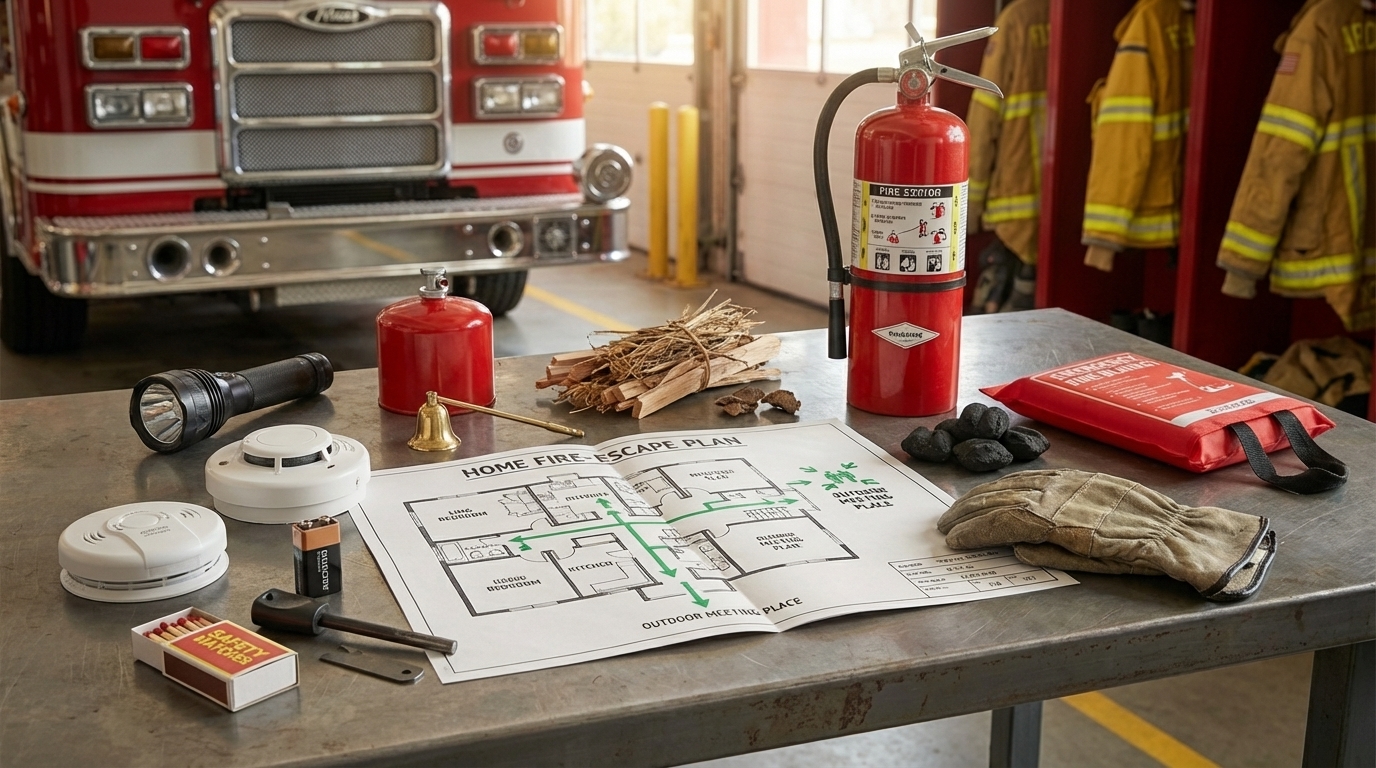
Fire Safety Merit Badge — Complete Digital Resource Guide
https://merit-badge.university/merit-badges/fire-safety/guide/
Introduction & Overview
Fire is powerful. In the right place, it cooks your dinner, warms your tent on a freezing night, and gathers your troop around the campfire. In the wrong place, it destroys homes, injures people, and spreads across entire forests. The difference between those two outcomes is knowledge—and that’s what this badge is all about.
Then and Now
Humans discovered fire over a million years ago, and for thousands of years, controlling it was purely practical trial and error. Communities learned fire safety the hard way: a stray spark burned down your home, and you figured out how to prevent it next time. In the early 1900s, as cities grew and fires spread rapidly through wooden buildings, fire safety became a science. Fire chiefs studied what worked and what failed. Engineers designed buildings with safer materials. Scientists figured out how to mix chemicals that would smother flames. Today, we understand fire so thoroughly that we can predict how it will spread, design buildings to resist it, and create equipment that suppresses it before it becomes a threat. Modern fire codes have saved countless lives.
Get Ready!
You’re about to become someone who understands fire—not just that it’s dangerous, but how and why it’s dangerous, and what actually stops it. That knowledge will make you safer at home, more capable at camp, and ready to make smart decisions when fires threaten. Let’s start.
Kinds of Fire
Fire isn’t a single thing—it’s a chemical reaction, and the way it behaves depends entirely on what’s burning. As a Scout, you’ll encounter fires in different places and under different conditions, and each one demands a slightly different approach.
Campfires & Cooking Fires
The most controlled fires you’ll work with, campfires burn solid fuels (wood, charcoal) and are usually contained in a fire ring. They’re predictable because solid fuels burn slowly and you can manage them by adding or removing fuel. Cooking fires require careful attention to heat levels—too hot and food burns, too cool and it stays raw.
House Fires
These are fast-moving emergencies that typically start in one room and spread rapidly through walls, ceilings, and chimneys. House fires often produce thick smoke long before visible flames reach you, which is why smoke alarms save lives. Different materials burn differently—wood burns hot and fast, but synthetic materials in furniture and carpeting can release deadly gases.
Wildland Fires
These massive fires consume grass, shrubs, and trees across landscapes. They move based on wind, terrain, and fuel density. Unlike a controlled campfire, a wildland fire is driven by weather and can shift direction without warning. Firefighters use science and tactics to predict movement and protect structures.
Chemical Fires
Some materials burn in ways that solid wood doesn’t. Flammable liquids like gasoline ignite at lower temperatures and burn faster. Metals like magnesium can burn with extreme heat. Each requires a different approach to extinguish safely.
What’s Next?
You’re about to dive into how fire actually works—the science behind what you’ve seen and what you need to know to work with it safely. Let’s understand the fire tetrahedron.
Req 1 — Fire Science & Hazards
Science of and Hazards of Fire. Do the following:
a. Explain the concept of fire. b. Name the parts of the fire tetrahedron and the products of combustion. c. Describe the life cycle of a fire. d. Explain the three methods of heat transfer.
This requirement covers the fundamental chemistry and physics that explain how fire works. Understanding these concepts will help you predict how fires behave and, more importantly, how to stop them.
🎬 Video: What is Fire? | Science for Kids — Little School — https://www.youtube.com/watch?v=AALNgOIJTfY
What Is Fire?
Fire is a chemical reaction called combustion. It’s not a thing you can hold in your hand—it’s a process. Three ingredients must be present at the same time for combustion to occur: fuel (something to burn), oxygen (the air around us), and heat (energy to get the reaction started). Remove any one of these three, and the fire stops.
The ancient understanding of fire as a mysterious force was replaced in the 1600s when scientists realized combustion was a chemical reaction, not something magical. By the 1900s, firefighters added a fourth element to the model—a chemical chain reaction—which explains why even when you have fuel, oxygen, and heat, fire sometimes won’t sustain itself. This four-part model is called the fire tetrahedron.
The Fire Tetrahedron
Imagine a pyramid with four sides. Each side represents one part of what’s needed for fire to exist:
Fuel — Any material that can burn: wood, gasoline, paper, propane, even dust in the air. Different fuels burn at different temperatures and speeds.
Oxygen — The air around us is about 21% oxygen. Fire needs oxygen to sustain combustion. In a low-oxygen environment (like a sealed room after the oxygen is consumed), fire will slow and eventually stop.
Heat — The energy that starts the combustion process and keeps it going. Heat is measured in temperature. Different fuels have different “ignition temperatures”—the minimum heat needed to make them catch fire. Paper ignites around 451°F, but gasoline only needs about 495°F.
Chemical Chain Reaction — Once combustion starts, the heat from the burning fuel breaks apart fuel molecules, releasing gases that continue to burn. This self-sustaining cycle is what keeps fire going even if you stop adding heat from an outside source. To stop a fire, you must break this chain reaction—usually by cooling the fuel below its ignition temperature or by removing oxygen.
Products of Combustion
When fuel burns, it doesn’t vanish—it transforms. The products of combustion are:
Carbon Dioxide (CO₂) — The main gas released when anything carbon-based burns. It’s heavier than air, so it sinks. In a house fire, it accumulates near the floor and can displace oxygen, making it harder to breathe.
Water Vapor (H₂O) — Released when fuels containing hydrogen burn. You’ve seen this as steam rising from a campfire.
Carbon Monoxide (CO) — A poisonous gas produced when fuel burns in low-oxygen conditions (called “incomplete combustion”). This is why fires in poorly ventilated spaces are especially dangerous—they produce more carbon monoxide. Carbon monoxide binds to the hemoglobin in your blood and prevents oxygen from being carried to your organs. Just a few breaths of concentrated CO can be lethal.
Smoke — A mixture of unburned fuel particles (ash, soot, and tar), gases, and water vapor. Smoke is often more dangerous than flames because it spreads faster than fire and can kill you by asphyxiation before you see any flame. Modern house fires produce thick, black smoke filled with toxic gases from synthetic materials (plastics, foam, fabrics).
Heat and Light — The energy released by the chemical reaction.
The Life Cycle of a Fire
Every fire has a predictable lifecycle with distinct phases. Understanding this helps you recognize where a fire is in its development and how to respond.
Ignition Phase
The fire starts. Heat reaches the ignition temperature of a fuel, combustion begins, and a small flame appears. At this stage, the fire is usually small and can be easily extinguished with water or a fire extinguisher. Ignition can happen from an open flame (a lighter, a match, a spark), friction (two objects rubbing together to create heat), or spontaneous combustion (a material getting hot enough to ignite without an outside flame source—this can happen with oily rags or hay).
Growth Phase
The fire spreads. Heat from the initial flames ignites nearby fuel. If there’s plenty of fuel and oxygen, the fire grows exponentially. Flames spread to curtains, furniture, walls. Heat builds up in the room, and smoke fills the space. This phase can last minutes or hours depending on fuel density and ventilation. In a closed room with lots of fuel, the temperature can become extreme. This is when most escape attempts happen—people have maybe 3–5 minutes to safely exit before smoke becomes too thick to navigate.
Flashover
In an enclosed space like a house, heat accumulates near the ceiling. When the temperature reaches a critical point (around 1,100°F), all the fuel in the room—walls, ceiling, furniture—suddenly ignites at once. This is flashover, and it’s explosive. If you’re still in the building during flashover, you will not survive. Flashover is why firefighters operate on the principle: “Get low and go”—if you’re escaping a fire, crawl to stay below the smoke.
Steady-State (Fully Developed) Phase
The fire is burning at a steady rate. It has consumed nearby fuel or is limited by oxygen supply. If windows break or doors open, the fire may accelerate. If oxygen becomes limited, the fire may slow.
Decay Phase
The fire burns down as fuel is exhausted. Heat drops. The fire stops growing and begins to shrink. However, a fire in decay can still flare up if new fuel (like a collapsing ceiling exposing fresh material) or oxygen (like a door opening) is introduced.
Heat Transfer: How Fire Spreads
Fire doesn’t just burn in one spot and stay there. Heat moves, and wherever heat goes, new fires can start. Heat transfers in three ways:
Conduction
Heat moves directly through a material. Touch the handle of a pot sitting on a stove—the handle gets hot even though it’s not in the flame. Heat conducts from the hot end to the cold end. In a house fire, metal pipes, beams, and walls conduct heat. A metal rod in contact with both a fire and a room full of wooden furniture can cause the furniture to ignite without ever touching flame.
Convection
Hot air and gases rise, carrying heat upward. In a house fire, hot gases rise toward the ceiling and then spread horizontally along the ceiling. When these super-heated gases touch a wall, they conduct heat into it. This is why attics and upper floors catch fire even though the original fire started downstairs. Convection is also why crawling low during a fire keeps you in cooler, more breathable air.
Radiation
Heat energy radiates outward in all directions, like light from a bulb. You feel this as warmth when you stand near a campfire—the flames aren’t touching you, but heat radiates across the distance. In a house fire, radiant heat from a fully burning room can ignite fuel across the room without conduction or convection playing a role. Radiant heat is why firefighters wear protective gear—it shields them from the intense heat radiating from flames.
Heat Transfer in Action
Identify these in a real fire or simulation- Conduction: Feel a metal object near a flame—it gets hot.
- Convection: Watch smoke rise from a campfire, then spread sideways at the top.
- Radiation: Stand at arm’s length from a campfire and feel warmth on your face without touching the flames.
Breaking the Tetrahedron
Now that you understand the four parts of the fire tetrahedron, you understand how to stop a fire. Remove any one side of the pyramid, and the fire ends:
- Remove the fuel: Move unburned wood away from the flames.
- Remove the oxygen: Smother the fire with a blanket, soil, or CO₂ extinguisher.
- Remove the heat: Cool the fire with water.
- Break the chain reaction: Use certain extinguishing agents (like dry powder or halons) that interrupt the chemical process.
Professional firefighters and fire prevention engineers use this model all the time. Building codes require fire-resistant materials because they require higher ignition temperatures (removing heat is harder), or they burn slowly (controlling the chain reaction). Fire suppression systems cool buildings or inject CO₂ to remove oxygen. Understanding what you’re fighting gives you the power to fight it effectively.
Now that you understand the science behind fire, let’s look at practical tools: fire extinguishers and how to use them.
Req 2 — Fire Extinguishers
Fire Extinguishers. Do the following:
a. Explain the different classes of fires. b. Identify the different classes of fire extinguishers and which should be used for each class of fire. c. Demonstrate how to use a fire extinguisher and a fire blanket.
Not all fires are the same, and not all extinguishers work on all fires. Using the wrong extinguisher can make a fire worse—sometimes dangerously worse. This requirement teaches you to match the right tool to the right fire.
Classes of Fires
🎬 Video: How to Distinguish Between the Different Classes of Fire — KnowledgeCity — https://www.youtube.com/watch?v=B8PrA_AOa6w
Fires are classified by what’s burning. Each class has different behavior and requires a different approach.
Class A: Ordinary Combustibles
Wood, paper, cloth, rubber, most plastics—these are materials in almost every building. Class A fires burn solid materials and produce ash. They’re the most common type of house fire. Water works well on Class A fires because it cools the fuel below the ignition temperature.
Class B: Flammable Liquids & Gases
Gasoline, kerosene, paint, propane, natural gas. These burn hot and fast, and water should never be used on a Class B fire. Why? Water is denser than gasoline—if you spray water on burning gasoline, the water sinks below the fuel, turns to steam, and explodes upward, spreading burning fuel everywhere. Class B fires need foam, CO₂, or dry powder extinguishers that smother or cool without water.
Class C: Electrical Equipment
Fires involving live electrical equipment (appliances plugged in, electrical panels, live wires). The danger is that water conducts electricity—if you spray water on live electrical equipment, the water becomes a path for electricity, and you can be electrocuted. Class C fires need non-conductive agents like CO₂ or dry powder. Once the electricity is turned off, a Class C fire becomes a Class A or B fire, depending on what was burning.
Class D: Flammable Metals
Magnesium, titanium, potassium—reactive metals burn at extreme temperatures and ignite easily. These fires are rare but extremely dangerous because water actually accelerates the burn. Class D fires need special dry powder extinguishers designed for metal fires.
Class K: Commercial Cooking Oils
In commercial kitchens, fires often involve hot cooking oil (olive oil, vegetable oil, or animal fat). When water hits hot oil, it flashes to steam, and burning oil spatters everywhere. Class K fires need wet chemical agents that cool the oil and form a foam blanket.
| Fire Class | What’s Burning | Common Location | Safe Extinguisher |
|---|---|---|---|
| A | Wood, paper, cloth, plastic | Homes, offices, forests | Water, multipurpose dry powder (ABC) |
| B | Gasoline, oil, propane, paint | Garages, workshops, kitchens | Foam, CO₂, dry powder (ABC, BC, or B) |
| C | Live electrical equipment | Appliances, panels, wiring | CO₂, dry powder (BC or ABC) |
| D | Metals (magnesium, titanium) | Laboratories, industrial sites | Special dry powder (D class) |
| K | Cooking oil and grease | Commercial kitchens | Wet chemical (K class) |
Fire Extinguisher Types & Labels
Every fire extinguisher is labeled with the classes it can handle. A multipurpose ABC extinguisher works on ordinary combustibles, flammable liquids, and electrical equipment. A CO₂ extinguisher is best for Class B and C fires. A wet chemical extinguisher is designed for Class K fires in commercial kitchens.
The label shows which classes the extinguisher handles, and the rating number (like 3A:40B:C) indicates the size of fire it can tackle.
Water & Foam Extinguishers (Class A, some B)
- Use water or water-based foam
- Effective on burning wood, paper, cloth
- Never use on electrical fires or flammable liquid fires
- Heavy and large; common in homes and offices
Dry Powder Extinguishers (ABC, BC, or D)
- Use pressurized powder that coats fuel and breaks the chain reaction
- ABC multipurpose type works on most common fires
- BC type works on flammable liquids and electrical fires (no Class A)
- D type is specialized for metal fires
- Can reduce visibility due to powder cloud; use in short bursts
CO₂ Extinguishers (Class B, C)
- Use compressed carbon dioxide gas
- Displaces oxygen and cools the fire
- Safe for electrical equipment (non-conductive)
- Makes a loud hissing sound and can frost your hands
- Effective but requires getting close to the fire
Wet Chemical Extinguishers (Class K, some A)
- Spray a liquid that cools oil and forms a protective foam blanket
- Designed for commercial kitchen fires with hot oil
- Never use water instead—it will cause the oil to splatter
How to Use a Fire Extinguisher: PASS
🎬 Video: How to Use a Fire Extinguisher Using the PASS Method — CQ Fire & Safety — https://www.youtube.com/watch?v=PQV71INDaqY
The standard method for using any fire extinguisher is remembered as PASS:
P — Pull the pin at the top of the extinguisher. This breaks the seal and readies the device.
A — Aim low at the base of the flames, not at the top. The flames you see are the result of combustion—the real burning is happening at the fuel source. Aiming at the base attacks the fuel.
S — Squeeze the lever (the handle) with steady pressure. The extinguisher will discharge its contents.
S — Sweep side to side across the fire until the flames are out. Don’t just hold the trigger—use sweeping motions to cover all the burning area.
After the fire is out, watch it for a minute. If flames restart (a common problem because some fuel wasn’t cooled enough), repeat the process.
Fire Blankets
A fire blanket is a woven sheet made from fire-resistant material (usually fiberglass or wool). It’s designed to smother small fires, especially Class A and B fires, by removing oxygen.
How to use a fire blanket:
- Locate the blanket. Keep it accessible in the kitchen or near a fireplace.
- Pull the corners to unfold it fully.
- Hold it at arm’s length to protect your hands.
- Drape it over the fire completely, covering all flames. If it’s a pan fire, carefully place it over the pan.
- Leave it in place for several minutes to cool the fuel and ensure the fire doesn’t restart.
- Do not remove it too quickly. If you pull it away and flames reignite, you’ve just made the problem worse.
Fire blankets are best for small fires in pots or pans. For larger fires, a fire extinguisher or evacuation is safer.
Practice Matters
The best time to learn how to use a fire extinguisher is before a fire happens. Some fire departments offer training sessions or allow public observation of extinguisher training. If your merit badge counselor can arrange a supervised demonstration or training, take advantage of it. Holding a real extinguisher and hearing the sound it makes when discharged will prepare you far better than reading about it alone.
Now that you understand how to fight fires with tools, let’s shift to protecting people from fire. What happens when fire injures someone, and what do you do?
Req 3a — Stop, Drop, Roll, Cool, Call
If someone’s clothing catches fire, the first few seconds are critical. This simple five-step technique can prevent severe burns and save a life. It’s designed to be instinctive—so simple that a young child can remember it under stress.
🎬 Video: Stop, Drop, Roll — Cool and Call! — eMedia Workshop — https://www.youtube.com/watch?v=K_roagbwfoU
Why Stop, Drop, and Roll Works
When clothing catches fire, your instinct is to run. Don’t. Running feeds the flames with oxygen and spreads the fire faster. Instead, you must smother the flames by removing oxygen—and the fastest way to do that is to roll on the ground.
When you drop and roll, you accomplish three things:
- You stop fanning the flames with movement.
- You press the burning fabric against the ground, which smothers flames and removes oxygen.
- You get the fire low, below your face, so you’re not breathing flames and smoke.
The Steps
Step 1: STOP
Stop moving immediately. Do not run. The temptation to run is overwhelming, but it makes the fire worse. Take a breath (if you can without breathing fire), and mentally prepare for the next step.
Step 2: DROP
Fall or lower yourself to the ground as quickly as possible. You’re not diving gracefully—you’re urgently getting to the ground. If your clothing is already burning on your head or face, covering your face with your hands as you fall offers some protection against flame and smoke inhalation.
Step 3: ROLL
Roll back and forth across the ground, covering the flames with your body. Roll multiple times—at least 10–15 rolls. The goal is to press burning fabric against the ground and cut off oxygen. If you can, cover your head and face with your hands to minimize burns to sensitive areas. Keep rolling until you think the flames are out, then roll a few more times to be sure.
Step 4: COOL
Once the flames are out, cool the burned area immediately. If water is available (a stream, a bucket, a hose), soak the burned area for at least 10 minutes. Cooling stops the burning process and reduces pain and further damage. If no water is available, use cool air—but do not apply ice directly to the skin, as it can cause additional tissue damage.
Step 5: CALL
Call 911 immediately. Even if the burns seem minor, a medical professional should evaluate them. Burns can be deceiving—what looks small on the surface might be deeper than it appears.
Preventing Clothing Fires
Most clothing fires happen in the kitchen, where people wear loose fabric near open flames or hot surfaces. The best defense is prevention:
- Wear fitted clothing when cooking (not oversized robes or baggy sleeves).
- Tie back long hair.
- Keep flammable items away from the stove (paper towels, wooden spoons with loose handles, kitchen towels).
- Never lean over a stovetop. Flames from a burner can ignite fabric on your chest or shoulder.
- Be aware of open flames. Candles, fireplaces, and campfires are stationary hazards—stay at a safe distance.
For more details on clothing fires and prevention, see Req 3b.
Practice
The best way to prepare is to practice the steps before you need them. In a safe environment with an adult (your counselor, a parent, or a firefighter), walk through the motions:
- Stand upright.
- Pretend clothing catches fire.
- Stop and mentally prepare.
- Drop to the ground.
- Roll (or mime rolling if doing it on a clean floor is awkward).
The physical memory helps when stress takes over.
Degrees of Burns
Understanding burn severity helps you know when to seek emergency care:
First-degree (Superficial) — Redness, like a sunburn. The outer layer of skin is damaged. Painful but not life-threatening. Cool the area and apply sunburn relief. Heals in a week or two.
Second-degree (Partial-thickness) — Blistering, swelling, wet appearance. The burn goes through the outer layer and into deeper skin layers. Serious pain. Risk of infection if blisters are broken. Requires medical attention.
Third-degree (Full-thickness) — Charred, white, or leathery appearance. The burn destroys all layers of skin and possibly goes into muscle or bone. Paradoxically, third-degree burns can be less painful at first because nerve endings are destroyed. These are life-threatening and require emergency care immediately. Do not remove stuck clothing—let the medical team handle it.
Call 911 for any burn larger than a few square inches, any burn to the face, hands, feet, genitals, or joints, or any burn of any size that’s second-degree or worse.
Now let’s explore how and why clothing catches fire, and what types of fabric are safer.
Req 3b — Clothing Fires
Clothing is a tool—it can protect you from burns or increase your risk of severe injury, depending on what it is and how you use it around heat and flames.
How Clothing Fires Occur
Clothing catches fire in three common scenarios:
Kitchen Fires
A loose sleeve dangles over a burner. A robe or long dress brushes against an open flame. Someone leans over a stovetop, and fabric above chest height ignites. Most home clothing fires happen in kitchens because that’s where people wear loose, flowing fabric near sustained heat sources. Loose sleeves are especially dangerous—they hang away from your body, so flames can travel up them before you feel the heat.
Campfire & Fireplace Incidents
Someone sits too close to a fire and embers land on their clothes. A loose shirttail or pant leg drags near flames. Wind pushes flames toward someone standing nearby. Campfires and fireplaces are predictable hazards—everyone can see them—but complacency leads to accidents. A Scout who’s distracted by a story might sit too close without noticing heat building.
Flames & Heat from Other Sources
Candles tipped over on a table. A fallen space heater. Sparks from welding or grinding. Flaming grease splatters out of a frying pan. These scenarios are less common but can happen suddenly without warning.
Fabric Matters
🎬 Video: How fast does fire spread — kacesafety — https://www.youtube.com/watch?v=fsaLCdC3iWw
Different fabrics behave differently when exposed to flame:
Natural Fibers
- Cotton — Burns readily, catches fire easily, but burns relatively slowly. A cotton T-shirt will ignite from a flame, but it gives you a few seconds to react. Cotton is not flame-resistant.
- Wool — Naturally harder to ignite than cotton. Wool fibers are thick and don’t carry flames as quickly. It’s a decent choice for fire safety, though not perfect.
- Silk — Burns readily and quickly. Avoid silk near open flames.
- Linen — Burns similarly to cotton. Not flame-resistant.
Synthetic Fibers
- Polyester — Melts when heated, which means it can stick to your skin and cause worse burns than the fire itself. Many synthetic blends behave this way. When polyester melts, it pools and adheres to skin, preventing cooling and causing deeper burns.
- Nylon — Similar to polyester—melts and sticks. Dangerous for fire scenarios.
- Acrylic — Burns readily and releases a lot of heat and black smoke.
Flame-Resistant Fabrics
Some synthetic fibers are treated to be flame-resistant (FR fabrics). These are required for firefighters’ turnout gear, military flight suits, and some work clothing. They are expensive and less common in everyday clothing, but if you can find FR clothing, it’s a smart choice for camping or cooking.
Practical Clothing Rules
- Wear fitted clothing rather than loose, flowing fabric.
- Tie back long hair and long sleeves when near heat.
- Avoid synthetic blends when possible (though this is impractical in modern life).
- Wear cotton or wool when you know you’ll be near open flames or hot sources.
- Never wear a robe or loose nightgown near the stove.
- Prefer closed-toe shoes (in case of spilled boiling water or hot grease).
How Clothing Protects or Contributes to Injury
Clothing can either reduce or increase burn severity:
Clothing That Protects
- Thickness and layers provide insulation. A heavy coat or multiple layers of cotton slow heat transfer and can prevent lighter burns.
- Tight fit keeps fabric from dragging into flames or hot surfaces.
- Length and coverage protect more skin. Long sleeves and long pants protect more area than shorts and a T-shirt.
Clothing That Increases Injury
- Melting synthetics stick to skin, trapping heat and causing deeper burns. A polyester shirt that melts can fuse to your torso, preventing cooling and causing third-degree burns where a cotton shirt might only cause first-degree burns.
- Loose fit allows flames to travel underneath and around your body, heating more skin simultaneously.
- Flammable materials like acetate or nylon ignite quickly and burn hot.
- Pockets and folds can trap flames and keep fabric in contact with skin longer.
The counterintuitive truth: A tight cotton shirt is safer than a loose polyester fleece, even though fleece is thicker. Why? Cotton doesn’t melt and stick; polyester does. When polyester melts onto skin, it’s vastly more damaging than a cotton burn.
Clothing Decisions at Camp & Home
At camp:
Wear sturdy, fitted clothing that covers your arms and legs. Cotton is ideal. Keep loose items (like hats, bandanas, or scarves) secured or removed when working around the campfire. Avoid sitting too close to flames—there’s always a risk of sparks or wind-blown flames.
At home:
When cooking, wear fitted clothes and avoid loose sleeves or robes. Tie back long hair. Avoid standing directly in front of the stove—position yourself to the side when possible. Be especially careful with flammable liquids (alcohol for flaming desserts, skewered appetizers, flaming brandy) in the kitchen.
Now let’s explore the types of burns beyond clothing fires, and a serious hazard many people ignore: carbon monoxide.
Req 3c–3d — Burns & Carbon Monoxide
Burns come from many sources, not just direct contact with flames. And carbon monoxide—a gas you cannot see, smell, or taste—kills hundreds of Americans every year. Understanding both helps you stay safe and help others.
Most Frequent Causes of Burn Injuries
🎬 Video: V2020 Preventing Burn Injuries — strategicfire — https://www.youtube.com/watch?v=MFGQJUMOEdE
Scalds: Hot Water & Steam
The most common source of burn injuries overall. Boiling water, steam from pots, hot tea, bathwater that’s too hot—these cause scalds. Scald burns are often worse than you’d expect because steam transfers heat faster than water and can cause deep burns. A cup of boiling water spilled on your chest will cause a second-degree burn almost instantly.
Prevention:
- Set water heater to 120°F (use a thermometer to check).
- Keep pot handles turned inward so they can’t be accidentally bumped.
- Never leave a pot of boiling water unattended.
- Test water temperature before a child gets in a bath.
Contact Burns: Touching Hot Objects
Touching a stovetop burner, a curling iron, a hot cast-iron skillet, or a space heater causes contact burns. These burns are often deeper than scalds because the object maintains its heat and continues burning skin while in contact.
Prevention:
- Never touch a stovetop or oven (hot even when off).
- Use oven mitts for all hot cookware.
- Keep space heaters away from bedding and flammable items.
- Unplug curling irons and hair straighteners after use.
Kitchen Fires & Grease Burns
Grease fires (when oil in a pan ignites) cause severe burn injuries. Even worse, people instinctively throw water on a grease fire, which makes it explode.
Prevention:
- Keep oil at a moderate temperature (don’t superheat).
- Never leave frying oil unattended.
- If a grease fire starts, cover the pan with a lid or fire blanket (cuts off oxygen).
- Never use water on a grease fire.
Campfire Burns
Sitting too close to a fire, falling into embers, or being burned by hot coals. Campfire burns are preventable through awareness and position.
Prevention:
- Maintain a safe distance (at least 3 feet from the fire).
- Never run or play near a campfire.
- Wear long pants and closed-toe shoes.
- Never sleep right next to embers or coals.
Clothing Fires (covered in Req 3b)
Electrical Burns
Touching a live electrical wire or faulty appliance. Electrical burns can cause deep tissue damage because electricity travels through the body, heating organs. Even minor-looking electrical burns require medical attention.
Prevention:
- Do not use electrical appliances in wet conditions (wet hands, wet floor).
- Ensure outlets near water have GFCI protection.
- Have an electrician check faulty appliances.
Burn Prevention Checklist
Review your home and camp- Water heater is set to 120°F or lower
- Kitchen pot handles point inward
- Space heaters are away from flammable items
- Hot appliances (curling irons, ovens) are unplugged after use
- No electrical cords are frayed or damaged
- Kitchen extinguisher is accessible
- Camp stoves are used on stable, clear surfaces
- Campfire is at least 3 feet away from seating areas
Airway Burns
An airway burn occurs when hot gases or steam damage the inside of your mouth, throat, or lungs. This is one of the most dangerous types of fire injury because swelling can block breathing within minutes.
Symptoms & Signs:
- Singed nasal hairs (a sign you’ve inhaled hot air)
- Coughing or difficulty breathing
- Hoarse voice or sore throat
- Drooling or difficulty swallowing
- Mouth or throat looks red or blistered
Treatment:
- Call 911 immediately. This is a medical emergency.
- Do not try to treat it yourself. Swelling can develop rapidly.
- Keep the victim sitting upright (to help breathing).
- Do not give the victim anything to eat or drink (their airway might swell and they might choke).
- Have the victim breathe cool, humid air (open a window or go outside if it’s safe).
Airway burns can kill by suffocation within hours, even if the external burns are mild. Always treat suspected airway burns as a life-threatening emergency.
Carbon Monoxide Poisoning
Carbon monoxide (CO) is a colorless, odorless, tasteless gas produced by incomplete combustion. You cannot detect it without a CO detector. It binds to hemoglobin in your blood more readily than oxygen does, gradually suffocating your organs from the inside while you have no idea it’s happening.
Common CO Sources:
- Car exhaust from a vehicle running in an attached garage
- Furnaces, water heaters, or stoves with improper ventilation
- Blocked chimneys or clogged vents
- Charcoal grills used indoors (never use a charcoal grill inside a tent, car, or enclosed space)
- Faulty space heaters or portable generators
- Fireplaces without proper draft
Symptoms & Signs of CO Poisoning:
Mild exposure: Headache, dizziness, weakness, chest pain, confusion
Moderate exposure: Severe headache, rapid heartbeat, confusion, loss of consciousness
Severe exposure: Loss of consciousness, seizures, heart failure, death
The tricky part: CO poisoning symptoms resemble the flu (headache, fatigue, nausea). People sometimes assume they have a cold, go to bed, and don’t wake up.
Prevention:
- Install CO detectors on every level of your home and near bedrooms. Test them monthly.
- Never run a car in an attached garage, even with the door open.
- Never use a charcoal grill indoors. Only use camping stoves (liquid-fueled or gas) in properly ventilated tents or outdoors.
- Have furnaces and chimneys inspected annually.
- Ensure all gas appliances are properly vented to the outside.
- Never block furnace or dryer vents.
- Use generators only outdoors, at least 20 feet away from windows, doors, and vents.
Treatment of CO Poisoning:
- Get to fresh air immediately. Leave the building.
- Call 911.
- If the victim is unconscious, perform CPR if trained to do so.
- In a hospital setting, hyperbaric oxygen therapy can help reverse CO damage to the brain.
The Hidden Threat
CO poisoning is more common than many people realize. According to the CDC, over 400 Americans die from unintentional CO poisoning annually, and thousands more are injured. Most cases happen in the winter when people seal their homes and rely on furnaces.
A particularly dangerous scenario: A Scout camping trip in a tent with a charcoal grill or camping stove running inside. Even a small grill producing CO in a sealed tent can kill everyone inside within hours. Always use camp stoves outside or in well-ventilated areas.
Now let’s shift from injuries to understanding how fires start in the first place.
Req 4 — Fire Origins
Origins of Fires. Do the following:
a. Explain the four classifications of fire origin (natural, accidental, incendiary, or undetermined) and give an example of each. b. Describe how a fire classified as incendiary might lead to criminal prosecution of a person charged with arson.
Fire investigators are detectives. They examine burn patterns, interview witnesses, and analyze physical evidence to determine how a fire started. This helps prevent future fires, hold people accountable, and understand risks.
🎬 Video: Fire Investigation — Fire Safety Research Institute — https://www.youtube.com/watch?v=SmmAh87Anh8
Four Classifications of Fire Origin
Fires are classified by their cause:
Natural Fires
Fires that start without human involvement. These are relatively rare outside wildland environments but do happen.
Examples:
- Lightning strike ignites a tree during a thunderstorm.
- Spontaneous combustion when hay stored with high moisture content generates heat internally and self-ignites.
- Volcanic activity in volcanic regions can ignite fires.
- Extreme heat from sun magnifying through glass or reflecting off metal surfaces.
Natural fires teach us about fire behavior, but they don’t carry legal consequences—no one is at fault.
Accidental Fires
Fires that start through human action but without intent to cause a fire. These are the most common category and include carelessness, lack of knowledge, and equipment failure.
Examples:
- A smoker falls asleep with a lit cigarette, which falls onto a bed.
- A child playing with matches ignites a couch.
- A faulty space heater placed too close to curtains overheats and starts a fire.
- An unattended pot of oil on the stove overheats and ignites.
- Embers from a cleaning fireplace are not fully extinguished and later ignite nearby wood.
Accidental fires are tragic and often preventable through awareness and maintenance. They may result in negligence charges in extreme cases, but the intent was never to cause harm.
Incendiary Fires
Fires deliberately set by someone. This includes arson (setting a fire to damage property or injure people), but also includes intentional fires set without criminal motive—like a controlled burn set by a land manager.
Examples:
- Someone deliberately pours gasoline in a house and ignites it to collect insurance money.
- A disgruntled employee sets a fire to damage their employer’s business.
- A homeowner sets a controlled backyard burn to clear brush, but the fire escapes and spreads to a neighbor’s property.
- Someone sets a fire during a protest or riot.
Incendiary fires that are criminally motivated are arson, which carries serious legal penalties.
Undetermined Fires
Fires where investigators cannot determine the origin despite investigation. This might be because the fire destroyed evidence, the scene was too damaged, or there simply wasn’t enough information.
Examples:
- A house fire is so thoroughly destroyed that the point of origin is unclear.
- A fire happens while no one is home, and there are no witnesses or evidence pointing to a cause.
- Multiple possible causes exist, and evidence doesn’t clearly point to one.
Undetermined doesn’t mean natural or accidental—it means the evidence is insufficient to classify it. Fire investigators would rather say “undetermined” than guess.
Arson & Criminal Prosecution
When a fire is determined to be incendiary (deliberately set) with intent to cause harm or property damage, the person responsible can be charged with arson, a serious felony.
What Makes Arson a Crime:
- Intent: The person deliberately started the fire, not by accident.
- Damage or danger: The fire damaged property or endangered lives.
- Motive: Often financial (insurance fraud), revenge, or destruction.
Penalties:
Arson convictions carry severe penalties:
- Prison time: Typically 5–20 years, depending on circumstances. If someone dies, charges are much more serious.
- Fines: Often $10,000–$100,000 or more.
- Restitution: The convicted person may be ordered to pay for fire suppression, property damage, and medical costs.
- Permanent consequences: A felony conviction affects employment, housing, and educational opportunities permanently.
How Investigators Prove Arson:
Fire investigators look for evidence:
- Point of origin: Where did the fire start? Is it an unusual location (like multiple starting points)?
- Accelerants: Were flammable liquids found at the scene? Chemical tests can detect gasoline residue, for example.
- Pattern evidence: Burn patterns can show how heat spread, suggesting a cause.
- Witness testimony: Did someone see suspicious activity?
- Motive: Did the defendant have financial problems, a grudge, or insurance benefits?
- Opportunity: Was the defendant at the location?
A prosecution for arson requires evidence strong enough to convince a jury beyond a reasonable doubt that someone intentionally set the fire.
Famous arson cases have included people who set fires for insurance money, revenge, or to cover up other crimes. In rare cases, serial arsonists start fires repeatedly, and investigators track patterns to catch them.
Fire Investigation as a Career
🎬 Video: Fire Investigations EXPLAINED (with real examples) — Wausau Fire Department — https://www.youtube.com/watch?v=-46WCvZCrYs
Fire investigators are part detective, part engineer, part chemist. They reconstruct fires, interview witnesses, collect and analyze physical evidence, and work with law enforcement. It’s a specialized career requiring training and certification. If you’re interested in how things work and solving mysteries, fire investigation is an intriguing field.
You’ve learned how fires start. Now let’s explore where most people face fire risk: at home.
Req 5a–5b — Common Home Fire Hazards
The statistics are stark: Every 87 seconds, a home fire is reported in the United States. Most are preventable. This requirement is about understanding the specific hazards in your home and taking action.
🎬 Video: Hidden Home Fire Hazards — Mark D. Olejniczak Realty, Inc. — https://www.youtube.com/watch?v=tQxAf2o1FEI
Year-Round Hazards
Unattended Cooking
Unattended cooking is the leading cause of home fires and cooking injuries. The risk is especially high when using oil or grease—a pot left on the stove can reach ignition temperature in minutes.
Prevention:
- Never leave cooking unattended, especially when using oil or high heat.
- Set timers so you remember what’s cooking.
- Turn pot handles inward so no one bumps them.
- Keep flammable items (towels, plastic utensils, paper) away from the stove.
- If a grease fire starts, cover the pan with a lid or fire blanket. Never use water.
- Wear fitted clothing with sleeves that won’t brush the burner.
- Have a fire extinguisher in the kitchen and know how to use it.
- If a fire gets too big, get out. Leave and close the door, then call 911 from outside.
Electrical Hazards
Faulty wiring, overloaded outlets, damaged appliances, and misused extension cords cause thousands of home fires annually.
Prevention:
- Do not overload outlets. One outlet = one high-power appliance. Use power strips with built-in surge protection and automatic shutoff.
- Inspect cords regularly. Frayed, cracked, or damaged insulation is a fire hazard. Replace the cord or the appliance.
- Unplug appliances you’re not actively using (toasters, space heaters, curling irons, hair dryers).
- Do not use extension cords permanently. If you consistently need an outlet somewhere, have an electrician install one.
- Space heaters are dangerous. Keep them at least 3 feet away from flammable materials. Never use them to dry clothes. Do not leave them unattended.
- Ensure older homes have GFCI outlets near water sources (kitchens, bathrooms). These shut off instantly if current leaks, preventing electrocution.
- Have an electrician inspect if outlets feel warm to the touch or if lights flicker.
Smoking
Smoking is a major cause of home fires, mostly because people fall asleep while smoking or discard cigarettes improperly.
Prevention:
- Smoke outside only. Never smoke in bed or on couches.
- Use sturdy ashtrays, never paper cups or plates.
- Make sure cigarettes are fully out before discarding. Run them under water, then place in an ashtray or trash.
- Never smoke when drowsy or after drinking alcohol.
- Encourage smokers in your household to use fire-safe cigarettes (which self-extinguish if unattended).
Clothes Dryers
Lint accumulation in dryers is a leading cause of fires. Lint is highly flammable, and it traps heat inside the dryer.
Prevention:
- Clean the lint trap after every load. This is the single most important step.
- Clean the exhaust vent (the duct leading outside) annually. Lint builds up inside the duct over time.
- Do not use the dryer if the vent is blocked or if clothes aren’t drying fully (a sign of poor airflow).
- Inspect the vent from outside to ensure the flap opens freely and nothing is blocking it.
- Never run a dryer overnight or when you’re sleeping. A dryer fire can develop rapidly.
- Have a professional clean the vent if you suspect buildup.
Rechargeable Batteries
Lithium-ion batteries (in phones, laptops, power tools, e-scooters, hover boards) can catch fire if they overheat, are damaged, or are defective. Fires from batteries can spread quickly and are harder to extinguish than wood fires.
Prevention:
- Charge devices in a cool location, not under pillows or blankets.
- Do not overcharge. Unplug when fully charged (though modern devices have safeguards).
- Inspect batteries for swelling, cracks, or damage. A visibly damaged battery should be removed and disposed of safely (take it to an electronics recycling center).
- Replace batteries if a device is recalled for battery defects.
- Do not leave devices charging overnight in bedrooms. Charge them in common areas where you’re awake.
- Keep lithium batteries away from heat and moisture.
Home Fire Hazard Inspection
Walk through each room and check- Kitchen: Is the area around the stove clear? Are pot handles inward?
- Kitchen: Is there a fire extinguisher accessible?
- Bedroom: Are space heaters at least 3 feet from beds and curtains?
- Bedroom: Are phones, laptops, and e-readers unplugged or on chargers away from the bed?
- Laundry: Is the dryer lint trap clean? Can you feel air coming out of the vent?
- All rooms: Are electrical cords intact (no fraying)?
- All rooms: Are outlets overloaded?
- Bathroom: Are hairdryers and curling irons unplugged?
Seasonal & Holiday Hazards
Winter Heating
When temperatures drop, people rely on furnaces, space heaters, fireplaces, and woodstoves. Improper use or maintenance causes fires and carbon monoxide poisoning.
Prevention:
- Have furnaces inspected and cleaned annually, before heating season starts.
- Ensure chimneys are clear of blockages and creosote buildup. Have them professionally swept.
- Space heaters should be at least 3 feet from flammable materials (beds, curtains, blankets, rugs).
- Never use a stove or oven to heat your home. It’s inefficient and dangerous.
- Install and test CO alarms before heating season.
- If you use a woodstove, have it professionally installed and inspected.
Holiday Decorations & Christmas Trees
Real Christmas trees are a fire risk if not properly maintained. Decorative lights, wreaths, and garland can also pose hazards.
Prevention:
- Choose a fresh tree. If the needles are brown or fall off easily, the tree is too dry. A dry tree can ignite from a single spark on lights.
- Cut the bottom of the tree (about an inch) just before bringing it home to expose fresh wood.
- Place the tree in water and keep the stand full of water. A tree drinks water—a tree in a dry stand dries out in days and becomes extremely flammable.
- Keep the tree away from heat sources: radiators, fireplaces, space heaters, heat vents.
- Check lights before hanging them. Damaged cords should be replaced, not taped up.
- Use LED lights if possible—they generate far less heat than incandescent strings.
- Do not use lights made for outdoor use indoors (they handle moisture, which isn’t needed inside).
- Do not leave lights on unattended or overnight.
- Remove the tree by early January. Dead trees are extremely flammable.
Candles
Holiday candles create ambiance but are a major fire source. Candles left unattended or placed near flammable materials cause house fires.
Prevention:
- Never leave a burning candle unattended. Blow it out before leaving the room.
- Keep candles away from curtains, bedding, and decorations. The flame should be at least 12 inches from anything flammable.
- Use candle holders that won’t tip over easily.
- Trim wicks to ¼ inch to reduce smoke and prevent mushrooming flames.
- Do not place candles in drafty locations where wind can blow the flame sideways onto nearby items.
- Consider flameless (battery-operated) candles for the same ambiance without the fire risk.
Fireworks
Consumer fireworks cause thousands of injuries and home fires annually. Even small fireworks can cause serious burns, eye injuries, and fires.
Prevention:
- Use fireworks only in open, clear areas, well away from buildings, trees, and dry grass.
- Keep a bucket of water nearby when using fireworks.
- Never try to relight a firework that doesn’t work.
- Never point fireworks at people or animals.
- Supervise children closely. Many hand injuries happen when children mishandle fireworks.
- Consider professional fireworks displays instead of consumer fireworks. They’re safer and more impressive.
- Do not use homemade fireworks or fireworks purchased outside the U.S. (safety standards are lax).
The Pattern
Most home fires are preventable. They happen because someone didn’t maintain equipment (dirty dryer vent), wasn’t paying attention (unattended cooking), or didn’t know the risk (dry Christmas tree). By understanding these specific hazards and taking action, you can dramatically reduce fire risk in your home.
Let’s look at one specific fire risk that deserves special attention: safely using candles.
Req 5c — Candle Safety
Candles are everywhere—in homes, churches, temples, restaurants, and campsites. Knowing how to use them safely, and being able to teach others, is a practical skill.
🎬 Video: Candle Safety Tips — Candle Month — https://www.youtube.com/watch?v=DGhObiz_r28
Lighting a Candle Safely
Step 1: Secure the candle
Place the candle in a stable holder (not a cup or container that could tip over). The holder should sit on a flat, level surface away from edges or anything someone might bump into.
Step 2: Check the surroundings
Look around the candle: Is there anything flammable within 12 inches? Curtains, paper, fabric, dry branches, dried flowers? If yes, move one or the other. Ideally, a candle should be in a room with good air circulation but not in a drafty location where wind will blow the flame sideways.
Step 3: Use a lighter or match
Hold the lighter or match to the wick and apply flame until the wick catches fire. For matches, light the match first, then bring it to the wick (not the other way around). Hold the match or lighter steady for a few seconds to ensure the wick is fully ignited.
Step 4: Wait a moment
Once lit, let the candle burn for 30 seconds to ensure the flame is stable. The wick should stand upright with a steady flame, not flickering violently or smoking heavily.
Step 5: Trim the wick
If you notice the wick is longer than ¼ inch, or if the candle is smoking, blow out the candle, wait for it to cool slightly, then trim the wick. Trim it with scissors or a wick trimmer to about ¼ inch above the wax.
Extinguishing a Candle Safely
Method 1: Blowing
Simply blow steadily at the flame. The air disrupts the combustion reaction, and the flame goes out. Most candles extinguish easily with a gentle to moderate blow. You don’t need to blast it.
Method 2: Using a wick dipper
Some candle holders come with a metal wick dipper. Dip the hot wick into the melted wax (which cools it) and immediately pull it back up. This extinguishes the flame without smoke.
Method 3: Snuffing
A candle snuffer is a small metal cone on a handle. Place the cone over the flame (without touching the candle) to smother it. This produces less smoke than blowing.
What NOT to do:
- Do not use water to extinguish a candle. Hot wax and cold water together can splatter hot wax.
- Do not blow out the candle so forcefully that hot wax splatters.
- Do not try to extinguish the candle by blowing and then immediately touching it. The wick is extremely hot and will burn you.
- Do not tip the candle to blow it out if wax is near the edge (risk of wax spilling).
Discussing Candle Safety with Others
As a Scout, you’ll often teach skills to younger Scouts. Use these talking points when discussing candles:
With your family:
- Agree on where candles are allowed in your home (maybe only in the living room, never in bedrooms).
- Establish a rule: candles are never left unattended. If you’re leaving the room, blow it out.
- Talk about who is allowed to light candles (maybe only adults, or older teens with supervision).
- Agree that if someone smells smoke from a candle, they blow it out immediately and tell an adult.
- If you use candles during power outages, agree to keep them away from flammable items and never leave them lit if anyone is sleeping.
With younger Scouts (if teaching):
- Start with the basic rule: “Never leave a candle burning if an adult isn’t nearby.”
- Demonstrate the proper way to light and extinguish.
- Have them practice lighting and extinguishing under your supervision.
- Make it clear that candles are tools, not toys. Respect the flame.
- Teach them what to do if a candle tips over: back away and get an adult.
Candle Safety at Camp
Candles at camp are less common than at home, but they appear in lanterns or during special programs.
- Only light candles if authorized by camp leadership.
- Never light candles inside tents. Camp stoves and lanterns are designed for enclosed spaces; candles are not.
- Use enclosed lanterns rather than open candles in windy outdoor settings.
- Always keep a water source nearby when using any flame at camp.
Now let’s move to a practical task: inspecting your home for fire hazards.
Req 5d — Home Fire Hazard Inspection
This is hands-on learning. You’ll walk through a real home (your own, a relative’s, or a similar building) and systematically identify fire hazards. This trains your eye to spot risks that others miss.
🎬 Video: Dan Doofus Checks His Fire Safety Checklist — NFPA — https://www.youtube.com/watch?v=23XUPENfeUU
Preparing for Your Inspection
Get approval: Work with your merit badge counselor to decide which building you’ll inspect. It could be your home, a grandparent’s house, a church, a school building, or a camp facility. If you’re inspecting someone else’s home, get permission from the owner first.
Get the checklist: The official Fire Safety merit badge pamphlet includes a Home Fire Safety Checklist. If you don’t have the pamphlet, ask your counselor for a copy or use one approved by them.
Recruit an adult: You cannot do this inspection alone. You need an adult (a parent, counselor, or facility manager) to accompany you. They’ll help you understand what you’re looking at and can open locked areas if needed.
Schedule time: Plan for 30–45 minutes to thoroughly walk through all areas of a home. Don’t rush.
What You’re Looking For
As you walk through, examine these categories:
Cooking Areas
- Are stove burners clean and clear?
- Are pot handles turned inward?
- Is there a fire extinguisher nearby? Is it accessible and not expired?
- Are flammable items (towels, plastic bags, paper) kept away from the stove?
- Is the area around the stove clear of clutter?
Electrical Safety
- Are outlets overloaded (too many things plugged into one outlet)?
- Are electrical cords in good condition (no fraying, cracking, or damage)?
- Are extension cords used permanently (sign of inadequate outlets)?
- Are appliances unplugged when not in use?
- Are space heaters at least 3 feet from flammable materials?
Heating & Ventilation
- If there’s a fireplace, when was the chimney last inspected?
- Is the furnace accessible and maintained?
- Are vents (dryer, furnace, bathroom) clear and unobstructed?
- Is there a CO alarm? (Check if present and working.)
Smoking
- Are ashtrays sturdy and used properly?
- Do smokers in the home have safe places to smoke (not in bed)?
Laundry
- Is the dryer lint trap clean?
- Can you see air coming out of the dryer vent outside?
- Is the dryer at least 4 feet away from flammable materials?
Bedrooms
- Are space heaters at least 3 feet from beds and bedding?
- Are phones and chargers away from beds?
- Are exit routes clear (no clutter blocking doors or windows)?
Exits & Escape Routes
- Are doors and windows operable (can they open easily)?
- Is there a clear path to exits in each room?
- Are stairs clear of clutter?
- Are doors locked in ways that prevent rapid exit (check that deadbolts don’t require keys to open from inside)?
Alarms
- Are smoke alarms present on each level and near bedrooms?
- Are CO alarms installed?
- Do alarms appear to have working batteries (no dust or dead indicators)?
- When was each alarm last tested?
Hazardous Materials
- Are flammable liquids (gasoline, paint, propane) stored safely in approved containers away from ignition sources?
- Are rechargeable batteries in good condition (no swelling or damage)?
🎬 Video: Follow Along with a Fire Inspection — CityofCarlsbadCA — https://www.youtube.com/watch?v=IIdG4Em92Hc
During Your Inspection
Be systematic: Walk through each room methodically. Don’t skip areas.
Take notes: Write down what you see. For each hazard, note the location and what the risk is.
Ask questions: If you’re unsure what something is, ask your adult companion. “What’s this?” is a good question.
Take photos: If your counselor approves, take photos of hazards you find (e.g., an overloaded outlet, a dryer vent clogged with lint). These make for powerful “before” images if you recommend fixes.
Talk to the homeowner: If you’re in someone else’s home, ask them about their safety practices. “How often do you clean the dryer vent?” “When was the furnace last inspected?” These conversations are as valuable as the inspection itself.
After Your Inspection
Compile your findings: Organize your notes by room or category. List each hazard, its location, and the risk it poses.
Prioritize: Which hazards are most urgent? A dryer vent clogged with lint is more immediately dangerous than a slightly overloaded outlet.
Make recommendations: For each hazard, suggest a fix. “The dryer lint trap should be cleaned after every load” or “The space heater should be moved at least 3 feet from the bed.”
Present to your counselor: Walk through your findings with your counselor. Discuss what you found, why it matters, and what actions should be taken.
Consider follow-up: If you inspected your own home, work with your family to fix the hazards you identified. Document the fixes with before-and-after photos.
Now let’s look at early warning systems: smoke and carbon monoxide alarms.
Req 5e–5f — Smoke & CO Alarms
Smoke and CO alarms are the difference between escaping a fire and not. They give you precious minutes to evacuate. But they only work if installed correctly, maintained, and not expired.
Local Requirements
Fire codes vary by location. Some municipalities require smoke alarms in all bedrooms and hallways; others require CO alarms only in homes with fuel-burning appliances.
Research your community:
- Call your local fire department and ask: “What smoke and CO alarms are required in homes in our area?”
- Check your city or county website for building code information.
- Ask your homeowner’s insurance company. They often provide guidance on safety equipment requirements.
- Talk to your parents/guardians. They may already know what’s required.
General guidance:
Most fire codes recommend:
- Smoke alarms on every level of the home, inside every bedroom, and outside sleeping areas.
- CO alarms in every home with a furnace, water heater, or fireplace. At minimum, one on each level.
Types of Smoke Alarms
Ionization Alarms
Detect fast-flaming fires (fires that spread quickly with visible flames). These use a small radioactive element to ionize air in a chamber. Smoke particles disrupt the ionization, triggering the alarm. Good for paper and wood fires, but slower to detect smoldering fires (like a cigarette in furniture).
Photoelectric Alarms
Detect smoldering fires (slow-burning fires with lots of smoke and little flame). They use a light beam; smoke particles scatter the light, triggering the alarm. Slower than ionization alarms for fast-flaming fires but better for smoldering fires.
Dual-sensor Alarms
Combine both technologies. They detect both fast-flaming and smoldering fires effectively. These are the most reliable choice.
Interconnected Alarms
Some alarms communicate with each other via wires or wireless. When one detects smoke, all alarms in the home sound. This is especially valuable in larger homes or homes with bedrooms far from the kitchen.
Types of CO Alarms
Electrochemical Alarms
Use a chemical sensor to detect CO. Reliable and affordable. Most common in homes.
Metal-oxide semiconductor (MOS) Alarms
Use a chemical-sensitive material. Also reliable, sometimes used in commercial applications.
Most CO alarms for homes are electrochemical. The key is that they display CO levels and alarm when concentration reaches dangerous levels.
Finding Alarms in Your Home
Walk through your home systematically:
- Check ceilings and walls in hallways, bedrooms, kitchen, and living areas for smoke alarms. (Most are white or beige circular discs on the ceiling or high on a wall.)
- Check for CO alarms near bedrooms, near furnaces, or in central locations.
- Open the cover or check the back to see the alarm type and expiration date. Most alarms are good for 7–10 years.
- Note the location and type in a list.
Example list:
| Location | Type | Installed | Expiration Date |
|---|---|---|---|
| Kitchen ceiling | Dual-sensor smoke | March 2019 | March 2029 |
| Hallway (upstairs) | Ionization smoke | Unknown | September 2023 (EXPIRED) |
| Master bedroom | Photoelectric smoke | January 2020 | January 2030 |
| Basement (furnace room) | Electrochemical CO | June 2018 | June 2028 |
Maintaining Alarms
Monthly testing:
- Press and hold the test button on each alarm for 5–10 seconds.
- The alarm should sound loudly. If it doesn’t, replace the battery or the alarm itself.
- Test every alarm in the home once monthly.
Cleaning:
- Use a vacuum cleaner hose to gently remove dust from the cover and vents of each alarm. Dust accumulation can interfere with sensors.
Battery replacement:
- Most alarms use 9V batteries. Replace them annually, in the fall (same time you reset clocks for daylight saving time). This makes it easy to remember.
- Some newer alarms have non-replaceable batteries and must be replaced entirely when expired.
Replacing expired alarms:
- An alarm is expired if it has reached the end-of-life date (typically 7–10 years after installation).
- Purchase new alarms (check the package for type: ionization, photoelectric, dual-sensor, CO).
- Follow the manufacturer’s instructions to install (usually mount on ceiling or high on wall).
- Write the installation date on the new alarm with a marker.
Alarm Maintenance Checklist
Do this monthly- Test each smoke alarm by pressing the test button
- Test each CO alarm by pressing the test button
- Listen for a loud alarm sound (not a quiet beep)
- Vacuum the cover and vents of each alarm to remove dust
- Check expiration dates
What to Do When an Alarm Sounds
If a smoke alarm goes off:
- Assume there is fire somewhere in the home.
- Leave immediately. Do not investigate.
- Close doors behind you as you leave (slows fire spread).
- Once outside, call 911.
- Meet at your family’s designated meeting spot (see Req 5g).
If a CO alarm goes off:
- Move everyone to fresh air immediately (outside or to a window).
- Call 911 from outside.
- Do not re-enter the building until authorities clear it.
- Have the home inspected for CO sources before returning.
Now let’s plan for evacuation. What will you do if fire strikes your home?
Req 5g — Home Fire Escape Plan
A fire escape plan is the difference between panicking and acting. When smoke is thick and disorientation sets in, you need to know exactly where to go.
🎬 Video: Every Second Counts in a Home Fire—Practice Your Escape Plan — NFPA — https://www.youtube.com/watch?v=Vc-AkbpdSYk
Developing Your Plan
Step 1: Identify all exits
- Walk through your home and mark every way out: front doors, back doors, windows (especially bedroom windows).
- Note which exits are most accessible from each room.
- Identify a window in every bedroom that’s large enough to escape through. If a window is painted shut or blocked, that’s a hazard to fix.
Step 2: Identify two exits from every room
- In the event one exit is blocked by fire or smoke, you need a second option.
- From a bedroom: main door + window
- From a living room: front door + back door (or window if doors are blocked)
- From a kitchen: main exit + alternate exit
Step 3: Plan escape routes
- If you’re in the kitchen and smell smoke, your route might be: kitchen → dining room → front door.
- If you’re in an upstairs bedroom and the hallway is blocked, your route is: window → escape ladder (if available).
Step 4: Establish a family meeting point
- Choose a location outside your home where everyone will meet after evacuating.
- It should be close enough to reach quickly (50–100 feet away).
- Good meeting points: a mailbox at the end of the driveway, a tree in the front yard, a neighbor’s house.
- Everyone must know this location and commit to going there without delay.
Step 5: Plan for special circumstances
- Young children: Who will help them evacuate? Assign a responsible adult.
- Elderly or mobility-limited family members: Who will assist them? Is there an accessible exit? May need a specialized plan.
- Pets: Plan to grab pets if safely possible, but never delay evacuation for a pet. Pets can survive a fire; people cannot.
- Night evacuation: Alarms will sound, waking you. Practice this scenario so everyone knows to evacuate immediately, not investigate.
Drawing Your Floor Plan
Create a simple diagram of your home showing:
- Layout: Rooms, doors, windows, hallways. This doesn’t need to be architectural—a sketch is fine.
- Exits: Mark all doors and windows in red or with an arrow pointing outward.
- Two escape routes: For each room, draw arrows showing two different paths to exit.
- Meeting point: Mark the location outside (mailbox, tree, etc.) clearly.
- Alarm locations: Mark where smoke and CO alarms are installed.
Example legend:
- 🚪 = Door
- 🪟 = Window
- 🔴 = Smoke alarm
- 🟠 = CO alarm
- ⭐ = Meeting point
Your sketch doesn’t need to be fancy. Its purpose is to make exit routes visible and memorable.
Fire Drill Schedule
Plan to conduct fire drills regularly:
- At minimum: Once every 6 months
- Ideally: Every 3 months (quarterly)
- In homes with young children: Monthly drills
How to run a drill:
- Announce it’s a drill (so no one panics about a real fire).
- Set a starting location: “Pretend you’re asleep in your bedroom.”
- Activate the alarm: Have someone sound the smoke alarm (use the test button).
- Evacuate: Everyone leaves using their planned escape route.
- Meet outside: Everyone gathers at the meeting point.
- Time it: Note how long it takes to fully evacuate.
- Debrief: Discuss what went well and what to improve.
Vary the starting location: Run drills starting from different rooms (bedroom, kitchen, living room) so everyone practices different routes.
Special Scenarios to Practice
Escape ladder drills: If your home has a second story with windows, practice deploying an escape ladder from a bedroom window. Make sure everyone knows how to use it.
Low-visibility practice: In a real fire, smoke will be thick. During a drill, have people close their eyes while evacuating (a family member guides them) to simulate disorientation.
Nighttime evacuation: Run a drill at night, with the home dark except for the alarm sound. This simulates a real fire when you’re asleep.
The Golden Rules
- Get out first. Never stop to collect possessions, pets, or information. Get out and to the meeting point.
- Stay out. Once you’re outside, do not re-enter the home for any reason. Wait for firefighters.
- Meet at the point. Never separate from your family once you’re evacuated.
- Call 911 from outside. Once you’re at the meeting point and everyone is accounted for, someone calls 911.
Now let’s address two more immediate dangers: detecting gas leaks and properly reporting fires.
Req 5h–5i — Gas, Smoke & Reporting Fires
Two immediate dangers: the smell of gas (an invisible hazard that can explode) and smoke (a sign fire is already burning). Both demand quick, decisive action.
If You Smell Natural Gas
Natural gas is odorless, so gas companies add a chemical odorant (mercaptan) that smells like rotten eggs or sulfur. If you smell this, gas is leaking.
🎬 Video: Do you know what to do if you smell natural gas? — Manitoba Hydro — https://www.youtube.com/watch?v=D5jDGMCZ35M
What to DO:
- Leave immediately. Get outside the building as quickly as possible. Do not waste time investigating or collecting items.
- Do not use electrical switches, phones, or anything that might create a spark. (Turn off light switches, do not call from inside the house.)
- Do not light a match or create any flame.
- Once outside, call 911 or your gas company’s emergency line from a safe distance (at least 100 feet away).
- Do not re-enter the building until the gas company or fire department clears it.
- Ventilate the building: If it’s safe to do so (if gas is not immediately threatening), open windows and doors from outside to help dissipate the gas.
What NOT to do:
- ❌ Do not turn lights on or off
- ❌ Do not use the phone inside the house
- ❌ Do not light matches, candles, or any flame
- ❌ Do not operate electrical appliances
- ❌ Do not start a car in the garage
- ❌ Do not investigate where the leak is coming from
- ❌ Do not ignore the smell thinking it will go away
Why? A spark from a light switch, a phone, or a car engine can ignite escaping gas, causing an explosion. Even a static electricity shock could potentially ignite it. Leave first, call second.
If You Smell Smoke
Smoke means fire is burning somewhere. Even if you can’t see flames, assume a fire exists nearby or has already spread into walls or hidden spaces.
What to DO:
- Alert others immediately. Yell “FIRE!” to wake or alert people nearby.
- Leave the building using your evacuation plan. Use stairs (never elevators).
- If smoke is thick, stay low. Crawl below the smoke where air is cleaner and cooler.
- Feel doors before opening them. Place the back of your hand on a door. If it’s hot, the fire is likely on the other side. Use an alternate route.
- Close doors behind you as you leave to slow fire spread to other areas.
- Get to your meeting point and account for all family members.
- Call 911 once you’re safe outside.
- Do not re-enter the building.
What NOT to do:
- ❌ Do not investigate to find the fire
- ❌ Do not use elevators (they can trap you or malfunction in a fire)
- ❌ Do not stop to collect belongings or pets
- ❌ Do not hide in the building
- ❌ Do not use water on certain fires (electrical, gas, or grease fires)
- ❌ Do not wait for everyone to be ready—leave immediately and meet outside
Why? Smoke kills faster than flames. In a real fire, you have only minutes before visibility is zero and air becomes unbreathable. Every second counts.
How to Report a Fire
When you call 911 to report a fire, the dispatcher needs specific information to send the right resources to the right location.
When calling 911:
- Stay calm. Speak clearly. The dispatcher is trained to understand emergencies.
- Give your location first: “I’m calling about a fire at 123 Main Street” or “There’s a fire at the corner of Oak and Elm.”
- Describe the fire:
- Where is it? (House, garage, vacant building, wildland area?)
- What’s burning? (If you know: “It’s a house fire,” “Brush fire,” etc.)
- How big is it? (“Small fire in one room” vs. “Entire building is burning”)
- Is anyone trapped inside?
- Answer dispatcher questions. They may ask:
- “Is anyone inside?”
- “Are there hazards nearby?” (propane tank, power lines, etc.)
- “Are there injuries?”
- Keep the line open. Do not hang up until the dispatcher tells you to. They may need more information.
Example call:
You: “I need to report a fire.” Dispatcher: “What is the address of the fire?” You: “It’s at 456 Elm Street, the blue house.” Dispatcher: “Is this a house, garage, or other structure?” You: “It’s the house. The kitchen is on fire.” Dispatcher: “Is anyone inside the house?” You: “No, we got everyone out. My family is outside in the front yard.” Dispatcher: “Are there any injuries?” You: “No injuries that I know of.” Dispatcher: “Okay, firefighters are on the way. Stay outside and away from the building.”
Calling from a cell phone:
- State your location clearly, as cell calls don’t always connect to the nearest dispatch center.
- If possible, have a specific address ready.
- If you don’t know the exact address, describe landmarks: “It’s next to the church on Main Street” or “It’s behind the gas station.”
False Alarms Matter
If you call 911 about a fire that turns out to be a bonfire, a grill, or something non-threatening, do not hang up in embarrassment. Explain what you saw and let the dispatcher decide if resources need to respond. It’s always better to err on the side of caution.
However: Deliberately calling 911 with a false report is a crime. Never “prank” call 911 about a fire. Firefighters responding to false alarms cannot respond to real emergencies.
Now let’s shift from home hazards to another category of fire danger: flammable and combustible liquids.
Req 6 — Safe Storage & Handling
Safety with Flammable and Combustible Liquids. Do the following:
a. Explain what flammable and combustible liquids are commonly used in homes and how to safely store them. b. Describe the safe way to refuel a liquid-fueled engine, such as a lawn mower, outboard motor, farm machine, or automobile with fuel from an approved container. c. Describe the options available for safely disposing of unwanted flammable, combustible, and hazardous substances in your community.
Liquids like gasoline, paint thinner, and kerosene are essential for many tasks, but they’re far more dangerous than most people realize. A gallon of gasoline contains the explosive energy of several sticks of dynamite.
🎬 Video: Flammable and Combustible Liquids Safety — Federal Safety Solutions — https://www.youtube.com/watch?v=4vARSD7zkg4
Common Flammable & Combustible Liquids in Homes
| Liquid | Common Use | Flash Point |
|---|---|---|
| Gasoline | Lawn mowers, chainsaws, generators | –45°F (extremely volatile) |
| Diesel fuel | Some heating, engines | 125°F |
| Kerosene | Heaters, lamps | 100°F |
| Paint thinner & mineral spirits | Paint cleanup, thinning | 104°F |
| Acetone (nail polish remover) | Cleaning | 0°F |
| Alcohols (rubbing alcohol, ethanol) | Cleaning, fuel | 55°F |
| Propane & butane | BBQ grills, camping stoves, lighters | Gas at room temperature |
Flash point = the lowest temperature at which a liquid produces enough vapor to ignite. Gasoline is so volatile that it can ignite even in freezing temperatures.
Safe Storage
General rules:
- Keep in approved containers. Never store flammable liquids in glass jars, plastic milk jugs, or food containers. Use containers designed for the liquid (e.g., red metal cans for gasoline, metal kerosene cans).
- Store outside the home. Flammable liquids should be in a garage, shed, or storage building—not inside living spaces.
- Keep away from heat and ignition sources. No smoking, no open flames, no hot surfaces within 20 feet.
- Keep containers tightly sealed. Vapors from open containers can travel and ignite elsewhere.
- Store in a cool location. Heat increases vapor pressure and fire risk.
- Keep quantities small. Don’t stockpile large amounts. Buy what you need and use it.
- Label everything clearly. No confusion about what’s in a container.
- Store away from children and pets.
- Ensure good ventilation. If storing in a garage, make sure air can circulate.
For gasoline specifically:
- Use only red, metal, approved gasoline containers (usually 1–5 gallons).
- Never store gasoline in a basement, attic, or living space.
- Do not store gasoline in a car trunk for extended periods.
- Never store gasoline near a water heater, furnace, or electrical equipment.
Safe Refueling
When refueling a lawn mower, chainsaw, generator, or outboard motor:
Before refueling:
- Stop the engine and let it cool for at least 5 minutes. Hot engines can ignite gasoline vapors.
- Move to a well-ventilated area, away from buildings, people, and ignition sources.
- Never smoke or allow others to smoke.
- If refueling a boat at a gas dock, follow the attendant’s instructions precisely.
During refueling:
- Use a funnel. Pouring directly from a gas can into a small tank often spills gasoline.
- Fill slowly. Splashing increases vapor release and spill risk.
- Do not overfill. Stop when fuel reaches the filler neck, not higher.
- Cap the fuel tank immediately once refueling is complete.
- Replace the gas cap on the container.
After refueling:
- Wait 5 minutes before starting the engine (let any spilled fuel evaporate).
- Clean up any spills. Wipe up spilled gasoline with absorbent material (rags, sawdust, sand) and dispose of them in a safe location.
- Store the gas can in its designated location.
At a gas station (refueling a car):
- Follow the attendant’s instructions.
- Ground yourself before touching the pump (static can ignite vapors).
- Do not smoke.
- Never leave the pump unattended while fueling.
- Do not overfill the tank.
Safe Disposal
Never pour flammable or hazardous liquids down a drain or onto the ground. They contaminate water, soil, and groundwater.
Find local disposal options:
- Hazardous waste collection days: Most communities hold annual or semi-annual events where residents can drop off flammable liquids, paint, batteries, and other hazardous waste for free.
- Call your city/county waste management: Ask for hazardous waste disposal locations and hours.
- Auto parts stores: Many (AutoZone, O’Reilly, NAPA) accept used motor oil and sometimes other fluids.
- Paint recycling programs: Some stores that sell paint accept used paint cans.
- Waste Management or Waste Connections: Call their hazardous waste hotline.
What you can NOT do:
- ❌ Burn it
- ❌ Pour it down a drain
- ❌ Pour it on the ground
- ❌ Put it in regular trash
- ❌ Dump it in a creek or pond
From home hazards to public buildings: how are larger spaces designed to protect people from fire?
Req 7 — Fire Safety in Public Buildings
Fire Safety in Public Buildings. Do the following:
a. Explain how public buildings are designed for fire safety. b. Explain what fire safety systems and equipment can be found in public buildings. c. Explain what fire safety precautions you should take when you are in a public building.
Public buildings—schools, theaters, offices, malls, hospitals—are required by law to meet strict fire codes. Architects and engineers design them to resist fire and allow rapid evacuation.
🎬 Video: Building and Office Evacuation Training Video — Safetyhub — https://www.youtube.com/watch?v=UuTowptYlrM
How Buildings Are Designed for Fire Safety
Fire-Resistant Materials
Modern building codes require materials that resist ignition or slow fire spread:
- Concrete and steel instead of wood framing (they don’t burn).
- Drywall (gypsum board) that releases water vapor when exposed to heat, slowing fire spread.
- Sprayed fireproofing on structural steel to keep it from weakening in high heat.
- Fire-rated doors and walls that contain fire to a single area (called “compartmentalization”).
Compartmentalization
Large buildings are divided into smaller sections with fire-rated walls. If fire starts in one area, fire doors close automatically, trapping it there and giving people in other areas time to evacuate.
Stairwell & Exit Design
- Multiple staircases so people can exit even if one is blocked.
- Wide hallways and corridors to accommodate rapid evacuation.
- Doors opening outward so crowds don’t jam them.
- Clearly marked exits with illuminated signs.
- Secondary exits in addition to main entrances (no dead ends).
- Ramps for wheelchair accessibility and alternate exit routes.
Roof Venting
Large roofs have vents that open automatically when exposed to heat. This allows hot smoke and gases to escape, reducing pressure buildup that could otherwise collapse the roof.
Atrium Design
In buildings with atriums (open vertical spaces), barriers and sprinklers prevent fire from spreading upward through the open space.
Fire Safety Systems & Equipment
🎬 Video: How does firefighting system in a building work? — Engineering Motive — https://www.youtube.com/watch?v=_yCllHMvQ_0
Automatic Sprinkler Systems
Sprinklers activated by heat suppress fire and buy time for evacuation. They’re required in many public buildings (especially large ones). A single burning chair can be controlled by overhead sprinklers before fire spreads.
Fire Alarm Systems
Connected smoke detectors throughout the building alert occupants to evacuate. Building alarms are louder and more attention-grabbing than home alarms.
Emergency Lighting
Battery-powered lights along hallways and exits activate automatically if power fails, illuminating escape routes.
Fire Extinguishers
Located throughout buildings and clearly labeled. Types vary by area (ABC in hallways, K-class in kitchens, etc.).
Fire Hoses & Standpipes
Permanent water supplies on each floor allow firefighters to quickly connect and spray water to upper-floor fires.
Smoke Evacuation Systems
Mechanical systems (fans, vents) help move smoke out of stairwells and exit routes, making evacuation safer.
Mass Notification Systems
Some buildings have PA systems or text-alert systems that provide evacuation instructions during emergencies.
Fire Doors & Dampers
Doors close automatically when an alarm sounds, compartmentalizing fire. Dampers in HVAC ducts close to prevent smoke spread.
What You Should Do in a Public Building
When you enter:
- Locate exits. Note where the nearest exit is relative to where you are. If you’re in a theater, a restaurant, or an unfamiliar building, scan for exits.
- Count rows to the exit (in a theater) so you can find it in the dark and smoke.
- Know the layout. If you work in a building, know where fire extinguishers and first aid kits are.
If a fire alarm sounds:
- Treat every alarm as real. Do not assume it’s a drill unless building management explicitly says so.
- Leave immediately. Do not finish what you’re doing, do not collect belongings.
- Use designated exit routes. Follow arrows and signs.
- Do not use elevators. Use stairs. Elevators can trap you or malfunction.
- Help others if you can. Assist elderly, disabled, or confused occupants.
- Stay with your group. If you’re with family or friends, account for them at the exit.
- Close doors behind you to slow fire spread.
- Assemble in a designated area outside. Building management should have identified this.
- Do not re-enter the building until authorities say it’s safe.
If you’re trapped:
- Close all doors between you and the fire.
- Seal gaps under doors with wet towels to block smoke.
- Move to an outside window or balcony if possible.
- Call 911 or use the building phone to alert rescuers to your location.
- Stay low if smoke is present.
- Signal from a window (wave a cloth, shine a light) so firefighters can locate you.
- Do not jump unless fire is immediately life-threatening and the floor is low enough that jumping is survivable.
Public Building Safety Checklist
When you enter a building- Note the nearest exit(s)
- Identify a secondary exit if available
- Look for emergency lighting
- Locate a fire extinguisher or alarm station
- Note the location of bathrooms and water sources (in case you need to wet a cloth)
- Determine the assembly point outside
Now let’s move to an environment most Scouts know well: camp.
Req 8 — Fire Safety at Camp
Fire Safety at Camp. Do the following:
a. Explain how the Leave No Trace Seven Principles apply to camping fires. b. Demonstrate lighting a match safely, the proper way to extinguish it, and to dispose of it. Explain the similarities and differences between safety matches and strike-anywhere matches. c. Explain and demonstrate making sparks with flint and steel or with a ferro rod and catching a spark to create a flame. Extinguish the flame safely using one of principles of the fire tetrahedron. d. Demonstrate the safe way to start a charcoal fire. e. Describe three common campsite fire lays. Collect, prepare, and set up tinder, kindling, and fuel for a campfire following the Leave No Trace Seven Principles. Ignite your fire lay and safely extinguish your fire. f. Demonstrate using a camp stove. g. Explain how to set up and keep a campsite safe from fire. h. Develop a lesson plan to teach a fire safety skill or topic, such as lighting a candle or a match or a charcoal fire or a lantern or a camp stove or using flint and steel or setting up a fire lay. Review your lesson plan with your counselor. Teach your skill or topic to one or more Scouts using the EDGE method.
Campfires are at the heart of Scout tradition. Learning to build, tend, and extinguish them safely turns fire from a hazard into a tool.
🎬 Video: How to Build a Mound Fire — Leave No Trace — https://www.youtube.com/watch?v=P1JSzgBEVhk
Leave No Trace & Camping Fires
Leave No Trace Principle 5: Camp with Care applies directly to camping fires:
- Use established fire rings when available. Do not create new rings, which damage soil.
- Keep fires small. Only burn what you need for cooking and warmth.
- Use dead and downed wood. Never cut live branches or trees.
- Fully extinguish before leaving. Cold ashes, not warm embers.
- Pack out ash (or disperse it over a large area) if in wilderness. In campsites, leave ashes in the ring.
- Use camp stoves instead of fires when possible, especially in fragile ecosystems.
A campfire managed with Leave No Trace principles leaves the campsite as untouched as possible for the next group.
Matches: Safety & Strike-Anywhere
Safety Matches
- Strike only on a specially coated striking surface (usually on the matchbox).
- The phosphorus is on the box surface, not the matchhead.
- Safer because they require specific friction to ignite.
- Less likely to self-ignite if rubbed accidentally.
Strike-Anywhere Matches
- Ignite on any rough surface (rock, boot, thumbnail, striking strip).
- Phosphorus is on the matchhead itself.
- More convenient for camping (no need for a striking surface).
- Greater fire risk if mishandled (can ignite accidentally if jostled in a pack).
Safe match handling:
- Hold the match away from your body.
- Strike downward at a 45° angle.
- Wait a second for the flame to fully develop (don’t bring it to your face immediately).
- To extinguish, blow gently or dip the flame into water (do not wave it, which spreads embers).
- Dispose of spent matches in a fire or in water-filled container (never leave them on the ground).
Flint & Steel / Ferro Rod
Flint and Steel (traditional)
Strike hardened steel against flint to create sparks. Requires skill and practice but produces reliable sparks in wet conditions (flint itself doesn’t absorb moisture).
Ferro Rod (modern alternative)
Strike a steel striker down the length of a magnesium/iron alloy rod to produce hot sparks. Easier to use and more reliable for beginners.
To use:
- Prepare a bundle of tinder (see below).
- Hold the flint/rod steady.
- Strike at a 45° angle, directing sparks into the tinder bundle.
- Once a spark catches (glowing coal), blow gently to encourage flame.
- Gradually add small kindling as the flame grows.
- Once a small flame is established, test that you can extinguish it using one principle of the fire tetrahedron (usually removing oxygen by smothering, or removing heat by cooling with water/dirt).
Charcoal Fire
Safe and efficient for cooking:
- Use a charcoal chimney (metal cylinder with grates). Pour charcoal in the top, light crumpled paper underneath.
- Wait 10–15 minutes until coals are white on the edges (fully ignited).
- Carefully dump coals into the grill or cooking area.
- Never use lighter fluid in a Scout setting (hazardous).
- Cook as heat decreases (don’t add more charcoal mid-meal—it won’t ignite properly and creates smoke).
- Fully extinguish by spreading coals and letting them cool, then drowning with water.
Three Common Fire Lays
Teepee Lay
Arrange kindling in a conical shape with tinder in the center. As the fire burns upward and inward, falling wood feeds the flames. Good for quick fires and cooking.
Log Cabin (or Crisscross) Lay
Stack kindling in alternating directions (like a miniature cabin). Air flows between pieces. Good for sustained fires that burn evenly.
Lean-To Lay
Lean kindling against a large log or branch. Tinder goes under the lean-to. Reflective heat from the backing log helps ignite kindling. Good for wet conditions because reflected heat helps dry wood.
Tinder, Kindling, Fuel:
- Tinder: Fine, dry material that catches flame easily (dry grass, bark, feather sticks, cotton balls).
- Kindling: Small sticks (pencil-thin to thumb-thick) that burn quickly and build heat.
- Fuel: Larger wood (wrist-thick to arm-thick) that burns slowly and sustains the fire.
Always gather more wood than you think you’ll need.
Following Leave No Trace:
- Collect only dead and downed wood.
- Break pieces into appropriate sizes (don’t strip bark or damage living trees).
- Use established fire rings.
- Keep fires small.
Camp Stoves
Cleaner and safer than campfires:
- Liquid-fueled (white gas): Most reliable in cold; requires priming.
- Propane cartridge: Convenient, consistent, but heavy for backpacking.
- Butane: Lighter, but less reliable in cold.
Safe use:
- Use on stable, level ground away from tents and flammable items.
- Ensure ventilation (never use inside tents or enclosed spaces).
- Follow manufacturer’s instructions for your stove type.
- Keep fuel separate from flames.
- Clean stove if it clogs.
- Fully cool before refueling.
Campsite Fire Safety
🎬 Video: Campfire Safety — NYSDEC — https://www.youtube.com/watch?v=fPr_Xr2djuA
- Fire ring away from camp. At least 15 feet from tents and shelters.
- Clear the area. Remove leaves, pine needles, and grass in a 10-foot radius.
- Keep water nearby. Bucket or hose for emergencies.
- Attend fires. Never leave a campfire unattended.
- Fully extinguish. Feel ashes with your hand—they should be cold.
- Never use gas camp stoves inside tents (carbon monoxide risk).
- Cooking stove away from tent. Set up outside and downwind.
- Store fuel safely. Away from camp, away from heat.
Teaching Fire Skills (Req 8h)
Create a lesson plan for a fire safety skill using the EDGE method (Explain, Demonstrate, Guide, Enable):
- Explain why the skill matters.
- Demonstrate the skill carefully, step-by-step.
- Guide the Scout as they try it.
- Enable them to do it independently and teach others.
Example: Teaching “Lighting a Match Safely”
- Explain: Matches can cause burns; proper technique minimizes risk.
- Demonstrate: Show the strike motion, flame development, safe extinguishing.
- Guide: Let the Scout practice with supervision, correct grip and angle.
- Enable: Have them light several matches successfully, then teach a younger Scout.
Now let’s expand from camp fires to the largest fires: wildland fires.
Req 9 — Wildland Fires
Wildland Fires. Do the following:
a. List causes of wildland fires and ways to prevent them. b. Explain the social, economic, and environmental consequences of wildland fires.
Wildland fires (also called wildfires or forest fires) are some of nature’s most powerful forces. They burn across millions of acres, destroy homes, displace families, and change entire landscapes. Understanding them is essential for any Scout who spends time in wilderness.
🎬 Video: Wildfires 101 | National Geographic — https://www.youtube.com/watch?v=5hghT1W33cY
Causes of Wildland Fires
Natural Causes:
- Lightning: The most common natural cause. A single strike can ignite dry vegetation.
- Volcanic activity: In volcanic regions, lava or hot ash can ignite fires.
- Spontaneous combustion: Rare, but can happen in extreme heat if fuel is dense and lacks airflow.
Human Causes (the majority):
- Unattended campfires: The leading human cause. A campfire left smoldering can reignite hours or days later.
- Discarded cigarettes: Smokers throwing lit cigarettes into dry brush.
- Burning debris: Outdoor trash fires that escape control.
- Machinery use: Sparks from equipment running in dry conditions.
- Arson: Deliberately set fires, usually for destructive or insurance fraud motives.
- Uncontrolled prescribed burns: Intentional burns set by land managers that escape due to poor conditions or human error.
Prevention Strategies
Personal Prevention (for Scouts & outdoor enthusiasts):
- Never leave a campfire unattended.
- Fully extinguish campfires. Cool to the touch, no smoke or embers.
- Use camp stoves instead of campfires in areas prone to drought or during fire season.
- Never discard cigarettes in outdoor areas.
- Report suspicious activity. If you see someone deliberately igniting brush, report it to authorities.
- Respect fire restrictions. When a forest closes campfires or requires permits, there’s a reason.
- Check local fire conditions before camping. Some areas ban fires during high-fire-danger days.
Landscape Prevention (by land managers):
- Prescribed burns: Controlled, low-intensity fires set by professionals to remove excess fuel and reduce wildfire risk.
- Thinning: Removing dead trees and small vegetation to reduce fuel density.
- Defensible space: Around structures, clearing vegetation and dead wood.
- Fire roads: Access for firefighting equipment.
- Fuel breaks: Areas of reduced vegetation to slow fire spread.
Social Consequences
- Displacement: Families forced to evacuate and sometimes lose homes.
- Health impacts: Smoke causes respiratory problems, especially in children and elderly.
- Economic burden: Firefighting, evacuation, property loss, and recovery cost billions annually.
- Mental health: Trauma for those who lose homes or witness destruction.
- Community disruption: Schools close, businesses shut down, lives are upended.
Economic Consequences
- Suppression costs: Firefighting (aircraft, personnel, equipment) costs hundreds of millions annually.
- Property loss: Homes, barns, equipment destroyed. A large fire can cause billions in damage.
- Timber loss: Destroyed forests represent lost economic value.
- Indirect costs: Business interruption, medical costs from smoke exposure, tourism impact.
- Insurance: After large fires, insurance becomes expensive or unavailable in fire-prone areas.
The 2018 Camp Fire in California (the deadliest wildfire in state history) killed 85 people, destroyed 18,804 structures, and caused over $16 billion in damage.
Environmental Consequences
- Ecosystem destruction: Loss of wildlife habitat, plant species, and biodiversity.
- Soil damage: Intense heat can sterilize soil, making regrowth difficult.
- Water quality: Ash and erosion runoff contaminate rivers and streams.
- Air pollution: Smoke travels hundreds of miles, degrading air quality across regions.
- Climate feedback: Burned forests release carbon stored in trees, contributing to climate change.
- Watershed damage: Burned watersheds become prone to flooding and mudslides.
Positive side note: Some ecosystems depend on fire. Native plants and animals evolved with natural fire cycles. Suppressing all fires for decades has led to dense forests vulnerable to catastrophic burning. In these cases, prescribed burns restore natural processes.
Wildland Fire Behavior
Understanding how wildfires behave helps you stay safe:
- Wind-driven: Fires spread upwind faster than downwind (flames angle forward). Wind can push a fire miles in hours.
- Topography matters: Fires spread uphill faster because heat rises and preheats fuel above. Ridge-top fires can advance rapidly.
- Fuel type: Dense, dry vegetation burns faster than sparse, green vegetation.
- Spotting: Embers carry ahead of the main fire, igniting new fires miles away.
- Chimney effect: In valleys, hot gases rise and create drafts that accelerate fire spread.
If You’re Camping During Fire Season
- Check fire conditions before booking a campsite.
- Know evacuation routes from your campsite.
- Keep your vehicle packed and ready to leave.
- Keep water accessible to extinguish a small campfire emergency.
- Listen to local news for fire updates.
- If ordered to evacuate, leave immediately. Do not gather possessions or wait to see if the fire reaches you.
Now let’s explore the people who fight these fires and the careers available in fire service.
Req 10 — Fire Service Careers
Careers. Do ONE of the following:
a. Visit a fire station in-person. Identify the various types of fire service vehicles. From the firefighters you meet during your visit, learn about the fire prevention activities in your community and about their careers. Discuss with your counselor what you learned during your tour and interviews.
b. Identify three career opportunities that would use skills and knowledge in the field of fire safety. Pick one and research the training, education, certification requirements, experience, and expenses associated with entering the field. Research the prospects for employment, starting salary, advancement opportunities and career goals associated with this career. Discuss what you learned with your counselor and whether you might be interested in this career.
Fire safety creates careers across many fields. You’ll choose one of two paths: visit a fire station to learn firsthand, or research a fire-related career in depth.
🎬 Video: Firefighters Career Video — CareerOneStop — https://www.youtube.com/watch?v=DNK5dYGn3Fg
Why This Matters
Throughout this guide, you’ve learned about fire science, prevention, and response. Some people turn that knowledge into careers. Fire service attracts people who want to help others, solve problems, and work in dynamic environments. It’s worth exploring whether this might be for you.
Types of Fire Service Professionals
Firefighters
Combat fires, rescue people from buildings and vehicles, perform medical first response. Typical day includes equipment maintenance, fire safety education, community outreach, and emergency calls (which can be frequent or infrequent depending on the community).
Fire Chiefs & Administrators
Manage fire departments, set budgets, oversee training, and represent the department in the community. Typically promoted from firefighter ranks.
Fire Investigators
Examine fire scenes, determine cause and origin, collect evidence, and work with law enforcement on arson cases. Require forensic knowledge and detective skills.
Wildland Firefighters
Fight wildfires across forests and grasslands. Seasonal work, physically demanding, often work long hours in remote areas during fire season.
Hazmat Specialists
Respond to chemical spills, gas leaks, and hazardous material incidents. Require specialized training in chemistry and toxicology.
Fire Prevention Engineers
Design fire suppression systems, inspect buildings for code compliance, and develop fire safety programs. Require engineering or technical certification.
Fire Safety Educators
Teach fire safety to schools, organizations, and communities. Develop curriculum and deliver presentations.
Emergency Dispatchers (911)
Receive emergency calls, dispatch fire and rescue, and provide instructions to callers. Require calm communication skills and quick decision-making.
Paramedics & EMTs
Many modern firefighters are also certified paramedics, providing medical care alongside firefighting.
Entry Requirements (General)
Most fire service careers require:
- High school diploma or GED
- Driver’s license
- Pass a background check (criminal history, drug screening)
- Pass a medical examination
- Physical fitness test (pushups, runs, climbing, etc.)
- Fire academy training (typically 12–18 weeks)
Some careers require college degrees or specialized certifications.
Path 1: Visit a Fire Station
See Req 10a for details. This gives you direct insight into what firefighters do and whether the career interests you.
Path 2: Career Research
Choose a fire-related career and research deeply:
- Training & certification: What classes or certifications are needed?
- Education: High school only, or college degree required?
- Experience: Do you need to start as a volunteer or in entry-level positions?
- Cost: How much does training cost? Are there programs that pay for training?
- Job prospects: How many positions exist? Is the field growing or shrinking?
- Salary: Starting salary and potential for growth?
- Advancement: What positions can you move into over a career?
- Personal fit: Do you have the physical capability, temperament, and interests?
Research sources:
- Bureau of Labor Statistics (bls.gov) — salary, job outlook, training requirements
- Fire department websites — career information, local hiring requirements
- Professional organizations (IAFF — International Association of Firefighters) — career paths, benefits
- Fire academies in your area — contact them directly about training
- Talk to firefighters — ask about their career path and challenges
Choose your path and dive deeper.
Req 10a — Visit a Fire Station
A fire station visit is a window into what firefighters actually do. You’ll see equipment, learn about the job, and get a sense of whether this career appeals to you.
🎬 Video: Fire Safety Tips for YOUR home! — Fire Department Chronicles — https://www.youtube.com/watch?v=wOtPRmg0UeI
Planning Your Visit
Contact the station:
- Call ahead. Most fire departments welcome Scout visits, but don’t just show up. Call the station and ask for a tour.
- Explain who you are. “I’m working on the Fire Safety merit badge and would love to visit and learn about careers.”
- Schedule a time. Ask when they have time available (some stations are busier than others; midday is often good).
- Ask how many people can come. Most stations have a limit on tour size.
Bring an adult:
- A parent, merit badge counselor, or troop leader should accompany you.
- Adults make the experience feel official and give the firefighters confidence.
Prepare questions:
Before you go, write down questions you want to ask:
- “What types of calls do you respond to most?”
- “How did you become a firefighter?”
- “What’s the hardest part of the job?”
- “What does a typical shift look like?”
- “What fire prevention programs does this station run?”
- “What training did you need to get this job?”
- “Do you like the work? Why?”
What You’ll See
Fire Trucks & Engines
Different vehicles for different jobs:
- Engine company vehicles (red trucks with hoses and pumps) respond to structure fires, vehicle accidents, and medical calls.
- Ladder trucks (tall vehicles with long ladders) reach upper stories and get people out of windows.
- Tanker trucks carry water in areas without hydrants.
- Rescue trucks carry specialized equipment for extrication, searches, and complex rescues.
- Hazmat vehicles carry equipment for chemical and hazardous material incidents.
- Ambulances/Paramedic units provide medical response.
- Command vehicles serve as mobile incident command centers during large fires.
Ask firefighters about each vehicle’s purpose and equipment.
Station Layout
- Apparatus bay (garage area where vehicles are parked)
- Engine room (equipment maintenance)
- Kitchen (firefighters prepare meals between calls)
- Sleeping quarters (crews rest during shifts)
- Briefing room (where firefighters gather for meetings and safety briefings)
- Training room (where skills are practiced)
Some stations may not show you sleeping areas, which is normal.
Equipment & Gear
Ask about:
- Turnout gear (protective clothing worn during firefighting)
- SCBA (self-contained breathing apparatus) — air tanks firefighters wear to breathe in smoke
- Hoses and nozzles — for water delivery
- Rescue tools — extrication equipment for vehicle accidents
- Ladders — various types for different situations
Questions About the Community
Ask firefighters:
- “What are the most common fires in our area?” (Structure? Vehicle? Wildland? Kitchen fires?)
- “What fire prevention programs does this station run?” (School visits? Home inspections? Community education?)
- “How does your station fit into the larger community?” (Is it career or volunteer? How many people?)
- “What are the biggest fire hazards in our neighborhood?” (Dry vegetation? Old houses? Industry?)
- “Have there been major fires in our area? What happened?”
These questions help you understand your community’s specific fire risks.
Questions About Careers
Ask firefighters about their career path:
- “How did you get into this job?” (Some were volunteers first; some went through academy training straight out of high school.)
- “What training did you need?” (Fire academy, EMT certification, driver’s license, etc.)
- “What’s a typical shift like?” (24-hour shifts are common.)
- “What’s the hardest part of the job?” (Dangerous situations? Emotional trauma? Time away from family?)
- “What do you enjoy most?” (Helping people? Camaraderie? Problem-solving?)
- “What skills do you need?” (Physical fitness? Thinking clearly under stress? Teamwork?)
- “How much does firefighting training cost?” (Many departments train recruits for free once hired; some require pre-hire training.)
- “Are there different types of firefighting careers?” (Structural vs. wildland, inspector, prevention educator, investigator, etc.?)
After Your Visit
Thank them:
- Thank the firefighters for their time. They’re busy, and they gave you their attention.
- Send a thank-you note to the fire chief or station manager.
Debrief with your counselor:
Discuss what you learned:
- What types of vehicles and equipment did you see?
- What fire prevention programs does the community have?
- What did firefighters say about their job?
- Did any career paths sound interesting?
- Do you think firefighting is a career you’d consider?
- What surprised you about the fire station or the job?
Documentation:
You might ask the station if they have any pamphlets or business cards you can keep for your records. Some stations give out Fire Safety merit badge certificates or patches to visiting Scouts.
A Note on Timing
If a call comes in while you’re visiting, firefighters will leave to respond to an emergency. Don’t take it personally—that’s their job. Many stations have had to interrupt or shorten tours because of emergency calls. If that happens, ask if you can reschedule or if any of them can answer a few more questions before they go.
If you choose the career research path instead, here’s what you’ll do.
Req 10b — Research a Fire Safety Career
Fire safety knowledge opens doors to diverse careers. Let’s explore three options, then dive deep into one.
Three Career Opportunities
1. Firefighter
Use your knowledge of fire behavior, rescue techniques, and teamwork to protect lives and property. Firefighters respond to structure fires, vehicle accidents, medical emergencies, and hazardous material incidents. It’s physically demanding, emotionally intense, and involves shift work, but it’s deeply rewarding.
2. Fire Prevention Inspector
Work for fire departments or private companies to inspect buildings for code compliance, identify hazards, and help property owners correct violations before fires happen. Combines fire science knowledge with office work and community interaction.
3. Fire Investigator
Examine fire scenes, determine cause and origin, collect evidence, and testify in court about arson cases. It’s detective work, blending fire science with forensic knowledge and legal proceedings.
Other options: Wildland firefighter, fire engineer, hazmat specialist, emergency dispatcher, fire safety educator, loss prevention specialist, arson prevention specialist.
Deep Dive: Choose One
Pick one of the three careers above (or another fire-related career you’re interested in). Research:
Training & Certification
- Fire Academy: Most positions require completion of a fire academy (typically 12–18 weeks of full-time training). Content includes fire behavior, suppression, rescue techniques, hazmat, CPR/AED, and legal procedures.
- EMT/Paramedic Certification: Many modern firefighters must be certified EMTs or paramedics (additional 6 months–2 years of training).
- Specialized Certifications: Fire Inspector certification, Fire Investigator certification, Wildland Firefighter certifications.
- Where to train: Community colleges, fire academies (run by state or local departments), private training organizations.
Education
- Minimum: High school diploma or GED.
- Preferred: Some departments prefer some college coursework in fire science, criminal justice, or engineering.
- Ideal for advancement: Bachelor’s degree in fire science, emergency management, or related field opens doors to leadership and specialized roles.
Experience
- Entry: Many departments hire people with no fire experience and train them at the academy. Some require volunteer firefighting experience first.
- Career progression: Firefighter → Senior/Lead Firefighter → Fire Lieutenant → Fire Captain → Fire Chief (or lateral moves into investigation, prevention, etc.).
- Wildland: Often requires seasonal firefighting as a starting point before full-time employment.
Costs
- Fire academy: Usually free if hired by a department (they send you). If paying privately, $2,000–$5,000.
- Certifications: EMT/Paramedic training, $1,000–$3,000.
- Gear: Once hired, departments provide all equipment. Personal gear (boots, watch) may cost $200–$500.
- Volunteer firefighting: Often free to join; you cover your own gear costs.
Job Prospects
- Overall: Firefighter positions are competitive. Population growth and retirements create openings, but many people apply.
- Location matters: Urban and suburban departments hire more frequently than rural. Some regions have more turnover.
- Wildland: Strong demand during fire season; may be harder to find year-round positions.
- Investigation/Prevention: Fewer positions but less competition. Growing field as departments focus on prevention.
- Check the Bureau of Labor Statistics (bls.gov) for specific job outlook data.
Starting Salary & Advancement
- Firefighter: $35,000–$50,000/year to start (varies widely by location and department size).
- With experience: After 10–15 years, experienced firefighters earn $55,000–$85,000/year.
- Leadership: Fire chiefs in large departments can earn $100,000+.
- Investigation/Prevention: Similar pay scale to firefighting, sometimes slightly higher.
- Wildland: Seasonal work, typically $15/hour–$20/hour; full-time positions offer better pay.
Advancement Opportunities
- Promotions: Test for lieutenant, captain, chief (competitive exams required).
- Specialization: Become a trainer, investigator, prevention specialist, or hazmat expert.
- Education: Pursue a degree in fire science or emergency management for leadership roles.
- Lateral moves: Transfer to government agencies (FEMA, Forest Service) or private sector (loss prevention, security).
Research Strategy
Use these sources:
- Bureau of Labor Statistics (bls.gov) — official salary, job growth, education data
- Local fire departments — contact recruitment officers, ask for career information packets
- Fire service websites — IAFF (International Association of Firefighters), state fire associations
- Fire academies — contact local community colleges or state academies for curriculum and costs
- YouTube — “Day in the life of a firefighter” videos give unfiltered views of the job
- Informational interviews — call or email firefighters and ask if they’d be willing to discuss their career path
- Trade magazines — “Fire Chief Magazine,” “Fire Engineering” feature career articles
Discussion with Your Counselor
Once you’ve researched, discuss with your counselor:
- What did you learn about the career? (Summarize your research.)
- What surprised you? (Something unexpected about the job, training, or salary?)
- What concerns do you have? (Physical demands? Time away from family? Emotional impact?)
- Does it appeal to you? (Could you see yourself in this career?)
- What’s your next step? (Explore further? Try volunteering? Move on to other interests?)
Your counselor isn’t trying to convince you one way or another. They’re helping you think clearly about whether a fire-related career is right for you.
A Realistic Picture
Fire service is rewarding for many people. The camaraderie, the sense of purpose, and the direct impact on people’s lives are powerful. But it’s also challenging: physically demanding, emotionally taxing (you see trauma and loss), shift work that disrupts family life, and genuinely dangerous.
Talk to actual firefighters about both the rewards and the challenges. Read accounts from firefighters who love it and those who’ve left the field. The best decision is an informed one.
You’ve now completed the requirements. Let’s explore some deeper topics and keep learning.
Extended Learning
A. Climate, Wildfires, and the Future
The western United States has entered an era of megafires—fires larger and more intense than anything seen in the historical record. The 2023 Maui wildfires killed over 100 people in a single day. Scientists attribute this to climate change (longer fire seasons, drier vegetation, more extreme heat) and a century of fire suppression that allowed fuel to accumulate.
Understanding this connection matters for your future. Scouts working in conservation, emergency management, or land stewardship will inherit the challenge of adapting to a new fire reality. Some solutions being explored: increased prescribed burning, forest thinning, building codes that use fire-resistant materials in wildland-urban interface zones, and early-warning systems.
The question “How do we live safely with fire?” is becoming central to how we plan communities and manage public lands.
B. Indigenous Fire Management
Before European settlement, Native Americans used controlled fires for thousands of years to maintain grasslands, prevent catastrophic wildfires, and promote the growth of specific plants and animals. Suppressing these fires created dense forests prone to megafires.
Today, tribal fire practitioners and land managers are partnering to reintroduce cultural burning. This honors indigenous knowledge while also reducing wildfire risk and restoring ecosystems. It’s an example of how respecting traditional practices can solve modern problems.
If you’re interested in fire and ecology, learning about indigenous fire management perspectives could shape how you think about conservation.
C. Fire Science & Research
Modern fire science uses computer models, satellite data, thermal imaging, and laboratory experiments to understand fire behavior at scales from a single leaf to entire fire weather systems.
Researchers study:
- Extreme fire behavior: Why do some fires move at 50+ mph? What creates fire tornados (rotating vortices of flame)?
- Smoke impacts: How do wildfire smoke emissions affect air quality and climate over vast regions?
- Building resilience: What materials and designs make homes safer in wildland-urban zones?
- Fire ecology: Which plant species need fire to reproduce? How do ecosystems adapt?
- Behavior modeling: Using AI and machine learning to predict fire spread and help dispatch resources.
Organizations like the National Interagency Fire Center (NIFC) and universities conduct this research. If you enjoy science and problem-solving, fire research is an exciting field.
D. Personal Resilience & Disaster Recovery
Many people have experienced fires—losing homes, evacuating suddenly, watching their community recover. The psychological and social dimensions of living with fire risk are as important as the technical ones.
Scouts can strengthen their communities by:
- Supporting neighbors during evacuations (offering shelter, assistance).
- Helping with post-fire recovery (cleanup, rebuilding efforts).
- Advocating for better building codes and fire prevention funding.
- Teaching others, especially children, about fire safety and resilience.
Resilience isn’t just about individual preparedness; it’s about communities supporting each other through crisis.
E. Real-World Experiences & Places to Explore
Visit these places to deepen your understanding:
Fire Museums & Education Centers
- National Fire Academy (Emmitsburg, Maryland) — offers public programs
- Firehouse siren tours and historical fire stations in many towns
- Local fire department stations often have educational programs for Scouts
Wildland Firefighting Opportunity Programs
- U.S. Forest Service and Bureau of Land Management hire seasonal wildland firefighters
- Crew Corps programs (Youth Corps) for ages 15–24 to fight fires and thin forests
- Physical work, wilderness living, and real firefighting experience
Controlled Burn Events
- Some land management agencies allow public observation of prescribed burns
- Contact your state forestry division or local Audubon chapter for opportunities
Fire-Affected Landscapes
- Visit areas recovering from wildfires to see ecosystem restoration in action
- Participate in post-fire restoration volunteer work (replanting, erosion control)
Outdoor Camps & Wilderness Programs
- Outward Bound and similar organizations teach wilderness skills, including safe campfire management
- Many camps include fire science education
F. Organizations Advancing Fire Safety
American Red Cross (redcross.org)
- Wildfire preparedness and disaster relief
- Smoke safety education
- Family preparedness programs
National Association of State Foresters (stateforesters.org)
- Coordinating wildfire prevention and forest management
- State-level fire prevention resources
International Association of Firefighters (iaff.org)
- Union representing professional firefighters
- Career information, safety advocacy
Fire Adapted Communities Learning Network (fireadapted.org)
- Resources for making homes and communities fire-resistant
- Networking and best practices
Nature Conservancy (nature.org)
- Landscape-scale fire management and conservation
- Climate resilience and prescribed burning programs
Local Fire Departments & Community Fire Stations
- Start here for volunteering opportunities, ride-alongs, and mentorship
Keep Learning & Stay Safe
Fire is powerful, necessary, and dangerous. The knowledge you’ve gained through this badge positions you to:
- Protect yourself and others by recognizing hazards and responding wisely.
- Make informed decisions about where you live, camp, and travel.
- Contribute to fire safety in your community through teaching, advocacy, and example.
- Consider a career that uses your fire knowledge to help others.
The most important takeaway: Fire respects those who respect it. Know what you’re dealing with, plan ahead, and stay alert. Whether you’re cooking a meal at camp, making a family escape plan, or someday directing firefighting operations, this knowledge will serve you.
Thank you for earning this badge. The world needs more people who understand fire and know how to live safely with it.
Ready to go deeper? Start with your local fire station. They’re always glad to talk to Scouts.