Req 7 — Heart Attack, CPR & AEDs
A heart attack can turn into cardiac arrest in minutes, which is why this requirement moves from recognizing the emergency to taking action with CPR and an AED. Work through the sections in order: understand what is happening, recognize the warning signs, know when to start CPR, and learn how an AED fits into the rescue.
What Is a Heart Attack?
A heart attack (myocardial infarction) happens when blood flow to part of the heart muscle is blocked — usually by a blood clot in one of the coronary arteries. Without blood flow, that section of the heart begins to die.
A heart attack is not the same as cardiac arrest:
| Heart Attack | Cardiac Arrest | |
|---|---|---|
| What happens | Blocked artery reduces blood flow to the heart | Heart stops beating effectively |
| Consciousness | Usually conscious | Unconscious |
| Breathing | Usually breathing | Not breathing (or only gasping) |
| Pulse | Has a pulse | No pulse |
| Treatment | Call 911, aspirin, keep calm | CPR + AED immediately |
A heart attack can lead to cardiac arrest if the heart’s electrical system is disrupted — which is why rapid treatment matters.
🎬 Video: What Happens During a Heart Attack — https://youtu.be/3_PYnWVoUzM?si=FlnFcSGpYJuxGIo5
Heart Attack Signs and First Aid
Signs and symptoms:
- Chest pain or pressure — often described as “squeezing,” “tightness,” or “a heavy weight on my chest.” May come and go.
- Pain radiating to the left arm, shoulder, neck, jaw, or back
- Shortness of breath — with or without chest pain
- Nausea, vomiting, or indigestion
- Cold sweat, lightheadedness, or dizziness
- Fatigue — especially unusual, sudden fatigue
- Anxiety — a feeling that “something is very wrong”
First Aid for a Heart Attack
- Call 911 immediately. Do not drive the person to the hospital yourself unless there is absolutely no other option — they could go into cardiac arrest in the car.
- Have the person sit or lie down in whatever position is most comfortable.
- Give aspirin if the person is not allergic to it and is not already taking blood thinners. Have them chew (not swallow whole) one regular aspirin (325 mg) or four baby aspirin (81 mg each). Aspirin helps prevent the blood clot from growing.
- Loosen tight clothing.
- Keep them calm. Anxiety increases heart rate and oxygen demand.
- Monitor breathing and pulse. Be prepared to begin CPR if the person becomes unresponsive and stops breathing.
🎬 Video: Symptoms & Signs of a Heart Attack in Women & Men — https://youtu.be/jouwrfr7_S0?si=By1f--Oq9UPUcHkd
When to Perform CPR
CPR is performed when all three of these conditions exist:
- The person is unresponsive — they do not respond to tapping and shouting
- The person is not breathing normally — no breath, or only gasping (agonal breathing)
- There is no pulse — check the carotid pulse (side of the neck) for no more than 10 seconds
If these three conditions are present, begin CPR immediately. Every minute without CPR reduces the chance of survival by 7–10%.
🎬 Video: Responding to Cardiac Arrest — https://youtu.be/DByqyhLV1zg?si=RO4saCDlfXZu2TN6
CPR Technique
CPR is the technique used to manually pump blood through the body when the heart has stopped. It keeps oxygen flowing to the brain and vital organs until a defibrillator or paramedics can restart the heart.
Hands-Only CPR
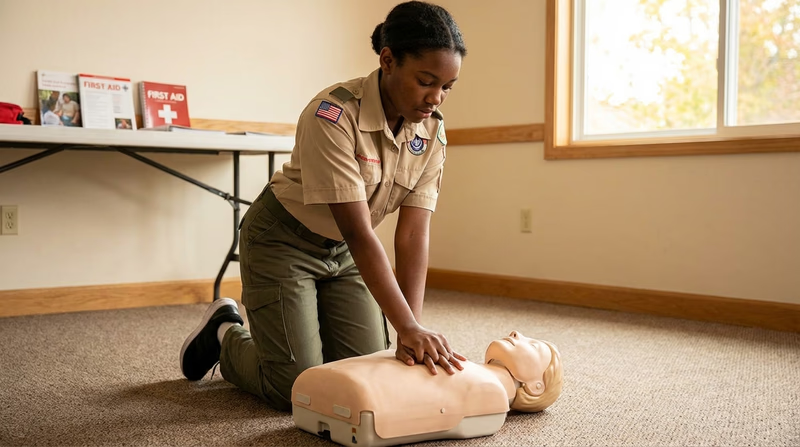
For bystanders without CPR training, Hands-Only CPR (compression-only, no rescue breaths) is recommended by the American Heart Association. It is simple and effective:
- Call 911 (or have someone else call).
- Place the heel of one hand on the center of the chest (on the breastbone, between the nipples).
- Place your other hand on top and interlace your fingers.
- Push hard and fast — compress the chest at least 2 inches deep at a rate of 100–120 compressions per minute.
- Do not stop until EMS arrives, an AED is ready to use, or the person starts breathing on their own.
The rhythm: Push to the beat of the song “Stayin’ Alive” by the Bee Gees — it is exactly 100 beats per minute.
Conventional CPR (with Rescue Breaths)
If you are trained in full CPR, the cycle is 30 compressions : 2 rescue breaths:
- Perform 30 chest compressions (hard and fast, 2 inches deep).
- Open the airway with head-tilt, chin-lift.
- Give 2 rescue breaths (1 second each, watching for chest rise). Use a CPR barrier.
- Repeat the 30:2 cycle until help arrives.
For two-rescuer CPR: One person does compressions while the other gives breaths. Switch roles every 2 minutes to prevent fatigue — compression quality degrades quickly when you are tired.
CPR for Children and Infants
| Adult/Teen | Child (1–puberty) | Infant (under 1) | |
|---|---|---|---|
| Compression depth | At least 2 inches | About 2 inches | About 1.5 inches |
| Compression method | Two hands on sternum | One or two hands | Two fingers on sternum |
| Rate | 100–120/min | 100–120/min | 100–120/min |
| Ratio | 30:2 | 30:2 (one rescuer) or 15:2 (two rescuers) | 30:2 (one rescuer) or 15:2 (two rescuers) |
🎬 Video: Hands-Only CPR — https://youtu.be/A5PnI4I-vd8?si=ERt7HtnwcmqFJmQA
What an AED Does
An automated external defibrillator (AED) is a portable device that analyzes the heart’s rhythm and, if needed, delivers an electrical shock to restore a normal heartbeat. It is used during cardiac arrest — when the heart has stopped beating effectively.
When the heart goes into cardiac arrest, it often enters a chaotic rhythm called ventricular fibrillation (V-fib). The heart muscle quivers rapidly instead of pumping blood. An AED delivers a controlled electrical shock that stops the chaotic rhythm, giving the heart a chance to reset and resume beating normally.
🎬 Video: Using an AED — https://youtu.be/in8j2Q2z3HE
Using an AED Correctly
Step-by-Step
- Continue CPR until the AED is powered on and ready. Every second without compressions reduces survival.
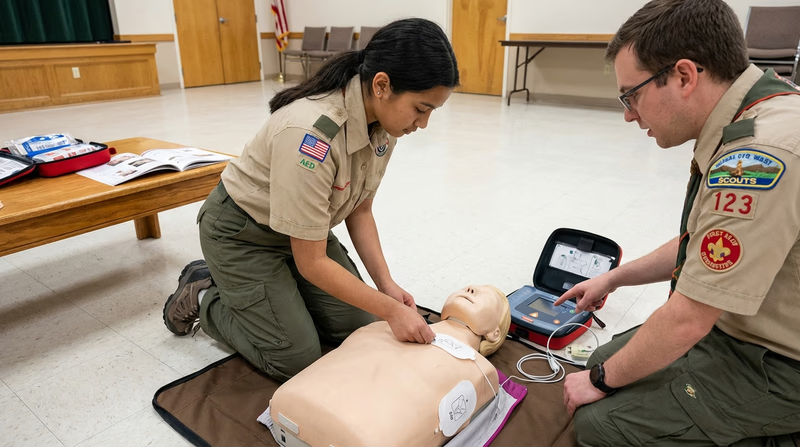
- Turn on the AED. Press the power button or open the lid (some models turn on automatically when opened).
- Attach the pads. Peel the adhesive pads from the packaging and place them on the victim’s bare chest as shown in the diagram on the pads:
- One pad on the upper right chest, below the collarbone
- One pad on the lower left side, below the armpit
- Clear the victim. Make sure no one is touching the person. The AED needs a clear reading.
- Let the AED analyze. The device will say “Analyzing heart rhythm — do not touch the patient.” Wait.
- If a shock is advised: The AED will say “Shock advised. Stand clear.” Make sure no one is touching the victim. Press the shock button when prompted.
- Resume CPR immediately after the shock. The AED will prompt you to continue compressions.
- If no shock is advised: The AED will tell you. Continue CPR. The AED will re-analyze every 2 minutes.
Important Details
- Bare chest required. Remove clothing from the chest. If the chest is wet, dry it quickly. If the person has excessive chest hair, the pads may not stick — some AED kits include a razor.
- Medication patches. If the person has a medication patch (nitroglycerin, nicotine) where a pad needs to go, remove it with a gloved hand and wipe the area before placing the pad.
- Implanted pacemaker or defibrillator. Look for a lump under the skin on the upper chest. Place the AED pad at least one inch away from it.
- Children under 8 or under 55 pounds. Use pediatric pads if available. If not, adult pads can be used — place one on the front of the chest and one on the back.
Finding AEDs in Your Community
AEDs are placed in locations where large numbers of people gather and where cardiac arrest is most likely to be witnessed. For this requirement, identify AED locations at places like:
- Schools — often in the main office, gymnasium, or cafeteria
- Places of worship — in the foyer or main gathering area
- Scout meeting places — your troop’s regular meeting location
- Sports facilities — gyms, pools, fields, and recreation centers
- Community buildings — libraries, community centers, government offices
- Airports, malls, and transit stations
- Camp — the health lodge or dining hall at Scout camp
Why These Locations?
AEDs are placed where:
- Many people are present (higher statistical chance of a cardiac event)
- Physical exertion occurs (sports facilities, gyms)
- Older adults gather (places of worship, community centers)
- Emergency response time may be long (remote camps, large buildings)
Smartphone AED Locators
Several apps and websites map AED locations:
PulsePoint AED — AED Locator App A free app that shows nearby AED locations and alerts CPR-trained bystanders when someone nearby is in cardiac arrest. Link: PulsePoint AED — AED Locator App — https://www.pulsepoint.org/ Where to Place AEDs American Heart Association guidance on where AEDs are most useful and how facilities should choose their locations. Link: Where to Place AEDs — https://cpr.heart.org/en/-/media/CPR-Files/Training-Programs/AED-Implementation/2023-updates/KJ1683-AED-Guide.pdf