Req 7a — Heart Attacks & CPR
Heart attacks and cardiac arrest are the leading cause of death in the United States. CPR performed by a bystander can double or triple a person’s chance of survival. As a Scout trained in first aid, you may be the only person nearby who knows what to do.
What Is a Heart Attack?
A heart attack (myocardial infarction) happens when blood flow to part of the heart muscle is blocked — usually by a blood clot in one of the coronary arteries. Without blood flow, that section of the heart begins to die.
A heart attack is not the same as cardiac arrest:
| Heart Attack | Cardiac Arrest | |
|---|---|---|
| What happens | Blocked artery reduces blood flow to the heart | Heart stops beating effectively |
| Consciousness | Usually conscious | Unconscious |
| Breathing | Usually breathing | Not breathing (or only gasping) |
| Pulse | Has a pulse | No pulse |
| Treatment | Call 911, aspirin, keep calm | CPR + AED immediately |
A heart attack can lead to cardiac arrest if the heart’s electrical system is disrupted — which is why rapid treatment matters.
Recognizing a Heart Attack
Signs and symptoms:
- Chest pain or pressure — often described as “squeezing,” “tightness,” or “a heavy weight on my chest.” May come and go.
- Pain radiating to the left arm, shoulder, neck, jaw, or back
- Shortness of breath — with or without chest pain
- Nausea, vomiting, or indigestion
- Cold sweat, lightheadedness, or dizziness
- Fatigue — especially unusual, sudden fatigue
- Anxiety — a feeling that “something is very wrong”
First Aid for a Heart Attack
- Call 911 immediately. Do not drive the person to the hospital yourself unless there is absolutely no other option — they could go into cardiac arrest in the car.
- Have the person sit or lie down in whatever position is most comfortable.
- Give aspirin if the person is not allergic to it and is not already taking blood thinners. Have them chew (not swallow whole) one regular aspirin (325 mg) or four baby aspirin (81 mg each). Aspirin helps prevent the blood clot from growing.
- Loosen tight clothing.
- Keep them calm. Anxiety increases heart rate and oxygen demand.
- Monitor breathing and pulse. Be prepared to begin CPR if the person becomes unresponsive and stops breathing.
CPR: Cardiopulmonary Resuscitation
CPR is the technique used to manually pump blood through the body when the heart has stopped. It keeps oxygen flowing to the brain and vital organs until a defibrillator or paramedics can restart the heart.
When to Perform CPR
CPR is performed when all three of these conditions exist:
- The person is unresponsive — they do not respond to tapping and shouting
- The person is not breathing normally — no breath, or only gasping (agonal breathing)
- There is no pulse — check the carotid pulse (side of the neck) for no more than 10 seconds
If these three conditions are present, begin CPR immediately. Every minute without CPR reduces the chance of survival by 7–10%.
Hands-Only CPR
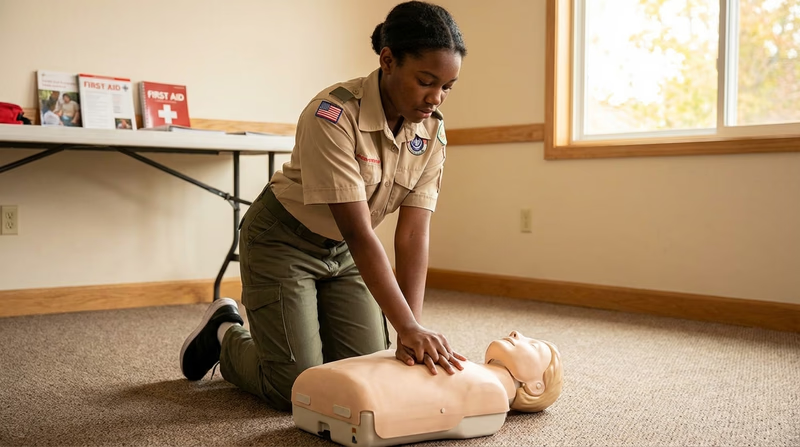
For bystanders without CPR training, Hands-Only CPR (compression-only, no rescue breaths) is recommended by the American Heart Association. It is simple and effective:
- Call 911 (or have someone else call).
- Place the heel of one hand on the center of the chest (on the breastbone, between the nipples).
- Place your other hand on top and interlace your fingers.
- Push hard and fast — compress the chest at least 2 inches deep at a rate of 100–120 compressions per minute.
- Do not stop until EMS arrives, an AED is ready to use, or the person starts breathing on their own.
The rhythm: Push to the beat of the song “Stayin’ Alive” by the Bee Gees — it is exactly 100 beats per minute.
Conventional CPR (with Rescue Breaths)
If you are trained in full CPR, the cycle is 30 compressions : 2 rescue breaths:
- Perform 30 chest compressions (hard and fast, 2 inches deep).
- Open the airway with head-tilt, chin-lift.
- Give 2 rescue breaths (1 second each, watching for chest rise). Use a CPR barrier.
- Repeat the 30:2 cycle until help arrives.
For two-rescuer CPR: One person does compressions while the other gives breaths. Switch roles every 2 minutes to prevent fatigue — compression quality degrades quickly when you are tired.
CPR for Children and Infants
| Adult/Teen | Child (1–puberty) | Infant (under 1) | |
|---|---|---|---|
| Compression depth | At least 2 inches | About 2 inches | About 1.5 inches |
| Compression method | Two hands on sternum | One or two hands | Two fingers on sternum |
| Rate | 100–120/min | 100–120/min | 100–120/min |
| Ratio | 30:2 | 30:2 (one rescuer) or 15:2 (two rescuers) | 30:2 (one rescuer) or 15:2 (two rescuers) |