Req 8a — Strains, Sprains & Fractures
Musculoskeletal injuries — injuries to muscles, tendons, ligaments, and bones — are some of the most common injuries you will encounter as a Scout. Understanding the differences between these injuries helps you provide the right first aid.
The Musculoskeletal System: A Quick Overview
Your body’s movement system has three key components:
- Muscles contract to produce movement
- Tendons connect muscles to bones
- Ligaments connect bones to other bones at joints
When any of these structures is stretched, torn, or broken, you have a musculoskeletal injury.
Comparing the Injuries
| Injury | What Is Damaged | Severity | Key Difference |
|---|---|---|---|
| Strain | Muscle or tendon (stretched or partially torn) | Mild to moderate | Affects the muscle-tendon unit |
| Muscle tear | Muscle fibers (significantly or completely torn) | Moderate to severe | More severe than a strain — actual tearing of muscle tissue |
| Tendon rupture | Tendon (completely torn) | Severe | Loss of function — muscle cannot move the bone |
| Sprain | Ligament (stretched or torn) | Mild to severe | Affects the joint — ligaments hold bones together |
| Dislocation | Joint (bone forced out of position) | Severe | Bone is visibly out of alignment at the joint |
| Simple fracture | Bone (cracked or broken, skin intact) | Moderate to severe | Also called a “closed fracture” — skin is not broken |
| Compound fracture | Bone (broken, bone pierces through skin) | Severe — emergency | Also called an “open fracture” — bone is exposed, high infection risk |
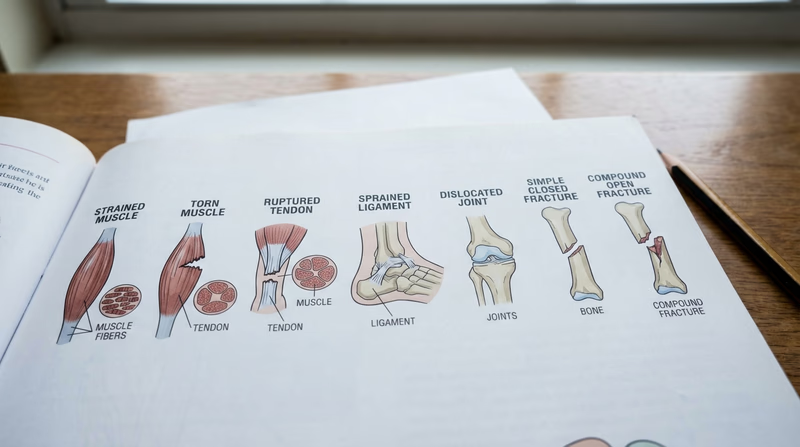
Muscle Strains, Tears, and Tendon Ruptures
Muscle Strain
A strain is an overstretching or minor tearing of muscle fibers or tendons. It is the most common musculoskeletal injury — the classic “pulled muscle.”
Signs and symptoms: Pain at the site, mild swelling, stiffness, limited range of motion, possible bruising.
First aid: Apply R.I.C.E. — Rest, Ice (20 min on / 20 min off), Compression (elastic bandage), Elevation. Avoid using the injured muscle. Most mild strains heal in 1–2 weeks.
Muscle Tear
A muscle tear is a more severe version of a strain where a significant portion of the muscle fibers actually rip apart. In a complete tear, the muscle separates into two pieces.
Signs and symptoms: Sudden, sharp pain during activity (“felt a pop”), significant swelling and bruising, a visible dent or gap in the muscle, inability to use the muscle, severe pain with any movement.
First aid: Apply R.I.C.E. Immobilize the area. Do not try to stretch or massage the injury. Seek medical attention — severe tears may require surgery.
Tendon Rupture
A tendon rupture occurs when a tendon completely tears away from the bone or snaps in two. The Achilles tendon (back of the ankle) and the quadriceps tendon (front of the knee) are the most commonly ruptured tendons.
Signs and symptoms: A sudden “pop” or “snap” felt or heard, immediate and severe pain, inability to move the affected joint normally (for example, unable to point the foot downward after an Achilles rupture), swelling, a visible gap where the tendon should be.
First aid: Immobilize the joint in the position you find it. Apply ice. Do not try to use the limb. Seek emergency medical care — tendon ruptures almost always require surgical repair.
Sprains
A sprain is a stretch or tear of a ligament — the tough bands that hold bones together at a joint. Ankles, knees, and wrists are the most commonly sprained joints.
Signs and symptoms: Pain at the joint, swelling (often rapid), bruising, inability to bear weight or use the joint, a “pop” felt or heard at the time of injury, instability in the joint.
Severity:
- Grade I (mild): Ligament stretched but not torn. Mild pain and swelling.
- Grade II (moderate): Ligament partially torn. Moderate pain, swelling, and bruising. Joint is somewhat unstable.
- Grade III (severe): Ligament completely torn. Severe swelling, bruising, and instability. The joint may feel “loose.”
First aid: R.I.C.E. Immobilize the joint with an elastic bandage or splint. Do not try to “walk it off.” Seek medical attention for Grade II and III sprains.
Complications: Chronic joint instability, re-injury, arthritis in the joint later in life.
Fractures
A fracture is a break or crack in a bone.
Simple (Closed) Fracture
The bone is broken but the skin is not broken. The broken bone ends stay inside the body.
Signs and symptoms: Pain, swelling, bruising, deformity (limb looks bent or shortened), inability to move or bear weight, a grinding sensation (crepitus) when the area is touched.
Compound (Open) Fracture
The broken bone pierces through the skin, creating an open wound. This is a medical emergency because of severe bleeding and high infection risk.
Signs and symptoms: All the signs of a closed fracture, plus a visible bone end protruding from the skin, an open wound at the fracture site, and severe bleeding.
First aid for fractures:
- Call 911 for compound fractures or any fracture you suspect involves the spine, pelvis, or femur (thighbone).
- Do not move the injured limb. Splint it in the position you find it (you will learn splinting in Req 8b).
- For compound fractures: Control bleeding with direct pressure around (not on) the bone. Cover the wound and exposed bone with a sterile, moist dressing. Do not push the bone back in.
- Treat for shock.
- Apply ice to reduce swelling (never directly on skin).
- Check circulation below the injury — feel for a pulse, check skin color and temperature, ask if they can feel you touching their fingers or toes.
Complications: Nerve damage, blood vessel damage, compartment syndrome (pressure buildup in the muscle), infection (especially compound fractures), improper healing.
Dislocations
A dislocation occurs when a bone is forced out of its normal position at a joint. Shoulders, fingers, elbows, and kneecaps are commonly dislocated.
Signs and symptoms: Visible deformity at the joint, intense pain, inability to move the joint, swelling, numbness or tingling below the injury.
First aid:
- Do not try to “pop it back in.” Attempting to reduce a dislocation without training can damage nerves, blood vessels, and cartilage.
- Immobilize the joint in the position you find it.
- Apply ice to reduce swelling.
- Check circulation below the injury.
- Seek medical attention immediately.
Complications: Torn ligaments, nerve or blood vessel damage, recurrent dislocations, fractures associated with the dislocation.
OrthoInfo — Sprains, Strains, and Fractures The American Academy of Orthopaedic Surgeons offers detailed, reliable information on every type of musculoskeletal injury.