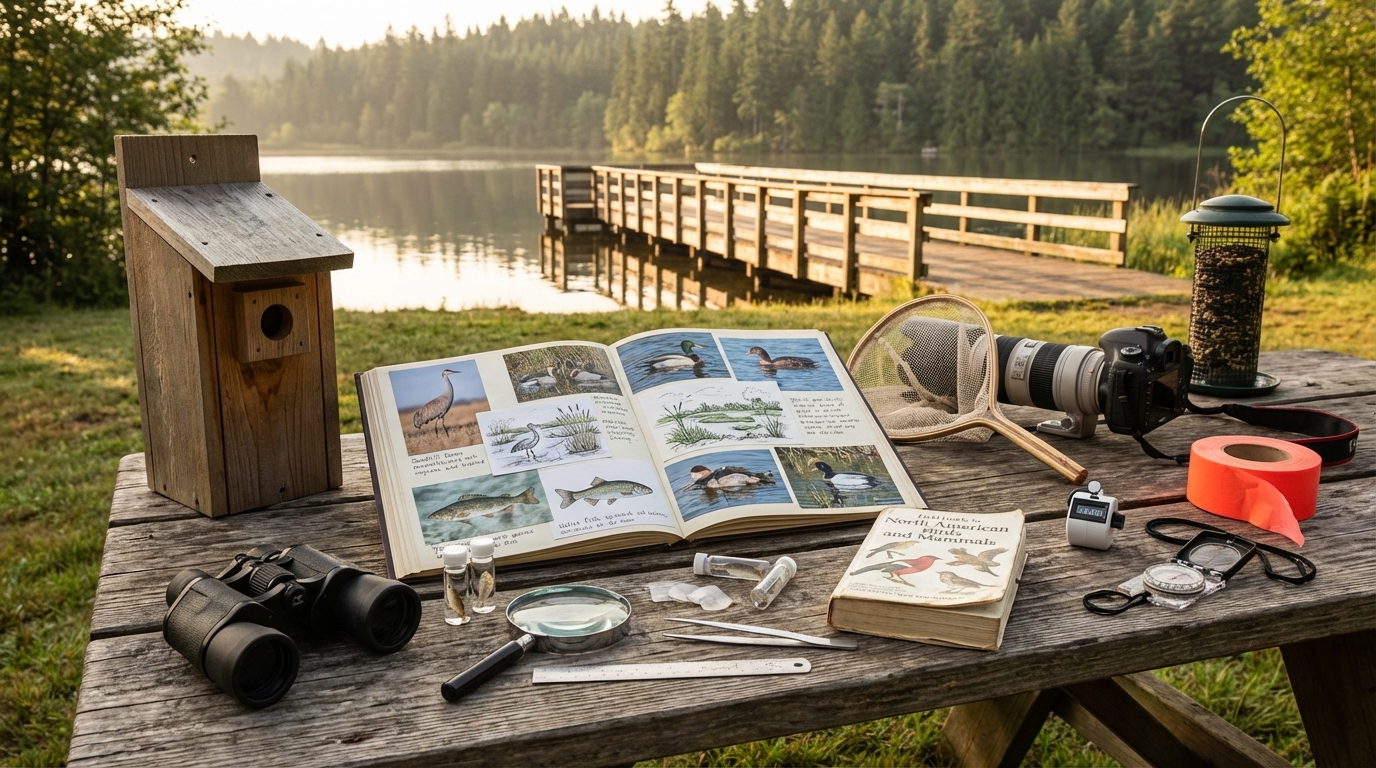
Fish and Wildlife Management Merit Badge — Complete Digital Resource Guide
https://merit-badge.university/merit-badges/fish-and-wildlife-management/guide/
Introduction & Overview
Every time you cast a fishing line into a lake, spot a deer at the forest edge, or hear a frog chorus on a spring evening, you’re experiencing the results of decades of careful fish and wildlife management. This merit badge takes you behind the scenes to understand how wildlife biologists, fisheries managers, and conservation officers protect and restore the animal populations that make wild places worth visiting. You’ll learn what threatens those populations — and what you, right now, can do about it.
Then and Now
Then: Hunting the Land Empty
In the early days of European settlement in North America, wildlife was treated as an inexhaustible resource. Market hunters shipped hundreds of thousands of passenger pigeons to city restaurants each year. Bison herds that once numbered 30–60 million animals were reduced to fewer than a thousand individuals by 1889. Waterfowl were shot by the wagonload, and river systems were dammed, drained, and dumped into without a second thought.
The turning point came in the late 1800s when hunters and naturalists — alarmed by the collapse of species they had grown up seeing in abundance — began pushing for change. Theodore Roosevelt established the first National Wildlife Refuge in 1903, protecting Pelican Island, Florida, from plume hunters. The Lacey Act of 1900 made it illegal to transport illegally taken wildlife across state lines. These early laws were imperfect, but they planted the idea that wildlife belonged to all citizens and that government had a role in protecting it.
Now: Science-Guided Stewardship
Today, fish and wildlife management is a rigorous science. Biologists use population surveys, radio telemetry, genetic sampling, and satellite tracking to monitor hundreds of species. Each state has a fish and wildlife agency staffed by professionals who set hunting and fishing seasons based on population data, restore habitat through land acquisition and conservation easements, manage hatcheries and stocking programs, and coordinate with federal agencies and neighboring states on species that cross borders.
The results are remarkable: white-tailed deer populations have recovered from near-extinction in parts of the East; wild turkey range has expanded into all 49 continental states; bald eagles — once listed as endangered — now number in the tens of thousands. These recoveries didn’t happen by accident. They happened because of the conservation framework you’re about to explore.
Get Ready!
Fish and Wildlife Management is one of the most hands-on merit badges in Scouting. You won’t just read about wildlife — you’ll build structures for animals to live in, observe real species in the field, study fish up close, and research careers that could take you to river valleys, salt marshes, mountain forests, and beyond. Every Scout brings a different home state and a different backyard, which means your experience will be genuinely your own.
Kinds of Fish and Wildlife Management
Fish and wildlife management covers a wide spectrum of animals and ecosystems. Here’s a quick tour of the major domains you’ll encounter throughout this badge.
Fisheries Management
Fisheries managers oversee freshwater lakes, rivers, and streams — and sometimes coastal marine waters — to maintain healthy, harvestable fish populations. Their tools include creel surveys (counting what anglers catch), stocking programs, size and bag limit regulations, habitat restoration (clearing stream channels, adding woody debris for cover), and fish passage structures like ladders that let salmon and other migratory species swim past dams.
Upland Wildlife Management
Upland game managers focus on birds like pheasant, quail, turkey, and grouse, and mammals like deer, elk, and rabbits. Much of their work involves managing vegetation — prescribed burns to rejuvenate grasslands, shrub plantings for edge habitat, food plots to supplement natural forage during winter.
Waterfowl and Wetlands Management
Ducks, geese, swans, and shorebirds depend on wetland habitats that have been drained at staggering rates — the lower 48 states have lost more than half their original wetlands. Waterfowl managers restore and protect marshes, manage water levels in impoundments, and coordinate international flyway management because migratory birds don’t recognize state or national borders.
Furbearer and Predator Management
Furbearers like beaver, otter, mink, and fox, as well as predators like coyote, bobcat, and mountain lion, require specialized management strategies. Managers must balance ecological roles (beaver dams create wetlands that benefit dozens of other species) with human-wildlife conflict (beavers also flood roads and farmland). Population monitoring, trapping seasons, and conflict resolution are all part of this domain.
Endangered and Non-Native Species Management
Some species need protection because their populations have fallen dangerously low — think whooping cranes, black-footed ferrets, or lake sturgeon. Others cause harm because they’ve been introduced where they don’t belong — zebra mussels, Asian carp, and feral hogs have caused billions of dollars in ecological and economic damage. Managing both ends of this spectrum is increasingly central to the job of a modern fish and wildlife manager.
Ready to understand the foundation that makes all this management possible? Let’s start with the big picture.
Req 1 — What Is Fish and Wildlife Management?
A river in Montana holds more trout today than it did thirty years ago — not because trout spontaneously rebounded, but because fisheries managers studied the population, identified what was limiting it, and took targeted action. That’s fish and wildlife management in a single sentence: science-driven intervention on behalf of wild animal populations. But to understand management, you first need to understand what it’s managing for — and that’s where conservation comes in.
Conservation: The Big Idea
Conservation is the careful use and protection of natural resources so they remain available for future generations. Applied to fish and wildlife, conservation means ensuring that animal populations stay healthy, that habitats remain capable of supporting them, and that the ecological processes they depend on keep functioning.
Conservation is not the same as “leaving nature alone.” A forest without any human intervention can become overgrown with invasive species, choked by fire suppression, or fragmented by development. Active conservation means making deliberate choices — what to protect, what to restore, how much harvest to allow — guided by the best available science.
Management: Putting Conservation into Practice
Wildlife management is the application of ecological science to maintain animal populations at levels desirable to humans and beneficial to the ecosystem. A state fish and wildlife agency might manage deer populations to reduce crop damage and vehicle collisions while still maintaining enough deer for hunting and wildlife watching. A fisheries biologist might manage a trout stream to produce high-quality angling while protecting the stream’s invertebrate community.
Management works with three levers:
Population management controls how many animals are in a given area. This includes setting hunting and fishing seasons, issuing permits and licenses, removing problem animals, or — when a population is too low — prohibiting harvest entirely.
Habitat management addresses the places animals live. Every species needs food, water, shelter, and space. When any of those components degrades or disappears, the population suffers. Habitat work includes prescribed burns, wetland restoration, stream bank stabilization, and forest thinning.
Human dimension management deals with the relationship between people and wildlife. No management plan succeeds if the public doesn’t support it. Wildlife managers communicate with landowners, hunters, anglers, hikers, farmers, and urban residents to build understanding and cooperation.
Purposes of Fish and Wildlife Management
Why does management matter? Here are the main reasons managers give for their work:
Ecological health. Fish and wildlife are threads in the ecological web. When key species decline, the whole system can unravel. Wolves reintroduced to Yellowstone changed where elk grazed, which allowed streamside willows to recover, which stabilized riverbanks, which improved fish habitat — a cascade of effects called a trophic cascade. Managing wildlife means managing ecosystems.
Sustainable use. Hunting and fishing are legal, regulated activities that generate billions of dollars in revenue and provide food for millions of families. The Pittman-Robertson Act (1937) and Dingell-Johnson Act (1950) placed excise taxes on firearms, ammunition, and fishing equipment, channeling those dollars — over $25 billion to date — directly to state wildlife agencies. Management ensures that these uses remain sustainable, not extractive.
Non-consumptive recreation. Wildlife watching, photography, and birding contribute even more economic value than hunting and fishing combined. Wildlife managers protect and enhance habitats to support these activities.
Public safety. Overpopulated deer cause thousands of vehicle collisions per year. Nuisance bears, coyotes, and mountain lions create public safety risks. Management keeps wildlife populations at levels that reduce conflict.
Biodiversity. Each species represents millions of years of evolutionary history and plays a unique role in its ecosystem. Management prevents extinctions and works to recover species from the brink.
Key Terms to Know
Make sure you can define each of these for your counselor- Conservation: Careful use and protection of natural resources for long-term availability
- Wildlife management: Science-based actions to maintain animal populations at desirable levels
- Population management: Controlling animal numbers through seasons, permits, and regulations
- Habitat management: Improving or protecting the places animals live, including food, water, shelter, and space
- Human dimensions: The study of how people think about, value, and interact with wildlife
- Trophic cascade: A chain reaction through an ecosystem when a key species changes in abundance
- Pittman-Robertson Act: 1937 federal law that taxes sporting goods and directs proceeds to state wildlife agencies
The North American Model
The philosophical foundation of U.S. and Canadian wildlife management is called the North American Model of Wildlife Conservation. Its core principle is that wildlife belongs to all citizens — the public trust doctrine — and that government agencies manage it on the public’s behalf. This stands in contrast to the European model, where wildlife traditionally belonged to whoever owned the land.
The model also holds that:
- Wildlife should be allocated by law, not market price
- Wildlife should be killed only for legitimate purposes (food, fur, self-defense, property protection)
- Wildlife is an international resource for migratory species
- Science is the proper basis for management decisions
🎬 Video: Conserving the Nature of America — U.S. Fish & Wildlife Service — https://www.youtube.com/watch?v=d1mOhYGjbP0
Now that you know what fish and wildlife management means and why it exists, let’s look at the specific forces that threaten the resources managers are working to protect.
Req 2 — Major Threats to Fish and Wildlife
Your counselor will want you to connect the major threats to the specific wildlife in your home state — so while this page covers the national picture, your job is to think locally. A Scout in Louisiana faces different pressures than one in Montana, even though the categories of threats are the same. Read through the major threat categories below, then research which two or three have the biggest impact on your state. Your state fish and wildlife agency’s website is the best place to start.
Habitat Loss and Fragmentation
Habitat loss is the single greatest threat to fish and wildlife worldwide, and every state in the country faces some version of it. When forests are cleared for development, wetlands are drained for agriculture, and grasslands are converted to subdivisions, the animals that depended on those habitats have nowhere to go.
Fragmentation is equally damaging, and often harder to see. A 500-acre forest divided by a four-lane highway becomes two 250-acre fragments — and for many species, those smaller patches cannot sustain viable populations. Deer can cross roads (often fatally for both the deer and the driver). Salamanders, turtles, and many small mammals cannot. Over time, isolated populations lose genetic diversity and go locally extinct.
In your state, look for habitat loss in the form of:
- Agricultural conversion of native prairie or wetlands
- Urban and suburban sprawl
- Road construction through previously intact forests or wetlands
- Channelization of rivers and streams (straightening natural meanders for flood control)
Invasive Species
A non-native species becomes “invasive” when it establishes itself in a new ecosystem and causes ecological or economic harm. Invasive species are the second leading cause of wildlife decline globally — and they’re one of the fastest-growing threats because they’re so hard to reverse.
Invasive plants like purple loosestrife, buckthorn, and kudzu crowd out native vegetation, reducing food and cover quality for wildlife. An upland bird that evolved to nest in native switchgrass is poorly equipped to use a dense stand of invasive phragmites.
Invasive animals can devastate native species directly. Sea lampreys nearly wiped out lake trout in the Great Lakes. Asian carp outcompete native fish for food and space. Zebra and quagga mussels filter so much plankton from water bodies that they starve native fish. Brown-headed cowbirds, which expanded their range following deforestation, parasitize the nests of dozens of songbird species. Feral hogs — present in at least 35 states — root up habitat, prey on ground-nesting birds, and spread disease.
Diseases introduced via non-native species (or spread by human movement) also threaten wildlife. Chronic wasting disease (CWD) has spread to deer and elk herds in many states. White-nose syndrome, caused by a fungus accidentally introduced from Europe, has killed millions of bats.
Common Invasive Species by Region
Research which of these affect your state- Northeast: Purple loosestrife, common reed (phragmites), emerald ash borer, brook trout displacement by brown trout
- Southeast: Kudzu, feral hogs, Burmese pythons (Florida), lionfish (coastal waters)
- Midwest: Asian carp (bighead, silver, black), zebra mussels, garlic mustard, white-nose syndrome in caves
- West: Quagga mussels, tamarisk (saltcedar), cheatgrass, bullfrogs displacing native frogs
- All regions: Chronic wasting disease in deer/elk, sea lampreys (Great Lakes), brown-headed cowbirds
Pollution and Water Quality Degradation
Fish and aquatic wildlife are especially vulnerable to water pollution, and most of it comes from non-point sources — meaning it doesn’t come from a single pipe but from the cumulative runoff of millions of sources: fertilized lawns, farms, parking lots, construction sites, and urban streets.
Agricultural runoff carries nitrogen and phosphorus into waterways, triggering algae blooms. When the algae die and decompose, bacteria consume all the dissolved oxygen, creating “dead zones” where fish cannot survive. The Gulf of Mexico hypoxic zone, fed by runoff from the Mississippi River basin, covers an area the size of New Jersey each summer.
Sedimentation from eroding stream banks and construction sites smothers the gravel beds where trout and salmon spawn. Larvae that hatch in those gravels cannot escape and suffocate.
Pesticides and herbicides used in agriculture and forestry accumulate in the food chain. Bald eagle and peregrine falcon populations nearly collapsed in the mid-20th century due to DDT contamination — a pesticide that thinned eggshells so severely that the birds could not reproduce.
Thermal pollution from industry and from shade removal along stream banks raises water temperatures beyond the tolerance of cold-water fish species.
Overexploitation
Legal, regulated harvest is sustainable — that’s the whole point of wildlife management. But unregulated commercial take, poaching, and harvest that outstrips the population’s reproductive rate are genuine threats.
The commercial fisheries collapse of Atlantic cod in the 1990s is a textbook case. Overharvesting can drive populations below the threshold where they can recover, even after harvest stops. Today’s regulations exist specifically to prevent this — but enforcing them requires adequate staffing of conservation officers and public compliance.
Wildlife trafficking — the illegal trade in live animals, parts, and products — remains a multi-billion-dollar global industry. While most of this trade involves tropical species, domestic poaching of black bears (for gallbladders and paws), white-tailed deer (antlers), and birds of prey affects populations in every state.
Climate Change and Weather Extremes
Climate change is an emerging and accelerating threat to fish and wildlife. Shifting temperature ranges, altered precipitation patterns, and more frequent extreme weather events all affect where species can live and reproduce.
Cold-water fish like brook trout and bull trout are losing thermal habitat as stream temperatures rise. Spring-blooming plants are flowering weeks earlier than they did a generation ago, while the migratory birds that evolved to arrive in time to eat caterpillars emerging from those buds have not shifted their schedules fast enough — a mismatch called “phenological decoupling” that reduces breeding success.
Wetland-dependent species face flooding and drought extremes that destroy nests, trap fish in shrinking pools, and alter the invertebrate communities that birds and fish depend on.
🎬 Video: Climate Change & Habitat Loss: Fisheries at Risk — NOAA Fisheries — https://www.youtube.com/watch?v=RiSRcx6Z9Oc
Understanding what threatens fish and wildlife is the first step. The next question is: what can you do about it?
Req 3 — How Everyone Can Help
Fish and wildlife management is not just for the professionals with the badges and the binoculars. Every person with a backyard, a fishing license, a car, or a garden makes dozens of decisions each year that add up to either wildlife conservation or wildlife decline. The good news: the actions that help wildlife are often free, straightforward, and deeply satisfying.
Create and Protect Habitat
The single biggest contribution most people can make is improving the habitat immediately around them.
Native plants matter more than most people realize. A yard full of non-native ornamentals provides almost no food for native insects — and native insects are the foundation of the food chain. A single native oak tree supports more than 500 species of caterpillars; a non-native ginkgo supports fewer than 10. Those caterpillars feed baby birds, which feed hawks, which are watched by hikers and photographers. Planting native trees, shrubs, wildflowers, and grasses is one of the most effective conservation actions a homeowner can take.
Reduce lawn area. A monoculture lawn mowed short and treated with fertilizers and pesticides functions as a near-biological desert. Converting even a portion of lawn to native plantings, pollinator gardens, or brush piles provides food and cover for birds, butterflies, toads, and small mammals.
Leave the leaves. Fireflies, many moth species, and hundreds of native bees overwinter in leaf litter. Raking and bagging leaves in autumn removes the overwintering habitat of dozens of species that will otherwise have nowhere to go.
Buffer streams and wetlands. If you live near a water body, maintaining a vegetated buffer zone (unfertilized, unmowed native grasses and shrubs) between your yard and the water filters runoff, provides cover for aquatic species, and prevents bank erosion.
Reduce Pesticide and Herbicide Use
Pesticides don’t discriminate between the pest you’re targeting and the beneficial insects, birds, and mammals you want to keep. Neonicotinoid insecticides — used widely on lawns and garden plants — persist in pollen and nectar and are a significant factor in bee decline. Rodenticides used to kill mice and rats accumulate in predators like owls, hawks, foxes, and mountain lions that eat poisoned rodents.
Practical steps:
- Use integrated pest management (IPM): identify the pest precisely, use the least toxic effective control, and only treat where the problem actually is.
- Choose plants suited to your climate and soil; healthy plants resist pests and disease without chemical help.
- Accept some insect damage on garden plants — those “pests” are often food for birds.
- Control invasive plants mechanically (pulling, cutting) rather than with herbicides whenever practical.
Be a Responsible Angler and Hunter
If you fish or hunt, you’re already participating in the most direct form of wildlife support — because fishing and hunting license fees and equipment taxes fund the vast majority of state fish and wildlife agency budgets. Being responsible means:
- Follow regulations. Size and bag limits are based on population data. Keeping undersized fish or exceeding bag limits removes animals from the breeding population.
- Practice catch-and-release carefully. Use barbless hooks when possible, minimize handling time, keep the fish in water, and revive exhausted fish before release.
- Pick up your gear. Lost monofilament, lead sinkers, and discarded fishing line injure and kill millions of birds and mammals each year. Carry a small bag for trash.
- Report violations. Most states have a hotline or app for reporting poaching. Poached wildlife is wildlife that isn’t available for anyone — hunter, angler, or wildlife watcher.
Keep Cats Indoors
Domestic and feral cats kill an estimated 1.3 to 4 billion birds and 6 to 22 billion small mammals annually in the United States — making them the single largest source of direct human-caused bird mortality in the country, exceeding vehicle strikes, building collisions, and power lines combined. Keeping pet cats indoors eliminates their predation on wildlife entirely. Community-run trap-neuter-return (TNR) programs reduce feral cat populations over time, though research on their effectiveness for wildlife protection is mixed.
Reduce Your Collision Footprint
Vehicle strikes are a major source of mortality for deer, turkey, turtles, amphibians, and other species that must cross roads to complete their life cycles.
- Slow down near wetlands and forest edges during dawn and dusk — peak movement times for most wildlife.
- Watch for turtles on roads in spring and early summer, especially near water. If you can safely stop and help one across, move it in the direction it was heading.
- Never relocate turtles. Moving a turtle far from its home pond almost always results in its death. Turtles have tiny territories they know intimately; a new environment is unfamiliar and stressful.
Support Conservation Organizations and Citizen Science
Habitat protection happens through land acquisition, conservation easements, and policy advocacy — and that requires funding and public support. Organizations like The Nature Conservancy, Ducks Unlimited, Pheasants Forever, Trout Unlimited, and National Wildlife Federation work at regional and national scales to protect habitat and influence policy.
Citizen science is another powerful lever. Programs like iNaturalist, eBird, Christmas Bird Count, the North American Breeding Bird Survey, and FrogWatch USA depend on millions of volunteers to collect data that professionals cannot gather alone. A Scout who logs 50 bird observations in eBird is contributing real data to scientific databases used by researchers and managers.
Personal Conservation Checklist
How many of these can you commit to?- Plant at least one native species in your yard or community this year
- Remove invasive plants from your property — identify them first at your state’s invasive species council website
- Follow all fishing and hunting regulations and encourage others to do the same
- Report poaching using your state’s tip hotline or app
- Keep cats indoors or in a catio (enclosed outdoor enclosure)
- Help turtles cross roads when it’s safe to do so
- Create a brush pile in your yard for small mammal and bird cover
- Participate in a citizen science project — eBird, iNaturalist, FrogWatch, or Christmas Bird Count
- Support a conservation organization financially or as a volunteer
- Talk to neighbors about habitat improvements they can make
Now that you know how individuals can help, it’s time to look at how professional managers apply these principles — the formal practices they use to sustain fish and wildlife populations at scale.
Req 4 — Five Management Practices
This requirement asks you to identify five management practices used in your state, so the examples you give your counselor should reflect your actual location. The practices covered here are used across North America — your job is to research which specific programs and tools your state agency runs. Think of this page as a menu: your counselor will want you to describe five, so pick the ones most relevant to where you live.
1. Harvest Regulation
Harvest regulation is the most visible management tool — it determines who can take which animals, in what numbers, using what methods, and during what seasons. Every state publishes annual hunting and fishing regulations based on population surveys conducted the previous year.
For wildlife, managers set seasons (dates when hunting is legal), bag limits (how many animals per day or per season), and equipment restrictions (shotgun only, archery only, muzzleloader). They also issue special permits for species that require controlled access — antlerless deer permits, antelope tags, and waterfowl stamps, for instance.
For fish, managers set minimum size limits (protecting juveniles and breeding-age fish), possession limits (how many you can keep), closed seasons (protecting spawning aggregations), and gear restrictions (no-snagging zones, single-hook rules).
The numbers behind regulations come from field surveys: deer spotlight counts, wild turkey gobbler surveys, fall waterfowl hunter surveys, and creel surveys for fish. Regulations are only as good as the data feeding them.
2. Habitat Management
Wildlife doesn’t just need food, water, and shelter in the abstract — it needs those resources in the right proportions, in the right spatial arrangement, throughout the year. Habitat management creates and maintains those conditions.
Prescribed fire is one of the most powerful habitat tools available. Fire removes woody encroachment from grasslands, rejuvenates shrubs, stimulates wildflower germination, and recycles nutrients. Many of North America’s most important wildlife species — bobwhite quail, prairie chickens, eastern wild turkey — are more abundant where fire is actively managed than where it has been suppressed.
Timber harvest done correctly benefits many species by creating different age classes of forest. Clear-cuts (clear in a limited area) create dense young growth that ruffed grouse, deer, and American woodcock need. Selective harvests maintain old-growth structure for cavity-nesting birds and bats.
Wetland management involves controlling water levels in managed impoundments. Waterfowl managers draw down water in summer to stimulate the growth of marsh plants whose seeds and tubers ducks eat, then flood the area in fall when ducks arrive on migration.
Stocking of fish — depositing hatchery-raised fish into lakes, streams, and ponds — is a widely used practice, especially for trout in public waters. Stocking supplements wild populations where habitat can support more fish than natural reproduction provides, or in waters that cannot support year-round survival of certain species.
3. Law Enforcement and Anti-Poaching Efforts
Regulations are only effective if they’re enforced. State conservation officers (also called game wardens, wildlife officers, or conservation police) patrol public lands and waters, investigate poaching, check hunting and fishing licenses, and educate the public about wildlife laws.
Poaching — the illegal take of wildlife — includes killing deer out of season, exceeding bag limits, taking protected species, and trafficking in wildlife parts. In many states, poaching is a significant drain on wildlife populations, particularly for species like black bear, wild turkey, and trophy-class white-tailed deer.
Many states operate “TIP” (Turn In Poachers) hotlines and apps that allow the public to report suspected violations anonymously. Rewards are sometimes offered for tips leading to convictions.
4. Population Surveys and Research
You can’t manage what you can’t measure. State fish and wildlife agencies invest heavily in population monitoring — systematic counts and estimates that tell managers whether populations are growing, stable, or declining.
Wildlife surveys include:
- Roadside spotlight surveys for deer and other mammals (counting animals seen per mile at night)
- Breeding bird survey routes — standardized routes where observers count birds at regular intervals
- Gobbler yelp counts for wild turkey
- Aerial waterfowl counts over wetland habitats
- Camera trap grids for wide-ranging species like mountain lions and black bears
- Track stations for bobcat and otter in areas where direct observation is difficult
Fisheries surveys include:
- Electrofishing — passing an electric current through the water to temporarily stun fish so they can be counted, measured, and released
- Gill netting and seining to sample fish communities
- Acoustic telemetry — tagging fish with sound transmitters and deploying underwater receivers to track movement
- Creel surveys — interviewing anglers at boat launches to estimate catch rates (you’ll explore this in Req 7b)
Research projects go deeper, investigating specific questions: What habitat features do wood ducks select for nest boxes? How far do elk move between seasonal ranges? What forage base limits smallmouth bass growth in this watershed?
5. Land Acquisition and Conservation Easements
All other management practices are limited by who controls the land. If critical habitat is privately owned and the owner has no interest in conservation, there may be little a state agency can do. Land acquisition and conservation easements change that equation.
Fee-simple acquisition means the state or a conservation organization buys the land outright, converting it to public ownership. State wildlife management areas (WMAs) and federal National Wildlife Refuges are acquired this way.
Conservation easements are a more flexible tool. The landowner keeps ownership and often continues farming or timber operations, but permanently gives up the right to develop the land for housing or industry. The easement is recorded in the deed and binding on future owners. Land trusts like The Nature Conservancy and many local land trusts hold millions of acres under easement.
Both approaches allow agencies to protect habitat at a landscape scale — which matters because most wildlife doesn’t recognize property boundaries.
More Management Practices to Consider
Pick the five most relevant to your state- Harvest regulation: Setting seasons, bag limits, and size limits based on population surveys
- Habitat management: Prescribed fire, timber harvest, wetland manipulation, stocking
- Law enforcement: Conservation officers, poaching tip lines, wildlife trafficking investigations
- Population surveys: Spotlight counts, electrofishing, creel surveys, camera traps
- Land acquisition: Fee-simple purchase and conservation easements protecting critical habitat
- Species reintroduction: Restoring extirpated species (wolves, elk, river otters, wild turkeys)
- Disease management: CWD monitoring, white-nose syndrome cave closures, fish health inspections
- Invasive species control: Physical removal, herbicide treatment, stocking of native predators
- Hunter and angler education: Safety courses, fishing clinics, wildlife identification training
- Cooperative programs: Landowner incentive programs paying farmers to manage habitat
With the management theory behind you, it’s time to get your hands dirty. The next three requirements ask you to pick one hands-on project, one observation or research activity, and one fish study technique — and actually do them.
Req 5 — Choose a Hands-On Project
Requirement 5 asks you to complete one of four hands-on field projects. These aren’t just activities — they’re real wildlife management and observation techniques used by professionals. Choose the option that fits your situation, interests, and the wildlife in your area:
- Req 5a — Nest Boxes: Build, install, and monitor at least two nest boxes (wood duck, bluebird, squirrel, etc.) for one nesting season. Best if you have access to open country, woodland edges, or a wetland.
- Req 5b — Bird Feeders: Build and install bird feeders, then keep a daily written record of visiting birds for two weeks. Works well in any backyard, urban or rural.
- Req 5c — Habitat Improvement Project: Design and carry out a real-world habitat improvement — either a fishery project or a backyard/community wildlife habitat. Highly flexible; great for Scouts who want to make a lasting impact.
- Req 5d — Wildlife Blind: Build a blind near a wildlife attractant (water, game trail, feeder) and photograph or sketch at least 10 different wild species from it. Perfect for Scouts interested in wildlife photography or nature journaling.
How to Choose
Choosing Your Project
Ask yourself these questions- Time available: 5a (nest boxes) requires at least one full nesting season — several months. 5b (feeders) takes two weeks of daily observation. 5c (habitat project) varies with your plan. 5d (blind) needs repeated visits until you’ve documented 10 species.
- Location: Do you have access to a wetland or woodland edge for nest boxes? A backyard for feeders? Land that could use habitat improvement? A spot with regular wildlife activity for a blind?
- Season: Nest boxes should go up before breeding season begins (late winter/early spring). Feeders work year-round but attract more species in winter and migration. Habitat projects can start anytime. Blinds are most productive near dawn and dusk.
- Resources: Nest boxes and blinds require some carpentry materials. Feeders require seed. Habitat projects may need native plant purchases or materials.
- Interest: Which option genuinely excites you? You’ll learn more — and produce a better result — if you’re curious about what you’re doing.
Select your option and head to that page for detailed guidance.
Req 5a — Nest Boxes
The Eastern bluebird nearly disappeared from most of the eastern United States by the 1970s — outcompeted for natural tree cavities by starlings and house sparrows that European settlers had introduced. What brought them back? Nest boxes. Thousands of volunteers installed millions of boxes along “bluebird trails,” and populations rebounded dramatically. What you’re about to do has a direct and documented track record of working. That’s not a metaphor — it’s measurable, repeatable conservation.
Why Nest Boxes Work
Many cavity-nesting birds — bluebirds, wood ducks, kestrels, tree swallows, screech-owls, nuthatches, and others — are limited by the availability of natural cavities in dead trees (called “snags”). As land development removes old trees and forests are managed more intensively, snags become scarce. Nest boxes substitute for natural cavities, and most species adopt them readily.
The key is making the right box for the right bird, placed in the right location. A wood duck box in an open meadow will never attract a wood duck. A bluebird box in a dense forest will never attract a bluebird. Matching species, box design, and habitat is what makes this project succeed.
Choosing Your Target Species
Your nest box plan should start with the question: what cavity-nesting wildlife lives in my area and needs nest boxes?
Bluebird (Eastern, Western, or Mountain): Open country, fence lines, meadow edges. Low nest entrance hole (1.5 inches) keeps starlings out. Mount on metal poles with predator guards.
Wood duck: Near water — wetlands, ponds, streams, flooded timber. Larger box (4" x 3" oval entrance) mounted on a metal pole in or at the water’s edge with a predator guard. Straw or wood shavings inside help ducks settle.
American kestrel: Open farmland, grasslands, forest edges. Medium-sized box (3" entrance hole) mounted 10–30 feet high on a post or tree.
Tree swallow: Similar habitat to bluebird — open fields and meadows near water. Accepts the same boxes. Often the first species to move in if bluebirds are slow to arrive.
Flying squirrel or gray squirrel: Woodland edges and forest interiors. Larger boxes (3" entrance) mounted 10–20 feet up a tree.
Screech-owl: Woodland edges, suburban trees, orchards. Medium box (3" hole) mounted 10–15 feet up in a tree or on a post.
Building Your Boxes
Use untreated, unpainted wood — cedar, pine, or fir work well. Never use pressure-treated lumber inside a box; the chemicals can harm eggs and nestlings. Key design features to include:
- Ventilation holes near the top of the sides — 3/8-inch holes on each side keep the box from overheating
- Drainage holes in the floor corners — water kills eggs and nestlings
- Rough interior surface or horizontal grooves inside below the entrance — helps nestlings climb out
- Sloped or overhanging roof — sheds rain away from the entrance
- Side or front panel that opens — for monitoring and cleaning
Do not add a perch below the entrance hole. Perches help predators, not birds.
Placing Your Boxes
Location determines success. General principles:
- Mount boxes at the height appropriate for your target species (see species list above)
- Face entrances away from prevailing winds and direct afternoon sun (facing north or east is often best)
- Space multiple boxes at least 100 feet apart for small species like bluebirds; wood ducks can be closer together since they don’t defend territories the same way
- Install a predator guard (metal baffle or PVC sleeve on the mounting pole) — raccoons and snakes are effective nest predators
Write down the GPS coordinates or describe the exact location of each box. This is your first written record entry.
Monitoring Protocol
Check your boxes every 5–7 days throughout nesting season (April–July for most small birds; earlier for wood ducks). When you check:
- Approach quietly; tap on the box before opening so adults can exit
- Open the monitoring panel and record what you see (nest material present, eggs, nestlings, adults)
- Don’t touch eggs or very young nestlings unless necessary
- Close the box and move away quickly to minimize disturbance
After each nesting attempt (successful or failed), clean the box — remove old nest material so parasites don’t accumulate and so the pair or a new occupant can start fresh.
Nest Box Monitoring Log Resource: Nest Box Monitoring Log — /merit-badges/fish-and-wildlife-management/guide/nest-box-log/What to Record
Your written records are the heart of this requirement. Record for each box visit:
- Date and time
- Weather conditions
- Box number/location
- Contents (empty, nest under construction, eggs — how many, nestlings — how many and estimated age, fledglings, abandoned)
- Species (if identifiable)
- Any evidence of predation or box damage
- Any observations of adults at or near the box
At the end of the season, summarize: How many nesting attempts? How many eggs total? How many nestlings fledged? What problems did you encounter?
🎬 Video: Keeping Peace Between Bluebirds and House Wrens — Nest Hollow — https://www.youtube.com/watch?v=CJYhEynyFEg
Finished with your nest boxes? You can compare your approach to another option, or move ahead to the observation and research requirement.
Req 5b — Bird Feeders
Every morning, somewhere around 50 million Americans look out a window and watch birds at a feeder. Most of them see this as a relaxing hobby. You’re going to turn it into something more disciplined — a systematic observation project that mirrors the kind of population monitoring real wildlife managers conduct. Two weeks of daily written records, feeder placement analyzed by habitat and season, and species you may never have noticed are right outside your window.
Building Your Feeders
The requirement says “construct” — so you’ll need to build at least the main feeder yourself, rather than buying one. The good news is that functional bird feeders are among the easier woodworking projects you’ll encounter.
Platform/tray feeder: The simplest design. A flat board (16" × 16" or larger) with 1" sides to keep seed from blowing off and drainage holes drilled in the floor. Hang it from a branch or mount it on a pole. Attracts the widest variety of species.
Hopper feeder: A rectangular box with sloped sides that feed seed down to a trough at the bottom. The seed is protected from rain. More complex to build but keeps seed fresh longer and holds more.
Tube feeder: A cylinder of PVC or wood with dowel perches and holes sized for specific seeds (small holes for nyjer/thistle, larger for sunflower). Finches and small sparrows prefer tube feeders.
The type you build matters for which species you’ll attract. Building two different feeders (a platform and a tube, for instance) loaded with different seeds will bring in a more diverse set of visitors — which makes your observation records more interesting.
Feeder Placement
Place feeders where you can observe them easily — a window you pass by frequently, or an outdoor spot where you can sit quietly. Placement also affects safety:
- Within 3 feet of a window or more than 30 feet away: birds either don’t build up enough speed to be injured in a window strike, or they’re far enough that a strike is unlikely. The danger zone is 10–30 feet from a window.
- Near shrubs or brush piles where birds can perch and watch for predators before flying in
- Away from areas with heavy foot traffic, which discourages timid species
Your Two-Week Observation Project
Once your feeders are up, the main work is daily observation and recording. Here’s what makes a good daily log entry:
- Date and time of observation (you don’t need to watch all day — a consistent 15–30 minute watch at the same time each day is more comparable than random observations)
- Species name (use a field guide; iNaturalist can help with identification)
- Number of individuals of each species (or “at least X” if a flock is large)
- Which feeder (if you have multiple)
- Behavior notes (feeding, chasing other birds, preening, alarm calling?)
- Weather conditions (temperature, overcast/sunny, precipitation)
Identifying Your Visitors
Don’t worry if you can’t identify every bird immediately. The skill builds quickly with practice. Essential tools:
Field guides: The Sibley Guide to Birds, National Geographic Field Guide to the Birds of North America, or the Peterson Field Guide series. A regional guide (Eastern or Western birds) may be easier for beginners than the full North American guide.
Apps: Merlin Bird ID (free, from Cornell Lab of Ornithology) includes a Sound ID feature that identifies birds by their vocalizations in real time — useful when you hear a bird you can’t see. iNaturalist allows you to upload photos for identification help from a global community.
Notes to take for ID: Size compared to something familiar (sparrow-sized, robin-sized, crow-sized), bill shape, color pattern including any wing bars or eye rings, tail length and shape, behavior while feeding.
🎬 Video: Merlin Bird ID Demo — Cornell Lab of Ornithology — https://www.youtube.com/watch?v=xmSUOLxyatY
Analyzing Your Data
After two weeks, look at your records as a whole:
- Which species appeared most frequently?
- Were any species only seen on certain days? What was the weather like on those days?
- Did activity vary by time of day?
- Were certain species dominant (chasing others away)?
- Did you see any species you’d never noticed before?
Your counselor will want to discuss your findings, so think about what your data actually shows — not just a list of birds, but patterns and questions.
Merlin Bird ID — Cornell Lab of Ornithology Free app with photos, sounds, and a step-by-step ID wizard. The Sound ID feature identifies birds by their calls in real time — invaluable for beginners. Link: Merlin Bird ID — Cornell Lab of Ornithology — https://merlin.allaboutbirds.org/ Project FeederWatch — Cornell Lab of Ornithology A citizen science program running November through April that asks participants to count birds at feeders on two-day periods throughout winter. Your two-week log could be the start of a multi-year contribution to national bird population data. Link: Project FeederWatch — Cornell Lab of Ornithology — https://feederwatch.org/Once you’ve completed your feeder observation project, you can compare your approach to other options or move ahead to requirement 6.
Req 5c — Habitat Improvement Project
This option gives you the most flexibility of the four — and the highest potential for lasting impact. You’re not just observing wildlife or building structures for them. You’re diagnosing a real habitat problem, designing a solution, carrying it out, and evaluating what happened. That’s exactly what professional habitat managers do, scaled down to something you can accomplish with the resources available to you.
Choosing Your Project: Two Paths
Path A: Fishery Improvement
A fishery improvement project addresses a specific problem in a water body — a pond, stream, lake, or wetland — that limits fish populations or overall aquatic ecosystem health.
What fishery improvement looks like:
- Removing invasive aquatic plants (purple loosestrife, Eurasian water milfoil) from a pond shoreline
- Installing brush piles or submerged structure in a farm pond to provide fish cover and spawning habitat
- Planting native vegetation along a stream bank to reduce erosion and shade the water (cooler water = better habitat for trout and many invertebrates)
- Removing accumulated debris that blocks fish passage in a small stream
- Establishing a no-fishing buffer zone on a small pond and documenting changes over a season
Before you start: Check with the water body owner and your state fish and wildlife agency. Many states regulate what can be done in or near water bodies, and some interventions require permits. Always get permission before working on land or water you don’t own.
🎬 Video: Fisheries Management: It's Better with Predators — Pew — https://www.youtube.com/watch?v=cLDWk4oic6s
Path B: Backyard Wildlife Habitat Improvement
Backyard habitat projects make a specific piece of land more functional for wildlife by improving one or more of the key habitat components: food, water, shelter, or space.
What backyard habitat improvement looks like:
- Converting a section of mowed lawn to a native wildflower meadow (food and shelter for pollinators and birds)
- Removing invasive shrubs (burning bush, Japanese barberry, multiflora rose) and replacing them with native alternatives
- Installing a rain garden or bioswale that filters stormwater runoff and provides wildlife water
- Creating a brush pile from yard debris to provide cover for rabbits, wrens, and small mammals
- Installing a bird bath or shallow wildlife pond
- Planting native trees or shrubs along a property edge to create a wildlife corridor connecting habitat patches
Planning Your Project
A good habitat project plan has four components:
1. Site assessment: What is the current condition? What animals already use this site? What habitat components are missing or degraded? Walk the site, take photos, note what you see.
2. Goal: What specific outcome do you want? “Increase the number of native pollinator species visiting the converted area” is a measurable goal. “Make it better for wildlife” is not.
3. Methods: What exactly will you do, when, in what sequence, using what materials? Be specific enough that someone could follow your plan without asking you questions.
4. Evaluation: How will you know if it worked? Plan your before-and-after measurement method at the start, not after the fact.
Project Planning Checklist
Complete before starting any work- Permission obtained from the landowner (if not your own property)
- State/local regulations checked — especially for any work near water
- Site photos taken (before photos are essential for comparison)
- Written plan completed with goal, methods, timeline, and evaluation method
- Materials list and budget prepared
- Safety plan — who will be present, what tools are needed, any hazards?
- Timeline established — enough time to show results before meeting with counselor
Documenting Your Results
“Share the results with your counselor” means bringing evidence, not just a story. Collect:
- Before and after photos of the project site from the same location and angle
- Observation notes — what wildlife did you see before, and what have you seen since?
- Any measurable data — plant coverage, water quality measurements, bird counts, fish caught per hour
- A written summary of what you did, what worked, what didn’t, and what you’d do differently
Even a project that had mixed results is a good learning experience. Honest evaluation of what didn’t go as planned shows your counselor that you understand the complexity of habitat management.
Native Plant Finder — National Wildlife Federation Enter your zip code to find native plants that support the most wildlife species in your specific area. Essential tool for planning a backyard habitat project. Link: Native Plant Finder — National Wildlife Federation — https://www.nwf.org/NativePlantFinder/ NRCS Backyard Conservation — USDA Natural Resources Conservation Service Practical guidance on ten backyard practices that improve wildlife habitat, from the federal agency that funds large-scale habitat conservation across the country. Link: NRCS Backyard Conservation — USDA Natural Resources Conservation Service — https://www.nrcs.usda.gov/conservation-basics/natural-resource-concerns/wildlife/backyard-conservationWhen your project is complete and you’ve shared the results with your counselor, you’re ready to move to the next requirement.
Req 5d — Wildlife Blind
Wildlife photographers say the secret isn’t the camera — it’s the patience to wait in a spot where animals feel safe enough to behave naturally. A blind removes you from the visible, noisy, obviously-human equation. You become, for an hour or a morning, just another part of the landscape. What you see from inside a well-placed blind is wildlife doing what wildlife actually does: grooming, foraging, communicating, chasing, resting. No field guide prepares you for that.
Choosing Your Location
The most important decision you make is where to put the blind. A blind in the wrong location, no matter how well constructed, will show you almost nothing.
Game trails are paths that animals use repeatedly — worn into soft soil, visible as narrow corridors through vegetation, often marked with tracks, droppings, or hair on low branches. Place your blind 20–40 feet off the main trail with a clear sightline, and downwind of the expected animal approach direction.
Water sources in dry seasons attract every animal that lives within a mile. A pond edge, a stream crossing, a stock tank, or even a large birdbath in a yard can produce remarkable diversity. Position yourself with the water in front of you and the sun behind you (animals are harder to photograph into the sun; the blind itself casts less visible shadow when lit from behind).
Salt licks attract deer, moose, elk, and many other ungulates throughout the year — placed mineral blocks can be purchased at farm supply stores and are legal in most states outside of hunting season. Check your state’s regulations before placing one.
Bird feeders or birdbaths: If you set up your feeder for Req 5b, this is an obvious combination — build a blind and photograph the birds visiting the feeder. Easy access, predictable activity, and you already know what species to expect.
🎬 Video: Wildlife Habitat Management — Arkansas Game and Fish Commission — https://www.youtube.com/watch?v=1mwWExEBAQQ
Designing and Building Your Blind
A wildlife blind can be as simple as a natural-material lean-to or as elaborate as a framed structure with shooting holes. What matters is that it breaks up your outline and reduces your movement and sound.
Natural blind: Use branches, brush, and leaves to construct a screen around a central sitting position. Weave branches together and fill gaps with leaves and grass. This type blends in best and requires no purchased materials.
Framed blind: Four corner stakes supporting a frame of horizontal poles, wrapped in burlap, camouflage fabric, or natural material. Leave “windows” for your camera or sketchbook. More durable and weatherproof than a natural blind.
Size: Big enough to sit comfortably for 1–2 hours with your camera or sketchbook. Too large and it’s hard to conceal; too small and you’ll move constantly.
Key design features:
- A viewing/shooting port at eye level when seated
- A small opening for your camera lens, roughly 6–8 inches wide
- No gaps at the bottom that let animals see your feet moving
- An entrance that can be closed without making noise
Getting Your 10 Species
The requirement says “any combination of 10 wild birds, mammals, reptiles, or amphibians” — so a mix of species counts. A single species photographed or sketched 10 times does not. Each of the 10 must be a different species.
Photography tips:
- Camera phones work fine for most situations; birds and large mammals from 20–30 feet away are well within phone camera range
- Shoot with the light source (sun or open sky) at your back
- Fill the frame — a tiny bird in the corner of a large photo is not a “good photograph” as the requirement describes
- Take multiple shots of each species; keep the best
Sketching tips:
- You don’t need artistic talent — you need observation. Sketches should record size, proportions, field marks (distinctive colors, patterns, shapes), and behavior
- Use pencil so you can add notes and corrections
- Write the date, time, location, and species name (or “unknown — see notes”) on every sketch
- Field sketching is actually better practice for wildlife identification than photography, because it forces you to really look
10-Species Tracking Checklist
Check off each species as you document it- Species 1: _________________________ (bird / mammal / reptile / amphibian)
- Species 2: _________________________ (bird / mammal / reptile / amphibian)
- Species 3: _________________________ (bird / mammal / reptile / amphibian)
- Species 4: _________________________ (bird / mammal / reptile / amphibian)
- Species 5: _________________________ (bird / mammal / reptile / amphibian)
- Species 6: _________________________ (bird / mammal / reptile / amphibian)
- Species 7: _________________________ (bird / mammal / reptile / amphibian)
- Species 8: _________________________ (bird / mammal / reptile / amphibian)
- Species 9: _________________________ (bird / mammal / reptile / amphibian)
- Species 10: ________________________ (bird / mammal / reptile / amphibian)
Patience and Practice
Most beginners underestimate how long wildlife observation takes. Animals are on their own schedule. Plan for a minimum of 1–2 hours per session, and accept that some sessions produce one species and others produce six. The average professional wildlife photographer spends 10–20 hours of blind time per quality image.
Enter the blind early — before animals are active — and settle in before making any more noise or movement. Many experienced observers report that the first 15–20 minutes after arrival are unproductive as animals in the area process the disturbance of your arrival. After that window, things often pick up dramatically.
NestWatch — Cornell Lab of Ornithology If your blind is near a bird nest, NestWatch has detailed protocols for monitoring without disturbing breeding birds — including which species are protected and how close you can approach. Link: NestWatch — Cornell Lab of Ornithology — https://nestwatch.org/You’ve completed one hands-on field project. Now it’s time for a different kind of challenge: systematic observation and research.
Req 6 — Choose an Observation or Research Activity
Requirement 6 asks you to conduct a wildlife observation or research activity — choose the one that fits your available time, interests, and resources:
- Req 6a — Observe 25 Species: Get outside and record 25 different species of wild mammals, birds, reptiles, amphibians, or fish. Document when and where you saw each one. Best for Scouts who enjoy being in the field.
- Req 6b — Classify State Species: Research which wildlife species in your state are classified as endangered, threatened, exotic, non-native, game species, furbearers, or migratory game birds. Discuss management practices for at least three. Excellent if you’re research-oriented and want to understand how wildlife law and classification work.
- Req 6c — Wildlife Scrapbook: Build a structured reference collection — at least 5 articles each on mammals, birds, reptiles, amphibians, and fish — with photos, organized alphabetically by species. Good for Scouts who learn by reading and collecting information.
How to Choose
Select your option below and follow that page for complete guidance.
Req 6a — Observe 25 Species
Twenty-five species sounds like a lot until you actually start looking. A morning at a local park can yield a dozen bird species before breakfast. A walk along a stream bank can add frogs, turtles, and fish. A backyard at dusk produces bats and deer. The challenge of this requirement isn’t finding 25 species — it’s training yourself to actually see what’s around you instead of walking past it.
What Counts as “Observed”
To count a species toward your 25, you need a reasonable identification — not certainty, but reasonable confidence. “A large brown hawk” doesn’t count if you couldn’t identify the species. “A red-tailed hawk” counts, assuming you saw enough to make the identification.
You may use all five animal groups:
- Birds (usually the easiest to find in large numbers)
- Mammals (many are nocturnal or secretive, but squirrels, deer, rabbits, and chipmunks are accessible)
- Reptiles (snakes, lizards, skinks, turtles — varies greatly by region)
- Amphibians (frogs, toads, salamanders — most active near water and at night or after rain)
- Fish (observed while snorkeling, from a boat, or caught and identified while fishing)
Does not count: domestic animals (dogs, cats, cattle, chickens), captive animals in zoos or aquariums, and animals observed only through binoculars at such distance that identification was a guess.
Where to Find Wildlife
Think strategically. Different habitats produce different species, and habitat edges (where two types meet — forest and meadow, water and land) are almost always more productive than the interior of a single habitat type.
Productive locations for wildlife observation:
- Stream and river corridors — birds, fish, frogs, turtles, mink, otter
- Ponds and lake margins — waterfowl, herons, frogs, painted turtles, bass
- Forest edges — deer, wild turkey, woodpeckers, hawks
- Meadows and grasslands — sparrows, kestrels, red fox, groundhog, garter snakes
- Your own backyard — more productive than most Scouts expect
- State parks, nature preserves, wildlife management areas
- Any wetland — one of the highest diversity habitats in any region
Identification Tools
Field guides for your region are the gold standard. The Sibley Guide to Birds, Peterson Field Guide series, and Audubon Society guides cover different groups. A regional mammal guide and a reptile/amphibian guide for your state will round out your toolkit.
Apps:
- Merlin Bird ID (Cornell Lab): Step-by-step wizard, photo ID, and real-time Sound ID
- iNaturalist: Photograph anything and get AI-assisted ID plus community verification
- Seek (from iNaturalist): Points a camera at wildlife and identifies in real time without saving data — good for beginners
Your state’s resources: Many state fish and wildlife agencies publish free ID guides for common wildlife species in the state. Check your agency’s website.
Recording Your Observations
Keep records for each species:
- Species name (common and scientific if you can find it)
- Date of observation
- Time (approximate)
- Location (be specific enough that you could return to the same spot — “Wilson Creek trail, 0.5 miles from parking area” is better than “in the woods”)
- Habitat (stream bank, meadow edge, backyard, etc.)
- What you observed (brief behavioral note — “feeding in shallow water,” “perched on fence post,” “calling from log in pond”)
- How you identified it (field marks you noticed, calls heard, field guide consulted)
Tips for Finding Each Group
Birds: Go out during the first two hours after sunrise — dawn chorus. Bring binoculars if you have them. Learn five common calls in your area before you start.
Mammals: Early morning and late evening are peak activity times. Track mud near water for footprints that confirm a species is present even if you don’t see it directly. Deer are everywhere; squirrels and rabbits are easy; nighttime walks near open water can reveal bats.
Reptiles: Sunny mornings in spring through fall. Look for basking snakes and turtles on rocks and logs. Lift flat boards or pieces of cover in meadow edges with permission and care — garter snakes, ring-necked snakes, and skinks often shelter beneath them. Always replace cover as you found it.
Amphibians: Spring and early summer near ponds, streams, and wetlands. Night walks after rain in spring produce incredible numbers of frogs and salamanders crossing roads to breeding ponds. Vernal pools (temporary spring ponds) are hotspots.
Fish: Snorkeling with a mask in clear streams, fishing and identifying catches, or watching from a bridge or dock over clear water. Many streams in warm weather have visible minnow schools, crayfish, and darters visible without getting wet.
Getting to 25 Species
Start with the easiest groups and work toward the harder ones- Birds: target 12–15 (they’re the most accessible group — check off house sparrow, robin, blue jay, crow, mourning dove, and you’re already at 5)
- Mammals: target 3–5 (squirrel, deer, chipmunk, rabbit, groundhog are starter species)
- Reptiles: target 2–4 (painted turtle, common garter snake, fence lizard or skink by region)
- Amphibians: target 2–3 (American toad, spring peeper, green frog — near any pond in spring)
- Fish: target 1–3 (bluegill, largemouth bass, creek chub — one fishing session can yield several)
🎬 Video: Introduction to eBird — Cornell Lab of Ornithology — https://www.youtube.com/watch?v=-t-0xAjxakw
Once you’ve documented your 25 species, you’re ready to move to the fish study requirement.
Req 6b — Classify State Species
Wildlife doesn’t exist in a single regulatory category — it’s sorted into a complex web of classifications that determines whether you can hunt it, protect it, manage it, or control it. Understanding how your state classifies its wildlife gives you a map of how management priorities are set and where resources are directed. This requirement asks you to build that map for your home state.
Understanding the Classifications
Each classification carries different legal protections and management approaches:
Endangered and Threatened Species
Endangered species face an imminent threat of extinction. Threatened species are likely to become endangered without protective action. Both categories trigger legal protections under the federal Endangered Species Act (ESA) and most state equivalents.
For a listed species, “management practices” might include:
- Critical habitat designation: legal protection of areas essential to the species’ survival, even on private land
- Recovery plans: formal documents outlining what it will take to recover the population to the point where listing is no longer necessary
- Captive breeding and reintroduction: raising individuals in captivity and releasing them to boost wild populations
- Predator management: controlling or removing species that prey heavily on listed species
- Voluntary landowner agreements: incentive programs that compensate private landowners for protecting habitat
🎬 Video: The Endangered Species Act: 40 Years at the Forefront — U.S. Fish & Wildlife Service — https://www.youtube.com/watch?v=DojGPBV4U0w
Exotic and Non-Native Species
Exotic or non-native (also called “invasive” when they cause harm) species were introduced from outside their natural range. In the context of this requirement, your state may track non-native wildlife that has established wild populations — things like Asian carp, Burmese pythons, nutria (in southern states), feral hogs, or non-native deer species.
Management for invasive species typically focuses on:
- Rapid response: removing new invasions before they establish
- Mechanical control: trapping, netting, and physical removal
- Hunting and fishing seasons: some states encourage heavy harvest of invasive species (there’s no bag limit on feral hogs in many states)
- Public awareness: educating the public about preventing spread (e.g., don’t dump aquarium fish into local water bodies)
Game Species
Game species are animals that may be legally hunted or fished under specific regulations. For most states, these include:
- Big game: white-tailed deer, mule deer, elk, moose, black bear, mountain lion, wild boar
- Small game: rabbit, squirrel, raccoon, opossum, groundhog
- Upland birds: wild turkey, pheasant, quail, grouse, dove, woodcock
- Waterfowl: ducks, geese, swans (regulated federally under the Migratory Bird Treaty Act)
- Game fish: bass, trout, walleye, northern pike, panfish
Management practices for game species focus on sustainable harvest levels: population surveys, season-setting, bag limits, and habitat management.
Furbearers
Furbearers are mammals historically trapped for their fur. They generally have regulated trapping seasons in most states. Common furbearers include beaver, otter, mink, muskrat, marten, fisher, bobcat, coyote, and fox. Many also have hunting seasons.
Management focuses on population monitoring and season-setting to ensure trapping doesn’t over-harvest populations, as well as human-wildlife conflict management (beavers flooding roads and agricultural land, for instance).
Migratory Game Birds
Migratory game birds include ducks, geese, doves, woodcock, snipe, and sandhill cranes — species that cross international borders during seasonal migrations. They’re managed under the federal Migratory Bird Treaty Act in cooperation with Canada and Mexico, meaning no state can set seasons and limits independently.
Your state participates in flyway management through one of four flyways (Atlantic, Mississippi, Central, or Pacific). Managers conduct breeding population surveys in the northern breeding grounds each spring to set the following fall’s hunting seasons.
How to Research Your State’s Species Lists
Your state fish and wildlife agency is the primary source. Look for:
- State endangered/threatened species list — often a separate list from the federal ESA list; states frequently list species that aren’t federally listed
- Invasive species list — usually maintained by a state invasive species council
- Game species regulations booklet — lists all legally huntable species with seasons and limits
- Furbearer management plan — describes regulated trapping seasons and population status
- State waterfowl regulations — lists migratory game birds and seasons
Research Checklist
Check off each category as you complete your list- Endangered species: Compile the state list from your agency’s website
- Threatened species: Often listed alongside endangered on the same document
- Exotic / non-native species: Check your state’s invasive species council
- Game species: Review the state hunting regulations booklet
- Furbearers: Usually listed in the furbearer section of hunting regulations
- Migratory game birds: Federal + state waterfowl regulations
- Three species to discuss: Select one from different categories for variety
Once you’ve completed your species classification research, you can compare options or move to the fish study requirement.
Req 6c — Wildlife Scrapbook
A well-built wildlife scrapbook isn’t just a homework assignment you hand to your counselor — it’s a reference you’ll actually use. Professional naturalists, wildlife biologists, and outdoor writers all keep personal reference collections because published information about a specific species is scattered across dozens of sources. Your job is to pull it together for 25 species (five per group) in a format you can find quickly.
Setting Up Your Scrapbook
The requirement is quite specific about structure. Follow it exactly:
- A binder or notebook with tabbed dividers — one per animal group: Mammals, Birds, Reptiles, Amphibians, Fish
- One species per sheet (or set of sheets), arranged alphabetically within each section
- At least five species per group — 25 total minimum
- Articles, pictures, and clippings from credible sources
- Life history topics covered: habitat, behavior, feeding habits, range, reproduction
The alphabetical-per-group requirement means you should decide which species you’re covering in each group before you start printing or clipping, so you can organize from the beginning rather than rearranging later.
Choosing Your 25 Species
You have wide latitude here — any North American fish and wildlife species counts. Some selection strategies:
Geographic relevance: Focus on species that actually live in or near your state. Your counselor can discuss them from direct experience.
Variety: Avoid choosing five species from the same family within a group. Five different turtles in the reptile section is technically valid but less educational than a turtle, a lizard, a skink, a snake, and an alligator.
Interest: Pick species you’re genuinely curious about. Research is easier when you actually want to know the answer.
Finding Quality Articles and Images
Online sources (with permission):
- Cornell Lab of Ornithology — All About Birds (allaboutbirds.org): Detailed life history accounts for every North American bird, with photos
- USGS — National Wildlife Health Center: Research articles on disease, population trends
- National Audubon Society: Articles and photos on birds and conservation
- National Geographic: Long-form natural history articles
- USFWS Species Profiles: Federal management documents for listed species
- State agency species accounts: Many state agencies publish detailed natural history summaries for species of interest
Print sources:
- Field notes and natural history magazines: Birding magazine, North American Birds, Natural History, Wildlife Professional
- Local newspapers: Conservation and wildlife stories from your state
- Science magazines: National Wildlife, Ranger Rick (younger audience but solid content)
What makes a good article: It covers one or more of the required topics — life history, habitat, behavior, or feeding habits — and comes from a credible source. A Wikipedia article printed out is a starting point, but a properly cited article from a science magazine or government agency is stronger.
What Each Species Sheet Should Include
For each of your 25 species, aim to have:
- Common name (as the header, for alphabetical ordering)
- Scientific name (genus and species in italics)
- Photos or illustrations — at least one clear image of the animal
- Range map if available
- Life history summary covering:
- Habitat (where does it live?)
- Diet (what does it eat?)
- Behavior (how does it act, what are its notable behaviors?)
- Reproduction (when does it breed, how many offspring?)
- Status (is it common, threatened, game species, etc.?)
- Source citation — note where each article came from and when
Scrapbook Structure Checklist
Verify your scrapbook meets all requirements before meeting with your counselor- Binder with five tabbed dividers: Mammals, Birds, Reptiles, Amphibians, Fish
- At least 5 mammals on separate sheets, alphabetical by common name
- At least 5 birds on separate sheets, alphabetical by common name
- At least 5 reptiles on separate sheets, alphabetical by common name
- At least 5 amphibians on separate sheets, alphabetical by common name
- At least 5 fish on separate sheets, alphabetical by common name
- Each species has at least one picture
- Each species covers at least one required topic (life history, habitat, behavior, or feeding)
- Sources cited on each sheet
Sample Species Selections
If you’re struggling to choose, here are example species for each group that have excellent available information:
Mammals: White-tailed deer, North American river otter, American black bear, little brown bat, Virginia opossum, North American beaver, coyote, striped skunk
Birds: Osprey, red-tailed hawk, American robin, wood duck, sandhill crane, barn swallow, ruby-throated hummingbird, wild turkey
Reptiles: Eastern box turtle, common snapping turtle, common garter snake, American alligator, eastern fence lizard, five-lined skink, northern water snake, Texas horned lizard
Amphibians: American bullfrog, spotted salamander, American toad, spring peeper, red-backed salamander, tiger salamander, Pacific tree frog, mudpuppy
Fish: Largemouth bass, rainbow trout, bluegill, walleye, brook trout, channel catfish, Atlantic salmon, sockeye salmon
All About Birds — Cornell Lab of Ornithology Detailed life history accounts, photos, sound files, and range maps for every North American bird species — ideal for building your Birds section. Link: All About Birds — Cornell Lab of Ornithology — https://www.allaboutbirds.org/ FishBase — Global Species Database Comprehensive species accounts for fish worldwide, including North American freshwater species — habitat, diet, behavior, and distribution information. Link: FishBase — Global Species Database — https://www.fishbase.se/Once your scrapbook is complete and you’ve reviewed it with your counselor, you’re ready for the fish study requirement.
Req 7 — Choose a Fish Study Activity
Requirement 7 puts you directly into the world of fisheries science — actual techniques used by professional biologists to study fish populations. Choose the one that fits your location and interests:
- Req 7a — Fish Aging from Scales: Read scale samples to determine the age of five fish species, or identify age classes in a lake population. Requires fish and a hand lens or microscope — often available at a local hatchery or through your counselor.
- Req 7b — Creel Census: Interview anglers at a boat launch or fishing area to estimate catch-per-unit-effort for a lake. A real field data collection method used by state fisheries agencies.
- Req 7c — Fish Stomach Contents: Examine the stomach contents of three fish and record what they’ve been eating — no fishing required.
- Req 7d — Freshwater Aquarium: Build a native-species freshwater aquarium with plants and animals. Observe for 60 days and discuss life cycles, food chains, and management needs. The most time-intensive option but deeply educational.
How to Choose
Choosing Your Fish Study Activity
Consider these factors- Access to fish: 7a and 7c require access to actual fish (hatchery, caught, or donated). 7b requires a public fishing area with anglers present. 7d requires collecting native aquatic species.
- Equipment: 7a may require a hand lens or low-power microscope. 7b requires only a clipboard and pencil. 7c requires dissection tools. 7d requires an aquarium and setup.
- Time: 7d requires 60 days of observation. 7a, 7b, and 7c can be completed in a day or two.
- Availability of help: Your counselor may have connections to a state hatchery (useful for 7a and 7c) or know good locations for a creel census (7b).
Select your option and head to that page for detailed guidance.
Req 7a — Fish Aging from Scales
A bass you pull from a farm pond looks like any other bass. But on each of its scales is a record of its entire life, written in rings the way a tree records growth in its trunk. Reading those rings — a technique called scale annuli analysis — is one of the fundamental skills of a fisheries biologist. You’re about to do something that professional biologists do every week to manage real fish populations.
Why Fish Aging Matters
Fisheries managers need to know the age structure of a population — how many one-year-olds, two-year-olds, three-year-olds, and so on. If a lake’s largemouth bass population is dominated by old, slow-growing fish and has almost no young fish, that tells the manager something has gone wrong with recruitment (the production of young fish). The regulation response might be a slot limit — keeping only fish within a specific size range — to reduce fishing pressure on the size classes that need protection.
Age data also tells managers growth rates (how fast fish grow in a given lake), maximum age (how long fish live), and mortality rates (what fraction of the population dies each year from all causes). These numbers feed into the population models that set seasons and limits.
How Scale Aging Works
Fish scales grow throughout the fish’s life, adding rings of new material. In warm seasons (spring and summer), growth is fast and the rings are widely spaced. In cold seasons (fall and winter), growth slows or stops, and the rings compress into a narrow dark band. Each pair of wide-spaced and narrow rings = one year of life. These annual marks are called annuli (singular: annulus).
Under a hand lens or low-power microscope, you count the annuli from the center of the scale outward to determine age.
Important nuances:
- Count annuli, not rings — one annulus is the entire wide + narrow growth band combination
- Scales near the lateral line (the sensory line running down the fish’s side) are generally the most readable
- Some species have more readable scales than others — perch, bluegill, and bass age well; catfish, which have no scales, use spines and otoliths (ear bones) instead
- Regenerated scales (scales that grew back after one fell off) don’t have early life history recorded and will give wrong results — look for scales with complete histories from the center
🎬 Video: FWRI Age and Growth Lab — FWC Research — https://www.youtube.com/watch?v=CQtwfmdv0GM
Getting Fish Scales
Catch and release: If you fish, you can take scale samples from fish you catch without harming them. Use a dull knife or fingernail to scrape 5–10 scales from just behind the pectoral fin. Put them in a labeled envelope (species, date, length, water body). Release the fish.
State hatchery: Many state fish hatcheries welcome students and will provide scale samples or allow you to take samples from hatchery fish. Your merit badge counselor may know someone there.
Bait shop or fish cleaning station: Ask if you can collect scales from fish being processed by anglers — most are happy to help.
Fisheries biologist: Your state fish and wildlife agency may have a fisheries biologist who would be willing to demonstrate the technique or provide samples from a recent survey.
Reading the Scales
You’ll need a hand lens (10x or stronger) or a low-power microscope (10–40x). Compound microscopes are too powerful for this — you want to see the whole scale at once.
Preparation:
- Place the scale between two clean glass slides (slides from a science lab kit work well) — this holds it flat
- Hold the slide up to a light source or place on a microscope stage
- Start at the center (the focus, or nucleus) and count rings outward
- Mark each annulus as you count to avoid losing your place
Recording: For each scale sample, record:
- Species
- Date and location fish was collected
- Fish length and weight if available
- Your annuli count (age estimate)
- Notes on scale quality (clear, readable? regenerated? damaged?)
Option B: Identify Age Classes in a Lake
If scale reading isn’t feasible, you can instead identify various age classes of one species in a lake. This works by measuring fish length. Fish of the same species in the same water body tend to fall into distinct size groups (year classes) that reflect the year they were born.
For example, bluegill in a farm pond might cluster around:
- 1–3 inches: young-of-year (YOY, hatched this summer)
- 3–5 inches: age-1 fish (hatched last year)
- 5–7 inches: age-2 fish
- 7+ inches: age-3 and older
By electrofishing data (from a state survey) or by measuring a sample of fish you catch, you can see the size distribution and infer the year classes. Compare your data to known growth rates published in fisheries literature for your species and region.
American Fisheries Society The primary professional organization for fisheries scientists in North America. Their educational resources and age-and-growth literature provide background on the methods you're using. Link: American Fisheries Society — https://fisheries.org/ FishBase — Species Accounts Species accounts for virtually every fish species, including maximum age, typical growth rates, and references to age-and-growth studies — useful for verifying your results make sense. Link: FishBase — Species Accounts — https://www.fishbase.se/With fish aging behind you, you can explore the other options or advance to the career requirement.
Req 7b — Creel Census
A fisheries biologist sitting at a boat launch with a clipboard isn’t wasting time — they’re conducting one of the most important and widely used tools in fisheries management. A creel census (also called a creel survey) interviews anglers about what they caught, how long they fished, and how many fish they kept. The resulting data — catch per unit effort, or CPUE — tells managers more about a lake’s fish population than almost any other technique.
What Is Catch Per Unit Effort?
Catch per unit effort (CPUE) is a measure of how many fish are caught for a given amount of fishing time. If anglers are catching 3 bass per hour of fishing on average, and the following year they’re catching 1.2 bass per hour using the same methods, the population likely declined. If it’s 4.5 per hour, it grew. CPUE is an index — it doesn’t tell you exactly how many fish are in the lake, but it tracks trends over time.
Professional fisheries biologists conduct creel surveys on most public lakes on a rotating schedule, often every 3–5 years. The data feeds directly into regulation-setting: are current bag limits and size limits producing a healthy population structure? Should they be adjusted?
🎬 Video: A Creel Survey — Texas Parks and Wildlife — https://www.youtube.com/watch?v=XmwezZbtQww
Planning Your Creel Census
Choosing a Location
You need a small lake with a defined access point — a boat launch, fishing pier, or shoreline area where anglers depart and return. Small lakes work better than large ones for this activity because you can intercept a meaningful fraction of the total fishing effort. A lake of 5–50 acres with a single access point is ideal.
Good locations to look for:
- State park fishing lakes
- Community ponds with public access
- Small water bodies in wildlife management areas
- School or Scout camp ponds
- Farm ponds (with landowner permission)
Timing Your Survey
Your survey will cover a defined time period — a full day or several hours. Decide in advance:
- Start time and end time: Professional surveys often cover 6am–8pm or run in two 4-hour blocks
- Interview period: The standard is to approach all anglers who are leaving (departing from the lake) during your survey period
- Survey day: Weekend days have higher fishing pressure and yield more interviews; weekdays have less traffic but are still valid
Your Interview Protocol
Approach every angler you can intercept who is departing the fishing area. Introduce yourself and explain that you’re a Scout conducting a fish and wildlife survey. Most anglers are happy to talk — they care about fish populations.
For each interview, record:
- Start time of fishing trip
- End time (when they’re leaving, which is now)
- Total hours fished (calculated or stated)
- Species targeted
- Number of each species caught (total)
- Number of each species kept (retained)
- Number of anglers in the party
- Fishing method (rod and reel, fly fishing, bait casting, etc.)
- General location fished on the lake (cove, main basin, drop-off, etc.)
Calculating Catch Per Unit Effort
After your survey, compile your data. The basic CPUE calculation is:
CPUE = Total fish caught ÷ Total angler-hours of fishing
An “angler-hour” is one person fishing for one hour. If a party of 2 anglers fished for 3 hours, that’s 6 angler-hours.
Example calculation:
- 8 angling parties interviewed
- Total of 22 angler-hours fishing effort
- Total of 37 fish caught of target species
- CPUE = 37 ÷ 22 = 1.68 fish per angler-hour
Separate your calculations by species: “Largemouth bass CPUE = 0.8 fish/angler-hour; bluegill CPUE = 2.4 fish/angler-hour.”
You can also calculate harvest rate (fish kept per angler-hour) separately from catch rate (all fish caught including released fish) — an important distinction in lakes with catch-and-release fisheries.
Creel Census Data Sheet
Copy this or use it as a template for your interviews- Party size (# of anglers)
- Trip start time
- Trip end time
- Total angler-hours (party size × hours fished)
- Species 1 caught / kept
- Species 2 caught / kept
- Species 3 caught / kept
- Fishing location (general)
- Fishing method
- Angler comments (optional but often insightful)
Reporting Your Results
Your counselor will want a brief written or verbal report covering:
- Survey location and date(s)
- Survey effort: How many hours did you survey? How many parties did you interview?
- CPUE by species: Your calculated catch-per-unit-effort for each species
- Harvest vs. catch-and-release ratio: What fraction of fish caught were kept?
- Your interpretation: What do your results suggest about the lake’s fishing quality? Are certain species more abundant? Did anglers seem satisfied or frustrated?
- Limitations: What are the weaknesses of your data? (Small sample size? Survey only covered part of a day?)
Your creel census gives you population-level data about fishing pressure and yield. Now let’s look at what individual fish are eating — a window into the food web they live in.
Req 7c — Fish Stomach Contents
Every fish you’ve ever seen in a lake or stream is either hunting or being hunted. The stomach contents of a fish are a snapshot of that fish’s role in the food web — what it eats, when it eats, how successful it was, and sometimes, what parasites and non-food items it’s accidentally consumed. Fisheries biologists call this diet analysis, and it’s one of the most revealing ways to understand the ecology of a water body.
Why Diet Analysis Matters for Management
If a lake’s trout population is declining and you find that the trout are full of non-native crayfish instead of the native insects and minnows they evolved to eat, you now have a management hypothesis: the non-native crayfish may have disrupted the food web. Diet analysis has revealed invasive species impacts, documented cannibalism in stressed populations, confirmed the effectiveness of hatchery stocking (hatchery fish eating wild food sources = survival), and identified lead sinker ingestion in loons and ducks.
Getting Your Three Fish
The requirement is explicit: you don’t need to catch the fish yourself. Options include:
Fish cleaning stations: If you’re near a lake or river with public fishing access, ask anglers at a cleaning station if you can examine the stomachs of fish they’re already cleaning. Most are happy to help and find it interesting. Bring a labeled container for the stomach contents.
State hatchery: Contact your state hatchery and ask if a biologist would supervise you examining stomachs from fish they’re working with. Many hatcheries regularly collect diet data.
Bait shop: Ask if they know of a local fishing guide or tournament angler who might be willing to let you examine a catch.
Your own fishing: If you fish, you can examine the stomachs of fish you’re already cleaning for the table. The fish are not being harmed specifically for this requirement.
Fisheries biologist cooperation: Your merit badge counselor may be able to connect you with a state biologist who is conducting a fish survey and would include diet analysis.
Conducting the Analysis
Equipment Needed
- Dissection scissors or small sharp scissors
- Blunt-tipped forceps (tweezers)
- A white dissection pan, white plate, or white paper — to make contents visible
- Hand lens (10x) for identifying small items
- Field guides or printed reference photos for invertebrate identification
- Labeled containers for each fish’s stomach contents
- Data recording sheet
Procedure
- Identify and record the fish: species, estimated length, where and when it was caught (if known)
- Remove the stomach: the stomach is a J-shaped pouch between the esophagus (coming down from the mouth) and the intestine. Cut it free and place it in a labeled container.
- Cut the stomach open along its length and spread the contents in the white pan
- Record all visible items: What do you see? Use these categories:
- Insects/invertebrates: Mayflies, caddisflies, midges, dragonfly nymphs, beetles, crayfish, amphipods — note whether whole or fragments
- Fish: Scales, bones, whole small fish — note species if identifiable
- Plant material: Algae, aquatic plants, seeds
- Miscellaneous: Fish eggs, mud (incidental ingestion), parasites, human debris (plastic, lead sinkers)
- Estimate relative volumes: What fraction of the stomach was insects? Fish? Plants? An “empty with two caddisfly cases” is very different from “packed with minnows.”
- Note digestion state: Freshly eaten items are intact; partially digested items are harder to identify; highly digested items appear as mush
🎬 Video: Fish and Wildlife Management merit badge: req. 7c — ScoutingWithTheFam — https://www.youtube.com/watch?v=UxcqdzQqHD8
What Your Findings Tell You
For each fish, interpret your findings:
- A stomach packed with one prey type (all mayfly nymphs, for instance) indicates a concentrated food event — a hatch, or a location where that prey is abundant
- A mix of prey types indicates opportunistic foraging
- An empty stomach could mean the fish was stressed and regurgitated before it died, or that feeding activity was low
- Parasites (nematodes, tapeworm segments, spiny-headed worms) are common findings and worth noting — heavy parasite loads can indicate stressed or crowded populations
- Lead sinkers or soft plastic fishing lures are documented findings in bass and pike stomachs — evidence of accidental ingestion of human debris
- A stomach full of crayfish in a trout, when crayfish are a non-native species in that water, is evidence relevant to invasion ecology
Diet Analysis Data Sheet
Complete one for each of your three fish- Fish species, estimated length, date and location (if known)
- Stomach fill level (empty / 25% full / 50% / 75% / full)
- Prey items found (list each category)
- Approximate proportion of each prey type
- Digestion state (fresh / partially digested / heavily digested)
- Parasites or non-food items present?
- Notes on identification certainty
Diet analysis connects individual fish to the entire food web of the water body. The next option takes that ecosystem view even further.
Req 7d — Freshwater Aquarium
Most aquariums are displays — you observe what happens. A native freshwater aquarium is an experiment. You’re creating a miniature ecosystem, stocking it with organisms that interact as they would in a real pond or stream, and watching 60 days of ecological relationships unfold in a glass box. Every food chain, every competition for territory, every life cycle you witness is the same dynamic that a fisheries manager sees at lake scale. The difference is that you can watch it from 12 inches away.
Planning Your Aquarium
Tank Size and Setup
A 10–20 gallon aquarium works well for this project. Larger is generally more stable — it gives each species more space and makes the chemistry easier to manage. You’ll need:
- Substrate: Aquarium gravel, sand, or ideally a mix of both. Native pond sediment can also work but introduces unknowns.
- Filtration: A basic aquarium filter (hang-on-back or sponge filter) keeps water oxygenated and filtered. If you’re collecting organisms from a clean water source, a sponge filter is gentler on invertebrates.
- Lighting: Natural light (but not direct sunlight, which causes temperature swings and algae blooms) or a simple aquarium light on a timer
- Hiding spots: Smooth rocks, driftwood, and dense plant groupings give animals cover — which reduces stress and shows you more natural behavior
Do not use tap water without dechlorinating it first — chlorine kills invertebrates. Fill the tank a few days before adding organisms, or use a dechlorinator available at any aquarium store.
Collecting Native Organisms
Check your state’s regulations before collecting anything. Most states allow limited collection of common invertebrates and small fish for educational purposes, but some require a permit, and some species are protected. A note from a teacher or merit badge counselor explaining the educational purpose can help if you’re questioned.
Where to collect:
- A clean, unpolluted stream or pond in your area
- The edge of a natural lake (wade carefully in shallow areas)
- Vernal pools in spring for tadpoles and salamander larvae
- Submerged plant beds for invertebrates
How to collect:
- D-frame aquatic net (mesh net on a D-shaped frame) for sweeping through aquatic plants
- White enamel pan or light-colored bucket — pour the net into it and pick through carefully
- Small flashlight for spotting invertebrates in stream drift at night
- Seining (dragging a fine-mesh net between two people through shallow water) for small fish
Selecting Your Species
Four or more native plant species (choose from what’s naturally present in local water bodies):
- Elodea (waterweed) — common, hardy, fast-growing, excellent oxygenator
- Duckweed — floating, provides shade and cover
- Water starwort — delicate, good for invertebrates to cling to
- Hornwort — excellent floating/submerged plant that requires no rooting
- Water milfoil (native species, not Eurasian milfoil) — dense structure
- Arrowhead — emergent plant, provides above-water stem structure
Four or more native animal species — the requirement examples are helpful guides:
- Whirligig beetles (Gyrinidae): Small oval beetles that spin circles on the water surface; predatory
- Freshwater shrimp (scuds/amphipods): Tiny crustaceans in leaf litter and among plants; important prey base
- Tadpoles: American toad, green frog, or bullfrog tadpoles are robust and easy to observe
- Water snails: Bladder snails, ramshorn snails, and pond snails graze algae and are fascinating to observe
- Golden shiners or creek chubs: Hardy small fish that are native to most of the eastern U.S.
- Freshwater mussels: Check legality first — many are protected
- Dragonfly/damselfly nymphs: Fascinating predators, but they will eat other small inhabitants
- Water striders: Surface-dwelling predators that walk on water tension
- Caddisfly larvae: Build protective cases from sand grains and plant material
- Crayfish: Active and interesting, but will eat fish if they’re large enough
🎬 Video: A guide to fish in your wildlife pond — The Wildlife Garden Project — https://www.youtube.com/watch?v=Oe1QzwH39SE
60 Days of Observation
Your counselor wants you to observe for 60 days because ecosystems reveal their dynamics over time. The first week you’ll see establishment behavior — species finding their territories, adjusting to the tank. By week two or three, you’ll start seeing predator-prey interactions. By week six or eight, you may see life cycle events: snail egg masses on the glass, tadpoles developing legs, insects molting.
What to observe and record:
- Which species are most active? At what times of day?
- What is eating what? Can you see a food chain?
- Are any species thriving? Declining? Why?
- Life cycle events: egg masses, molts, metamorphosis, death
- Water quality: Is algae growing excessively? Is the water cloudy or clear?
- Species interactions: aggression, hiding behavior, schooling, territorial defense
Keep a brief journal — one observation entry per week minimum, more if something interesting is happening. Note the date and what you observed.
Discussing Life Cycles, Food Chains, and Management
When you meet with your counselor, be prepared to discuss three specific topics:
Life cycles: What did you actually observe? Tadpole-to-frog metamorphosis is the most dramatic if you have tadpoles. Snail reproduction (tiny egg clusters on glass) is easily missed. Insect molts (shedding the exoskeleton) leave transparent “ghost” skins behind. Even just observing the growth of plants over 60 days is a life cycle observation.
Food chains: Can you trace a food chain from your aquarium? Example: Algae → snails → dragonfly nymph. Who was eating whom? Was the predator’s population limited by prey availability?
Management needs: This is the key management connection. What did your aquarium reveal about how this ecosystem needs to be managed?
- Did one species overpopulate and need “harvest” to stay in balance?
- Did a predator eliminate prey and then starve?
- Did algae overgrow because there weren’t enough grazers?
- What would happen if you introduced an invasive species? These are the same questions a real lake manager faces at larger scale.
Disposal of Organisms
The requirement includes an important warning: check local laws before releasing organisms. Releasing organisms — even native species — from an aquarium into the wild is restricted or prohibited in most states. Reasons include:
- Disease transfer: Aquarium fish can carry diseases that wild populations haven’t been exposed to
- Genetic concerns: Mixing hatchery or captive-raised populations with wild populations can have genetic consequences
- Accidental introduction of plants: Aquatic plants spread easily and many become invasive
Acceptable disposal methods:
- Return organisms exactly to the water body where they were collected, same day if possible
- Find a new home with another Scout, educator, or aquarium enthusiast
- Contact a local pet store or nature center — many accept aquarium donations
- If organisms must be humanely euthanized, your counselor can advise on appropriate methods
Your 60-day observation project is done and your counselor discussion is complete. One requirement left: exploring where this science can take you as a career.
Req 8 — Career Opportunities
The skills you’ve been building throughout this badge — field observation, data collection, habitat assessment, ecological analysis — are exactly the skills that fish and wildlife professionals use every day. These careers range from outdoor fieldwork to laboratory science to policy writing to education, and they exist at local, state, federal, tribal, and nonprofit levels. There may be more options than you expect.
Three Career Areas to Consider
1. Wildlife Biologist / Wildlife Manager
What they do: Wildlife biologists conduct population surveys, analyze data, design and implement management programs, write and enforce regulations, and work with landowners and the public. A state wildlife biologist might spend half the year in the field running spotlight deer counts, turkey gobbler surveys, and trapping sessions — and half in the office analyzing data and writing reports.
Where they work: State fish and wildlife agencies, federal agencies (USFWS, USDA Wildlife Services, National Park Service), tribal wildlife departments, land trusts, and conservation nonprofits.
Education: A bachelor’s degree in wildlife biology, natural resources, or ecology is the standard entry point. Field experience during college (internships, research assistant positions, conservation corps) is often as important as the degree. Advanced positions typically require a master’s degree.
Certification: The Wildlife Society offers the Certified Wildlife Biologist (CWB) credential, which requires a combination of education, experience, and demonstrated professional competency. Many employers prefer or require it.
Salary range: Entry-level state wildlife biologist positions typically start at $35,000–$50,000 depending on the state. Federal positions start somewhat higher under the General Schedule pay system ($45,000–$65,000 at GS-7 or GS-9). Senior biologists and managers can earn $70,000–$100,000+.
Job outlook: Employment of zoologists and wildlife biologists is projected to grow about 5% over the next decade (Bureau of Labor Statistics). Competition for state positions can be intense, and field experience differentiates candidates.
2. Fisheries Biologist
What they do: Fisheries biologists specialize in fish and aquatic ecosystems. They conduct creel surveys, electrofishing population assessments, fish stocking programs, stream habitat assessments, and water quality monitoring. In hatcheries, they manage fish health, breeding programs, and production.
Where they work: State fish and wildlife agencies (fisheries divisions), federal agencies (USFWS, Bureau of Reclamation, Army Corps of Engineers), tribal fisheries departments, and private consulting firms.
Education: Bachelor’s degree in fisheries biology, aquatic sciences, or related field. The American Fisheries Society (AFS) is the professional organization; the AFS Certified Fisheries Professional (CFP) credential is the career standard.
Unique pathways: Aquaculture (fish farming for food production) is a rapidly growing field that applies many of the same skills. Marine fisheries offers opportunities in coastal states. Water quality consulting combines fisheries and environmental science.
Salary range: Entry-level state fisheries biologist positions: $35,000–$52,000. Federal positions: $45,000–$70,000. Private sector aquaculture and consulting roles vary widely.
3. Conservation Officer / Game Warden
What they do: Conservation officers (called game wardens, wildlife officers, or conservation police in various states) enforce fish and wildlife laws, investigate poaching, check licenses and bag limits, respond to human-wildlife conflicts, and conduct public education. They work independently in large geographic territories and are classified as law enforcement officers.
Where they work: Every state employs conservation officers; federal equivalents include USFWS Special Agents and National Park Service law enforcement rangers.
Education: Requirements vary by state, but most require at least a two-year degree (some require a four-year degree in criminal justice, law enforcement, or natural resources). All states require completion of a law enforcement academy after hire.
Physical requirements: Conservation officer positions have physical fitness standards that are typically more rigorous than other fish and wildlife positions. Background investigations, polygraph examinations, and psychological evaluations are standard.
Salary range: Starting salaries vary significantly by state: $35,000–$55,000 is typical, with full law enforcement benefits (pension, health care). Many states offer premium pay for working irregular hours and remote locations.
Other Careers to Explore
More Fish and Wildlife Career Options
One of these might be a better fit for your interests- Wildlife educator / naturalist: Teaches wildlife biology at nature centers, zoos, state parks, and conservation organizations. Requires strong communication skills alongside science knowledge.
- Wildlife photographer / filmmaker: Documents wildlife for publications, documentaries, and conservation advocacy. Competitive field combining technical photography and field biology skills.
- Environmental consultant: Works for private firms assessing wildlife impacts of development projects (required by environmental law). Good salaries; less outdoors time than agency work.
- Wildlife veterinarian: Provides medical care for wild and captive wildlife. Requires veterinary degree (DVM) plus specialized training in wildlife medicine.
- Ornithologist / herpetologist / ichthyologist: Specializes in a specific animal group; primarily in academia and research institutions.
- Aquatic ecologist: Studies freshwater or marine ecosystems; often works in research universities or government agencies.
- Conservation policy analyst: Develops and advocates for wildlife policy at state, federal, or international levels. Combines biological knowledge with policy and communications skills.
- Wildlife damage specialist: Works for USDA Wildlife Services or state agencies managing human-wildlife conflict — crop damage, livestock predation, airport bird strikes. Combines field biology with problem-solving.
Researching Your Chosen Career
For the career you pick, your research should answer all of the following:
Finding Career Information
The Wildlife Society — Careers in Wildlife Professional organization for wildlife biologists. Their careers section includes job listings, salary surveys, student membership, and guidance on entering the profession. Link: The Wildlife Society — Careers in Wildlife — https://wildlife.org/careers/ American Fisheries Society — Careers The primary professional organization for fisheries scientists. Job listings, student resources, and a searchable directory of fisheries professionals you could contact for informational interviews. Link: American Fisheries Society — Careers — https://fisheries.org/careers/ Bureau of Labor Statistics — Occupational Outlook Handbook: Zoologists and Wildlife Biologists Official U.S. government salary data, employment projections, and work environment descriptions for wildlife and fisheries careers. Link: Bureau of Labor Statistics — Occupational Outlook Handbook: Zoologists and Wildlife Biologists — https://www.bls.gov/ooh/life-physical-and-social-science/zoologists-and-wildlife-biologists.htm🎬 Video: Wildlife Management - Careers in Action — Oregon State University Ecampus — https://www.youtube.com/watch?v=vApuhek--To
🎬 Video: Careers in Fish & Wildlife Law Enforcement — Kentucky Department of Fish & Wildlife Resources — https://www.youtube.com/watch?v=k0lWtspbdGo
Congratulations — you’ve worked through every requirement of the Fish and Wildlife Management merit badge. One more step: exploring what lies beyond the badge.
Extended Learning
A. You’ve Earned It — Now Go Deeper
Completing Fish and Wildlife Management means you’ve done something most people never do: you’ve gone from casual observer of the natural world to someone who understands the science and policy behind it. You understand why fish populations are counted, why wetlands are managed, why some species are protected and others are hunted. That knowledge positions you to engage with conservation at a level that most adults don’t reach.
What follows goes beyond what the requirements ask. These are the topics that biologists argue about at conferences, that managers wrestle with in the field, and that conservation organizations are funding right now because the answers aren’t settled yet.
B. The Science of Wildlife Corridors
One of the biggest unsolved problems in conservation biology is habitat fragmentation — the way human development breaks continuous wild landscapes into isolated patches. A forest patch of 50 acres that was once connected to thousands of acres of continuous forest becomes an ecological island when roads and development surround it. Isolated populations can’t exchange individuals with other populations, which leads to inbreeding, genetic erosion, and eventually local extinction.
Wildlife corridors are narrow strips of habitat connecting isolated patches — riparian (streamside) buffers, hedgerows, highway underpasses, or landscape-scale corridors across hundreds of miles. The theory is simple: if animals can move between patches, populations stay connected, genetic diversity is maintained, and species can shift their ranges in response to climate change.
But corridor science is more complicated than it sounds. Not all corridors work for all species. A 30-foot-wide grass strip might connect rabbit populations but do nothing for forest-interior birds. A mountain lion corridor that crosses 12 lanes of interstate traffic requires carefully designed underpasses with specific dimensions and vegetation — and even then, not all individuals will use them. The I-70 wildlife crossings in Colorado and the proposed Wallis Annenberg Wildlife Crossing on U.S. 101 in California represent cutting-edge attempts to reconnect fragmented populations.
The monitoring challenge is equally difficult. How do you know if a corridor is working? Remote cameras, radio telemetry, genetic sampling from scent posts, and population-level monitoring before and after construction are all used. Wildlife managers now have decades of data from older crossings in Europe — where highway wildlife passages have been common since the 1980s — and the results are encouraging but inconsistent. The science is being refined constantly.
What makes corridors particularly relevant to management is the intersection with private land. Most wildlife corridors in the United States would need to pass through or adjacent to private property. Making them happen requires conservation easements, willing sellers, and public support — which means wildlife biologists must also be communicators and policy advocates.
C. Reading the River: Bioassessment and Water Quality
Professional fisheries biologists don’t just count fish — they read rivers the way a doctor reads vital signs. The technique is called bioassessment: using the composition of the biological community (what’s living there) to evaluate the ecological health of a water body.
The most common approach uses macroinvertebrates — the insects, crustaceans, worms, and snails living in stream sediments and on rocks. These creatures are exquisitely sensitive to water quality. Species like stonefly nymphs, caddisfly larvae, and riffle beetles can only survive in cold, clean, well-oxygenated water. Pollution-tolerant species like midges, worms, and some snails can survive in degraded conditions. The ratio of sensitive species to tolerant species — an Index of Biotic Integrity (IBI) — tells you more about long-term water quality than a single chemical water test.
Why does this matter for fish management? Because you can’t manage a trout population effectively in a stream where the invertebrate community has already collapsed due to agricultural runoff, sedimentation, or thermal pollution. The invertebrates are the food base. Restore the invertebrates and you restore the trout. Ignore them and stocking programs become a band-aid over a deeper problem.
Learning to identify stream macroinvertebrates is a skill that takes a few hours to get started and a lifetime to master. Many states offer volunteer macroinvertebrate monitoring programs (stream teams, water quality monitoring programs) where trained citizens sample streams on a regular schedule — contributing data that professionals couldn’t collect alone. Your state’s department of environmental quality or fish and wildlife agency likely has a program you could join.
D. How Predators Rebuild Ecosystems
The 1995 reintroduction of gray wolves to Yellowstone National Park is one of the most documented wildlife management events in history — and its implications are still being studied. When wolves were removed from Yellowstone in the 1920s, the elk population grew unchecked. Elk overgrazed stream banks, consuming willow, aspen, and cottonwood down to bare ground. Streamside willows disappeared. Beavers lost their building material and left. Streams widened, eroded, and warmed.
When 14 wolves were reintroduced in 1995, the cascade of effects was startling:
Behavioral changes came first. Elk stopped congregating in river valleys where wolves could corner them. They moved. This gave willows and cottonwood on stream banks a chance to grow — not because there were fewer elk, but because the elk changed where they spent time. The fear of predation changed grazing patterns.
Vegetation recovered. Willows along stream banks grew taller. Aspen regenerated in areas where elk had browsed it to nothing for decades. Song birds returned to nest in the recovered shrubs.
Beavers followed the willows. Beaver populations — which had been nearly absent — expanded. Beaver dams raised the water table, created wetland ponds, and provided habitat for fish, amphibians, and waterfowl.
Stream channels narrowed. With more bank vegetation and more beavers, stream banks stabilized. Channels narrowed and deepened, creating better habitat for fish. Water temperature dropped in shaded reaches.
This process — where adding or removing a top predator cascades through the ecosystem, changing the behavior and distribution of prey and the structure of vegetation — is called a trophic cascade. It’s the same principle you encountered in Req 1, but here you see it play out in documented detail.
The Yellowstone wolf case has inspired reintroduction proposals and debates across the country: mountain lions and their effects on deer; sea otter reintroduction and its effects on urchin populations and kelp forests; cougar populations expanding into the eastern United States along the Appalachians. Understanding trophic cascades is central to modern large-scale wildlife management.
E. Real-World Experiences to Seek Out
The field comes alive when you’re actually in it. Here are experiences that will take your knowledge from this guide and turn it into something real:
Volunteer for a State Wildlife Survey
Most state fish and wildlife agencies use volunteers for deer spotlight counts, breeding bird surveys, frog calling surveys, and stream monitoring. Contact your state agency's wildlife division and ask how to sign up. You'll work alongside professional biologists, collect real data, and see exactly how management operates.
Visit a State Fish Hatchery
Nearly every state operates at least one fish hatchery, and most offer public tours. You'll see fish at every life stage from egg to stocking size, watch feeding and water quality operations, and often talk to a hatchery biologist about how stocking programs are managed. Hatcheries are usually free to visit and run well-organized tours for Scout groups.
Attend a National Wildlife Refuge Open House
The U.S. Fish and Wildlife Service manages 568 National Wildlife Refuges covering 150 million acres. Many refuges host public events — waterfowl migration viewing programs, eagle surveys, birding walks, and environmental education days. Find your nearest refuge at fws.gov/refuges and check their events calendar.
Participate in a Christmas Bird Count
Running since 1900, the Audubon Society's Christmas Bird Count is the longest-running citizen science wildlife census in North America. Each year in late December and early January, thousands of observers cover 2,600 count circles across the Western Hemisphere. Your data from a single morning contributes to a population trend dataset that spans more than a century. All skill levels welcome — beginners pair with experienced birders. Find your local count at audubon.org/conservation/science/christmas-bird-count.
Join a Stream Macroinvertebrate Monitoring Team
Stream bioassessment monitoring programs exist in most states, usually run by state environmental agencies or watershed councils. Volunteers are trained to sample and identify aquatic invertebrates, then monitor assigned stream reaches on a regular schedule. It's one of the most hands-on ways to participate in water quality science and connects directly to fish habitat management.
F. Organizations Working on Fish and Wildlife
These are the leading organizations at different scales of fish and wildlife conservation — each doing work that directly connects to what you’ve learned in this badge:
The Wildlife Society
The professional organization for wildlife biologists and managers. Publishes The Journal of Wildlife Management, sets professional standards, and runs student chapters at universities.
wildlife.orgAmerican Fisheries Society
The primary professional organization for fisheries scientists. Publishes peer-reviewed journals, maintains career resources, and advocates for science-based fisheries management.
fisheries.orgDucks Unlimited
The world's largest waterfowl conservation organization, focused on protecting and restoring wetland habitat across North America. Has protected more than 15 million acres since its founding in 1937.
ducks.orgTrout Unlimited
Focused on protecting and restoring cold water fisheries. Operates through 300 local chapters with active stream restoration, advocacy, and education programs. Has a youth program specifically for young anglers and conservationists.
tu.orgNational Wildlife Federation
One of the largest conservation organizations in the U.S., working on habitat protection, wildlife conservation policy, and public education. Their Certified Wildlife Habitat program has recognized more than 250,000 properties.
nwf.orgAssociation of Fish and Wildlife Agencies
The organization representing all 50 state fish and wildlife agencies. Coordinates interstate wildlife management, advocates for federal funding for state programs, and publishes policy positions on conservation issues.
fishwildlife.org