Req 1 — Field Notebook & Species Study
This requirement is where forestry stops being a topic and starts becoming something you can actually do. Instead of just talking about forests, you will go outside, study real plants, and learn to notice the clues that separate one species from another. By the time you finish, your notebook should show that you can identify 15 species and explain what each one tells you about the place where it grows.
This requirement covers three connected ideas:
- Identification clues — leaves, twigs, cones, fruits, bark, and other visible features
- Habitat — the kind of place where each species grows best
- Uses and native status — how people or wildlife use the species, and whether it belongs in your area naturally
Build a Field Notebook You Can Really Use
A good field notebook is more than a list of names. It is a record of what you observed, where you saw it, and how you figured it out. You can use a bound notebook, a clipboard with printed pages, or a small binder. What matters is that each species entry is complete and consistent.
Forest Field Notebook WorksheetFor each of your 15 entries, include:
- The species name
- Whether it is a tree, shrub, or vine
- The location and date
- Key identifying features
- The habitat where you found it
- Important uses by people or wildlife
- Whether it is native or introduced in your area
Req 1a — Identification Clues
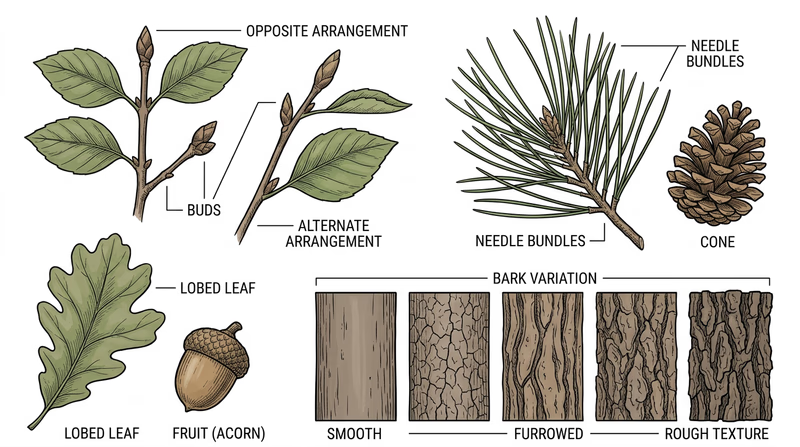
Tree identification is like detective work. You start with what you can see clearly, then narrow the possibilities. Leaves are often the first clue, but they are not the only one. In winter, twigs and buds may matter more than leaves. On conifers, cones and needles can be the most useful feature. On shrubs and vines, fruit clusters, stem color, growth pattern, and bark texture may help a lot.
Here are some clues to watch for:
- Leaf arrangement — opposite, alternate, or whorled on the twig
- Leaf type — simple or compound
- Leaf shape — oval, lobed, needlelike, heart-shaped, and more
- Leaf edge — smooth, toothed, or deeply lobed
- Twig features — buds, scars, color, fuzz, smell, or pith
- Bark — smooth, shaggy, scaly, furrowed, peeling, or patchy
- Cones, nuts, berries, seed pods, or fruits — shape, size, and season matter
It helps to compare similar species side by side. A red oak and a white oak may both look like “oak” at first glance, but their leaves, bark, and acorns have differences. The same is true for hickories, maples, ashes, dogwoods, pines, and many other groups.
What to Record for Each Species
Use more than one clue whenever possible
- Leaf or needle details: shape, size, arrangement, and edge.
- Twig or bud clues: color, thickness, opposite or alternate buds, and any smell when scratched.
- Fruit or cone clues: acorns, samaras, berries, pods, cones, or nuts.
- Growth form: tall straight tree, understory shrub, climbing vine, or spreading thicket.
Req 1b — Habitat
A species name is only part of the story. Foresters also want to know why a plant is growing in a certain place. Habitat means the conditions that support that plant: sunlight, water, soil, slope, elevation, and neighboring species.
You might find one species thriving on a dry ridge, another along a cool stream, and another taking over an old field edge. Those patterns matter. They help you understand how forests are organized and how species respond to disturbance, moisture, and shade.
When you describe habitat, be specific. “In the woods” is too broad. Better notes might say:
- north-facing slope with moist soil
- sunny trail edge near a parking area
- floodplain near a creek
- rocky upland ridge with thin soil
- shaded understory under mature hardwoods
Those details help explain why you found that species there.
Req 1c — Uses, Wildlife Value, and Native Status
Forestry is not only about recognizing plants. It is about understanding their role. Some species provide strong lumber, rot-resistant posts, syrup, paper pulp, medicine, shade, erosion control, or ornamental value. Others are especially important to wildlife because they produce mast — food such as nuts, seeds, berries, or acorns — or provide nesting cover and browse.
Native status matters too. A native species evolved in your region and fits into the local ecosystem. Wildlife often depends on it in ways that are easy to miss. Introduced species may be harmless, helpful, or highly damaging. Some spread aggressively, crowd out native plants, change soil chemistry, or create poor habitat for native insects and birds. That is why the requirement asks you to think about whether a species is invasive or potentially invasive.
For each species, try to note at least one human use and one wildlife benefit when you can. For example, one species may be prized for furniture wood, while another stabilizes streambanks or feeds pollinators. A vine might offer bird cover but become a problem if it smothers young trees. Forestry often involves balancing those tradeoffs.
How to Find 15 Good Species
The best way to succeed is to visit more than one kind of place. A neighborhood park, creek edge, school woodland, and local trail may each add different species. Look high, low, and across layers of the forest. Mature canopy trees are only part of the picture. Shrubs, saplings, vines, and understory species all count if they are part of the local forested area.
Good species lists are not built by chasing rare plants. Start with common, easy-to-observe species and build confidence. As your eye improves, you will begin noticing differences you missed before.
If you want a head start on Req 2b or Req 2c later, pay attention now to stumps, fallen logs, scars, insect galleries, fungal growth, dead tops, and storm-damaged limbs. A careful Scout can gather clues for multiple requirements during the same outing.
Arbor Day Foundation — Tree Identification A beginner-friendly tree guide that helps you compare common identification clues such as leaves, bark, and fruit.