Req 2b — Reading Tree Rings
A stump can look like just a cut tree, but to a forester it is a timeline. Every ring records a season of growth, and the spacing of those rings can reveal wet years, dry years, crowding, release from competition, storm damage, fire, insects, and changing light conditions. This requirement teaches you how to look at wood like a history book.
What Ring Width Tells You
In many climates, a tree forms one visible growth ring each year. A wider ring usually means the tree had better growing conditions that year. A narrow ring can mean stress: drought, shade, poor soil, crowding, insect attack, damage, or some other limit on growth.
What matters most is not one single ring, but the pattern across many years. You are looking for variation in growth rate. That means you want examples where rings change noticeably over time or differ from one part of the forest to another.
Record the Site, Not Just the Rings
This requirement specifically asks for location or origin details such as elevation, aspect, slope, and position on the slope. That is because growth patterns make more sense when you understand the site.
Here is what those terms mean:
- Elevation — how high the site is above sea level
- Aspect — the direction the slope faces, such as north, south, east, or west
- Slope — how steep the ground is
- Position on slope — ridge top, upper slope, middle slope, lower slope, or bottomland
These factors affect sunlight, moisture, wind, and soil depth. A north-facing slope may stay cooler and moister than a south-facing slope. A bottomland may have deeper soil and more water than a dry ridge. That is why two trees of similar age can show very different growth.
What to Notice in Ring Patterns
Use these clues while examining each stump, log, or core
- Ring width: Are some years wide and some narrow?
- Sudden change: Does growth suddenly speed up or slow down?
- Damage clues: Are there scars, stains, rot, or uneven shapes?
- Competition clues: Was the tree crowded early, then released later after nearby trees were removed or died?
Common Reasons Growth Rates Change
Several forces can alter ring patterns:
- Competition for light — A tree growing under a closed canopy may show many narrow rings until a gap opens above it.
- Water availability — Drought years often produce narrow rings, while wetter years may produce wider ones.
- Site quality — Deeper, richer soil usually supports faster growth than rocky, shallow soil.
- Damage — Fire scars, insect outbreaks, broken tops, and root problems can slow growth.
- Stand changes — Thinning or storm damage in the surrounding stand can suddenly give a tree more light and space.
A good explanation connects ring evidence to site evidence. For example, if a log from a lower moist slope has wider rings than a stump on a rocky ridge, that difference may reflect better water supply and deeper soil. If a tree has narrow early rings followed by much wider later rings, it may have spent years shaded by older trees and then been “released” when the canopy opened.
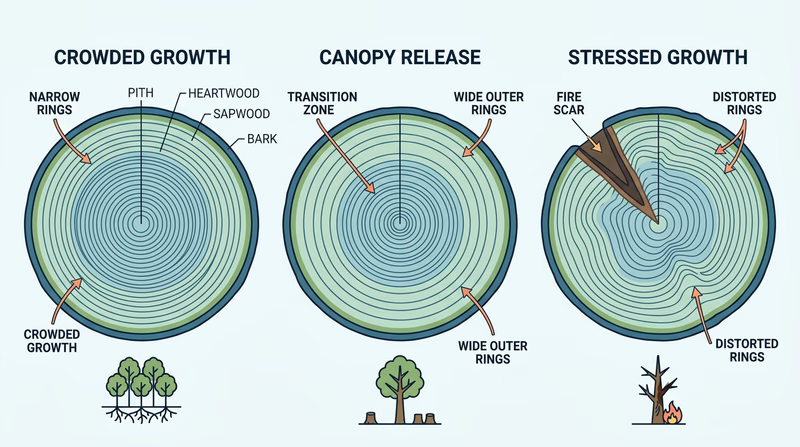
Three Strong Example Types
If you are searching for good material, these are often productive:
- A stump in a crowded stand where trees competed for light.
- A log near a stream or moist hollow where growth may have been faster.
- A tree with obvious injury or disturbance history such as a scar, rot pocket, lean, or abrupt growth change.
If you cannot identify the exact species, you may still be able to interpret the ring pattern, but species information always helps because some trees naturally grow faster than others.
Sketching and Interpreting
Your sketch does not need to be artistic. It just needs to communicate what you saw. Mark the pith if visible, note especially wide or narrow zones, and label any scars or unusual features. In your notes, explain what you think happened and why. Forestry often involves reasoned interpretation, not perfect certainty.
This requirement also builds directly toward Req 4 on forest management. When foresters thin a stand or change how trees are spaced, they are partly trying to influence future growth patterns like the ones you are studying here.
USDA Forest Service — Forests and Water Information on how forest conditions, soils, and management affect water and the health of forested landscapes.