Req 4 — Forest Management Basics
This requirement covers five ideas that help explain how foresters make decisions:
- Multiple-use management
- Sustainable forest management
- Even-aged and uneven-aged management
- Intermediate cuttings
- Prescribed burning and related practices
Forest management means guiding what happens in a forest so it can meet clear goals over time. Those goals may include timber, wildlife habitat, clean water, recreation, wildfire risk reduction, rare species protection, or public safety. The key word is guiding. Forests will change with or without people, but management tries to shape that change on purpose.
Multiple-Use Management
Multiple-use management means the same forest may be managed for more than one value at the same time. A national forest, for example, might support hiking, hunting, timber production, wildlife habitat, watershed protection, and scenic beauty. Those uses do not always fit together perfectly, so foresters must balance tradeoffs.
A trail user may want dense shade, while a wildlife biologist may want a sunny opening for young forest habitat. A timber harvest may improve stand health in one place but create a short-term visual change people dislike. Multiple-use management is the art of planning for all those needs, not just one.
Sustainable Forest Management
Sustainable forest management means caring for forests so they remain healthy, productive, and useful far into the future. It does not mean never cutting a tree. It means harvests, restoration work, and protection efforts are planned so the forest can keep functioning over time.
Sustainability includes more than tree growth. It also includes soil, water, biodiversity, regeneration, and resilience to future stress. A forest is not being managed sustainably if it produces timber today but leaves behind erosion, invasive species, damaged streams, or no next generation of trees.
Even-Aged and Uneven-Aged Management
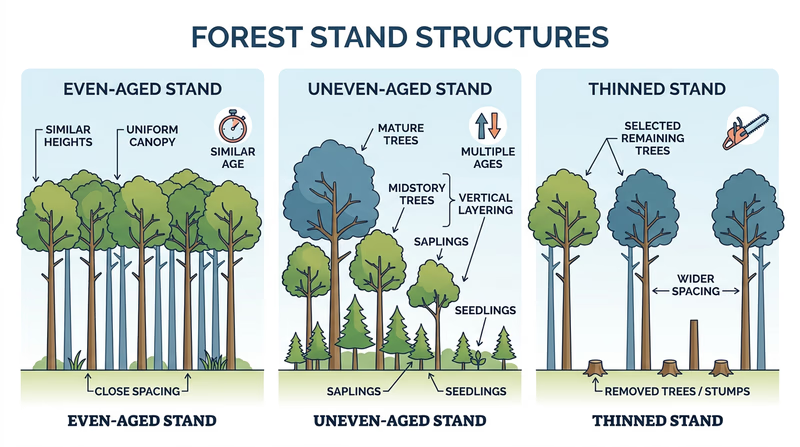
These terms describe the age structure of a stand.
Even-Aged Management
In an even-aged stand, most trees began growing around the same time, so they are close in age. This often happens after a major disturbance such as fire, clearcutting followed by regeneration, or a large storm event. Even-aged systems may be used for species that need a lot of sunlight to regenerate well.
Uneven-Aged Management
In an uneven-aged stand, trees of many ages grow together. Some are seedlings, some are saplings, some are mature, and some are very old. This can create a more layered structure and is often used where continuous cover is important.
Neither approach is automatically better. The right choice depends on species, site conditions, wildlife goals, fire regime, and management objectives.
Intermediate Cuttings
Intermediate cuttings are treatments made before the final harvest stage in a stand. They are used to improve forest conditions while the stand is still developing. Examples can include thinning crowded trees, removing damaged trees, or improving spacing so the remaining trees grow better.
The basic idea is simple: if too many trees are competing for limited light, water, and nutrients, the stand may stagnate. Removing some trees at the right time can increase growth, improve tree quality, and reduce stress.
Prescribed Burning and Related Practices
Prescribed burning is the planned use of fire under specific weather, fuel, and safety conditions to meet management goals. In some ecosystems, this can reduce fuel buildup, recycle nutrients, control unwanted vegetation, and help fire-adapted plants and wildlife.
Related practices can include mechanical thinning, mowing, pile burning, and creating fuel breaks. These are often used together. In many places, decades of fire suppression allowed fuels to build up so much that wildfires became hotter and more destructive than the natural fires those forests once experienced.
Putting the Ideas Together
Imagine a forest near a town. People hike there, wildlife lives there, the stream below supplies water, and some trees near the road have become hazardous. The stand is overcrowded, fuel has built up, and invasive shrubs are spreading. A forester may respond with thinning, invasive plant control, stream buffer protection, hazard tree removal near the road, and maybe prescribed fire in the right season. That is forest management in real life: combining tools to meet several goals at once.
Req 4 also connects strongly to Req 5 and Req 6. When you visit a managed forest or study hazard trees, you will see these ideas applied on the ground.
Project Learning Tree Forestry and environmental education resources that explain how forests are managed for ecology, products, wildfire, and people.