Req 7 — Forest Threats & Wildfire Response
This requirement covers three connected topics:
- major threats that can damage forests
- ways to reduce those consequences
- what to do if you discover a forest fire
Forests are resilient, but they are not invincible. Some disturbances are natural and even helpful in the right pattern. Others become destructive when they are too severe, too frequent, or mixed with human pressure.
Req 7a — Consequences of Major Forest Threats
The requirement asks you to describe consequences from five listed elements. Here is a quick guide to all ten so you can choose the ones you understand best.
Wildfire
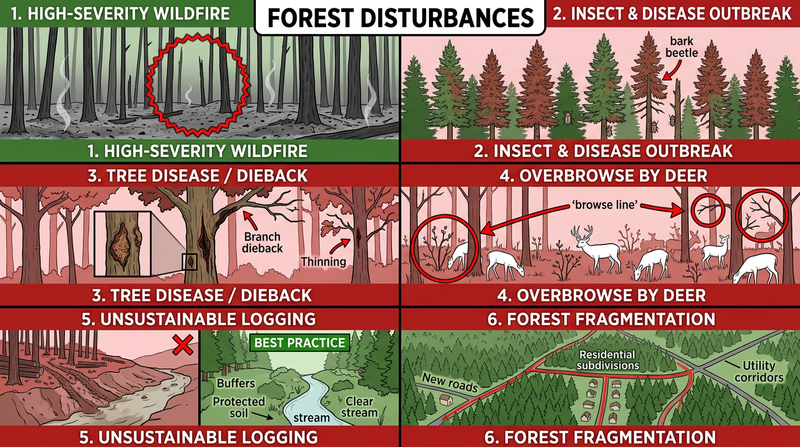
Severe wildfire can kill mature trees, damage soil, fill streams with ash and sediment, and create hazard trees. But in some fire-adapted ecosystems, low-intensity fire can also help maintain healthy forest structure.
Absence of Fire
In forests that evolved with regular fire, too little fire can allow fuel to build up, shade-intolerant plants to disappear, and later wildfires to become more severe.
Destructive Insects
Outbreaks can kill large numbers of trees, weaken stands, and increase future fire or hazard-tree problems. They can also shift which species dominate a forest.
Loss of Pollinating Insect Population
Many flowering shrubs, vines, and understory plants depend on pollinators. If pollinators decline, seed production can drop and forest plant diversity can suffer.
Tree Diseases
Diseases can cause rot, cankers, wilt, dieback, and mortality. Some wipe out key species in parts of their range, which changes habitat and forest composition.
Air Pollution
Ozone and other pollutants can stress trees, reduce growth, and make forests more vulnerable to drought or pests. Acid deposition can also affect soils and streams.
Overgrazing
Livestock or heavy browsing pressure can strip vegetation, compact soil, and prevent regeneration of young trees and shrubs.
Deer or Other Wildlife Overpopulation
Too many browsers can reshape the understory, eliminate seedlings of preferred species, and reduce plant diversity for decades.
Improper Harvest
Poorly planned harvest can damage soil, increase erosion, reduce regeneration, harm streams, and leave a stand less healthy than before.
Urbanization
Development can fragment habitat, increase invasive species, change drainage, create more edge, and isolate wildlife populations.
A Good Way to Tackle 7a
Choose five threats you can explain with real cause-and-effect details
- Name the threat clearly.
- Describe what it does to trees or forest structure.
- Explain who or what else is affected such as streams, wildlife, people, or soil.
- Give one specific consequence like erosion, habitat loss, fuel buildup, or failed regeneration.
Req 7b — How to Reduce the Consequences
Once you describe a threat, ask what could make the situation better. The answer depends on the problem:
- Wildfire or absence of fire: prescribed burning, thinning, defensible space, education, and prevention.
- Insects and diseases: monitoring, quarantine rules, removing infested material, increasing species diversity, and reducing tree stress.
- Overbrowsing or overgrazing: fencing, herd management, rotational grazing, and protecting regeneration.
- Improper harvest: better planning, stream buffers, erosion control, and regeneration standards.
- Urbanization: smart land-use planning, green corridors, retaining tree cover, and invasive-species control.
A strong answer pairs each consequence with a realistic response. Foresters cannot eliminate every threat, but they can often reduce severity and improve resilience.
Req 7c — What to Do If You Discover a Forest Fire
If you discover a forest fire, your job is not to fight it. Your job is to report it quickly and protect yourself and others.
- Get to a safe location first.
- Call 911 or your local wildfire control agency.
- Give the best location you can using road names, trail names, mile markers, GPS, landmarks, or map coordinates.
- Warn nearby adults or staff if you are in a park, camp, or recreation area.
- Leave the area if directed or if the fire is spreading toward you.
Professional crews may control a wildfire with hand tools, engines, dozers, aircraft, hose lays, fireline construction, burnout operations, and careful use of weather and terrain. They study wind, slope, fuels, and access before acting.
National Interagency Fire Center Information on wildfire response, fire behavior, and the agencies that coordinate wildland firefighting in the United States.